
Ninety three percent of home buyers use real estate websites as an information source, and roughly 44% start the whole search online (NAR). The sellers and buyers you want are already searching. The only question is whether your site is the one they find.
This is the playbook: eight steps to rank a real estate website, ordered by impact, written for the operator who wants the phone to ring, not a marketing lecture. No fluff, no guarantees. Just the work, in the order that matters.
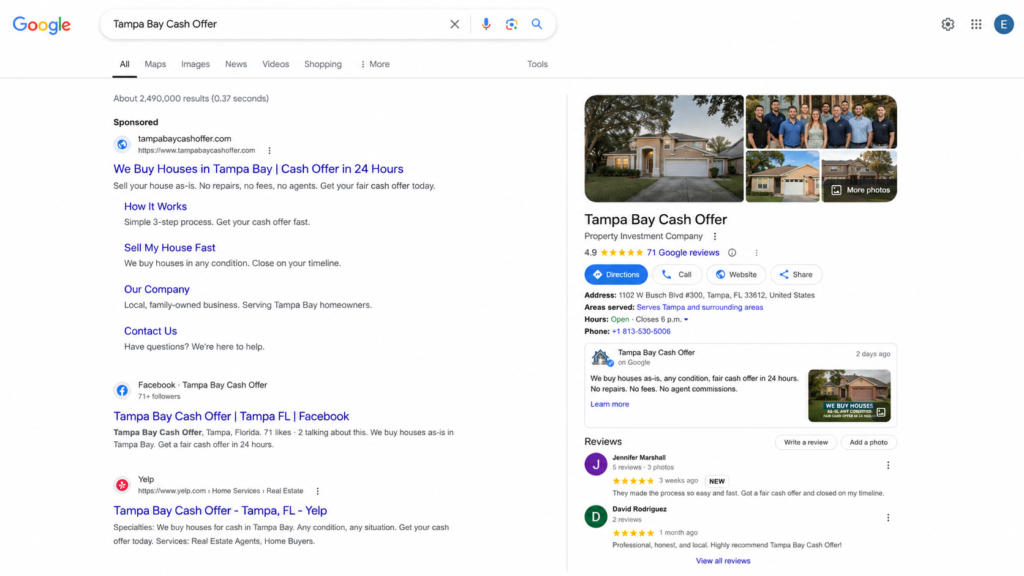
- What real estate SEO actually means
- Step 1: Run a baseline audit
- Step 2: Keyword research
- Step 3: Build location pages
- Step 4: Optimize your Google Business Profile
- Step 5: Fix the technical basics
- Step 6: Publish content that answers questions
- Step 7: Earn backlinks Google trusts
- Step 8: Optimize for AI search
- How long real estate SEO takes
- 7 mistakes that kill rankings
What Real Estate SEO Actually Means (and Why It Beats Paid Leads)
Real estate SEO is the work of optimizing your website so buyers and sellers find you when they search Google for property, a cash offer, or an investor in a specific area. Done right, it puts your site in front of people at the exact moment they are looking, and it keeps doing it after the work is done.
That last part is the whole difference from paid. The moment you stop funding Google Ads, the leads stop with them. SEO keeps working. One page you rank today can still pull leads two years from now with zero additional spend.
The other advantage is intent. Someone who types “sell my house fast” into Google already wants what you offer. You are not interrupting them with an ad. You are showing up as the answer. That is why organic leads close differently, and why mature organic can run down to figures like $161 per lead and keep falling (BASEO client data) while paid cost per lead climbs every year.
Step 1: Start Your Real Estate SEO With a Baseline Audit
You cannot fix what you have not measured. Before you write a single page, get an honest read on where your site stands.
Start with the free tools. Connect Google Search Console and GA4 so you can see what Google already knows about your site and where your traffic comes from. Run your key pages through PageSpeed Insights. Only then reach for paid tools like Ahrefs or Semrush, which are worth it for competitor keywords and gap analysis once the basics are in place.
Here is the baseline checklist:
- Confirm your important pages are actually indexed in Search Console.
- Check page speed, especially on mobile.
- Find orphan pages (pages with no internal links pointing to them).
- Flag duplicate or near-identical content, the classic Carrot-template problem.
- Verify call tracking and form tracking exist, so leads are countable from day one.
- Note which local keywords your top competitor ranks for that you do not.
This is also the first thing BASEO does for a new cash buyer. Before any monthly fee, you get a free written audit: the three biggest issues holding the site back, the competitor gap, and the deal math for your market. It is yours to keep whether we ever speak or not.
Step 2: Real Estate SEO Keyword Research That Matches How People Search
People search the way they talk, not the way marketers write. Nobody types “distressed property acquisition services.” They type “who buys houses for cash near me.”
Your keyword research is really just writing down the real sentences your market uses. A few examples:
- “we buy houses [city]”
- “how much is my house worth in [city]”
- “sell my house fast [city]”
- “best realtor for first time buyers [city]”
Notice how specific those get. That is long-tail, and long-tail is where you win first. “Real estate” has millions of searches and zero chance for your site. “Sell inherited house fast in [your city]” has less volume, far less competition, and a searcher who is ready to talk. Less traffic, more leads. That trade is almost always worth it.
The 4 Search Intents in Real Estate
Every real estate keyword falls into one of four intents, and each one needs a different page.
- Research: the searcher wants information about areas or prices (“cost of living in [neighborhood]”).
- Comparison: they are weighing options or agents (“cash buyer vs realtor”).
- Transactional: they are ready to act now (“sell my house fast [city]”).
- Valuation: they want a number (“what’s my home worth in [city]”), which is the moment to capture a seller before they call anyone else.
Map One Keyword Group to One Page
One rule prevents most self-inflicted ranking problems: each group of keywords maps to one dedicated page. When two pages target the same terms, Google cannot decide which to rank, so it often ranks neither well. That is keyword cannibalization.
So do not mix “sell my house fast Dallas” and “Dallas homes for sale” on the same page. Different intent, different searcher, different page. One page, one job.
Step 3: Build Location Pages (the Core Asset of Real Estate SEO)
If you take one thing from this playbook, take this: location pages are the core asset of real estate SEO. Every market you buy in deserves its own page, and no two of those pages should read the same.
The reason is simple. Real estate is local-first, and Google prioritizes local results. Someone searching in Tampa gets Tampa results. Without a real Tampa page, you are invisible to that search no matter how good your homepage is.
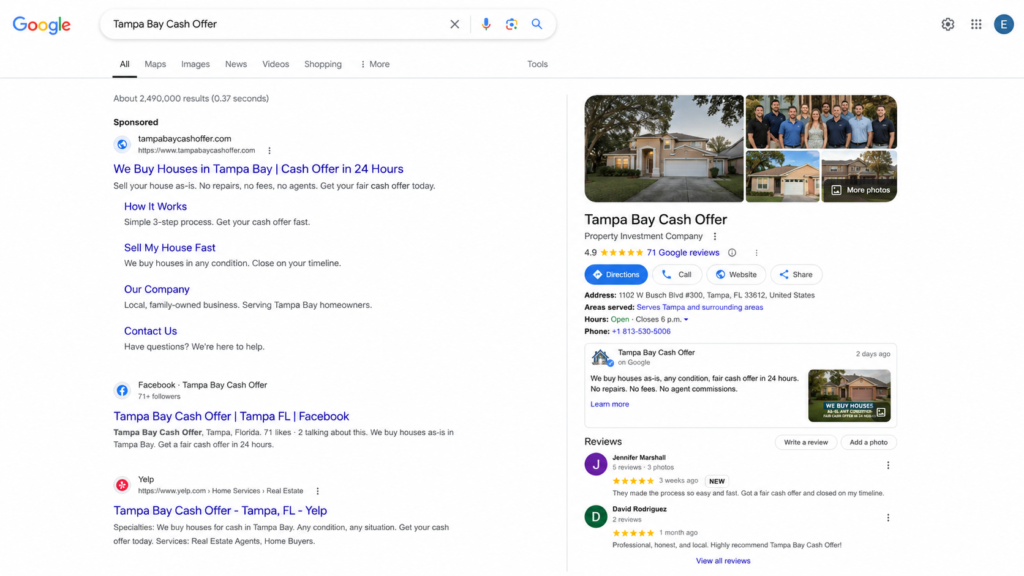
Building original pages for every market you serve is the core of what BASEO does for cash buyers, and it is the foundation of SEO built for cash home buyers.
What Every Location Page Needs
A location page that ranks is not a homepage with the city name swapped in. It carries real, local substance:
- The local keyword in the title tag and H1.
- Local market data (median price, inventory, days on market).
- Unique local content: neighborhoods, schools, transit, what living there is actually like.
- An embedded map of the service area.
- Internal links back to your main service or pillar page.
- A visible, obvious call to action.
How to Scale Location Pages Without Duplicate Content
Here is where most investors get burned. They build one good city page, then clone it fifty times and change only the city name. Google’s March 2024 update was built to crush exactly that. Its new Scaled Content Abuse policy targets mass-produced, unoriginal pages, and the rollout cut low-quality content in results by about 45% (Google Search).
So the goal is scale with substance. Every page needs its own local data, not a template with the city changed. Thin or duplicated pages do not just fail to rank, they can drag down the pages that would have. The upside: the big portals do not publish this depth of local content, so a focused local site can out-rank them on their own turf. BASEO builds those pages original to each market, which is the difference between programmatic done right and a template that gets penalized.
Step 4: Optimize Your Google Business Profile for the Map Pack
If you want the fastest visibility win available, it is your Google Business Profile. It is the most direct lever you have on whether you show up in the local map pack, the three-business box that sits above the regular results.
Google decides local rankings on three things (Google Business Profile Help):
- Relevance: how well your profile matches the search. This is content: categories, services, description.
- Proximity: how close you are to the searcher. Geography.
- Prominence: how well-known you are. This is reviews, citations, and links.
You cannot move your office, but you control relevance and prominence completely. The checklist:
- Set the correct primary and secondary categories (Property Investment Company, not just “Real Estate”).
- Keep your name, address, and phone identical everywhere online.
- Add real photos and post regularly.
- Ask for a review the moment a deal closes, when goodwill is highest.
- Respond to every review, good or bad.
This works. Rebuilding a client’s Google Business Profile from scratch drove a 430% increase in direction requests (BASEO client data), which is sellers literally asking their phone how to get to the business. That is the map pack doing its job.
Step 5: Real Estate SEO Technical Basics: Speed, Mobile, Schema
Most property searches happen on a phone, so mobile-first is not optional. If your site is slow or awkward on mobile, you lose the seller before they read a word.
The technical basics come down to a few things Google measures, called Core Web Vitals:
- LCP (Largest Contentful Paint): how fast the main content loads. Aim under 2.5 seconds.
- CLS (Cumulative Layout Shift): whether the page jumps around while loading. It should not.
- INP (Interaction to Next Paint): how quickly the page responds when tapped.
Real estate sites carry a specific weight problem: photos. Listing and neighborhood images are heavy, and uncompressed they crush your load time. Compress every image, and give each one descriptive alt text that names what it shows in natural language. Getting the tracking, schema, and technical foundation right before scaling content is the exact order BASEO works in, because content on a broken foundation just hides the problem longer.
Real Estate Schema Markup That Moves the Needle
Schema markup is code that tells Google exactly what your page is, in a language it reads perfectly. For real estate, four types earn their keep: RealEstateAgent, LocalBusiness, FAQPage (which can trigger rich snippets in the results), and Review. You do not need to see it as a visitor. Google does, and it uses it to understand and feature your pages.
Step 6: Publish Content That Answers Real Questions
Write for people first. That is not a platitude, it is the highest-return content strategy there is. Useful, genuinely local content is the strongest signal you can send: it builds topical authority, earns backlinks on its own, and gives AI systems the material they need to cite you.
Publishing deep local content consistently is the single highest-impact content action a real estate site can take. It is also where seller-situation pages live, the pages built around the specific, urgent reasons people sell.
The 4 Content Types That Generate Real Estate Leads
Four content types do the heavy lifting for a real estate site:
- Neighborhood guides (“Living in [area]: The Complete Guide”). They rank for research intent and never expire.
- Valuation posts (“How Much Is My House Worth in [city]?”). They catch sellers at the exact moment of intent.
- Process explainers (“How to Sell Your House Step by Step”). They answer the questions every seller has and build trust.
- Market updates (monthly or quarterly, with your own local data). Nobody can copy numbers you gathered yourself, and they earn links.
The longevity is the point. A well-researched neighborhood guide published today can still generate leads two years from now with no additional spend. That is the compounding a paid ad never gives you. The urgent seller-situation pages (probate, foreclosure, divorce, inherited property, problem tenants) are exactly the pillar content BASEO builds for cash buyers, because those searches carry the highest intent on the whole site.
Step 7: Earn Backlinks That Google Actually Trusts
A backlink is another site vouching for yours. Google treats them as votes of confidence, and they remain one of the strongest ranking signals. But this is quality over quantity, and it is not close. One link from a trusted local news outlet is worth more than dozens from spammy directories.
Where good links come from:
- Guest posts on real estate and home-improvement blogs.
- Local digital PR: get quoted in local news, sponsor a community event.
- Natural niche partners: local lenders, contractors, title companies, REIA groups.
Do not buy links. Link schemes are the fastest way to earn a penalty that undoes months of work. The links that hold up are editorial and local: chambers of commerce, REIAs, local news. Not link farms, not PBNs. That is the kind of authority BASEO builds for the markets you operate in.
Step 8: Optimize for AI Search (AI Overviews, ChatGPT, Perplexity)
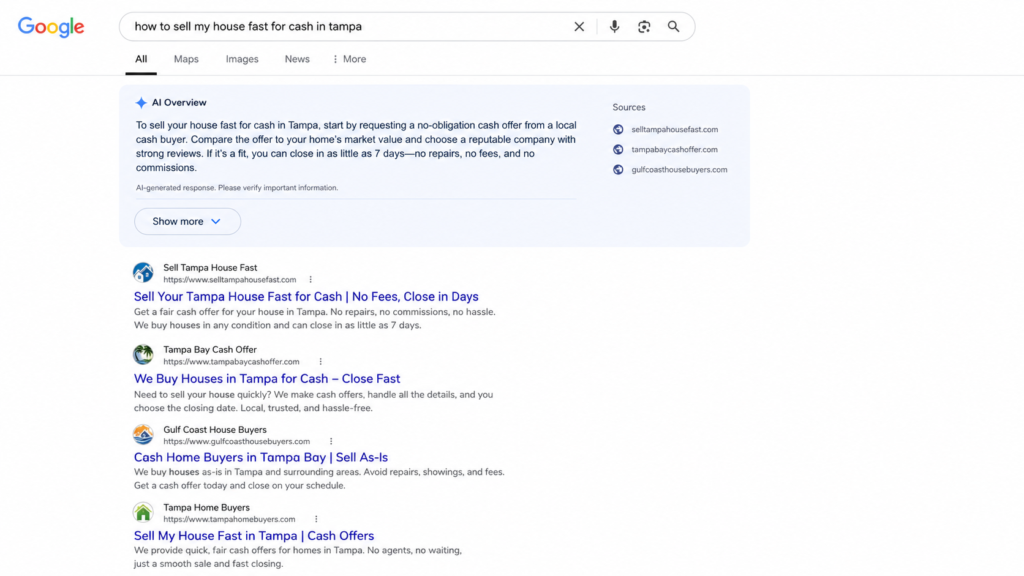
Here is the gap almost no competitor has closed yet. A seller no longer always starts at Google or a portal. They open ChatGPT and ask “how do I sell my house fast for cash in Tampa,” and the tool answers with a short list of companies. Buyers are increasingly starting their whole search inside AI tools before they ever touch a traditional search bar (Florida Realtors).
Whoever shows up in both classic search and AI answers captures most of the high-intent leads, because AI traffic is qualified before it arrives. In one study, visitors from ChatGPT converted at 15.9%, against 1.76% for Google organic (Seer Interactive). The AI did the qualifying before the click.
Getting cited comes down to a few things you can actually do:
- Structure content in clear question-and-answer format, the way the FAQ at the bottom of this article is written.
- Add FAQ sections to your key pages.
- Use schema that signals expertise and answers specific questions.
This is BASEO’s core work. We format pages for citation, add citation-friendly schema, and track weekly whether you (or a competitor) get cited across ChatGPT, Perplexity, Claude, and Google AI Overviews. On the flagship account, the client’s pages started getting cited by AI Overviews and Perplexity by month 7 (BASEO client data). The window to be early on this is still open, and it will not stay open forever.
How Long Does Real Estate SEO Take? A Realistic Timeline
Anyone promising leads in 30 days is describing paid ads or lying. Here is the honest version.
Most sites see measurable ranking improvement within 3 to 6 months of consistent work (SEO.com). ROI typically breaks even around month 10. Page-one rankings in competitive markets can take 6 to 12 months. It is slower than paid at the start and cheaper than paid forever after.
| Phase | Timeframe | What happens |
|---|---|---|
| Foundation | Months 1–3 | Tracking live, technical fixes, indexation, first pages published |
| Local traction | Months 3–6 | City pages and GBP start ranking, first organic leads |
| Compounding | Months 6–12 | Consistent page-one rankings, steady lead flow, AI citations |
The reason to start is the compounding. Content accumulates. One Florida cash buyer went from 3 organic leads a month to 28 in nine months, same market, no extra ad spend (BASEO client data). The pages you build this quarter keep paying next year.
7 Real Estate SEO Mistakes That Kill Rankings
Most rankings are lost to avoidable mistakes, not tough competition. The seven that do the most damage:
- Keyword stuffing. Cramming keywords reads as spam to Google and to humans. Write naturally.
- Copied location pages. Duplicate city pages get penalized. Make each one original.
- Ignoring your Google Business Profile. It is the fastest local win, and it is free.
- Relying only on IDX listings. Listings expire and lose their SEO value. Build permanent pages around them.
- Thin pages. A 150-word city page ranks for nothing. Give it real depth.
- Generic keywords with no location. “Real estate” will never rank for you. Localize everything.
- Traffic with no way to convert. Visitors without contact forms are just numbers. Traffic that never becomes a lead does not pay for itself.
Want This Done for You?
Running all eight steps consistently is a job that takes months. BASEO does programmatic SEO and AI search optimization for real estate businesses that want organic leads without chasing them. If you want to see where your own site stands first, that is what the free audit is for. We work only with cash home buyers, so it already knows your market.
See exactly what’s broken on your site and what your top competitor built instead. Get your free site audit →
Real Estate SEO FAQs
Quick answers to the questions investors ask most about ranking a real estate website.
Most real estate websites see measurable ranking improvements within 3 to 6 months of consistent SEO work. Page-one rankings in competitive markets typically take 6 to 12 months. SEO compounds over time: every optimized page keeps generating traffic and leads long after it is published.
Yes, especially in less competitive markets. Start with your Google Business Profile, one dedicated page per service area, and content that answers real buyer and seller questions. The tradeoff is time: consistent execution over 6 to 12 months is what separates agents who rank from agents who quit.
For most real estate businesses, yes. Paid ads stop producing leads the moment you stop paying. SEO keeps generating exclusive, high-intent leads from people already searching for your services. The break-even point typically arrives around month 10, and returns compound after that.
Optimize your Google Business Profile and build dedicated pages for each area you serve. These two actions target the local search intent that drives most buyer and seller traffic, and the map pack is the fastest visibility win available to a real estate website.
Yes. Blog content targeting specific local searches compounds in value: a well-researched neighborhood guide published today can generate leads two years from now with zero additional spend. It also feeds AI search engines the material they need to cite your site in generated answers.
Both. Raw IDX feeds create thin, duplicate pages that can hurt rankings, and listings expire and lose their SEO value. IDX helps when you add unique local copy, contextual content, and careful indexation around it. Never rely on listings alone as your SEO strategy.