
The right real estate website builder is not the one with the prettiest template. Most agents pick wrong because they shop the way they’d shop for a listing photo: they compare how the demos look. The three decisions that actually move business are quieter. Does it pull live MLS listings through IDX? Does it capture and route a lead the second someone lands? And can you control the SEO so the site gets found at all? We evaluated seven platforms against exactly those criteria, plus real pricing (IDX and add-ons included, not just the headline plan), design flexibility, and lead generation. Some are built for solo agents, some for luxury teams, one for the tightest budgets. Below is the honest breakdown, starting with the quick verdict so you can skip to your case.

Quick verdict: the best real estate website builder by use case
Short on time? Here are the seven real estate website builders, ranked by who each one fits. Prices are current as of July 2026; confirm the number on the official site before you buy, because plans change often.
- Placester: best all-in-one for solo agents ($59/mo, plus $25/mo per MLS for IDX).
- AgentFire: best brand-first design for competitive markets (from $129/mo, optional setup).
- Real Geeks: best for lead generation with a built-in CRM (from $299/mo).
- Agent Image: best custom build for luxury teams and brokerages ($2,000+ setup, ~$99/mo hosting).
- Luxury Presence: best high-end plug-and-play design plus agency services (from ~$300/mo, plus setup).
- Wix: best budget and AI-assisted website builder for real estate (from $17/mo, annual billing).
- Squarespace: best design polish without real estate lock-in (from $16/mo, annual billing).
Two quick notes before the detail. Among these website builders for real estate, only the vertical platforms (Placester, Real Geeks, AgentFire) include IDX and a CRM out of the box. The generic ones (Wix, Squarespace) win on price and design freedom but need a third-party app for live listings.
What a real estate website builder actually does (and what it doesn’t)
A real estate website builder is a no-code platform that creates, publishes, and manages a property website: listings, lead capture, and hosting in one subscription, with no developer required. That is the whole job description. You pick a template or answer a few prompts, connect a listings feed, and the platform keeps the site online.
Here is what it does not do. It does not generate demand. It does not rank you on Google. And it does not replace a content strategy. A builder gives you a technically fine starting line and a place to send traffic. Getting the traffic is a separate job, run on top of the builder, not inside it. Hold that distinction, because it is the whole argument of this article: the box and the leads are two different purchases.
Generic builders vs. real estate specific platforms
Two families compete for the same agent. The generic builders (Wix, Squarespace, Jimdo, GoDaddy) ship real estate templates and drag-and-drop design, but no native IDX. According to Website Planet, free and generic builders rarely support MLS feeds directly, so live listings get added through third-party apps or embed codes. You trade listings functionality for a lower price and total design freedom.
The vertical platforms (Placester, Real Geeks, AgentFire, Constellation1) are built for the job. IDX, a CRM, and agent or broker workflows come standard, so the listings, the lead, and the follow-up live in one system. The trade is the mirror image: you pay more and design inside their rails. That is the real fork for any agent, or any estate agent website builder shopper in the UK reading the same reviews. Do you want cheap and flexible, or do you want property search that works on day one? Neither answer is wrong. Picking without knowing the trade is.
IDX and MLS integration: the dividing line
IDX (Internet Data Exchange) is the connection that pulls live listings from the MLS onto your site, so what a buyer sees on your pages matches what is actually for sale. MLS is the shared listings database agents feed. Sync them and your inventory updates itself. Skip the sync and you are copy-pasting listings that go stale in a week.
Three things trip agents up here. First, the feed usually costs extra: Placester’s IDX runs on top of the base plan, for example, so the “starting price” is never the real price. Second, the feed needs your local MLS to approve it, which takes days, not minutes. Third, IDX listing pages carry an SEO cost most agents never hear about. They are near-identical to thousands of other IDX pages (thin content), they churn as homes sell and unpublish, and without correct canonical tags they can compete with your own pages for the same search. For NAR members, get.realtor Premium Plus syncs automatically with the MLS so listings stay current, which removes the maintenance headache but not the SEO one. This is buying criterion number one. Without IDX, your site is a brochure that sends every serious buyer to Zillow.
How we evaluated these real estate website builders
We scored every platform on five criteria, in this order:
- Pricing: the true monthly total, including IDX and add-ons, not the headline plan.
- Design quality and flexibility: how good it looks and how far you can move off the template.
- Ease of use: how genuinely no-code the build is for a non-technical agent.
- Lead gen and CRM: forms, home valuation, chat, and where the lead lands.
- SEO and AEO control: access to schema, URL control, site speed, and indexability.
One bias, stated plainly: criterion five carries more weight here than in most roundups, because control over search is the difference between a site that sits there and a site that brings deals. These conclusions come from operating real estate websites and watching what ranks, not from reading vendor landing pages.
The 7 best real estate website builders
Each platform below follows the same format so you can compare like for like: who it’s best for, real pricing, three pros, two cons, and a short SEO verdict of our own. Start with the one that matches your situation from the quick verdict above.
Placester: best all-in-one for solo agents and small teams
Best for: newer solo agents and small teams who want a working IDX site fast without piecing tools together.
Pricing (July 2026): the Essential plan is $59/month, and adding IDX runs $25/month per MLS, so an IDX-enabled site starts at $84/month, per Placester. Plus is $79/month and Premier $129/month ($154 with IDX); team plans start at $199/month. An optional concierge service that manages setup and updates adds about $50/month. Plans are no-contract with a 14-day trial.
Pros:
- Generates a ready-to-edit real estate site in minutes using AI, so a solo agent is live the same day.
- IDX and a basic CRM are bundled, so listings and leads sit in one place at an entry price.
- Placester positions its sites on technical foundations meant to surface in both Google results and AI-generated answers, a claim worth testing but rare at this tier.
Cons:
- The value proposition thins out for teams, where Real Geeks or Agent Image do more.
- The base price is not the real price once the IDX feed and any concierge are added.
SEO verdict: a strong technical starting point for a solo agent, and the AI-answer positioning is a real plus. The ceiling is capped by template structure, so what ranks is the local content you add, not the platform.
AgentFire: best for brand-first agents in competitive markets
Best for: agents, teams, and boutique brokerages who need a branded, design-led site that still captures leads.
Pricing (July 2026): a Spark site is $129/month with no required setup fee, per AgentFire; an optional Express Setup is $199, and semi-custom or custom design packages run from roughly $700 to $3,500 one-time. MLS pass-through fees are separate, so confirm your market’s charge before signing. HousingWire calls AgentFire a fit for agents, teams, and boutique brokerages on tight budgets who still need to compete for online leads in tough markets.
Pros:
- Design-first system that produces a genuinely distinctive brand presence, not a template everyone recognizes.
- Local-area content tools (“Area Guides” style pages) that fit how buyers actually search by neighborhood.
- Lead capture and IDX layered onto the design, so the brand work does not cost you conversions.
Cons:
- A design-led build only pays off if you actually publish content into it.
- The $129/month base can climb fast once you add a design package, plugins, and MLS fees.
SEO verdict: good bones and a sensible local-content structure. Performance still tracks the local content the agent publishes, not the template, so the framework helps only if you feed it. If you find a live AgentFire site in your market, study how many neighborhood pages it actually has.
Real Geeks: best for lead generation and built-in CRM
Best for: agents and teams whose whole reason for a site is lead volume plus a system to work those leads.
Pricing (July 2026): the Establish plan starts at $299/month for up to two users (plus a one-time onboarding fee around $250), scaling through Grow at $599, Expand at $999, and Conquer at $1,599/month, per Real Geeks. The Geek AI add-on is bundled into Grow and above. HousingWire notes Real Geeks is trusted by more than 7,000 agents and teams.
Pros:
- IDX site and a full CRM in one platform, with AI features to organize contacts and automate follow-up.
- Automated home valuation (Estate IQ) that turns a homeowner’s address into a seller lead, plus a built-in Facebook ad tool for traffic.
- An AI-assisted SEO blogging tool and a two-way integration with CRMs like Follow Up Boss if you already run one.
Cons:
- Even with the Follow Up Boss integration, the model nudges you to replace your current CRM with theirs.
- Deep feature set means a steeper setup than a solo-agent builder.
SEO verdict: the lead machinery is the strongest here, but be careful with the AI blogging tool. Publishing AI-generated pages without editing is how sites end up with thin, near-duplicate content that competes with itself for the same search. Use it to draft, then make each page genuinely local.
Agent Image: best for luxury teams and brokerages
Best for: luxury teams and brokerages who need a custom site that stands out in a fiercely competitive market.
Pricing (July 2026): a project cost, not a flat subscription. Setup runs from about $2,000 for a template build to $7,500 and well into six figures for a full custom site, with an ongoing hosting-and-support fee around $99 to $199/month, per Agent Image. IDX integration is typically $50 to $150/month on top. HousingWire frames these custom designs as costly for a solo agent but necessary for teams and brokerages fighting in brutal luxury markets.
Pros:
- Top-shelf custom design and deep customization that genuinely differentiates a high-end brand.
- Because the build is custom, you get more technical access than any templated platform offers.
- Fits the buyer expectations of a luxury market, where a template can quietly cost you listings.
Cons:
- Overkill and over budget for a solo agent or a new team.
- Custom control only helps if someone on your side knows how to use it.
SEO verdict: the highest SEO ceiling on this list. A custom build means real control over schema, URL structure, and speed, which is exactly what programmatic and AI-search work needs. That ceiling is only reached if you hire someone to use it.
Luxury Presence: best for high-end plug-and-play design
Best for: Realtors who want an elegant, ready-to-run luxury site plus done-for-you marketing services.
Pricing (July 2026): custom quotes, not published rates. Independent reviews put monthly plans from about $300 (entry Launch tier) to $1,500 (top All In tier), with setup fees of roughly $3,500 to $5,000, per AgentAdvice. Agents at partner brokerages may see reduced fees. HousingWire describes Luxury Presence as pairing customizable plug-and-play sites for Realtors with full agency marketing services.
Pros:
- Clean, modern, high-end design without a custom-build timeline.
- Agency marketing services bundled, so design and promotion come from one team.
- Strong luxury branding out of the box for agents who need to look established fast.
Cons:
- Plug-and-play means it is harder to differentiate when local competitors run the same base.
- The bundled services push the real monthly cost well up.
SEO verdict: the agency package can be worth it, but ask exactly what the SEO service includes before you sign. “Marketing services” covers everything from a monthly blog post to real local-search work, and the gap between those is your entire result.
Wix: best budget and AI-assisted option
Best for: budget-conscious agents who want to build fast and are comfortable adding an IDX app.
Pricing (July 2026): the Light plan is $17/month on annual billing ($24 month-to-month), rising through Core at $29, Business at $39, and Business Elite at $159/month, per Wix. It is the lowest entry point on this list, before you add a third-party IDX app.
Pros:
- An AI assistant asks about your business and brand, then generates a full site you can keep refining by chat, with a drag-and-drop editor for manual control.
- The widest template library here: Wix offers 2,500+ templates overall and, per Website Planet, around 40 built for real estate, the most of any free-tier builder, plus automatic mobile optimization.
- Built-in SEO and GEO tools, so on-page basics and AI-search formatting are handled inside the platform.
Cons:
- Not built specifically for real estate, so agent workflows are thinner than a vertical platform’s.
- No native IDX. Live MLS listings require a third-party app (IDX Broker, iHomeFinder) or an embed, per HousingWire and Website Planet.
SEO verdict: for the price, the SEO and GEO tooling is genuinely useful and the platform is fast enough. The catch is the same as every generic builder: the tools are there, but nothing about a template does the local-content work that actually ranks a real estate site.
Squarespace: best for design control without real estate lock-in
Best for: agents who prioritize personal brand and content over on-site property search.
Pricing (July 2026): the Basic plan is $16/month on annual billing, rising through Core at $23, Plus at $39, and Advanced at $99/month, per Squarespace. It carries a well-earned reputation for premium template polish.
Pros:
- The most polished out-of-the-box design of any builder here, with strong content and blogging tools.
- No real estate lock-in, so the site works as a brand hub, not just a listings portal.
Cons:
- No native IDX, so live MLS search needs a third-party integration.
- Limited control over advanced schema and programmatic page architecture.
SEO verdict: a solid technical base and clean markup, but the schema and site-architecture control top out below a custom build. If your strategy is brand and content rather than on-site search, Squarespace is a fair pick. If it is programmatic ranking, it will fence you in. Against Wix, Squarespace wins on design and loses on real estate features and IDX options.
Real estate website builder comparison table
The seven platforms side by side, with prices verified July 2026. Rates change often, so reconfirm on the official site the day you buy.
| Platform | Best for | Starting price | IDX included | Built-in CRM | SEO control |
|---|---|---|---|---|---|
| Placester | Solo agents, small teams | $59/mo + $25/mo IDX | Add-on | Basic | Medium |
| AgentFire | Brand-first agents, boutique brokerages | From $129/mo (+ optional setup) | Yes | Add-on | Medium |
| Real Geeks | Lead-focused agents and teams | From $299/mo | Yes | Yes (full) | Medium |
| Agent Image | Luxury teams and brokerages | $2,000+ setup, ~$99/mo | Yes (custom) | Via integration | High |
| Luxury Presence | High-end plug-and-play + agency | From ~$300/mo (+ setup) | Yes | Yes | Medium |
| Wix | Budget, AI-assisted build | From $17/mo (annual) | No (third-party) | Basic | Medium-High |
| Squarespace | Design-led personal brand | From $16/mo (annual) | No (third-party) | No | Medium |
The thing no builder solves for you: ranking
Notice what every comparison above, including the top five platforms, argues about: templates, price, and features. Not one of them answers the only question that decides whether the site pays for itself. Why doesn’t it show up on Google?
The builder is the container. The traffic comes from something else entirely: site architecture, local content, and authority. Two agents can buy the identical platform and one gets found while the other never does, because ranking was never a feature of the box. It is work done on top of the box. This is the same gap we spend our days closing at TheBaseo, and it is why we lead with SEO for realtors rather than web design. The platform choice is the easy 10% of the decision. The next two sections are the 90% no vendor demo shows you.
Why templated builder sites plateau on SEO
A default builder site is five or six pages: home, about, listings, contact, maybe a blog. Those pages look almost exactly like the sites of 400 other agents on the same platform. There is no market-specific content, so there is nothing for Google to rank you for beyond your own name.
Then the IDX listings work against you. Homes sell, listings unpublish, and the pages behind them turn into 404s or thin, near-empty shells. Search engines notice a site that keeps shedding pages. Worst of all, a template has no architecture: no silos organized by city, by neighborhood, by property type. Everything is a flat handful of pages fighting for the same generic terms.
Picture two agents on the same template in the same market. One leaves the default six pages up. The other builds 40 pages, one for each neighborhood they work, each with real local detail on schools, price trends, and what it’s like to buy there. Same platform, same budget. The second agent owns local search and the first is invisible. That gap is not design. It is site architecture, internal linking, and local content, none of which a template builds for you.
Programmatic pages and AEO: where the traffic is going
Programmatic SEO is how the agent with 40 neighborhood pages got there without writing 40 pages by hand. You generate pages at scale from data: one page per neighborhood, one per price band, one per property type, each populated from a structured source and made genuinely useful. Done right, it is how a single agent covers an entire metro in search.
AEO (answer engine optimization), sometimes called GEO, is the next layer. AI answers in Google’s AI Overviews, ChatGPT, and Perplexity cite sources that have clear entities, structured data, and direct answers to real questions. Pages built to be quoted get quoted. The tell that this matters: the builders themselves now sell it. Placester advertises technical foundations for both Google and AI answers, and Wix ships GEO tools. When the platforms market the thing, the thing is no longer optional.
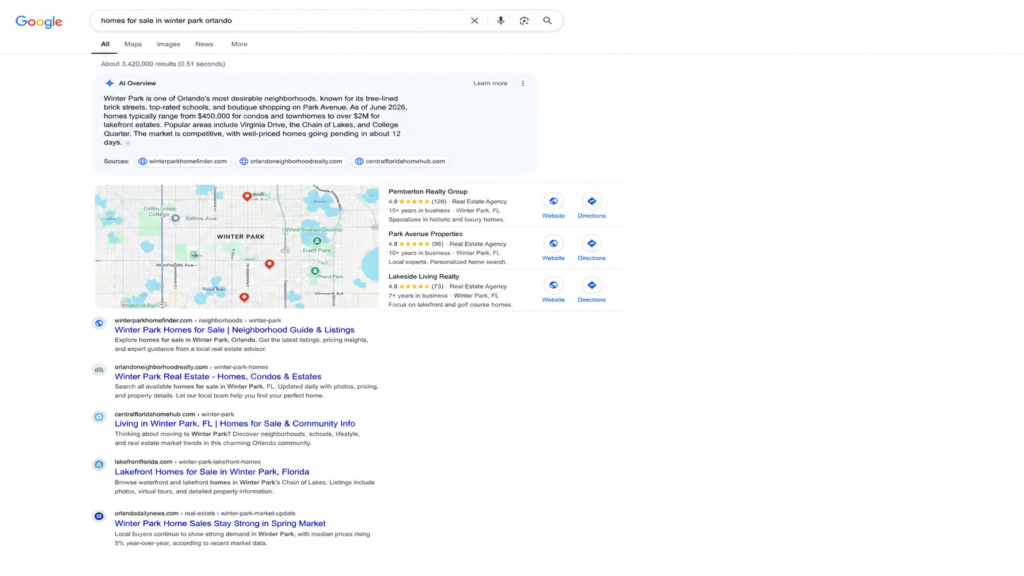
A quick example of the structure. Instead of one “listings” page, you build a URL pattern like /homes/winter-park/under-500k/ and /homes/winter-park/condos/, each a real page answering a real search. That is the layer that outranks the top five builders’ default sites, and it is exactly the work we do: programmatic pages and AI-search optimization that get real estate businesses cited and found. If you want the mechanics, our guide to ranking in AI Overviews breaks it down.
How to create a real estate website in 7 steps
Once you know a builder is just the container, the build itself is straightforward. Here is the sequence, with the two steps most guides skip pulled to the front where they belong.
- Choose your platform by IDX, not by template. Decide first whether you need live MLS search on the site. If yes, start with a vertical platform (Placester, Real Geeks) or budget for a third-party IDX app on Wix or Squarespace. The template is the last thing to worry about.
- Lock your domain and hosting. Register a clean, brandable domain (most builders bundle hosting). Use your name or your market, not a string of keywords.
- Pick a template or generate with AI. Choose a real estate template or let an AI assistant (Wix, Placester) draft the site from a few questions, then customize the structure to match how you actually work.
- Connect the IDX/MLS feed. Apply for your local MLS feed, connect it, and confirm listings display and update correctly. Expect a few days for approval, and confirm canonical tags so listing pages don’t compete with your own content.
- Set up lead capture. Add contact forms, a home-valuation tool, and a chat widget, and route every submission to a CRM so no lead sits unanswered. This is where a site becomes a business asset instead of a business card.
- Configure technical SEO and your Google Business Profile. Set titles, meta descriptions, schema, and clean URLs, then claim and complete your Google Business Profile so you show up in the local pack. This is the step that starts the ranking work.
- Publish and measure. Launch, connect analytics, and watch leads, not just visits. Then keep adding local pages, because the site that ranks is the one that keeps growing.
How much does a real estate website cost?
Three tiers, with July 2026 numbers. A DIY generic builder (Wix from $17/mo, Squarespace from $16/mo) runs roughly $16 to $39 per month, before you add an IDX app. A vertical platform with IDX lands from about $84 per month all-in on Placester once you count the feed, up to $299 per month and beyond on a lead-focused system like Real Geeks. A custom or agency build (Agent Image, Luxury Presence) means a four-figure setup fee ($2,000 to $7,500 or more) plus an ongoing retainer of roughly $99 to $300+ per month. HousingWire’s own picks span exactly that range, from AI builders around $17 per month to high-end platforms built for teams and brokerages.
Here is the line no pricing page prints: the real cost of a real estate website is not the platform, it’s the content. A $17 site with 40 sharp neighborhood pages beats a $500 site with six. The subscription is rounding error next to the work that makes the site rank, which is why the smart budget question is not “which builder is cheapest” but “what will it cost to actually get found.” For the wider picture, see our marketing for real estate agents breakdown.
Which real estate website builder should you choose?
Skip the fiches and match your situation:
- Solo agent on a budget → Placester or Wix, because you get a working site fast at the lowest all-in cost, Placester with IDX built in and Wix with an app.
- Brand-first agent in a competitive market → AgentFire, because distinctive design that still captures leads is its whole reason to exist.
- Team focused on lead volume → Real Geeks, because the built-in CRM, home valuation, and ad tools are the strongest lead machinery here.
- Luxury team or brokerage → Agent Image or Luxury Presence, because custom or high-end plug-and-play design is what a brutal luxury market demands, and Agent Image gives you the SEO ceiling to match.
Get a real estate site that actually ranks
You picked the builder. That was the easy part. The part that decides whether the phone rings is the layer no template performs for you: architecture, local content, and authority. TheBaseo does SEO, AEO, and programmatic pages for real estate businesses, built around the Deal Flow Bridge, which is PPC for speed now while SEO compounds into the channel that pays for itself. No rankings promised, no timelines invented. Want to see what’s actually keeping your site off page one? We’ll send a free, written diagnostic of your site, your market, and your competitors. Get your free site audit →
Frequently asked questions
Placester is the best overall real estate agent website builder for solo agents and small teams, with an IDX site and CRM from around $59 per month plus an IDX fee. Choose AgentFire for brand-led design, Real Geeks for lead generation, and Agent Image for luxury brokerages.
Yes. Wix, SITE123, Webador and Jimdo all offer free plans with real estate templates. The catch is IDX: free builders rarely support MLS feeds directly, so listings must be added through third-party apps or embed codes. NAR members can also get free sites via get.realtor.
If you want visitors to search live listings on your site, yes. IDX syncs your site with the MLS so properties stay current automatically. Without it, your site works as a brand and lead-capture page but sends buyers to Zillow or your brokerage to browse inventory.
Anywhere from a few hours to a few days. AI builders like Wix and Placester can generate a ready-to-edit real estate site in minutes. Adding your own photos, listing descriptions, IDX feed and SEO settings is what stretches the timeline into days.
Wix wins for real estate specifically: it has around 40 real estate templates, an AI site generator, and built-in SEO and GEO tools. Squarespace offers stronger out-of-the-box design polish. Neither includes native IDX, so both need a third-party integration for MLS listings.
A builder gives you a technically sound starting point, not rankings. Modern platforms handle speed, mobile and basic on-page setup. What decides visibility is site architecture, local neighborhood content and structured data, none of which any template provides for you.