
You got your license, or you closed your first deal, and you figured the hard part was over. Then the phone went quiet.
Here’s what most gurus won’t tell you about how to get motivated seller leads: there’s no single magic tactic. Deals come from three things working together. Relationships. Consistent prospecting. And being findable the moment a stressed seller starts looking for a way out.
This is the prioritized playbook. Free before paid, this week before this year. Start where the deals are warmest and cheapest, then layer on speed. No fluff, no filler. Just what works, in the order it works.

An operator in his truck, working a FSBO lead. This is where most first deals actually come from, not a lead list.
In this playbook:
- Why Motivated Seller Leads Are the Hardest Part
- Your Sphere of Influence: The Warmest Seller Leads
- How Do Real Estate Investors Generate Leads? The 3 Lead Buckets
- Free Ways to Get Motivated Seller Leads
- Paid Ways to Get Motivated Seller Leads
- Turn One Deal Into Ten: Referrals and Repeat Business
- Pick a Niche and Own a Market (Geographic Farming)
- Build a Daily Lead Generation System
- How Long Does It Take to Get Motivated Seller Leads?
- Common Lead Generation Mistakes New Investors Make
- Your Next 30 Days: An Action Plan
- FAQ
Why Motivated Seller Leads Are the Hardest Part
Anyone can run comps and write an offer. Finding the seller willing to take it is the actual job. Once the phone rings, the rest of the business gets easier fast.
Real estate runs on relationships more than any pitch admits. In the 2024 NAR Profile of Home Buyers and Sellers, 40% of buyers found their agent through a referral from friends or family, and 66% of sellers used an agent they already knew or one who was referred to them (NAR). Different transaction, same lesson: people transact with the operator they already trust or the one a trusted person pointed them to.
Your first deals will come the same way, from people who already know you. So treat lead generation as a daily habit, not a campaign you run once and check off. The operators pulling in deals every month aren’t smarter than you. They just show up and prospect when it’s boring, week after week.
Your Sphere of Influence: The Warmest Seller Leads
Your sphere of influence is everyone you already know who could refer or become a motivated seller. That’s a longer list than you think: past sellers, contractors, wholesalers, agents, probate attorneys, property managers, tired landlords, and the people you know from your neighborhood, gym, or church.
This is the highest-return, lowest-cost source of deals you have. Those people already trust you, so a warm referral skips the entire step where a cold seller decides whether you’re legit. Relationships with probate attorneys, agents, property managers, and contractors can turn into a steady stream of leads (PropertyLeads). Start here before you spend a dollar anywhere else.
How to Build Your Sphere of Influence List
Dump every contact you have into a spreadsheet or CRM. Phone, email, Instagram, old text threads. Don’t filter yet. Aim for 100 to 300+ names, then tag each one by how well they know you and how likely they are to send you a seller.
Think broadly. The contractor who did your last rehab hears about distressed houses all day. The closing attorney sees probate and divorce files. The property manager knows which landlords are done. A simple tag list keeps it usable:
- Name
- Relationship (close friend, past client, vendor, acquaintance)
- Source (phone, email, IG)
- Referral likelihood (High / Medium / Low)
- Last touch date
That last column is the one most operators skip, and it’s the one that turns a contact list into a pipeline.
Scripts to Reactivate Your Network Without Being Pushy
You’re not selling anything here. You’re telling people what you do and asking to stay top of mind. Value first, no hard close. Here are three you can copy and adjust:
Text (warm contact): “Hey [name], quick update. I’ve been buying houses for cash around [area], as-is, no repairs or agent fees for the seller. If you ever hear of someone who needs to sell fast, would you keep me in mind? Appreciate you.”
Email (past client or vendor): “Hi [name], hope you’re well. Wanted you to know I’m actively buying homes in [market], especially the ones that need work or where the owner just wants it done quickly. No pressure at all, but if anyone in your circle is ever in that spot, I’d love an intro. Happy to make it easy for them.”
Nurture (monthly check-in): “Morning [name]. Random useful stat: cash buyers in [city] are still closing in about [X] days right now, way faster than a traditional sale. Anyway, hope the family’s good, we should grab coffee soon.”
The nurture message is the one that compounds. Send something useful a few times a year and you stay the name people think of when a seller finally raises their hand.
How Do Real Estate Investors Generate Leads? The 3 Lead Buckets
Real estate investors generate motivated seller leads through three channels: free sweat-equity methods (sphere of influence, driving for dollars, FSBOs, social media, and local SEO), paid sources (lead lists, portals, and ads), and referrals from past sellers. Most successful operators run two or three of these consistently instead of betting everything on one.
That’s the whole map. Every tactic in this guide falls into one of three buckets, and the reason to think in buckets is simple: you pick by budget and timeline, not by whatever a podcast hyped last week.
- Free / sweat-equity trades your time for leads. Slow to start, cheap forever, and the online pieces compound.
- Paid / money-for-speed buys volume fast, but quality varies and it stops the day you stop paying.
- Referral / repeat is the compounding engine. Highest conversion, lowest cost, but you have to earn it first.
The math is what makes any of these worth the grind. The average wholesale assignment fee runs about $13,000 nationally (Real Estate Bees), and a typical flip netted $65,981 in gross profit in 2025 (ATTOM). One deal covers months of effort in any bucket. The free bucket’s online piece, a site sellers actually find, is the one asset here that keeps producing after you build it, and it’s the part BASEO builds for cash buyers who’d rather close deals than learn SEO.
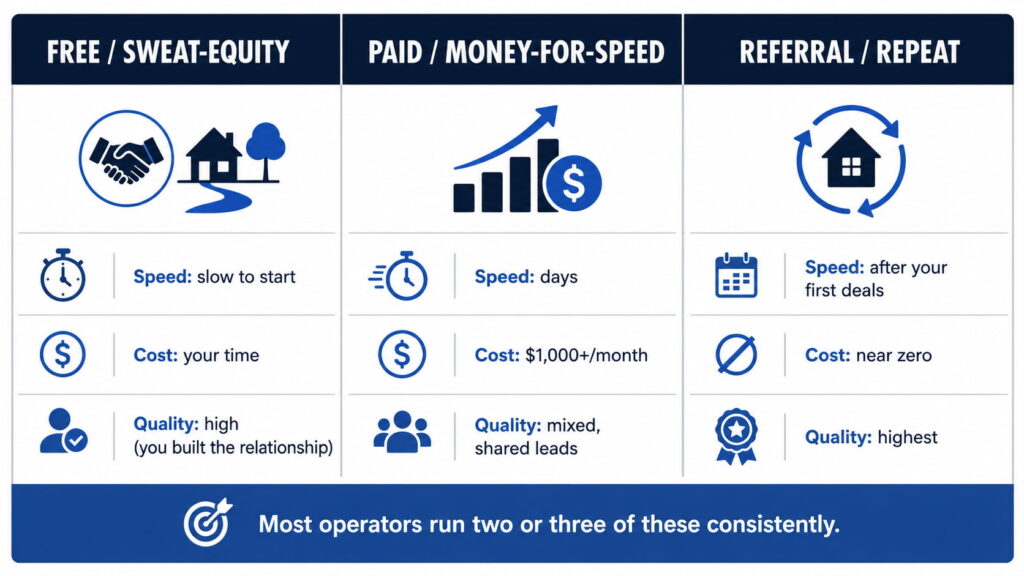
The three buckets, mapped by speed, cost, and lead quality. Pick two to run daily before you add a third.
| Bucket | Speed to first lead | Cost | Lead quality | Best for |
|---|---|---|---|---|
| Free / sweat-equity | Weeks (online: months) | Time, not money | High, and compounding online | Operators with a small budget |
| Paid / money-for-speed | Days | $1,000+/month | Mixed, often shared | Operators who need volume now and already follow up |
| Referral / repeat | After your first deals | Near zero | Highest | Every operator, once you’ve closed a few |
Free Ways to Get Motivated Seller Leads
Free leads aren’t actually free. You pay in time and effort instead of dollars, which makes this bucket the right place to start when the budget is thin. The upside: you keep control, and the online pieces you build here compound into a pipeline that outlasts any ad campaign.
Driving for Dollars and Local Networking
This is the fastest free on-ramp for a new operator. Drive your target neighborhoods and log every house that looks neglected: peeling paint, an overgrown yard, code-violation notices, a full mailbox. Those are the owners most likely to sell fast and as-is. Build the list, skip-trace the owners later, and reach out.
Pair it with showing up where sellers and referral sources gather. REIA meetings, foreclosure auctions, contractor and property-manager networks. You’re not there to pitch. You’re there to be the local cash buyer people remember. Capture every address and contact, and follow up within 24 hours while you’re still fresh in their mind.
Door Knocking and Circle Prospecting
Knocking on doors or calling around a distressed, absentee, or pre-foreclosure home is old-school for a reason. Conversion is low, but you control the volume completely, and you’re talking to owners no one else is bothering. A value-first opener beats a script every time:
“Hi, I’m a local buyer. I pay cash, buy as-is, and close on your timeline. Is this a house you’d ever consider selling?”
Set a consistency target you’ll actually hit, like 25 doors or one hour a day, and protect it. One caution: respect the Do-Not-Call Registry when you’re phoning, and check local solicitation and permit rules before you knock. A single complaint isn’t worth a marginal lead.
FSBOs and Expired Listings
For-Sale-By-Owner and expired listings are a motivated-seller goldmine, and they cost almost nothing to work. A FSBO is already trying to sell without paying a commission, so a clean cash offer with no fees means more in their pocket. An expired listing is an owner who wanted to sell, couldn’t, and is now frustrated with the traditional route.
Find them on Craigslist and FSBO sites, in expired MLS data through an agent, and in county records. The mindset that wins here: these sellers don’t need more noise, they need a better option. Lead with the fast, as-is, no-commission close and treat them like people, not a list.
Social Media Content That Builds Trust
Stop posting your deals. Start being useful. Sellers research a buyer quietly long before they ever call, so your feed’s job is to make you look like the credible local operator, not a flipper bragging about spreads.
Post local market updates, a plain-English breakdown of how a cash sale actually works, the before-and-after of a rehab, answers to the questions every nervous seller has. Pick one primary platform and post a few times a week. You’re not chasing viral. You’re making sure that when a seller finally searches your name or your city, they find someone who clearly knows the local market and looks like a safe pair of hands.
Local SEO and a Content-Driven Website
Here’s the channel most of your competitors gloss over, which is exactly why it’s the opening. A seller in trouble types “sell my house fast [city]” or “we buy houses [city]” into Google, and increasingly into ChatGPT. If your site isn’t there, you’re invisible at the precise moment of highest intent.
When a motivated seller searches, the buyers on page one get the call. Everyone else gets nothing.
What actually ranks isn’t a homepage. It’s an original page for every market you buy in, plus seller-situation pages for the searches people type under stress: probate, foreclosure, divorce, inherited property, problem tenants. Template pages that just swap the city name don’t cut it anymore, and a claimed, active Google Business Profile with real reviews is what puts you in the map pack. That’s the core of what BASEO builds for cash buyers: a unique page per market, seller-situation pillars, the Google Business Profile rebuilt, and call and form tracking installed first so every lead is actually counted.
Be honest with yourself about the timeline. SEO compounds, but it takes roughly 6 to 12 months to hit stride. The trade is that it builds equity while paid ads only rent attention. The numbers back the patience: one Florida cash buyer went from 3 to 28 motivated seller leads a month in nine months, same market, no extra ad spend, at $161 per organic lead by month 9 (BASEO client data). That same client saw a 430% increase in Google Business Profile direction requests (BASEO client data). And the AI channel is real, not hype: visitors coming from ChatGPT convert at 15.9%, against 1.76% for Google organic (Seer Interactive), because the AI already narrowed the seller’s options before they clicked.
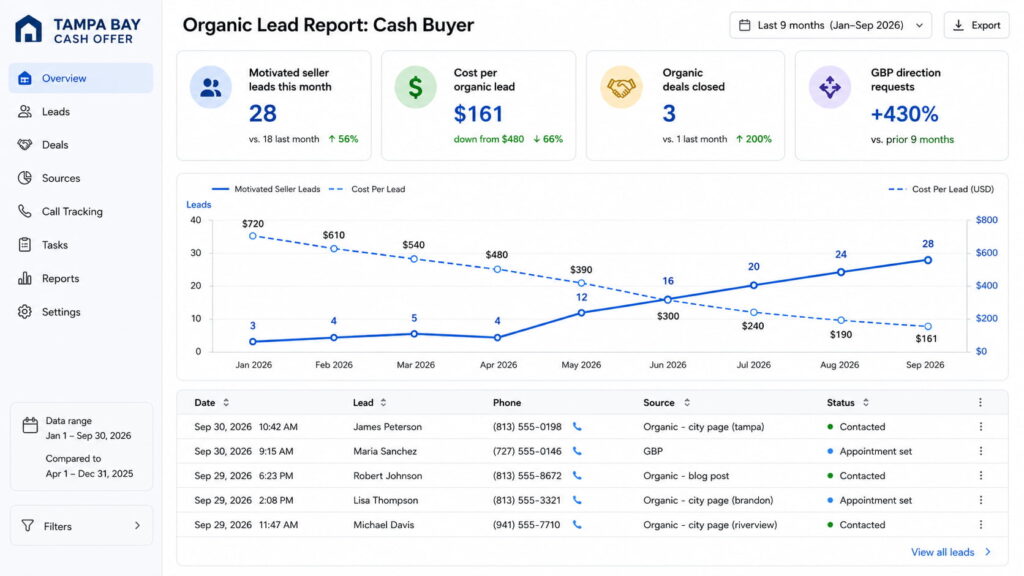
The compounding curve: leads climbing from 3 to 28 while cost per lead falls. This is what “SEO builds equity” looks like on a report.
If you’d rather see where your own site stands before building anything, that’s the whole point of the free audit. Send your domain and you get back the 3 biggest issues holding your site back, the keywords your top local competitor ranks for that you don’t, and the deal-math projection for your market. It’s written, delivered in about two business days, no call required, and yours to keep. You can also read how the organic channel works for cash home buyers before you decide.
Email Marketing and Market Updates
Every lead that doesn’t close today is worth keeping warm. Build an email list from your sphere, your web leads, and your driving-for-dollars contacts, segment it by location, and send one short market update a month: what cash buyers are paying, notable recent sales, a quick note on timelines.
It’s the cheapest way to stay top of mind for years. Sellers move on their schedule, not yours, and the operator who’s been quietly showing up in the inbox is the one they call when life finally forces the decision.
Paid Ways to Get Motivated Seller Leads
Paid channels buy speed and volume. They do not buy quality, and they stop the moment you stop paying. The rule before you turn any of them on: have a follow-up system first, or you’ll spend real money generating leads you never call back. Mid-career operators routinely spend $1,000+ a month on leads, which sounds like a lot until you remember one assignment averages around $13,000 (Real Estate Bees). The math works if you close. It’s a disaster if you don’t follow up.
Motivated-Seller Lead Lists and Portals
Lead lists are skip-traced distressed or absentee data you buy in bulk. Lead portals sell you inbound seller inquiries, usually on a per-lead or subscription model. Both can fill a pipeline fast.
The catch is real. Portal leads are often shared with several investors at once, intent runs low, and they demand relentless follow-up to convert. Who this is actually for: an operator with a dialer, a CRM, and the discipline to work a lead ten times, not a beginner hoping a purchased list closes itself. If that’s not you yet, spend the money on the free bucket instead.
Wholesale and JV Referral Partnerships
If cash is tight, partner with people who already have deals. Other wholesalers, agents, and birddogs will bring you sellers in exchange for a fee or a split paid only when the deal closes. No upfront cost, no wasted marketing spend, just a slice of the spread when money changes hands.
Structure it cleanly so nobody feels burned later. Get it in writing, define the split before the deal, and be clear on roles: they bring the seller, you bring the close and the capital. Done right, it’s the lowest-risk way to keep deals moving while you build your own channels.
Paid Social and Google Ads
Facebook and Instagram lead ads, plus Google search ads on “sell my house fast [city],” can put leads in your inbox within days. That speed is the entire point of paid. But it demands tight targeting, a real landing page, and follow-up measured in minutes, not hours.
Know the price of admission. Paid clicks on “sell house fast” run roughly $12 to $63 each, and seller cost per lead lands anywhere from about $100 to $350 depending on the market (Realty Crux). Quality tends to sit below content and referral leads, so treat ads as a speed layer, not a foundation. This is also where a specialist matters: BASEO runs motivated-seller PPC under the same cost-per-deal lens as organic, and shrinks it as the organic channel takes over the heavy lifting. The point of paid isn’t to feed it forever. It’s to keep the phone ringing while the free bucket compounds.
Turn One Deal Into Ten: Referrals and Repeat Business
Referrals are the highest-converting, lowest-cost leads you will ever get. No cost per click, no cold open, just a seller who arrives already trusting you because someone they trust sent them. This is the bucket that turns a good year into a business.
The trick is asking at the right moment. The best times are when goodwill peaks: at the signed contract and again at the closing table. Make it effortless for them: “If you know anyone who needs to sell fast, send them my way. I’ll take good care of them.” A happy seller, their neighbors, their family, and the attorney who referred them are all one conversation from your next deal.
Then systematize it so it doesn’t rely on memory. Check in with past sellers around four times a year, send something genuinely useful, and drop off a small closing gift three or four months after the deal. It takes multiple touches before most people act, often six or more (PropertyLeads), so the operators who stay in the rotation are the ones who get the call. Stay in the rotation.
Pick a Niche and Own a Market (Geographic Farming)
Spreading yourself across ten strategies and three counties is how operators stay busy and broke. The fix is focus. Niche down and farm.
Niching means picking a lane and becoming the obvious buyer for it: probate, foreclosure, tired landlords, or a specific set of zip codes. Geographic farming means choosing one area and showing up in it relentlessly, month after month, through mail, door knocking, local sponsorships, and an online presence built for that exact market. Depth beats breadth. The seller who’s seen your name five times calls you, not the buyer they’ve never heard of.
Set the expectation up front: farming takes 6 to 18 months to produce real traction, and most operators quit around month 4, right before it works. Consistency is the entire strategy.
The online version of farming a market is a real page for that market. Google’s March 2024 update introduced a Scaled Content Abuse policy that specifically crushed template pages that just swap the city name (Google Search Central), so each market page has to be genuinely original to rank. That per-market page buildout is exactly what BASEO handles for the markets a cash buyer operates in.
Build a Daily Lead Generation System
Tactics don’t fail because they’re bad. They fail because they’re done once, then abandoned. Scattered effort is why most operators plateau. A repeatable daily block is why the rest scale. The goal of this section is to turn everything above into a habit you run without deciding.
The 3-Hour-a-Day Rule
The common coaching benchmark is about three hours of lead generation a day to support a six-figure acquisitions business. It sounds like a lot until you block it like an appointment and stop negotiating with it. A sample block:
- 60 minutes of seller calls and follow-ups (the highest-value hour, do it first).
- 60 minutes of driving for dollars or list work.
- 30 minutes of content, one post or one email.
- 30 minutes of sphere-of-influence touches, five people you haven’t talked to in a while.
Protect those three hours and the pipeline takes care of itself. Skip them for a “busy” week and you’ll feel the gap 60 days later, because that’s the lag on your lead gen.
Use a CRM to Track and Follow Up
Most operators don’t have a lead problem. They have a follow-up problem. Deals come in, get scribbled somewhere, and die. A CRM fixes that: log every contact, set the next action, and automate the sequence so nobody slips through.
Speed is the other half. Respond to an inbound seller within five minutes and you’re up to 21 times more likely to qualify the lead than if you wait (Verse.ai). Slow-play it and the seller has already called the next buyer on the list. Pair fast first contact with patient follow-up, because it takes six or more touches before many sellers convert (PropertyLeads). Any of the well-known real estate investor CRMs will do the job. The tool matters far less than actually working it every day.
How Long Does It Take to Get Motivated Seller Leads?
It depends on the channel. Driving for dollars, sphere-of-influence outreach, and cold calling can produce leads in days to weeks. Paid ads can produce them in days. Content marketing takes 3 to 12 months, local SEO 6 to 12 months, and geographic farming 12 to 18 months. Consistency matters more than the channel, and most operators who quit do so too early.
Here’s the honest breakdown:
| Channel | Time to first leads | Cost | Compounds? |
|---|---|---|---|
| Paid ads | Days | High, ongoing | No, stops when you stop paying |
| Sphere of influence | Days to weeks | Free | Somewhat |
| Driving for dollars / door knocking | Weeks | Time | No |
| FSBO / expired outreach | Weeks | Low | No |
| Social media content | 1–3 months | Time | Yes |
| Local SEO / content site | 6–12 months | Moderate | Yes, strongly |
| Geographic farming | 12–18 months | Moderate | Yes |
For the SEO channel specifically, expect the first organic leads around month 3 to 5 and real volume by month 6 to 9. The Florida client hit 12 organic leads by month 5 and 28 by month 9 (BASEO client data). Anyone promising motivated-seller leads in 30 days is selling you paid ads or lying. The channels that compound are slow to start and impossible to stop once they’re rolling. That’s the trade.
Common Lead Generation Mistakes New Investors Make
Most of these cost deals quietly, month after month:
- Chasing every shiny tactic. Getting mediocre at ten channels instead of good at two or three.
- No follow-up system. Leads arrive and die in a notebook because there’s no next action logged.
- Quitting a channel too early. Killing SEO or farming at month 3, right before the payoff at month 8.
- Buying leads before you can work them. Paying for volume with no CRM and no time to follow up ten times.
- Talking only about yourself. “I buy houses!” instead of the seller’s problem you solve.
- Inconsistent prospecting. Going hard for a week, then going dark, so the pipeline whipsaws.
- Ignoring online presence entirely. Sellers searching right now can’t find you. One operator’s site had collapsed from 10,000 to 284 monthly organic sessions under a previous agency before it was rebuilt (BASEO client data). Invisible is a choice, and it’s an expensive one.
Your Next 30 Days: An Action Plan
You don’t need all of this at once. You need momentum. Here’s a 30-day start:
- Week 1. Build your sphere-of-influence list, 100 to 300 names, and send the announcement scripts. Pick the market or niche you’re going to own.
- Week 2. Start driving for dollars and launch a social cadence, three posts a week. Log every lead somewhere you’ll actually look.
- Week 3. Stand up or fix your website and local SEO, claim and rebuild your Google Business Profile, and set up a CRM so no lead is ever lost.
- Week 4. Add one paid channel, ads or a lead list, now that follow-up exists to catch what it brings in.
The piece most operators skip is week 3, the online presence that compounds while they sleep. Some run it themselves and do fine. Most would rather spend that time closing deals. If you want to know exactly what’s missing on your site and what your top local competitor built to outrank you, the free BASEO audit spells it out, market-specific, no call required.
Frequently Asked Questions
Most land it through their sphere of influence, the people who already trust them. Announce that you buy houses for cash, ask to be kept in mind, and pair that with driving for dollars and fast follow-up. Warm referrals from your existing network are the fastest path to a first deal.
Through three buckets: free sweat-equity methods (sphere of influence, driving for dollars, FSBOs, social media, local SEO), paid sources (lead lists, portals, and ads), and referrals from past sellers. Most successful operators combine two or three consistently rather than relying on a single tactic.
It varies by channel. Sphere outreach, driving for dollars, and paid ads can produce leads in days to weeks. Content marketing takes 3 to 12 months, local SEO 6 to 12 months, and geographic farming 12 to 18 months. Consistency matters more than the channel, and most who quit do so too early.
The highest-return free sources are your sphere of influence, driving for dollars, FSBO and expired listings, social media content, and a locally optimized website. Your own network converts best, because those people already know and trust you before you ever make an offer.
It ranges widely. Many mid-career operators spend $1,000+ a month on lists and ads, while experienced buyers spend less because referrals carry the business. New operators can start at $0 by focusing on sphere of influence, driving for dollars, and content before paying for volume.
Yes. Prove your value upfront: make fair as-is cash offers, close on the seller’s timeline, and answer every question honestly. Sellers care far more about certainty and speed than your résumé. Lean on your network and show up consistently online.
Both still work, but conversion is low and requires volume and consistency. They shine for targeting specific neighborhoods, FSBOs, and expired listings. Lead with value, respect the Do-Not-Call Registry and local solicitation rules, and treat them as one channel within a larger system, not the whole plan.
Final thoughts
There’s no magic channel for how to get motivated seller leads. Deals come from relationships, from prospecting when it’s boring, and from being findable the moment a seller decides they’re done. The operators winning your market aren’t smarter than you. They’ve just been consistent longer.
So pick two channels and run them daily, then add the online asset that keeps producing after you build it. That’s the one most operators skip, and it’s the one that compounds. If you want to know exactly what’s broken on your site and what your top local competitor built to rank, that’s what the free audit is for: the 3 biggest issues, the keywords they rank for that you don’t, and the deal-math for your market. Written, no call required, yours to keep.