
Most social media advice for real estate isn’t written for you. It’s written for Realtors, who sell listings. You buy houses. A Realtor posts a listing to attract buyers. You need a motivated seller to call you before a competitor does. Same platforms, opposite job. This is the version built for cash buyers: what to post, how to turn a follower into a lead, and where social quietly runs out of road.

Why Social Media Marketing Works Differently for Cash Buyers
The Realtor playbook doesn’t transfer. Agents build a personal brand to win listings. You don’t have listings, and “brand” for its own sake doesn’t buy houses.
For a cash buyer, social media does three jobs: it builds local trust, it puts you in front of seller networks, and it grows a disposition buyers list. That’s it. Everything you post should serve one of those.
And here’s the honest part most posts skip. Social is weakest exactly where you need it most. The seller in probate, foreclosure, or a messy divorce isn’t scrolling for a home buyer. He’s typing “sell my house fast” into Google at 11pm. Social builds the trust that makes him pick you later. It rarely catches him at the moment of intent.
What Investors Actually Want From Social Media: Sellers, Deals, and a Buyers List
Followers are a vanity number. Deals are the number. Keep three outcomes in front of you, all measured in leads and closings:
- Motivated seller leads. The person who fills out your form or sends a DM saying “what would you pay for my house?”
- A cash buyers list. For wholesalers, a warm list of buyers who take your assignments fast is leverage on every deal.
- Local credibility. The trust that shortens the gap between “saw your video” and “signed your contract.”
If a piece of content doesn’t move one of those three, it’s a hobby, not marketing.
Choosing the Right Social Media Platforms as a Cash Buyer
You don’t need to be everywhere. You need to be consistent somewhere. Pick based on two things: where your sellers and buyers actually are, and which format you’ll still be making in six months. Consistency beats reach, and consistency comes from doing something you don’t hate.
Here’s how the main platforms map to a cash buyer’s job.
Facebook: Local Groups, Marketplace, and Motivated Sellers
Still the workhorse for most investors. It has the widest local reach, active community and neighborhood groups, and Marketplace. It skews older, which lines up with a lot of inherited-property and tired-landlord sellers. Join local groups and give real value, answer questions, share market notes. Don’t spam “we buy houses” links. The person who remembers you helped is the one who calls.
Instagram: Rehab Before-and-Afters and Trust
Instagram is your proof channel. Before-and-after rehab reels, quick walkthroughs, and stories that show the work. It’s where a nervous seller decides you’re a real operator and not a scam. Carousels that teach (“3 things that happen when a house goes to probate”) do quiet, compounding work.
TikTok: Reaching Younger and First-Time Sellers
TikTok gets fast reach with younger and first-time sellers through short, personal video. It rewards volume and honesty, not production budget. A winning format is simple: “here’s what we paid for this house and why.” Only invest the time if your market’s sellers are actually here. For some rural markets, they’re not.
YouTube: Searchable Content That Feeds Google and AI
YouTube is the one social platform that’s also a search engine. A video titled “Selling an inherited house in [city]” can rank for years and pull sellers long after you post it. It also feeds AI answers, which matters more every month. If you only add one long-form channel, this is the one with the longest tail.
LinkedIn: Cash Buyers, Agents, and Referral Deals
LinkedIn isn’t for sellers. It’s for the deal network: agents sitting on pocket listings, other investors for dispositions, attorneys who handle probate. Low cadence, high value. A few sharp market posts a month keep you top of mind with the people who send deals.
The Content That Attracts Motivated Sellers (Not Just Other Investors)
The most common mistake in investor content: the whole feed talks to other investors. Guru quotes, “closed another one” flex posts, deal-math jargon. Sellers don’t speak that language, and they scroll right past it.
Rotate five pillars instead. Keep the flexing small and the seller-useful content large.
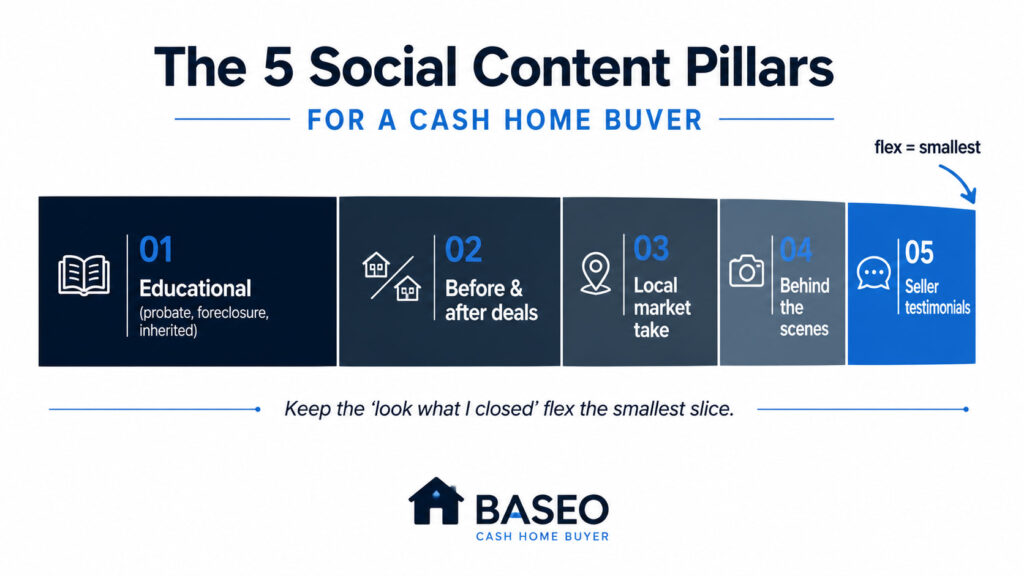
1. Educational Content for Distressed Situations
Answer the questions a stressed seller actually Googles. Three that work: “What happens to the mortgage when you inherit a house?” “Can you sell a house in foreclosure?” “Do I have to make repairs to sell as-is?” You become the person who explained it before you ever pitched.
2. Before-and-After Deals and Proof
Show a house you bought as-is and what you did with it. The transformation proves two things at once: you close, and the seller who took your offer came out fine. Real photos beat any stock image.
3. Local Market Point-of-View
Have an actual take on your market. What you’re paying, what’s sitting, what’s moving. Not recycled national headlines, a real local read. This is what makes a seller trust that you know their neighborhood, not just their zip code.
4. Behind-the-Scenes and Personal Brand
Let people see the operator. A day driving for dollars, a closing, the team. Humanize yourself so a nervous seller feels safe dialing your number. The line to hold: personal, not oversharing.
5. Seller Testimonials and Social Proof
“We closed in nine days, no repairs, no agent fees.” A short video from a past seller plus the problem you solved is the highest-trust content you can post. Always get permission before you use a name, a face, or an address.
How Often Should Investors Post on Social Media?
Aim for three to five posts a week on your main platform, and treat consistency as the real target. One post a week sustained for six months beats five a week for three weeks and burnout. Batch a month of content in one sitting and schedule it, so a busy week of closings doesn’t take you off the map.
Here’s a realistic cadence by platform once you’ve picked your two or three.
| Platform | Realistic cadence | Best format |
|---|---|---|
| 4–7 posts/week | Group value, market notes, before/after | |
| 3–5 posts/week | Reels, before/after, carousels | |
| TikTok | Daily (only if used) | Short personal video |
| YouTube | 1–2 videos/week | “Selling a house in [situation/city]” |
| 1–2 posts/week | Market takes, deal-network posts |
Turning Social Media Followers Into Motivated Seller Leads
A follower isn’t a lead. The gap between the two is where most investor social falls apart. Here’s the funnel that closes it.
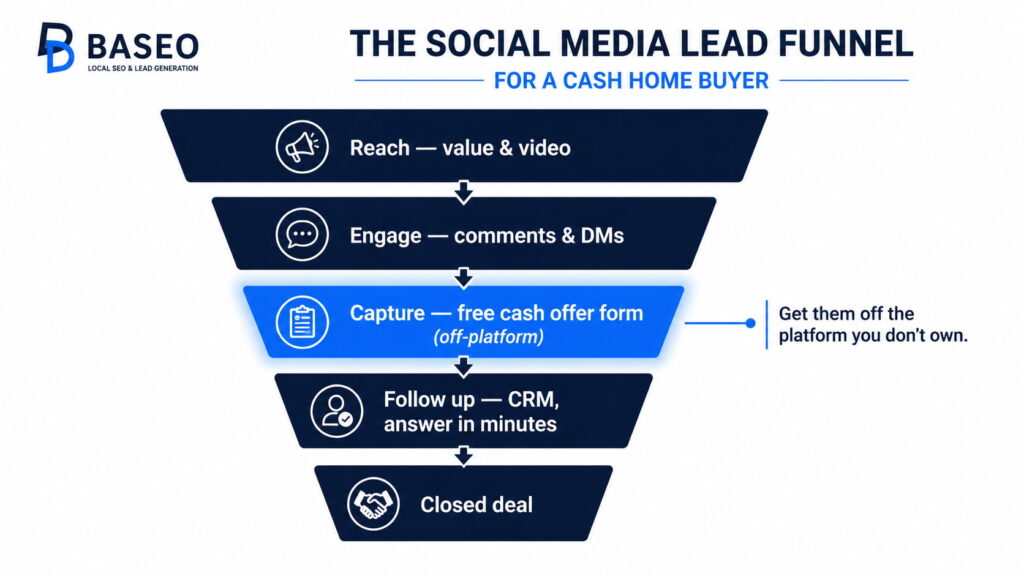
Reach comes from the video and value you post. Engagement is the comment or DM. Then comes the step most investors skip: capture off the platform. Move that conversation to something you own, a simple “what would you pay for my house?” form, a free cash-offer request, an email. A lead sitting in Instagram DMs isn’t yours. The algorithm owns it, and it can bury you tomorrow.
Then follow up fast. Responding to a web lead within five minutes has been shown to lift the contact rate by up to 900% versus waiting (Verse.ai roundup of the InsideSales study). A motivated seller who messaged three investors is talking to whoever answers first. Speed isn’t a nice-to-have on a distressed lead. It’s the whole game.
Building a Cash Buyers List on Social Media (For Wholesalers)
This one is pure investor, and no Realtor guide covers it. If you wholesale, social is a fast way to build a cash buyers list so you can move a contract the day you get it.
Run a simple play: post “deal of the week” style content, spin up a local buyers Facebook group, and add a one-line opt-in (“want first look at our next deal? drop your email”). A warm list of buyers who trust your numbers means you assign faster and negotiate harder on acquisition, because you already know the deal will move. The buyers list is leverage on every future contract.
Paid vs. Organic Social, and the Fair Housing Trap for “We Buy Houses” Ads
Organic builds trust slowly and for free. Paid buys reach now. The smart use of paid isn’t to invent an audience from scratch, it’s to put money behind a post that already worked organically, or to promote a lead magnet like a free cash offer.
But there’s a rule that trips up almost every investor, and getting it wrong is a legal problem, not just a marketing one.
A “we buy houses” ad is a housing ad. On Meta, housing ads must run under a Special Ad Category, and that category strips most of your targeting. You can’t target by age, gender, or zip code, and there’s roughly a 15-mile minimum radius in the US. This came out of a Fair Housing Act settlement between the Department of Justice and Meta over discriminatory ad delivery (Meta, DOJ).
Housing ads run under Meta’s Special Ad Category. Age, gender, and ZIP targeting are off the table.
The practical takeaway: your ads have to lean on creative and offer, not tight demographic targeting. And because this is Fair Housing law, confirm your setup with someone who handles compliance before you scale spend. This is one place where “move fast and figure it out” can cost you.
Social Media vs. Search: Why Social Alone Won’t Fill Your Pipeline
Here’s the reframe that changes how you budget your time. Social media is rented attention. You’re posting on someone else’s algorithm, and the day you stop, the reach stops with you. Search is different. A seller in crisis types “sell my house fast [city]” with intent to act this week, and whoever shows up owns that moment. Social rarely catches it.
| Social media | Organic search + AI | |
|---|---|---|
| Attention type | Rented (algorithm-owned) | Owned (your pages, your rankings) |
| Seller intent | Low to medium (browsing) | High (searching to sell now) |
| What happens when you stop | Reach dies fast | Rankings keep pulling leads |
| Cost trend | Rising ad costs, constant effort | Compounds; cost per lead falls over time |
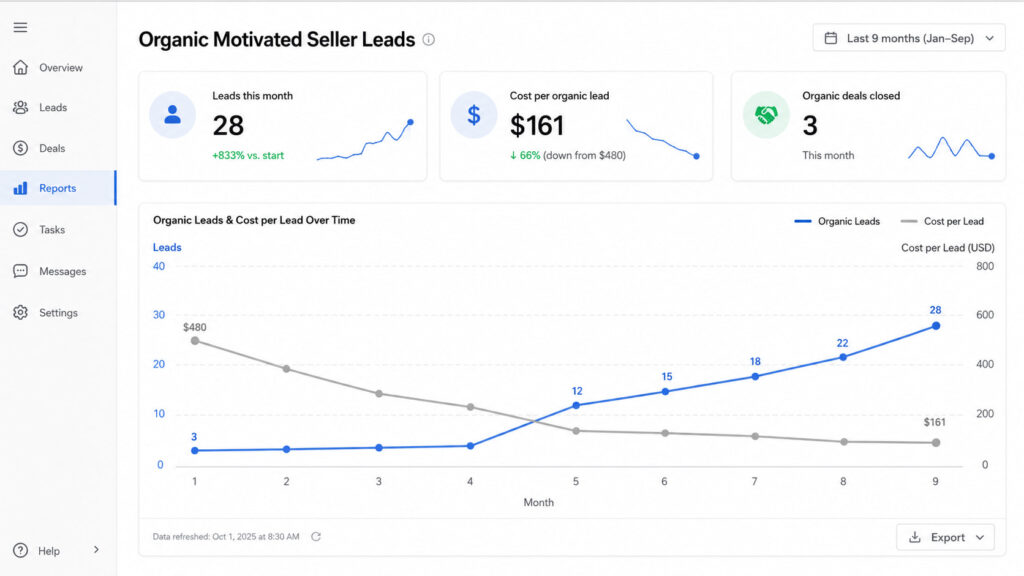
The compounding is the part that matters. One Florida cash buyer went from 3 to 28 motivated seller leads a month in nine months, in the same market, with no extra ad spend, at $161 per organic lead and falling (BASEO client data). Compare that to seller keywords on Google Ads, where “sell my house fast” clicks run $5 to $65 each (Carrot). And traffic from AI tools like ChatGPT has been shown to convert at 15.9% against 1.76% for regular Google organic in one study, because the seller is already qualified by the time they click (Seer Interactive).
That owned, compounding channel is exactly what SEO for real estate investors is built to capture. Use social for trust and reach. Use search to catch the seller at the moment he’s ready to sign.
How Social Media Feeds AI Answers Like ChatGPT
More sellers are skipping the search box entirely and asking ChatGPT or Google’s AI “who buys houses fast in [city]?” The answer they get is assembled from content the AI can read and trust: YouTube videos with the city named out loud, consistent reviews, a coherent brand that says the same thing across every channel. Your social presence is an input to those answers, not a separate silo.
This isn’t theory. One Carrot user reported getting 26 of 45 leads in a single week from ChatGPT (Carrot). The investors showing up in AI answers now are claiming a window before their local competitors even know it exists.
The practical move: name your city and situations explicitly in captions and video, keep your reviews and profile consistent, and make sure the content lives somewhere searchable, not just on a feed. Tracking and optimizing which AI tools cite you in your markets is part of what BASEO’s organic lead channel work covers for cash buyers. Social feeds the machine. Search and AI are where it pays out.
Common Social Media Mistakes Investors Make (and the Fix)
Most of these are fixable this week. None of them require a bigger budget.
- Posting to other investors. Fix: write every caption for a stressed seller, not the REI group.
- Only flexing closings. Fix: make “look what I closed” the smallest slice, not the whole feed.
- No call to action or capture. Fix: end posts with one clear next step to an off-platform form.
- Leaving leads in the DMs. Fix: move every serious conversation to a channel you own, then follow up in minutes.
- Inconsistency. Fix: batch a month of content and schedule it so closings don’t knock you offline.
- Ignoring Fair Housing on ads. Fix: run housing ads under the Special Ad Category and confirm compliance.
- Buying followers and chasing vanity metrics. Fix: measure leads and deals, not likes.
The Tools to Plan, Create, and Schedule
Don’t overbuild your stack. Group tools by function and start small.
For scheduling, a tool like Buffer, Hootsuite, or the free Meta Business Suite lets you batch and queue posts. For design and video, Canva handles graphics and carousels while CapCut handles quick vertical video edits. For capture and follow-up, you need a form and a CRM so leads land somewhere you control and get worked fast.
Start with one scheduler and one design tool. Add a capture form the day you post your first seller-facing call to action. That’s enough to run the whole system above without drowning in software.
Final thoughts
Social media is a trust-and-reach layer for a cash buyer, not the pipeline itself. It warms sellers up, builds your local name, and grows a buyers list. But the seller who’s actually ready to sign is searching, and that demand compounds only where you own the asset instead of renting attention on a feed.
So before you spend another month posting into the void, get clear on which channel actually feeds your deals. If you want to know exactly where your motivated seller leads will come from, and what’s missing between your current presence and a pipeline that runs without you posting daily, that’s what the free audit is for. Written, no call required, yours to keep. Get your free site audit →
Frequently Asked Questions
Quick answers to what cash buyers ask most about social media.
Facebook is the best all-around platform for most cash home buyers because of its wide local reach, active community groups, Marketplace, and older seller base. Instagram is the strongest second channel for before-and-after proof, and YouTube wins for searchable content that keeps pulling seller leads for years.
Aim for three to five posts a week on your main platform, and prioritize consistency over volume. Posting steadily for six months beats a burst that burns you out in three weeks. Batch a month of content in one session and schedule it so a busy week of closings doesn’t take you offline.
Yes, but mostly indirectly. Social builds the trust and local reach that make a seller choose you, and it can surface leads through groups, DMs, and video. The catch: you have to capture those conversations off-platform and follow up fast, because most high-intent sellers still find buyers through search.
Yes, but they count as housing ads and must run under Meta’s Special Ad Category. That removes targeting by age, gender, and ZIP code and applies a minimum radius, because of Fair Housing law. Lean on strong creative and offers instead of tight targeting, and confirm your setup with someone who handles compliance.
Rotate five pillars: educational content for distressed sellers, before-and-after deals, a real local market take, behind-the-scenes to humanize you, and seller testimonials. Keep “look what I closed” flexing the smallest slice. Write every post for a stressed homeowner, not for other investors in your REI group.
Do social yourself if you can post consistently and answer leads fast, since it builds trust cheaply. But it won’t capture the seller searching “sell my house fast” at the moment of intent. That high-intent, compounding demand comes from search and AI, so most investors treat social as a layer and make search the pipeline.