
Knowing where to find foreclosure listings is half the battle in this business. There are dozens of sources, but they sort into five buckets: government portals, major real estate sites, bank REO pages, auction platforms, and county records. Some are free. Some charge a monthly subscription. This guide walks all five and tells you which ones are worth your time and which ones you can skip.

Quick Answer: The Best Places to Find Foreclosure Listings
The best free foreclosure listings come from government portals (HUDHomeStore.gov, Fannie Mae HomePath), Zillow’s foreclosure filter, and your county recorder’s records. The top paid services are Foreclosure.com and Auction.com, which is the largest auction marketplace in the country.
Here are the sources worth knowing:
- HUDHomeStore.gov: federal FHA foreclosures, free
- Fannie Mae HomePath: Fannie Mae REO homes, free
- Freddie Mac HomeSteps: Freddie Mac REO homes, free
- Zillow: filter foreclosures, free to view
- County recorder records: pre-foreclosure filings, free
- Bank REO pages: buy direct from the lender, free
- Auction.com: biggest foreclosure auction marketplace
- Foreclosure.com: largest paid distressed database
Free Government Foreclosure Listings
Government sources are the most reliable listings you’ll find, and they cost nothing. When a federally backed loan goes into foreclosure, the agency behind it ends up owning the house. That agency then lists the property itself, so you’re looking at real inventory from the actual owner. There is no access fee, ever. Anyone charging you to access a government foreclosure list is selling you something you can get for free.
HUD Home Store (HUDHomeStore.gov)
HUD Home Store is the official portal for homes that had an FHA-insured mortgage, went into foreclosure, and reverted to the U.S. Department of Housing and Urban Development. It’s free to search by state and ZIP code, and every property runs through a sealed-bid system rather than a fixed price.
Two things to know before you get excited. First, HUD prioritizes owner-occupants: for roughly the first 15 days a listing is live, only buyers who will live in the home (and certain nonprofits) can bid, and investors wait for the extended period. Second, you can’t bid yourself. Offers have to go through a HUD-registered real estate broker.
One more warning. Sites with names like USHUD charge a subscription for “HUD listings” despite the name. The real thing is HUDHomeStore.gov, and it’s free.
Fannie Mae HomePath
Fannie Mae HomePath lists homes Fannie Mae owns after foreclosure or deed-in-lieu. It’s free, you can search by location without an account, and creating one lets you save searches and get email alerts when new inventory hits.
Like HUD, HomePath runs a “First Look” window where owner-occupants get first crack before investors can make offers. Fannie Mae also runs occasional incentives for buyers who plan to live in the home, so read each listing’s terms.
Freddie Mac HomeSteps
Freddie Mac HomeSteps is the Freddie Mac version of the same thing: houses Freddie Mac took back and now sells directly. It’s free, you can browse without an account, and an account gets you alerts. It runs a First Look Initiative that favors owner-occupants early, just like the other two. Same model, different agency, worth checking alongside HomePath.
VA & USDA Foreclosures
These two are where you find inventory almost nobody else is looking at. The VA sells homes it takes back on defaulted VA loans, and those sales are open to any buyer, not just veterans; they’re handled through a VA REO servicer. The USDA lists foreclosed rural properties at resales.usda.gov. Both are free.
Most foreclosure guides never mention either one, which is exactly why they’re worth a look. Less competition on a listing is less competition on price.
Foreclosure Listings on Major Real Estate Portals
The big consumer portals carry foreclosures too, but they’re mixed in with normal listings, so you have to filter to surface them. All of these are free to view. The catch is data freshness, which varies a lot by listing type.
Zillow
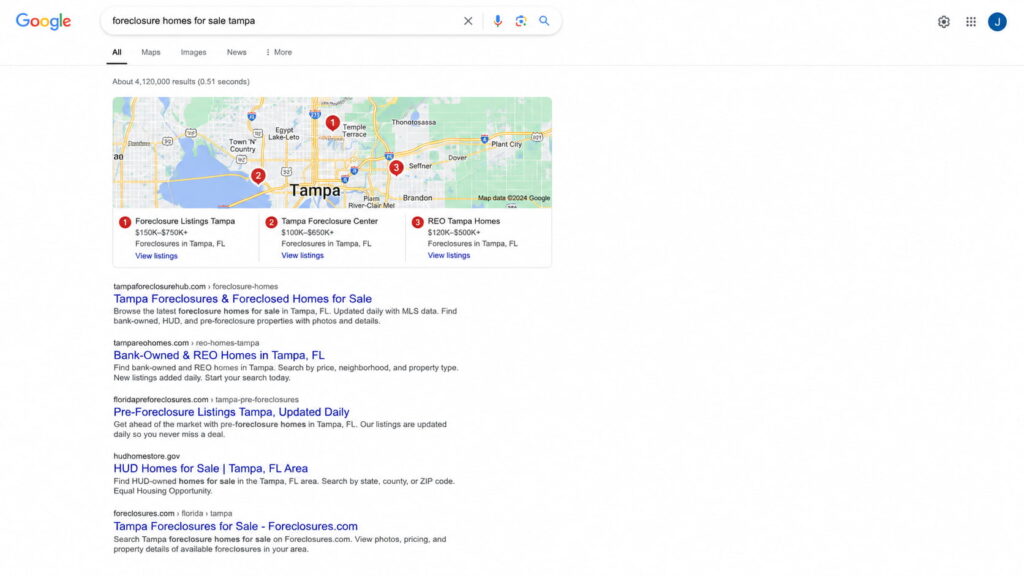
On Zillow, foreclosures live behind a filter. Open the “More” filter and check the listing-type categories: foreclosures, foreclosed, pre-foreclosures, and auctions. On many listings Zillow will show the unpaid loan balance and the scheduled auction date, which is useful context before you dig deeper.
One caution: Zillow’s pre-foreclosure data can be out of date. Those homes aren’t officially for sale, so the status you see may have changed weeks ago. Treat it as a lead, not a fact, and confirm before you act. You can reach the foreclosure view directly at zillow.com/foreclosures.
Realtor.com & Redfin
Both Realtor.com and Redfin let you filter for foreclosures and bank-owned homes, and both pull their data from the MLS. That makes them reliable for REO that a listing agent has already put on the market. If a bank-owned home is actively for sale, you’ll usually find accurate details here, including status, price, and photos.
MLS.com
Don’t confuse MLS.com with “the MLS.” It isn’t the multiple listing service agents use; it’s a public-facing portal that happens to include a foreclosures-by-state section. It’s a fine free starting point for a quick scan of what’s out there, but treat it as a jumping-off point, not a source of truth.
Bank & Lender REO Listings
When a house doesn’t sell at auction, it goes back to the bank as REO, short for real estate owned. Plenty of lenders publish that inventory directly on their own sites. Bank of America runs its Real Estate Center, Wells Fargo lists REO through its Premier Asset Services / PEMCO channel, and Chase publishes bank-owned homes too.
Buying REO straight from the lender can cut out a layer of middlemen, and banks are often motivated to move these off their books. The trade-off is that each lender’s inventory is its own silo, so you’re checking several sites instead of one. If you already know you want to buy a foreclosure with cash, a clean REO purchase from the bank is one of the simpler ways to do it.
Foreclosure Auction Platforms
Auctions are where the deepest discounts live, and also the most risk. You’re often bidding on a property you can’t walk through first, and winning bids usually need cash or certified funds fast. This is the channel for buyers who know their numbers cold and can move money quickly, not for someone testing the waters.
Auction.com
Auction.com is the largest online foreclosure and bank-owned auction marketplace in the country, with properties across all 50 states. It runs both online auctions and on-site courthouse sales, and many of those require the winning bidder to pay in cash or certified funds within a tight window.
There’s more inventory coming, too. Foreclosure auction volume climbed about a third year over year in early 2026, a sign the pipeline is filling back toward normal levels. More listings means more chances to find something that pencils out, if you’re ready to compete on price and speed.
Hubzu & Xome
Hubzu and Xome are the two main alternatives to Auction.com. Hubzu, run by Altisource, and Xome both list foreclosure and bank-owned properties, and both are free to browse. If you’re serious about auctions, watch all three; the same property doesn’t always show up on every platform, and inventory rotates.
Paid Foreclosure Listing Services
Here’s the honest version. Paid services aggregate pre-foreclosure and auction data, and they often surface it earlier than the free sites do. That head start has real value. But you’re paying a monthly subscription for it, and that math only works if you’re buying enough volume to justify the cost. A casual buyer doesn’t need one.
Foreclosure.com
Foreclosure.com is the largest distressed-property database out there, with close to two million listings spanning foreclosures, pre-foreclosures, bankruptcies, and tax liens, updated daily. It runs a free trial that then converts to a subscription of about $40 a month. That’s the trade: broad, early data behind a paywall. Worth it if you’re sourcing constantly, overkill if you’re not.
RealtyTrac
RealtyTrac is similar, with more than a million properties updated daily, but it leans into historical and trend data on top of the listings. That extra layer makes it useful for the due-diligence side of a deal, not just finding one. Pricing runs around $50 a month after a trial. For an investor who wants context on a market before committing, it earns its keep.
How to Find Pre-Foreclosure Listings for Free (County Records)
This is the channel most guides mention in a single sentence and move on. It’s also where the earliest, least-crowded leads are.
Every foreclosure is a legal process, and that process is public record. When a lender starts foreclosing, filings hit the county recorder or clerk’s office, often weeks or months before the property shows up on any portal. You can search those filings yourself, for free, and get to owners before your competition even knows the house exists.
Three documents matter:
- Notice of Default (NOD): the lender has formally started foreclosure because the borrower fell behind. This is the earliest public signal.
- Lis pendens: Latin for “suit pending,” this is filed when a judicial foreclosure lawsuit begins. It means litigation is underway on the property.
- Notice of Sale (or Notice of Trustee’s Sale): the auction is scheduled, with a date. This is the last stop before the property sells.
Many counties put these online. Dallas County, for example, publishes foreclosure notices you can pull without leaving your desk. Others still require a visit to the clerk’s office, but the information is always public.
Why bother when portals exist? Because the county record is the source everything else copies from, and it’s first. Reaching an owner right after a Notice of Default, while they still have room to negotiate, is a very different conversation than bidding against a crowd at auction. If you want the full picture of that window, here’s what pre-foreclosure means for a buyer.
Free vs. Paid Foreclosure Sources: Which Should You Use?
For most buyers, the free sources are enough. Government portals, Zillow’s filter, and your county records will keep a steady pipeline in front of you without a single subscription. The paid tools earn their place when you’re buying at volume and the value of getting data a few days early outweighs the monthly cost.
| Source | Cost | Best for | Update frequency |
|---|---|---|---|
| Government portals (HUD, HomePath, HomeSteps, VA, USDA) | Free | Reliable REO from the actual owner | Weekly |
| Major portals (Zillow, Realtor.com, Redfin) | Free | Casual browsing; REO already listed | Daily (REO); pre-foreclosure lags |
| Bank REO pages (BofA, Wells Fargo, Chase) | Free | Buying direct from the lender | Varies by lender |
| Auction sites (Auction.com, Hubzu, Xome) | Free to browse | Deepest discounts; cash buyers | Daily |
| County records | Free | Earliest pre-foreclosure leads | As filed |
| Paid services (Foreclosure.com, RealtyTrac) | ~$40–$50/mo | Volume buyers; early data | Daily |
A simple rule: casual buyers stick to free government portals, Zillow, and county records. Serious investors combine a paid service with county records, so they get both the aggregated feed and the raw filings before anyone else.
How to Verify a Foreclosure Listing Before You Act
A foreclosure listing is a starting point, not a guarantee. Listings on free and third-party sites especially can be sold, withdrawn, or simply stale, and acting on old data wastes time or worse.
Verify in three steps. First, check the county records for the property’s current status; that’s the source of truth on where it sits in the process. Second, confirm the listing on the official owner’s portal, whether that’s HUD, a GSE like Fannie Mae, or the bank that holds the REO. Third, contact the listing agent or servicer directly to confirm it’s still available and get the real condition and terms. Five minutes of verification saves you from chasing a house that closed last month.
Ready to Sell a Property Fast Instead?
If you landed here because you’re the one facing foreclosure, or you inherited a house you never wanted and don’t want to pour money into, there’s a simpler path than watching it head to auction. Selling directly to a cash buyer lets you skip the listing process, the repairs, and the auction timeline entirely, and close on a date that works for you.
No obligation, no pressure. Request a free cash offer and see what your house is worth as-is.
Frequently Asked Questions
A few of the questions buyers ask most about finding foreclosure listings.
Yes. Government portals like HUDHomeStore.gov, Fannie Mae HomePath, and Freddie Mac HomeSteps list foreclosures for free, with no access fees. County recorder offices also publish Notice of Default and auction filings for free, and Zillow lets you filter foreclosures at no cost.
It depends on your goal. For free official listings, HUDHomeStore.gov and Fannie Mae HomePath are best. For the widest selection, Foreclosure.com (paid) lists close to two million properties. For auctions, Auction.com is the largest. Casual buyers often start with Zillow’s foreclosure filter.
Zillow’s bank-owned (REO) listings are usually accurate because they come from the MLS. However, its pre-foreclosure data can be outdated, since those homes aren’t officially for sale yet. Always confirm status through county records or the listing agent before acting.
Search your county recorder or clerk’s office for Notice of Default (NOD) and lis pendens filings; these appear before a property is publicly listed. Paid services like Foreclosure.com and RealtyTrac also aggregate pre-foreclosure data earlier than free portals.
Not always, but it helps. Some sources, like HUD Home Store, require a registered agent to submit bids. Bank REO purchases and auctions can sometimes be done directly, though an agent experienced with foreclosures helps you avoid title and condition risks.