
You boosted a post of the backyard you finished last Thursday, put $80 behind it, and got three comments asking how much. You answered all three. You booked nothing, and somewhere in that week you decided you cannot advertise a landscaping business on Facebook.
The ad was fine. The premise was not. You ran Facebook the way you run Google, and they are not the same transaction.
What follows is the version that pays: which service belongs in the ad, what to offer, who should see it, what a real test costs before you know anything, and the one number that tells you whether to keep spending or shut it off. No guesses where a figure exists, and a source on every figure that isn’t yours.
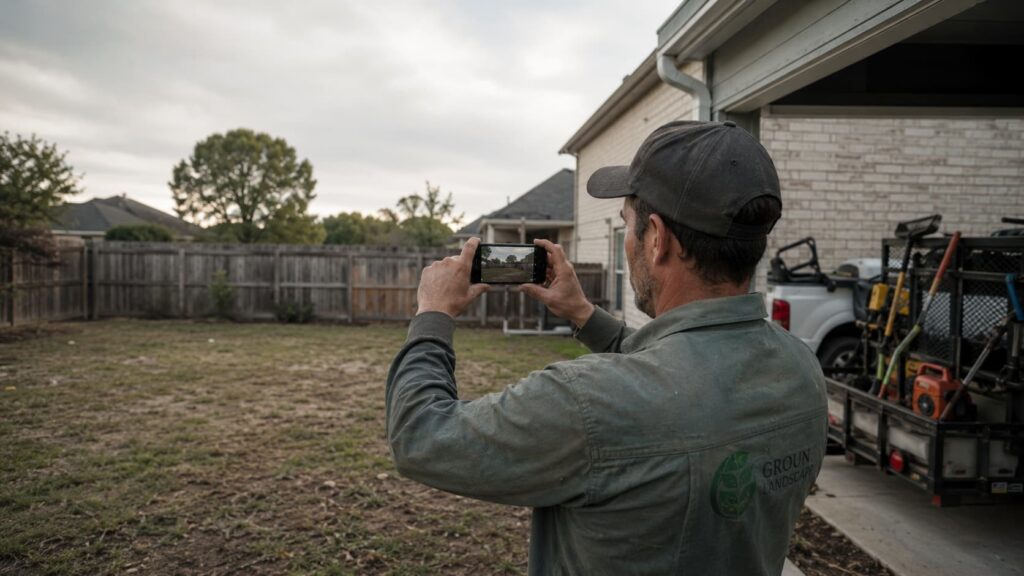
The photo that decides whether you have an ad in six weeks is the one you take before anyone unloads a tool.
In this article
- The short answer
- Facebook is not a search engine, and that changes everything
- Step 1: Which landscaping service to advertise on Facebook
- Step 2: Build the offer, not the ad
- Step 3: Target like an operator, not like a marketer
- Step 4: Your job site is the creative
- Step 5: Lead forms or your website? Pick on purpose
- Step 6: What Facebook ads cost a landscaping business
- Step 7: Speed to lead decides whether any of this pays
- Step 8: Measure your Facebook ads by cost per booked job
- The Facebook ad calendar for a landscaping season
- Why most landscaping Facebook ads fail
- Where Facebook fits next to search, the map, and your website
- Where to go from here
- Frequently asked questions
The short answer
Facebook advertising works for a landscaping business when you advertise one visual, higher-ticket service to a tight radius of local homeowners, with a concrete offer, before-and-after photos from your own jobs, and a response measured in minutes. It fails when you advertise everything to everyone and wait.
Every word in that paragraph is a condition, not a tip. Drop the tight radius and you pay to reach people forty minutes past where your trucks go. Drop the offer and you get the three “how much?” comments and no phone number. Drop the response speed and someone else gets the job you already paid for.
The table below is the whole article compressed. Most operators are in the middle column, and none of the moves in the right column cost more money. They cost a decision.
| Decision | What most operators do | What works |
|---|---|---|
| The service you advertise | The whole catalog in one ad | One visual service with margin in it |
| Targeting | 25 miles around the office, everybody | The ZIP codes on your route, homeowners |
| Creative | A stock photo, or the logo | Before and after from your own jobs |
| The offer | “Contact us for a free estimate” | One offer with a date on it |
| Where the click goes | The homepage | A lead form or that service’s page |
| The metric you watch | Cost per lead | Cost per booked job |
None of this promises a result. It describes the conditions under which the channel has a chance.
Facebook is not a search engine, and that changes everything
When a homeowner types “landscapers near me” into Google, he has already decided he needs a landscaper. He is choosing which one. That is demand capture, and everything about how search works follows from it: he came looking, so the job of the ad is to be there and be credible.
Nobody on Facebook is looking for you. You are interrupting someone who opened the app to look at photos of his sister’s kids. That is demand creation, which is a different job with different economics.
Four consequences fall out of that one difference, and each of them is a section further down this page.
- The image has to build the want. On search you answer a question with text. On Facebook you create a desire with a picture, or nothing happens.
- The lead is colder, so speed matters more, not less. He was not shopping thirty seconds ago. His interest has a shelf life measured in minutes.
- Urgent and low-ticket services do worse. Visual, high-ticket services do better. Nobody scrolling their feed decides to buy a mow. Plenty of them have been staring at the same ugly backyard for two years.
- The lead costs differently and closes differently. Pricing a Facebook lead against a search lead as if they were the same unit is a reading error, and it is the one that makes operators quit the channel early.
What a homeowner is actually doing when your ad shows up
Picture the person you are paying to reach. It is Sunday afternoon. He is on the couch with his phone, and he has no active need for a landscaper. What he has is a backyard that has bothered him for two years and that he has never put a price or a date on.
Your ad is not going to talk him into buying today. That is not what it does. What it does is show him a finished result on a house that looks like his, in a neighborhood he recognizes, and make the next step small enough that he takes it before the moment passes.
Which is why what comes back to you is a person who is interested, not a person who is buying. Those are different things and they need different handling. If you treat that name like a Google lead, if you wait for him to call you, if you send an estimate three days later, you will lose him and conclude the channel is full of tire-kickers.
He is not a tire-kicker. He is early. Your job is to get in front of him while the want is still warm, which is the whole argument of Step 7.
When Facebook beats search, and when it doesn’t
Facebook wins when the work is visual and the ticket is big enough to carry an acquisition cost: patios, retaining walls, full design-build, a yard renovation someone has been putting off. It wins when you have a seasonal offer with a real date that pushes a postponed decision over the line. It wins in the off-season, when you are filling next season’s calendar and nobody else is bidding for attention. And it wins on your own people, which almost nobody does: past customers, and the estimates you sent that never closed.
Search and the map win somewhere else, and they win decisively. They win on urgency, when an irrigation line is spraying across the driveway and he needs someone today. They win on commodity work bought on proximity and price, like a mow or a one-time cleanup. And they win at the end of the decision, when he is comparing three companies and wants to see reviews before he calls. That is what Google Ads and Local Services Ads are built for, and it is not what a feed ad does.
So the honest framing is not either-or. Most operators who make both work did not choose between the two channels. They chose the order: first the channel where people are already looking for you, then the channel that creates the demand. Turning on demand creation before demand capture is running is the expensive way around.
Step 1: Which landscaping service to advertise on Facebook
One service per campaign. Pick it for margin and visual drama, not for volume.
This is the decision most guides skip entirely, and it settles the outcome before you write a word of copy. Advertise “landscaping” and you are advertising nothing. Advertise the patio and you have a photograph, a price range, and a homeowner who already knows he wants one.
Here is why mowing loses on Facebook. It is a commodity decision bought on proximity and price, it gets searched for rather than desired, and the ticket cannot absorb a lead that costs high double digits. Nobody sees a photo of a cut lawn and feels something.
Here is why hardscape, design-build, and full yard renovations win. The finished result is a photograph. The ticket absorbs the acquisition cost without you noticing. And the decision was already sitting there unmade, waiting for a concrete image to attach itself to.
Run the arithmetic on your own business before you take anyone’s word for it. In landscaping, a design and install job runs somewhere between $3,000 and $50,000 depending on scope. Say you pay $60 for a lead and you close one in five. That is $300 in lead cost per booked job. On a $14,000 patio, $300 is about two percent of the job, and you would not notice it on the invoice.
Now run the same numbers on a $180-a-month maintenance account. That same $300 is more than your first six weeks of revenue from that customer. The account may well be worth having. At $180 a month it is $2,160 a year and $6,480 over three, which dwarfs the $300 you paid to find it. But it does not pay for itself inside the ad campaign, and if you judge the campaign in month one, it will look like a failure that isn’t one.
That gap is the whole reason to pick the service first. Same platform, same targeting, same $60 lead. Different verdict.
Step 2: Build the offer, not the ad
Eighty percent of the result is what you promise, not how the ad looks. Operators spend a week fussing over the photo and thirty seconds on the offer, then wonder why a good photo produced comments instead of quote requests.
“Contact us for a free estimate” is not an offer. It is what every company in your market says, including the one charging half your price and the one that will not show up. It asks the homeowner to volunteer for a sales conversation with no idea what he gets.
A real offer has three parts: a what, a who it is for, and a when.
Offers that book landscaping jobs
A 3D design or render of the yard, at no cost, with the measure visit. High perceived value, low real cost to you, and it filters hard. A homeowner who won’t give you an hour to measure was never going to sign a $20,000 install.
Season capacity with a real date on it. “We’re booking patio installs through October. Four slots left.” That is scarcity a homeowner believes, because it is true and he knows your trucks are finite. Never invent the number. If you say four slots and take fourteen, you have taught your whole market that your word is decoration.
A spring cleanup package with a published starting price. This one is a door, not a destination. The cleanup is how you get on the property, and the maintenance conversation happens with your crew standing in the yard.
An early-booking discount in the off-season. You fill January and February selling April, when nobody else is spending, attention is cheap, and the homeowner is already thinking about the yard because he can see it out the window doing nothing.
The neighbor offer. “We’re working on Ridgeview this month.” It is the most local thing you can say, it explains why he is seeing you, and it makes your presence a fact instead of a pitch.
One warning that matters more than the rest. If you publish a starting price, it has to be real and it has to be one you can honor. A hook price you walk back at the estimate does not just lose that job. It burns the street, and in a business where the next customer is usually a neighbor of the last one, that is expensive in a way the ad account will never show you.
Offers that fill your phone with tire-kickers
- Big percentage discounts with no floor. “50% off!” attracts people shopping for a number, not for a company.
- Giveaways and free-service contests. They fill your list with people who want free, which is a different market from people who want to hire.
- “Free estimate” with nothing else attached. Everyone offers it, so it distinguishes you from nobody.
- Any offer with no date. Without a deadline there is no reason to act today, and a homeowner who does not act today does not act.
- Anything that leads with price in a service where you do not compete on price, which is most of what you sell.
The rule underneath all five: an offer a cheap customer cannot resist is an offer a good customer ignores.
Step 3: Target like an operator, not like a marketer
Facebook’s targeting looks infinite, which is exactly why almost everyone uses it badly. The two default mistakes are picking everyone within 25 miles of the office pin, and ticking an interest box like “gardening,” which tells you a person likes plants and nothing about whether he can write a check for a retaining wall.
You already know the right criterion, because you use it every week when you decide which jobs to bid. Where do the trucks already go, and which houses actually close.
Radius, ZIP codes, and the route you already drive
Write down the ZIP codes and neighborhoods where you already have finished jobs and photos. Run there first, before any generic radius.
Three things follow from that, and they stack. Drive time does not eat the margin, because the work sits where you already are. The photos in the ad are of houses the person scrolling recognizes, which is the strongest relevance signal you have and it costs nothing. And your proof is local, so when he asks his neighbor about you, there is a neighbor to ask.
The 25-mile circle around your office is the single most reliable way to burn budget in this channel. It includes areas you do not really service, neighborhoods that never close, apartment blocks full of renters, and a lot of people who will click your ad and waste your money politely.
Exclude, do not just include. Most operators build the include list and stop there. If there are three towns in your radius where you have never closed a job and never want to drive, cut them out of the ad set explicitly. Every dollar those impressions cost is a dollar that was not spent in the neighborhood where you have four jobs and a portfolio.
Homeowners vs renters, and why the interest checkboxes lie
This section is deliberately light on specific checkbox names, and here is why. Meta has been discontinuing detailed targeting options that used to be available in Ads Manager and restricting the exclusions advertisers can add (Meta Business Help Center). Any article naming a specific interest category is one product update away from being wrong. Check the current options in Meta’s own documentation the day you build the campaign.
Two more things make interest targeting weaker than it looks. Meta’s Advantage+ detailed targeting can deliver beyond the audience your selections define (Meta Business Help Center), so the box you ticked is a suggestion more than a fence. And property-related targeting sits close to Meta’s restricted special ad categories for housing, where the available options are limited by policy (Meta Business Help Center).
What survives every one of those changes is not clever. It is three things. Tight geography: the four or five ZIP codes where your trucks already go and where the houses look like the ones that closed. Your own data, uploaded as a custom audience. And letting the system optimize toward the conversion event, meaning the action you told Meta to count as a result, instead of pre-filtering the audience by interest yourself.
There is also a mechanical cost to over-segmenting that operators rarely connect. A smaller audience produces fewer weekly events, fewer events keep the campaign learning longer, and a campaign stuck learning delivers at a higher and more erratic cost. You can slice the audience so finely that you make your own leads more expensive. Step 6 shows the numbers on that.
The two audiences worth more than any cold targeting
Two audiences beat any cold targeting you will ever build, and most landscaping operators use neither.
Audience one: retargeting. People who visited your site, watched half of one of your videos, or opened a lead form and did not finish it. That last group is the sharpest. He typed his name, thought about it, and stopped. He is one reminder away, and he is the cheapest name on your list. Run your own numbers against the $58.56 you are paying for a cold lead: whatever a reminder to somebody who already opened your form costs, the gap between the two is the argument. If you have not measured it, that is the first thing to measure, because it decides where the next thousand dollars goes.
Audience two: your own list. Past customers, and above all the estimates you sent in the last 24 months that never closed. Upload them as a custom audience, then build a lookalike from the customers with the highest ticket, not from all of them. A lookalike built on everyone teaches the system to find you more of your cheapest work.
Why these beat cold targeting is not complicated. One group already knows who you are. The other group resembles people who have already paid you. Everything else is a guess with a budget attached.
Two practical notes. Retargeting needs the pixel installed on your site, which is a fifteen-minute job you either did two years ago or never did. And uploading a customer list means you need the right to use those contacts for advertising, so check what you told people when you collected them. Getting that list out of your records or your field software is between you and your software; that is not something we sell or set up, and anyone telling you it comes free with a marketing package is selling you something else.
Most operators reading this have three hundred unclosed estimates sitting in a drawer or a folder they have not opened since the job was quoted. That is the cheapest audience you will ever own, and it is currently worth nothing.
Step 4: Your job site is the creative
The landscaper’s unfair advantage on this platform is that the product is a photograph. You take an ugly space and make it dramatic, and the homeowner scrolling can project the result onto his own yard in about a second. Almost nothing else advertised in a feed works that way.
Almost nobody uses it. The average landscaping ad in a feed is a logo on a green background, a stock photo of a lawn that is not in this country, or a carousel of images from a stock library that the person scrolling has already seen under a different company’s name.
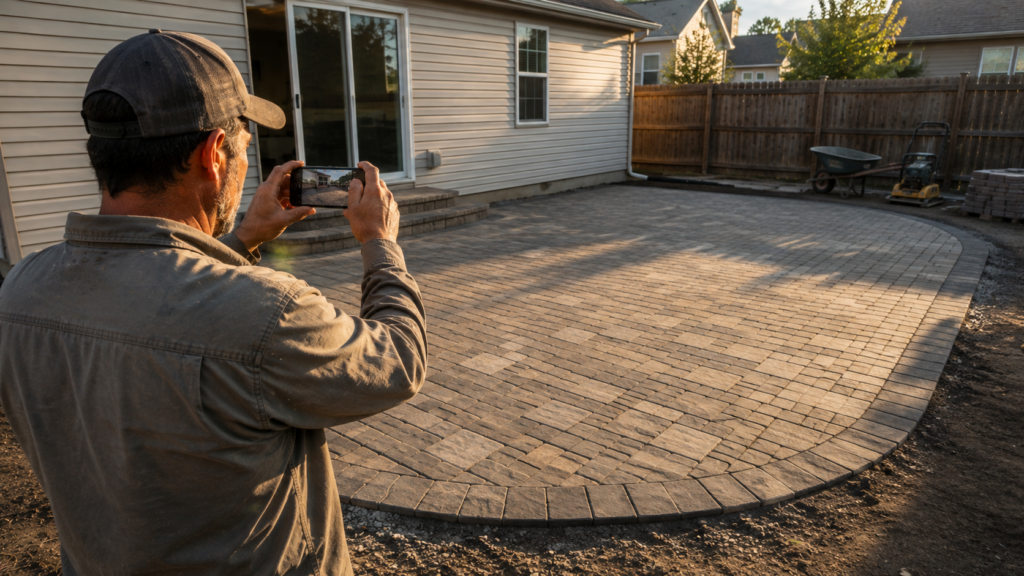
The after photo only works if someone remembered to take the before. Same spot, same time of day.
What to shoot on every job so you never run out of ads
Make this the crew’s job, not yours, and make it a rule rather than a suggestion:
- The before, shot before the first tool comes off the trailer. No exceptions, on every job, even the ones that look boring. That photo has a job nobody assigns it: six weeks from now it is the left half of an ad you are paying to run, and the crew that skipped it has a finished patio and nothing to advertise. There is no version of this where you go back for it.
- The after, from the same position, at a similar hour. Same angle and similar light is what makes the pair land. Different angle and different light and it reads as two unrelated photos.
- A vertical video of 15 to 25 seconds walking the finished job. Phone held upright, one continuous take, no narration required.
- A short clip of the crew working. Real people doing real work is proof you exist, and it is the thing a homeowner is quietly worried about when he hires a stranger.
- A video testimonial from the customer when the job went well and he is standing right there feeling good about it. Ask on the last day, never a week later.
On format, pick by what the job needs. A carousel suits work that happens in stages a homeowner can see: excavation, base, pavers, the finished patio. Video suits the jobs where the whole yard changed and one frame cannot hold it. A single image suits a direct seasonal offer, where the picture only has to do one thing. Test which one your market responds to rather than trusting anybody’s blanket claim, including ours.
And ask the customer for permission to use his property in advertising, in writing if you can, on the day you finish. Most people say yes happily. The one who says no would have said no louder after seeing his house in an ad.
The ad copy structure that gets a homeowner to stop scrolling
Four lines. In this order.
- The place. The neighborhood or the town, first. Local relevance is what stops the scroll, and it is the one thing a national competitor cannot copy.
- The transformation, in one concrete sentence. What it was, what it is now. No adjectives borrowed from a brochure.
- The proof. Years operating, number of jobs in that area, or one line from a real review.
- The offer and one next step. One. Not a phone number and a form and a message button.
Written out for a patio, it reads like this:
Ridgeview Estates: we replaced a cracked concrete slab with a 480 square foot paver patio in four days.
Twelve years working this side of town, 40+ patios in Williamson County.
Booking installs through October, four slots left. Tap below for a free 3D design with your measure visit.
Here is the version almost everyone writes instead:
Looking to transform your outdoor space? Our expert team provides quality landscaping services with attention to detail and customer satisfaction guaranteed! Contact us today for a free quote!!
The first one is about a specific street and a specific job. The second could belong to any company in any city, and the person scrolling has seen it four hundred times.
Two form rules. The first 125 characters carry the weight, because the rest collapses behind “See more” and most people never open it. And put a price in only if it is real.
Step 5: Lead forms or your website? Pick on purpose
A native lead form removes almost all the friction. He taps, Facebook fills in his name and number, done. You get more volume at a lower cost per lead, and you get a contact who is colder and less committed than one who typed a URL. You compensate for that with qualifying questions inside the form (which service, which town, rough budget range, when he wants it done) and with a response that happens in minutes.
Your own site does the opposite. Fewer leads, better ones. He clicked through, read a page, looked at your work, and then chose to give you his number, which is a much stronger signal. And the part that matters over a longer horizon: that traffic builds your pixel, your remarketing pools, and a page that also earns search traffic long after the ad budget stops.
Operationally, the split is usually clean. Use the lead form for high-volume seasonal offers where the job is a cleanup or a package and the goal is to fill a schedule fast. Send traffic to a service page that shows the portfolio and takes the number for hardscape and design-build, where the ticket is high and the homeowner wants to see the work before he hands over his phone.
Whichever you pick, three things are not optional. The phone number has to be tappable. The form has to be short enough to finish standing in a yard. And the page has to load fast on a phone on cellular data, because that is where every single one of these people is.
Step 6: What Facebook ads cost a landscaping business
The real question behind this keyword is not how to do it. It is how much you have to risk before you know whether it works, and nobody publishing on this topic will answer it.
So here is the answer, with the sources attached and with what the sources cannot tell you stated plainly.
What a landscaping lead costs on Facebook
The one landscaping-specific social advertising benchmark we could verify puts the average cost per lead at $58.56, with a click-through rate of 1.79%, a cost per click of $1.13, and a median monthly social spend of $750 (LocaliQ home services benchmarks). Read the vintage before you build a plan on it: that data was collected between May 2020 and June 2021 across 4,595 North American home services accounts, and the figures are medians rather than means. Treat it as a market reference point, not as your number.
Now the comparison everybody wants, and the qualification almost nobody attaches to it. The most recent landscaping search advertising benchmark from the same publisher puts cost per lead at $117.92, across a sample of 3,211 accounts, with a cost per click of $8.76 and a conversion rate of 6.42% (LocaliQ 2025 search benchmarks).
Set those two numbers next to each other and it looks like Facebook wins by half. Do not do that. They come from two different datasets collected years apart, one social and one search, and only the search figure is current. Anyone telling you social runs thirty or fifty percent under search for landscaping is comparing numbers that were never measured together. The honest position is that no published data can tell you which channel is cheaper in your market.
Which is the whole reason the price of the lead is the wrong thing to be arguing about.
There is a third price you already know, and it is the one you should be measuring both of these against. A shared lead from an aggregator gets sold to you and to four other crews, you pay it whether you close the job or lose it, and it goes up every year. That is not a lead source, it is a lead rental. The point of running this math on Facebook is not to find a cheaper lead than search. It is to find out which of these three you would still be paying for if you stopped tomorrow, and which one leaves you something.
Three things move your number more than anything else: which service you advertise, how tight the targeting is, and the creative format. That is the entire reason Steps 1, 3 and 4 come before this one.
Then do the calculation the benchmark cannot do for you, which is the one that actually decides anything.
Cost per lead divided by close rate equals cost per booked job. At $58.56 and a 20% close rate on a cold social lead, that is roughly $293 to book a job. Put that against the job.
| What you are advertising | Cost per lead | Close rate (assumed) | Cost per booked job | Typical job value | What acquisition costs you |
|---|---|---|---|---|---|
| A patio or design-build install | $58.56 | 20% | ~$293 | $14,000 | about 2% of the job |
| A full yard renovation | $58.56 | 20% | ~$293 | $6,000 | about 5% of the job |
| A monthly maintenance account | $58.56 | 20% | ~$293 | $180 per month | more than the first six weeks |
The cost per lead is the sourced benchmark above. The 20% close rate is an assumption used to show the shape of the math, not a figure anyone published. Replace it with your own the moment you have enough leads to count.
The same $293 is a rounding error on one job and a hole in the other. This is what Step 1 was about.
The learning phase, and why 30 days is the minimum test
Before Meta’s system delivers your ads at a stable cost, it needs enough data to figure out who responds. Meta calls that the learning phase, and while an ad set is in it, cost per result is less stable (Meta Business Help Center).
The threshold is public and it is specific. An ad set becomes “learning limited” when it is unlikely to receive around 50 optimization events in the week following your last significant edit (Meta Business Help Center). Meta lists the causes itself: audience too small, budget too low, bid or cost control too low, high auction overlap, an optimization event that happens too rarely, or too many ads running at once.
Now put that next to the benchmark and you get the real answer to “how much should I spend.”
At $58.56 a lead, fifty leads a week is roughly $2,900 a week. That is around $12,700 a month, and there is no version of this article where I tell you a local landscaping crew should spend that to test a channel. Meanwhile the same dataset’s median monthly social spend for landscaping is $750, which at that cost per lead buys about thirteen leads a month. Call it three a week, against a threshold of fifty.
That gap is the mechanical reason so many landscapers conclude Facebook does not work. They are not wrong about what they saw. They ran a campaign that never left learning, watched an erratic cost per lead, and switched it off at day nine.
So the honest guidance is not a budget number somebody invented. It is this:
- Fund it to produce a countable number of leads every single week, not a trickle. If your budget cannot produce enough leads in a month to calculate a close rate, you have bought noise.
- Use Meta’s own listed remedies when an ad set goes learning limited: raise the budget, raise the cost control, or choose an optimization event that happens more often (Meta Business Help Center).
- Stop over-segmenting. A smaller audience is fewer events, and fewer events is a longer stay in learning at a higher cost.
- Scale in weekly increments, not doubles. A significant edit restarts the learning, so aggressive changes reset the clock you are paying for.
- Do not judge the campaign before 30 days, and do not judge it before you have enough booked jobs to compute a close rate. Those are two separate conditions and you need both.
These are market reference points and platform mechanics, not a forecast of what your account will do.
Step 7: Speed to lead decides whether any of this pays
The Facebook lead arrives colder than a search lead and with more competition for his attention, because two seconds after he taps submit he is scrolling again. Response time is measured in minutes here, not hours, and a phone call beats an email every time.
This is not a new observation, and the research is older than most of the platforms it applies to. Harvard Business Review’s audit of how companies handle inbound online leads found most of them responding far more slowly than the window in which the lead is still live (HBR, 2011). That was fifteen years ago and the gap has not closed, which is precisely why it is still an advantage available to you.
The system is four pieces and you can have it running today:
- A notification to the phone of whoever actually answers, which on most crews is you, in the truck, between two jobs. Not an inbox somebody opens after dinner.
- A 30-second opening script for the first call: who you are, which ad he tapped, one qualifying question, and a time you can be at the property. The qualifying question is the service and the street, because those two answers tell you whether it is on your route and whether it is the job you advertised.
- A text as backup within two minutes if he does not pick up. A lot of people will not answer an unknown number and will read a text standing in the yard they want fixed.
- Three attempts across the first 48 hours before you write it off, spread across different times of day. If your crew starts at 6:30, one of those attempts belongs to the drive out.
To be clear about what this is and is not: this is a discipline problem, not a software purchase. We do not sell or configure CRMs, field software, or follow-up automation, and this article is not a soft pitch for one. If Jobber or Aspire or a whiteboard by the phone gets you calling back in five minutes, use whichever one you will actually use.
Step 8: Measure your Facebook ads by cost per booked job
Cost per lead is the metric that makes an expensive channel look cheap. It counts what you paid to make a phone ring and stops there, which is exactly the point at which the interesting part starts.
Fill in this table once a month, by channel. It takes about fifteen minutes and it will change what you spend money on.
| Channel | Quote requests | Spend | Cost per lead | Jobs booked | Close rate | Average job | Cost per booked job |
|---|---|---|---|---|---|---|---|
| Facebook, patio campaign | 14 | $820 | $59 | 3 | 21% | $11,400 | $273 |
| Google Ads, “paver patio” | 9 | $1,060 | $118 | 4 | 44% | $12,900 | $265 |
| Google Business Profile | 11 | $0 | $0 | 5 | 45% | $9,800 | $0 |
Those rows are illustrative, filled with plausible numbers so you can see the shape. Yours will look different. But notice what the shape does: the channel with the lowest cost per lead in that table is not the channel with the lowest cost per booked job, and if you had been optimizing on cost per lead you would have moved budget in exactly the wrong direction.
That is the Facebook versus search comparison in one row. A social lead and a search lead are not the same unit, so comparing their prices tells you nothing. Compare what it costs to put a job on the schedule.
Two vocabulary notes, because they are not cosmetic. Count quote requests and booked jobs, not “conversions,” because a conversion is a category that hides whether anyone actually asked you for a price. And put a required “how did you hear about us?” field on every intake, by phone and by form. Ads Manager attribution and what the customer says on the phone will not agree, and when they disagree the customer is the one holding the checkbook.
The Facebook ad calendar for a landscaping season
This calendar runs on your season, not on the month. Snow belt operators will hit these beats eight to ten weeks later than Sun Belt operators, and a crew in Phoenix runs a different summer than a crew outside Minneapolis. Set the trigger by when your local season wakes up, then count backwards.
| Season | What to advertise | The offer | What to expect |
|---|---|---|---|
| Late winter, pre-season | Spring cleanup, early booking | Early-booking discount, real dates | Cheapest attention of the year, fewest competitors bidding |
| Spring | Cleanup, maintenance starts | Package with a published starting price | Peak demand and peak cost, competition is all in |
| Summer | Hardscape, design-build, renovations | 3D design with the measure visit | Higher lead cost, ticket carries it easily |
| Fall | Cleanups, plantings, fall installs | “Ready in spring” installation offer | Underused window, low competition |
| Off-season | Retargeting your own list, next-year contracts | Contract for next season, locked pricing | Low budget, kept live to preserve account history |
The move that decides the year is the first row. Start three to four weeks before your season wakes up, not when it does. The operator who waits until the yards green up is showing his ad to a homeowner who hired somebody two weeks earlier, and paying peak prices to do it.
The move almost nobody makes is the fall install. Selling an autumn installation on the argument that the yard is finished and settled before spring is a real reason to buy now instead of in April, and you are making that argument in a month when your competitors have stopped advertising.
And keep something running in the off-season, even at a small daily budget. Retargeting your own list costs very little, it keeps the account’s history alive instead of starting from zero every February, and it is the only time of year you have the attention of a homeowner who is looking at a dead yard with nothing else to think about.
Why most landscaping Facebook ads fail
Eight failures, and the correction for each one. You can execute every correction today.
- Boosting a post instead of running a campaign. Boosting optimizes for likes and comments. Build the campaign in Ads Manager with a lead objective instead.
- Every service in one ad. Split it. One campaign per service, and start with the one with the best margin.
- Switching it off at day seven. You killed it during learning. Commit to 30 days before you form an opinion.
- A budget too small to ever leave the learning phase. Fund fewer campaigns properly rather than four campaigns badly.
- A generic radius around the office pin. Replace it with your actual ZIP codes, and exclude the towns you do not serve.
- Stock photos and logo graphics. Use last week’s job. You already own better creative than anything you can buy.
- Leads waiting three days for a call. Route the notification to the phone of whoever answers, and call inside five minutes.
- Judging the channel on cost per lead. Track close rate and job value, then judge it on cost per booked job.
Where Facebook fits next to search, the map, and your website
Three channels, three different jobs. Search and the map capture the homeowner who has already decided he needs someone, which is why the intent is higher and the leads close faster. Facebook creates demand among the homeowners who have not decided yet, which is why it can reach people search never will. And your website and your Google Business Profile are the asset that is still there when the ad budget stops, which neither of the paid channels can claim.
The sequencing error is the expensive one, and it is common. Paying to create demand while your Google Business Profile is half filled out and you do not rank in the map pack for your own service in your own city is pushing people toward an empty house. That homeowner who liked your patio photo is going to search your company name before he calls you. What he finds in the next fifteen seconds decides whether the call happens, and you have already paid for him either way.
This is the page your Facebook lead visits before he calls you. Everything on it is a place you either exist or you don’t.
None of that is an argument against running Facebook. It is an argument about order. Get found by the people already looking for you, make sure the profile and the pages they land on are worth the click, and then spend money creating demand on top of a foundation that converts it. That first part, the search channel, the map, and the site underneath both, is the work our team does for green industry operators. Facebook is not something we run, and this article is not a pitch for it.
Where to go from here
Facebook pays for a landscaping business when you advertise the right service with a real offer to a tight radius, and the number that decides whether to keep going is cost per booked job, not cost per lead.
You are about to pay to put your work in front of people who have never heard of you. The fifteen seconds after that, when he types your company name into Google, is the part you have not bought and cannot control. If you want to know what he finds there before you spend the money, that is what the audit is for. Free. No call. Written, in about two business days. Yours to keep, even if we never speak again.
Frequently asked questions
They work when the setup matches the platform. Facebook reaches homeowners who are not searching yet, so it performs best for visual, higher-ticket work like patios, walls and full yard installs, advertised to a tight local radius with real before-and-after photos and a concrete seasonal offer.
The one landscaping-specific social benchmark we could source puts cost per lead at $58.56, though that data was collected in 2020 and 2021. Treat it as directional, not current. Your number moves with the service you advertise, how tight the targeting is, and the creative format.
Enough to produce a countable number of leads every week. Meta calls an ad set learning limited below roughly 50 optimization events a week, and most local budgets never approach that. Fund it so you can calculate a close rate within 30 days, then scale in weekly increments.
Neither is better, and cost per lead will not settle it. Search and Local Services Ads reach homeowners already looking, so intent is higher and jobs close faster. Facebook reaches the ones still putting the project off. Most operators run search first, then add Facebook for high-ticket work.
Before-and-after creative from your own jobs, in a local neighborhood the viewer recognizes. Carousels suit showing a project step by step, short vertical video suits the full transformation, and a single image suits a direct seasonal offer. Stock photos and logo graphics are what people scroll past.
Lead with geography, not interests. Target the ZIP codes and neighborhoods you already drive, exclude the ones you do not serve, and layer on your own customer list and a lookalike built from your highest-ticket clients. Detailed interest categories change often and rarely predict who can hire you.
Use Ads Manager. Boosting optimizes for engagement, meaning likes and comments, while Ads Manager lets you optimize for leads, control geography, exclude areas, run retargeting and measure cost per lead. Boosted posts are the most common reason a landscaper pays for attention and books nothing.