
Two crews work the same town. Both do good work. One has 14 reviews and the newest is from two years ago. The other has 61, and the newest went up last week. The second crew charges more and closes faster, and neither of those is an accident.
Reputation management is not managing your image. It is keeping a flow of recent reviews coming in, because Google and the language models read them with a date attached, and so does the homeowner deciding which of you to call. Here is the ask system that produces that flow, the replies, the three numbers that say if it is working, and what it costs.
- What landscaping reputation management actually is
- Why reviews decide who gets the call
- Your review count is the wrong metric. Velocity is the right one.
- The ask: a review system your crew can run from the truck
- Responding to reviews: the 80% rule
- Where your reviews need to live besides Google
- Putting reviews on your website so they earn traffic
- What landscaping reputation management costs
- How to measure it in booked jobs, not stars
- The 30-day reset for a crew stuck at eleven reviews
- Get your reviews and map pack audited, free
- Landscaping reputation management FAQs
What landscaping reputation management actually is
Landscaping reputation management is the ongoing work of generating, monitoring and responding to reviews on your Google Business Profile and the other places people check before they call. Done right it keeps the profile eligible for the map pack and credible to the homeowner about to request a quote.
That is three separate jobs, and most providers sell them as one word. Review generation is asking. Review monitoring is finding out when something posts. Review response is answering what posted.
They are not equal. For a landscaping company, generation is nearly all of the value, response is most of what is left, and monitoring is a notification you could set up yourself in ten minutes.
Which leaves reputation repair, the part sold hardest on this topic, as the smallest piece of the three and the one that moves the least money. Repair assumes you have a reputation problem. Almost no landscaper does. What you have is eleven reviews and nobody asking for the twelfth.
Why reviews decide who gets the call
A maintenance contract gets lost over one star. A high-ticket install gets lost over a review nobody bothered to answer.
That is the whole argument, and the numbers behind it are not small. One of the jobs a landscaping client of ours closed off organic search was an $18,600 retaining wall (BASEO client data). The homeowner who signed it read the profile first. Everybody does.
The star rating is a filter, not a score
97% of consumers read reviews for local businesses, and 41% say they always read them when browsing (BrightLocal Local Consumer Review Survey 2026). But the number that decides your week is this one: 68% will only use a business with four or more stars, and 31% will only use one with 4.5 or better.
Read that as a filter, not a scoreboard. Reviews do not earn you points that accumulate into preference. They qualify you or they remove you, before you are ever a candidate. At 3.9 stars, two thirds of the market never puts you on the list, and the quality of the work never enters the conversation.
Now run the arithmetic, because this is where the fragility shows up. Say you sit at 4.6 stars across 12 reviews. Two unhappy customers leave one star each and you land at 4.1.
You are out of the 4.5 filter entirely and close to the edge of the 4.0 one. The same two reviews, against 60, take you from 4.6 to 4.5.
| Reviews before | Rating before | After two 1-star reviews | Move |
|---|---|---|---|
| 12 | 4.6 | 4.1 | −0.5 |
| 25 | 4.6 | 4.3 | −0.3 |
| 40 | 4.6 | 4.4 | −0.2 |
| 60 | 4.6 | 4.5 | −0.1 |
| 100 | 4.6 | 4.5 | −0.1 |
What two one-star reviews do to a 4.6 rating, by how many reviews you had before they landed.
Put a dollar on that filter. Say twenty of your quote requests a month start with somebody searching locally. At 4.6 stars every one of them can see you. At 4.1 you are under the line 68% of consumers told BrightLocal they hold, so about six of those twenty still have you on the list and fourteen never did. You do not need to know your close rate to feel the size of that, because the jobs on the other side of it are not small: one of them, for a landscaping crew working off organic pages, was an $18,600 retaining wall (BASEO client data). Two one-star reviews against a thin profile is not a rating problem. It is the difference between sitting in that homeowner’s consideration set and not existing in it.
So the defense against a bad review is the volume you built before it arrived. Not the cleverness of the reply. You cannot write your way out of a thin profile, and the crew with 60 reviews is not braver than you, just harder to knock down.
Reviews are a local ranking signal, not just social proof
Google says this itself, which matters, because most of what gets written about reviews and rankings is an SEO blog quoting another SEO blog. Google’s own local ranking documentation names three factors: relevance, distance, and prominence. Reviews sit under prominence, and the page states it plainly: “More reviews and positive ratings can help your business’s local ranking” (Google).
The honest ceiling: reviews will not put you in a neighboring town’s map, because distance is its own factor and no amount of five stars moves your truck closer to a house. What they decide is the comparison between two profiles already close enough and already in the right category. That is the fight for third place, and it settles on volume and freshness.
Which is why the reviews and the profile are one job and not two. Reviews are an input to prominence, and prominence only gets counted for a listing Google can already read: the right primary category, a real service list, the towns you actually drive to. A crew asking hard for reviews on top of a profile that still says “Lawn care service” when it sells retaining walls is feeding a signal into a listing that was never in the running. That order is why BASEO rebuilds the profile and starts the review work in the same month. The rest of what moves the map is in the map pack playbook.
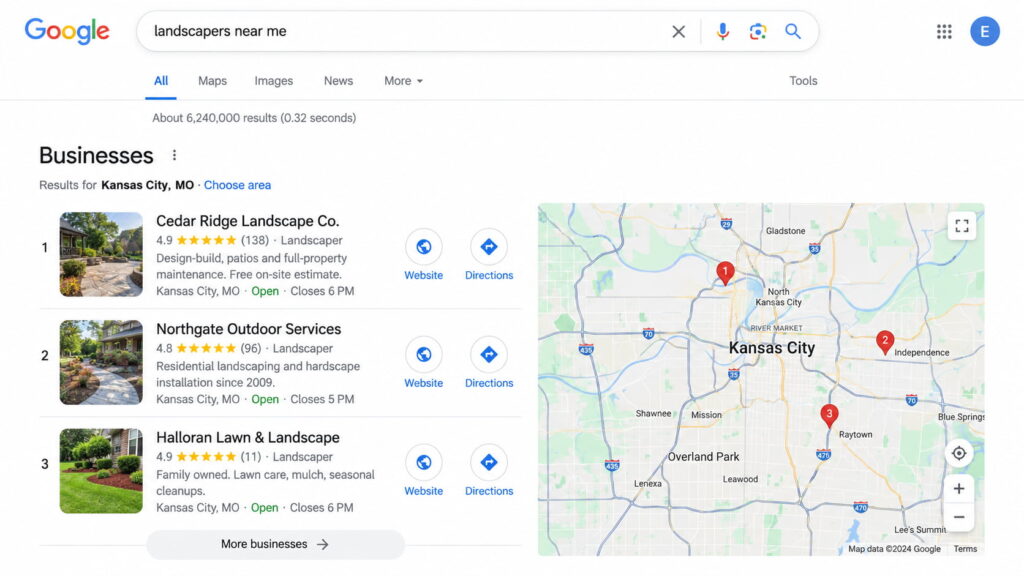
Same rating, a fraction of the reviews. The third crew is not worse. It is thinner.
Reviews now feed the AI answers too
45% of consumers now use ChatGPT and generative AI tools to find local businesses, which makes AI the third most popular source of business recommendations, behind Google and Facebook (BrightLocal, 2026). Nobody selling reputation management to landscapers is mentioning this yet, and the mechanism is worth understanding before anybody sells you a product for it.
When a model builds an answer to “best landscapers in Naperville,” it is working over public text: profiles, directories, and the body of the reviews themselves. No ranking algorithm to game, no dial to turn. Your reviews are not evidence about you. They are the source text.
Which is why the words matter more than the stars. A rating is a number a model can weigh. A review body is text a model can quote. When your customer writes that the wall has held through two springs, that clause can end up inside an answer somebody reads instead of a page of search results, with your name on it. Five stars and no sentence gives the model nothing to carry. That is why the script further down asks the customer to mention the work and the town: you are not collecting ratings, you are writing the paragraph somebody else’s assistant reads out loud.
It is the same reason the reviews work and the AI work are one project: the signals an assistant leans on are the ones that drive the map, so BASEO tracks who gets named in each market next to the map positions. Nobody controls whether an assistant names you. What you control is whether there is anything to name you from, and almost no green industry operator is building that yet. What generative search changed has the rest of the shift with the dates attached.
Your review count is the wrong metric. Velocity is the right one.
74% of consumers seek reviews written in the last three months. 32% look for reviews written in the last two weeks.
BrightLocal Local Consumer Review Survey 2026
Your lifetime review count is a stock, and it depreciates. Sixty-one reviews with the newest dated 2023 reads worse to a homeowner than twenty with the newest from Tuesday, and he is doing that math on his phone without anyone teaching him to. He is not counting. He is checking whether you are still in business and still good.
So here is the formula, in your units. Close 20 jobs a month. Ask on every one of them.
A response rate of 20% to 30% on that ask gives you 4 to 6 new reviews a month, which is 12 to 18 sitting inside the 90-day window people are actually looking at. Those are the assumptions, not a forecast: change the job count or the ask rate and the whole thing moves.
| Jobs closed/month | Ask rate | Response rate | New reviews/month | Reviews in the 90-day window |
|---|---|---|---|---|
| 20 | 50% | 25% | 2.5 | ~8 |
| 20 | 100% | 20% | 4 | 12 |
| 20 | 100% | 25% | 5 | 15 |
| 20 | 100% | 30% | 6 | 18 |
| 35 | 100% | 25% | ~9 | ~26 |
The ask rate column is the one you control. Response rate is the customer’s decision, job count is the season’s, and the ask is yours.
The metric that comes out of this is reviews in the last 90 days, and it belongs on the same sheet as your cost per lead, not on a reputation dashboard you log into twice and forget. It is the number that tells you whether the flow is running, and it is the one every provider on this topic replaces with a lifetime total, because a lifetime total only ever goes up.
Now the part that costs snow-belt crews their spring. If you only ask during the busy season, you arrive at March with your most recent review dated October. Five months of decay lands precisely on the week the spring searches start, and the homeowner comparing you to the crew across town is reading both profiles in the same thirty seconds. Count backwards from that: a fresh 90-day window in April means asks going out in January and February, which is exactly when nobody feels like asking anybody for anything.
That is the argument for a system rather than a habit. The ask has to be attached to the job rather than to the owner’s memory, which is what BASEO builds into an account so the January asks happen in January. You can build your own version of the same thing, and the next section is how.
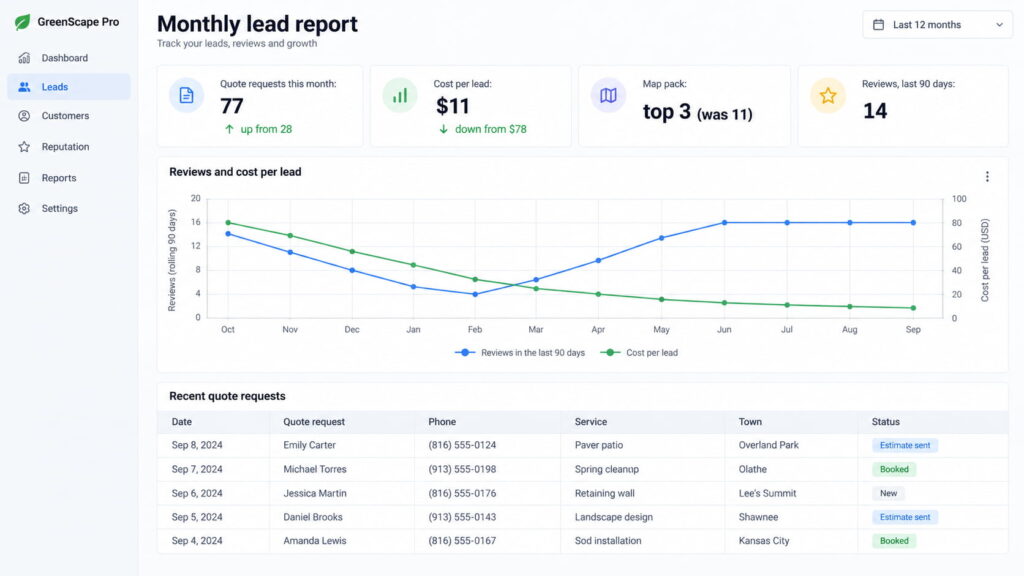
Reviews in the last 90 days, on the lead report, next to the number it affects. The winter trough is the part most crews never see.
The ask: a review system your crew can run from the truck
The bottleneck is not software. Most crews that tell me they tried reviews mean they bought a tool, watched it send some texts, and stopped looking at it.
A system is three things: who asks, when they ask, and what happens when the customer does not answer. That is it. The three sections below are those three things, in that order.
Ask on site, before the trailer is loaded
The satisfaction peak of a landscaping job is the moment the customer walks out the back door and sees the finished work. Not three days later, when what he is looking at is an invoice. It is also the same moment you ask for a referral, which is the other thing that walk-out is worth.
So the ask happens there, and the person who did the work makes it. Two sentences, said out loud, while the trailer is getting loaded:
“Hey, glad you like it. If you’ve got a minute tonight, a review on Google helps us a lot, and if you can mention the patio and the town it helps even more.”
That is the whole script. Sayable by a foreman with gloves on, eight seconds, and it prompts for the two things that make the review worth having.
Make it easy to act on: a QR code on the truck door and on the invoice, pointed at a short link that opens straight to the review form on your Google profile. Not your homepage. Not a survey.
The load-bearing part is who says it. The person who built the wall asking about the wall is a different ask than an unfamiliar office number three days later, and a better one.
Time it to the kind of work. On a recurring maintenance account, ask on the third or fourth visit, once the route is a habit and the customer has something to compare you against. Asking on the first cut is asking a stranger. On an install or a hardscape build, ask the day of handover, standing in front of the thing you built.
One rule that is not negotiable and gets explained two sections down: you ask everybody. Not the ones you think are happy. Everybody.
If you would rather not run this yourself, it is the piece BASEO takes over, because an ask tied to the finished job survives a busy July and an ask tied to the owner’s calendar does not. But the script above is the whole idea, and plenty of crews run it themselves with a printed card in each truck.
The follow-up, and the 24-hour window
One follow-up. By text. Inside 24 hours. Direct link, no template, no logo, no signature block.
Thanks again for having us out today. If you’ve got a second, here’s the link to leave a review: [short link]
Under 160 characters, which is the point. It should look like it came from a person, because it did.
What not to do: three reminders over two weeks, a designed email with your logo at the top, and any version of “please give us 5 stars.” That last one is a smaller cousin of the problem in the next section, and it is worth breaking the habit now.
Text beats email in this trade for a reason that has nothing to do with open rates. He already has your number. He texted you to say the side gate would be unlocked.
If you run field service software, hang the trigger off job completed, not invoice paid. Those look like the same event on a screen and they are days apart in real life. The invoice lands after the feeling has cooled, and it lands attached to a bill.
What gets your reviews deleted: gating, incentives, bulk buys
Google’s Maps content policy has a section called Rating Manipulation. Under it, the policy prohibits content that would “discourage or prohibit negative reviews, or selectively solicit positive reviews from customers” (Google Maps user-contributed content policy).
That sentence describes a product several companies sell. It is the “how did everything go?” survey that sends the 4s and 5s to your Google link and routes the 1s and 2s to a private feedback form instead. It is called review gating, it is marketed as a feature, and it is a policy violation with a product name and a monthly subscription.
The same section covers incentives: “Offer incentives – such as payment, discounts, free goods and/or services – in exchange for posting any review or revision or removal of a negative review.”
Read that against what actually happens in this trade. The free mow raffled among everyone who leaves a review is an incentive in exchange for posting a review. So is $25 off the next service, and so is the gift card. The policy carves out no exception for a small business being nice about it.
Third: bought reviews. Under Fake Engagement, the policy covers “Reviews or ratings that have been paid for, directly or in kind.” These come off in batches, because that is how they are found.
The consequence is unglamorous. Google removes, and does not send a notice explaining what went or why. The crew that bought forty reviews to close a gap can end up back near where it started, minus whatever legitimate ones came through the gated survey, with no way to tell which was which. The profile ends up worse than before anybody tried to fix it.
None of this is a reason to be timid about asking. It is a reason to ask everybody, plainly, with nothing attached. That is also why BASEO’s review work has no incentives, no fake reviews and no purchased links in it, and why the ask goes to every customer rather than a filtered list.
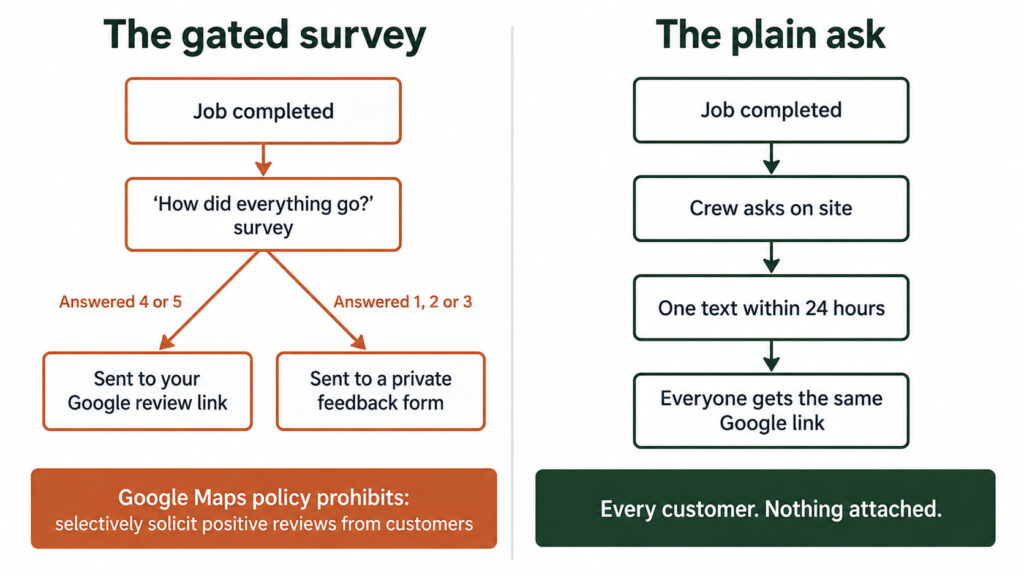
The difference is one arrow. One of these is a subscription product, and it is the one Google’s policy describes.
Responding to reviews: the 80% rule
80% of consumers say they’re likely to use a business that responds to all of its reviews. 19% expect a response the same day, and 81% expect to hear back within a week (BrightLocal, 2026).
Responding is not manners. In most of what you sell, the customer never sees you again once the crew pulls out: the wall is up, the install is done, and the next contact is a referral or nothing. Your replies are the only place that relationship stays visible, and the audience is not the person who wrote the review. It is the homeowner three towns over, comparing you against two crews whose profiles have nothing under the reviews but silence. On a maintenance account you get another swing at it every week. On a $14,800 patio you get one, and it is public.
So the standard is simple enough to hold a crew to: all of them, inside seven days, written by a person.
The five-star reply that sells the next job
The reply to a good review is free advertising space, and the person it is written for is not the customer who left it. He is done. He is not reading this. The reader is the next homeowner scrolling your profile at nine at night, three weeks out from a job he has not described to anybody yet, trying to work out whether you have built the thing he wants.
Three parts:
Name the service and the town. That is the text a searcher scans and a model reads. Add one detail from the job that proves you were the one standing there, because generic gratitude proves nothing and everybody can tell. Then mention the adjacent service in half a sentence, not as a pitch.
“Thanks, Marla. That back patio came together well once we got the base sorted out after all the rain in June. If you ever want to talk about lighting along the walkway, we do that too. Appreciate you having us out in Overland Park.”
“Appreciate it, Dan. Third season on your property now and the crew likes working out there. We’re doing more of the fall cleanups on your street this year, so we’ll be around. Thanks for sticking with us.”
Do not paste the same reply thirty times. Thirty identical replies are visible at a single glance, and what they tell the reader is that nobody is minding this. That is worse than not replying at all, because it is documented proof of a template. It also wastes the only thirty chances you get to put the words “retaining wall” and your town on that profile in your own writing.
The negative reply is written for the next reader, not the reviewer
You are not negotiating with the person who complained. That negotiation is over and you lost it. You are leaving evidence for the several hundred people who will read the exchange, most of whom already assume the complaint is about half true and are watching to see how you handle it.
Four moves:
- Acknowledge the fact, with no adjectives. “We were two hours late on the 14th” beats “we’re so sorry you feel that way,” which is a sentence that has never helped anyone.
- Supply the fact that is missing, without arguing. One sentence of context, offered rather than defended.
- Say what you did about it. Not what you will do. What you did.
- Move it off the platform. A real phone number and a real name, so the next reader sees a door rather than a standoff.
“You’re right that we were two hours behind on the 14th, and I should have called you before you had to call us. The crew got held on a drainage repair that ran long that morning. We’ve changed how we handle the schedule when a job overruns, and I’d rather finish this by phone than here. Ray, 913-555-0148.”
About sixty words, all four moves, no defensiveness, and the next reader comes away thinking the owner picks up the phone.
Then there is the review from someone who was never your customer. Report it through the profile, and reply anyway, one line, so the next reader sees a response rather than silence. Do not have six guys report it from six phones: coordinated reporting is its own problem and it speeds nothing up.
The uncomfortable part is that Google removes very few of them and takes its time. Which is the argument for volume all over again. A bad review against sixty is a bad day. Against eleven, it is a quarter.
Where your reviews need to live besides Google
Ordered by what they return for a landscaping company, not by how big the platform is. Every other list you will read is sorted the other way.
1. Google Business Profile. The one that moves the map, and it is not close. If you only ever ask for one, ask for this one.
2. Local Services Ads. Here is the point nobody makes: your reviews and your rating feed the LSA profile too, so a review program is quietly a lever on your cost per lead in the most expensive channel you run. If you are already paying for leads there, the review work is doing double duty. We put the actual numbers on what an LSA lead costs.
3. Facebook. Still ahead of AI as a source of local recommendations, and in a lot of suburban markets it is where the neighborhood conversation actually happens.
4. Angi, Yelp and Houzz. Be clear-eyed about what these are: platforms that will charge you for the lead your own review generated, then sell the same homeowner to four other crews. Worth understanding before you invest effort in feeding it, which is a different question from whether paid channels work. We laid out the difference in leads you own instead of rent.
5. Nextdoor. Worth it for residential route maintenance specifically, where the recommendation is neighbors talking about a truck they see every week.
| Platform | What it gives you | Effort |
|---|---|---|
| Google Business Profile | Map position, AI mentions, most of your calls | Where all of it goes by default |
| Local Services Ads | Feeds the LSA profile, lowers cost per lead | Free, if you are already running LSA |
| Second-biggest recommendation source, neighbors talking | Low, ask occasionally | |
| Angi / Yelp / Houzz | Leads you pay for, shared with competitors | Only where you already get work |
| Nextdoor | Route-density referrals in one neighborhood | Low, and only for maintenance |
The rule that matters more than the order: do not scatter the ask. One customer, one platform, Google by default. Splitting twenty asks across five platforms leaves you with five thin profiles nobody trusts instead of one that ranks.
Putting reviews on your website so they earn traffic
Put the real review text on the service page and on the town page, with the town name inside it. Not a rotating widget of stars. The actual sentences. That is unique local copy on a page that otherwise reads like every other landscaper’s in your county, and it was written by somebody other than you, which is the part that makes it worth indexing.
Two honest warnings, because there is a lot of bad advice on this specific point.
First, do not let anyone sell you review schema as a rich-snippet trick. Google’s documentation is direct about it: “If the entity that’s being reviewed controls the reviews about itself, their pages that use LocalBusiness or any other type of Organization structured data are ineligible for star review feature” (Google Search Central). Marking up your own reviews on your own site will not put stars next to your result. It did once. It does not now.
Second, the same policy names embedded third-party widgets specifically, and they carry a separate problem anyway: a widget that pulls its text through third-party JavaScript can leave nothing in the indexable HTML. The unique local content you thought you added is not there. Paste the text.
Then use it commercially. The three reviews sitting above your quote form get chosen by service and by town, not by star count. A glowing review about a spring cleanup does nothing on a retaining wall page, where the person reading is trying to decide whether you have built one before. There is a fuller treatment of the page-by-page decisions in what to write page by page, and of the build itself in a site built to book estimates.
What landscaping reputation management costs
Three paths, and the right one depends almost entirely on how many jobs you close.
Doing it yourself: nothing, plus about twenty minutes a week. Print the script, put the QR on the trucks, send the texts, answer reviews on Friday morning. It does not fail on knowledge. It fails in July, when the schedule is full and asking for a review is the eleventh thing on a list of ten.
Review software: one of the big three will tell you what it costs. NiceJob publishes its pricing at $75 a month for the reviews plan and $125 for the tier above it, single location (NiceJob, checked September 2026). Birdeye and Podium do not publish a price at all. Birdeye’s pricing page is a form asking how many locations you have and what your phone number is (Birdeye). Podium’s says to talk to sales (Podium). Both checked the same week.
Before you buy any of them: automating the ask does not fix the problem, because the problem was never that the text was hard to send. It was that nobody sent it. And some of these platforms ship the survey flow described three sections up, the one Google’s policy explicitly prohibits. Ask what the flow does before you sign.
An agency running it inside your local marketing. More than a subscription, and hold it to four things: an ask on every completed job, responses written by a person, monitoring you never think about, and reporting that shows reviews in the last 90 days rather than a lifetime total. Missing any of the four and it is a dashboard with an invoice attached. Five kinds of company pitch landscapers and they are not interchangeable, which is why we sort the agencies that pitch you separately.
The decision rule: under about fifteen jobs a month, do it yourself. There is not enough finished work to feed a tool. Above it, the math changes.
What BASEO charges depends on the market and it is in the free audit, not on this page. Which of the three paths your job volume actually supports is one of the things that audit answers.
How to measure it in booked jobs, not stars
Three numbers. Not a dashboard, not a score. Three.
Reviews in the last 90 days. The one from the velocity section, and the only review metric that reflects what a homeowner is actually looking at.
Ask rate. Closed jobs where somebody asked, divided by closed jobs. This is the only one of the three you fully control, and it predicts the other two. A crew at a 40% ask rate does not have a review problem, it has an asking problem, and those get fixed differently.
Calls from the Google profile, month over month. Straight off the profile’s own performance report. It is the closest thing you have to a direct line between review work and a phone ringing.
| Metric | Where it comes from | How often you look |
|---|---|---|
| Reviews in the last 90 days | Your Google profile, count them | Monthly |
| Ask rate | Your own job list: jobs asked ÷ jobs closed | Monthly |
| Calls from the profile | Google Business Profile performance report | Monthly, alongside cost per lead |
What not to measure: average rating as a monthly number. At sixty reviews it barely moves, and a metric that cannot move cannot tell you to do anything differently. Skip the “sentiment score” the dashboards sell too. It is a number calculated from other numbers with no action on the end of it.
All three roll up into the only number that competes with every other line in the budget, which is what it costs you to book one job. That is the lens BASEO reports on: one page, plain English, calls and quote requests you can dial yourself. The channel-by-channel version of that math is in cost per booked job by channel.
The 30-day reset for a crew stuck at eleven reviews
One task a week. Four weeks. Do them in order.
- Week 1: the profile and the backlog. Claim the profile if it is not claimed, fix the primary category, and fill in the service list and the service area properly. Then answer every unanswered review you have, including the ones from 2023. Deliverable: a complete profile and zero unanswered reviews.
- Week 2: the ask, in hand. A short link straight to the review form and a QR code on the truck doors and the invoice. The two-sentence script printed and handed to both foremen, said out loud once so it does not feel strange the first time. Deliverable: every crew leader can make the ask without looking anything up.
- Week 3: the back-fill. The last twenty customers from the last ninety days, by text, one at a time, in your own words. Not a blast. And not filtered for who you think will give you five stars, which is the week that takes nerve and also the week that produces the reviews. Deliverable: twenty asks sent.
- Week 4: the three numbers and a standing target. Count reviews in the last 90 days, work out your ask rate, pull calls from the profile. Set the monthly number you are going to hit and put it on the same sheet as your cost per lead. Deliverable: a number to hit every month.
What to expect from that, honestly. At twenty jobs a month with a real ask rate, going from eleven reviews into the twenties inside a month is a realistic outcome, mostly because week 3 draws on ninety days of finished work all at once instead of a single month’s. Change those assumptions and the number changes with them.
Going from eleven to a hundred in a month is not realistic, and anybody who offers it is describing something Google takes back down.
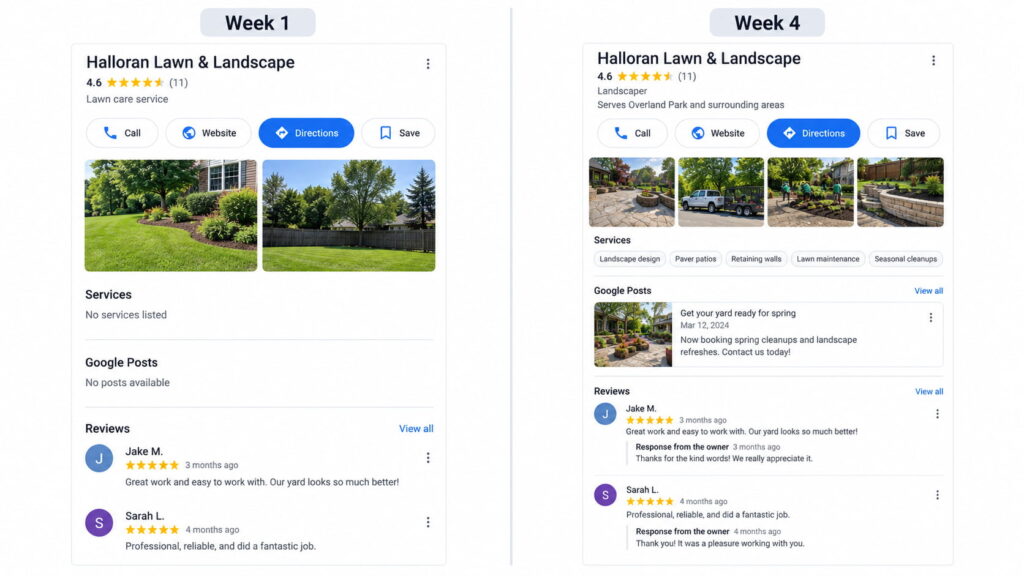
Same eleven reviews in both panels. Week 1 is why the asking has not been working.
Get your reviews and map pack audited, free
You will get the three crews currently sitting in your town’s map, their review counts, how many of those reviews landed in the last ninety days, and the same three numbers for you. Plus what is missing between you and that third spot.
Written, in about two business days. No call, and no card. Yours whether we ever speak or not.
Landscaping reputation management FAQs
There is no fixed number. What matters is beating the top three map results in your town and keeping the flow going: BrightLocal’s 2026 survey found 74% of consumers look for reviews from the last three months. Most local crews should target four to six new reviews a month.
Ask on site, the moment the customer sees the finished work, and follow up once by text within 24 hours with a direct link. The crew that did the job should make the ask, not the office. Ask every customer, not only the happy ones.
Only if it violates Google’s content policies: spam, off-topic content, conflicts of interest, or a review from someone who was never a customer. You can report it, but removal is not guaranteed and takes time. Responding publicly usually does more for the next reader than reporting.
No. Google’s Maps content policy prohibits offering incentives, including payment, discounts, or free goods and services, in exchange for posting a review. Incentivized reviews can be removed in bulk. Asking every customer with nothing attached is allowed and is what the policy expects.
Yes, indirectly. Google’s own local ranking documentation lists prominence as a ranking factor and states that more reviews and positive ratings can help your local ranking. Reviews will not outrank proximity, but between two similar crews in the same town they decide the third map slot.
Three ranges: doing it yourself costs nothing but about twenty minutes a week; review software runs a monthly subscription per location, from about $75 where it is published; an agency running it inside your local marketing costs more but includes written responses and reporting. Under fifteen jobs a month, doing it yourself wins.
Google Business Profile first, because it feeds the map pack and your Local Services Ads profile. Facebook second, since it is still a top local recommendation source. Angi, Yelp, Houzz, and Nextdoor come after, and only where you already get leads. Send each customer to one platform.