Most social media ideas for landscapers fail for a reason nobody writes about: it is never the idea list. You already know a before-and-after does well. What you do not have is a photo of the before, because at 7am nobody stopped the crew to take one, and by August you are not stopping for anything.
So this fixes the order. You get 23 ideas grouped by the job each post actually does, a 15-minute capture routine that gets the footage without slowing the crew down, and a 30-day calendar that says what to post on which day. Sorted by function, not dumped in a list, because that is the part that decides whether any of it turns into a phone call.
- Why social media works for landscapers (and what it will not do)
- Before you post: the 15-minute job-site capture routine
- Social media ideas that show off the work
- Social media ideas that build trust and authority
- Social media ideas that make you findable locally
- Social media ideas that get replies
- Social media ideas that sell
- What to post in the off-season
- Which platform to use for what
- How often to post: a 30-day starter calendar
- Hook and caption templates you can copy
- How to turn a post into a booked job
- Mistakes that kill a landscaping social account
- Want this run for you?
- Frequently asked questions
Why social media works for landscapers (and what it will not do)
Social media is not where the homeowner finds you. It is where he checks you.
He found you on Google, or a neighbor gave him your name, or he saw the truck. Then he opened your profile to see whether you are a real company or a number that stops answering in March. Pitchit, which sells lead software into this industry, puts it at 80% of homeowners researching online before they ever call, contacting an average of 2.8 contractors before they decide.
Read 2.8 in your own units. You are one of about three tabs open on a phone in somebody’s kitchen, and one of those tabs is usually an aggregator that sold your number to the other two, paid for whether you close or lose. Nobody should tell you to cancel that while it is feeding your crew. But the profile he opens next is the one place in that comparison where you are not renting the space.
That is also where twenty years of good work stops helping you. Your reputation lives in the heads of people who already hired you, and he has never met any of them.
Now the honest half. Social will not replace your Google Business Profile or your reviews, which still decide whether you show up in the map at all. That order is the first thing BASEO’s free audit measures, because posting five times a week into a profile with the wrong primary category is doing the second job before the first. It will not pay off in two weeks either, and it sells nothing without a next step and a fast answer.
If you need work booked this month, work you can book this week is a different problem, and this channel sits somewhere specific ranked by cost per lead.
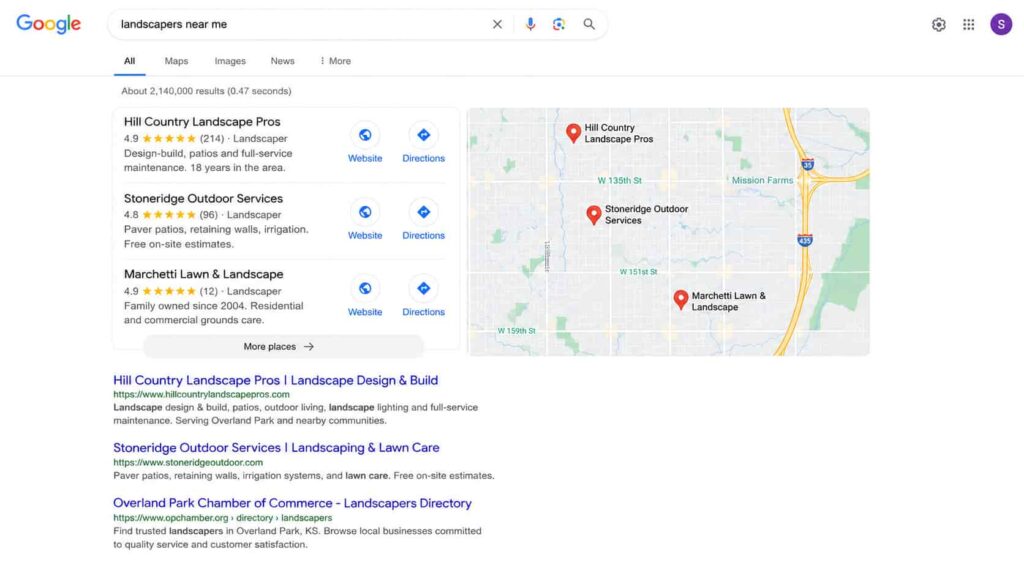
The third crew does the same quality of work as the first. The review count is the whole difference the homeowner can see.
Before you post: the 15-minute job-site capture routine
Here is the part every other article skips, and it is why their idea lists never get used.
You are not short on ideas. You are short on footage. Every one of the 23 ideas below assumes you have a photo, a clip or a detail shot behind it, and if capture is not solved, none of them happen.
The routine adds up to under 15 minutes, and not in one block. Four moments already built into the day: before you unload, once mid-job, at cleanup, and one last look before the gate closes.
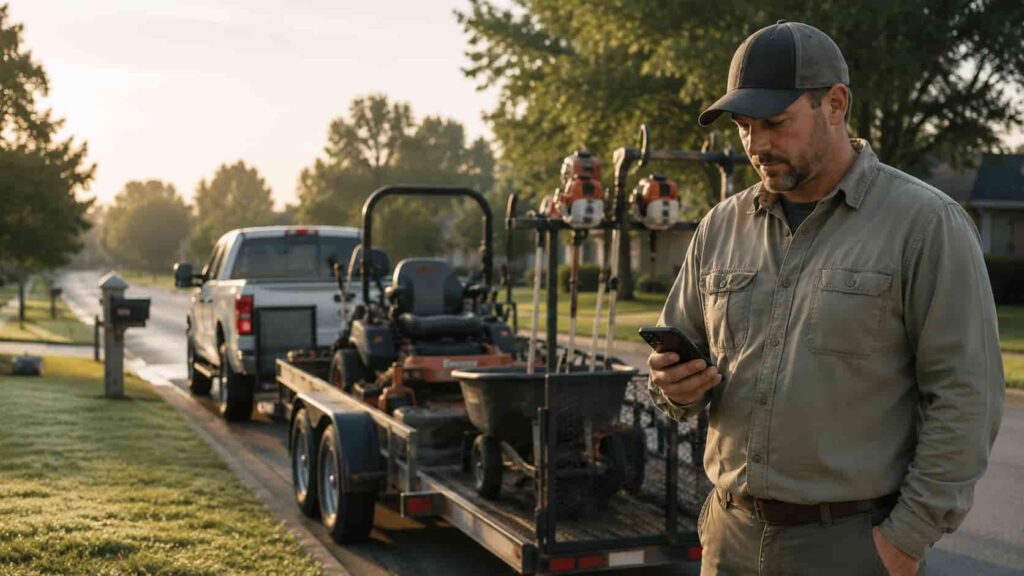
The 6am load-out is a post. It is also the most accurate picture of the business you will ever publish.
The four-shot rule for every job
Four shots. Same four, every job, no thinking required.
One: the before, from a marked point. The mailbox, the corner of the garage, the second fence post. Somewhere you can find again. Shoot it before anything comes off the trailer.
Two: a 10-second clip mid-job, machine running, sound on. The skid steer, the edger, the plate compactor. This clip carries every video you make later.
Three: the after, from the exact same marked point. A before-and-after only lands if the frames line up. From a different angle, the same transformation reads as two unrelated yards and the viewer scrolls.
Four: one detail close-up. The edging line against the sidewalk, the mowing stripes, the clean cut where mulch meets turf. That shot is the one that gets shared outside your zip code.
Shoot all four vertical, 9:16. One vertical file feeds Reels, TikTok, Shorts and Stories with no re-cropping.
Who on the crew shoots it, and with what
“My guys are not going to do this” is a real objection, and the answer is that you are asking too many people.
One person per crew. The foreman, or the youngest guy already holding his phone. One phone, so the files land in one place. And it goes on the job closeout checklist next to blowing off the driveway, because a favor gets forgotten and a checklist item does not.
The technical minimum takes ten seconds to teach at a tailgate. Wipe the lens, it has been in a pocket with mulch all morning. Sun behind you, which on a front yard means shooting from the street. Never use digital zoom, walk closer, you are walking the property anyway.
Then one shared album per job, named by the address, dumped before the truck gets back to the shop. Otherwise the photos live in one guy’s camera roll next to a broken hydraulic line.
Getting permission to post a client’s property
This one almost never gets mentioned, and it is the question operators actually search.
Get permission in writing, and keep it small: one line in the contract or the estimate saying the client agrees to let you photograph the finished work for your marketing. Not a separate form, and not a conversation while he is writing a check.
What stays out of the frame, always:
- The house number
- The street sign, and the street name in your location tag
- License plates, including your own if the truck is in the shot
- Children, and anyone who did not agree to be photographed
- Anything through a window, and any interior
If a client says no, you have not lost the post. Frame the detail instead, shot tight with no facade. Nobody can tell whose house it is and the work still speaks.
One caveat: this is business practice, not legal advice. Consent and advertising rules vary by state. Have an attorney look at the clause once and it is done forever.
Social media ideas that show off the work
This is the block that stops the thumb and proves you can do the job. Roughly 40% of what you post.
Each of the 23 ideas comes in the same three parts: what it is, why it works, and one literal line you can copy. That last part is deliberate. Every other list tells you to post before-and-afters. None of them hands you the caption.
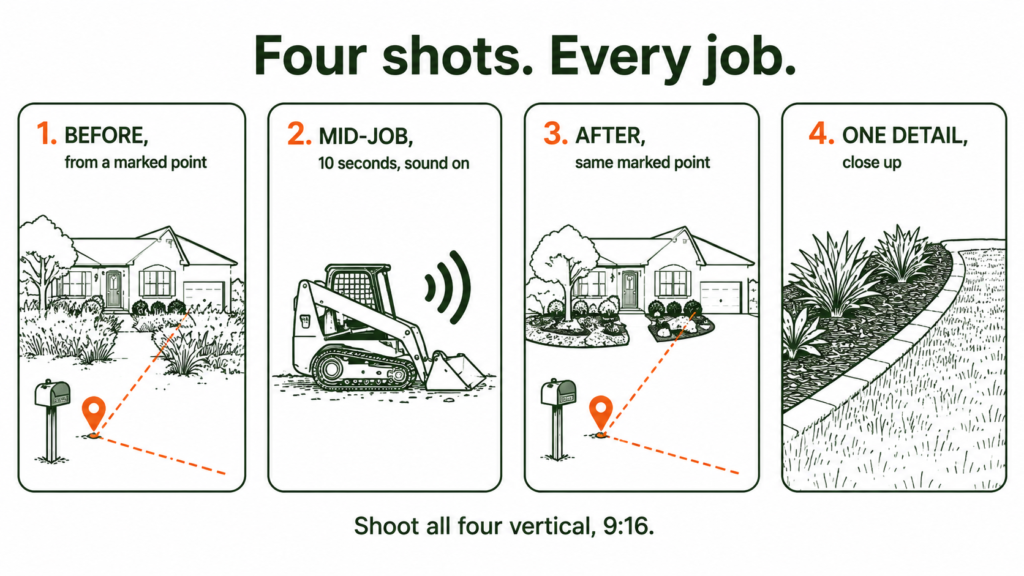
The marked point is the whole trick. Same frame, or the before-and-after does not read.
1. Before-and-after transformations
The highest-performing format in this trade, and the reason the four-shot rule exists.
It works because it is the only post that shows the value of the job instead of describing it. A homeowner cannot judge your base prep. He can judge a yard that went from embarrassing to finished.
Two rules. Shoot both frames from the same marked point at roughly the same time of day, so the light does not do the work the crew did. And in video, lead with one second of the after, then cut to the before.
What it looks like: “Same spot, same angle, eleven days apart. Front yard in [neighborhood], full tear-out and rebuild.”
2. Time-lapse of a full install
A full install compressed into 20 to 30 seconds. A phone in timelapse mode on a cheap tripod, or wedged on the dash facing the work.
It makes a day of labor legible. A patio looks expensive until a homeowner watches four guys spend eleven hours on base prep, which is a pricing argument you never have to make out loud. Paver patios, new beds, regrades and sod compress well. Routine maintenance does not.
What it looks like: “800 sq ft paver patio. 3 days, 2 guys. Sound on for the plate compactor.”
3. The satisfying-detail close-up
Fifteen seconds, one detail, no music. The first edger pass down a sidewalk untouched in two years. Mulch going down. Mowing stripes.
This performs out of proportion to the effort because it is not really landscaping content, it is satisfying content, and that travels well past your service area. The key is ambient sound. Muting it and dropping a trending song underneath is the most common way operators kill one of these.
What it looks like: “Two years of overgrowth vs one pass. Sound on.”
4. The elevated or drone reveal
For big design-build jobs where the layout is the achievement and ground level cannot show it.
No drone? Three free options: a ladder, a second-floor window if the client allows it, or the roof of the truck. Ten feet of elevation changes a patio shot more than most people expect.
One thing before you buy anything: flying a drone commercially in the US, including for your own marketing, requires an FAA Part 107 remote pilot certificate.
What it looks like: “You cannot see this one from the driveway. Full backyard build in [neighborhood].”
5. Work-in-progress series
The same job posted in installments. “Day 2 of 5.”
It gives people a reason to come back, and it shows process, which is what separates a company from a guy with a truck in the mind of somebody about to spend $20,000. Stories are the natural home, or a carousel for the feed.
Always close the series with the reveal. A series that trails off unfinished reads like a job that trailed off unfinished.
What it looks like: “Day 3 of 5. Base is in, screed rails are set, pavers start tomorrow.”
6. The problem-yard rescue
The worst yard you touched this month. Standing water that never drains, roots lifting a walkway, a slope washing out every storm.
Three beats: the problem, the diagnosis in one sentence, the fix. That sequence positions you as the crew that solves things rather than the crew that cuts grass. One line you do not cross: never make fun of the yard or the person who owns it. The villain is the problem, and somebody watching has that exact yard.
What it looks like: “This corner held water after every rain for six years. It was never a grass problem.”
Social media ideas that build trust and authority
Roughly 25% of what you post. The work posts prove you can do it. These prove you know why, and that a stranger can safely let you onto his property.
| Category | What the post is for | Share of the calendar | Ideas |
|---|---|---|---|
| Show off the work | Stop the scroll, prove capability | ~40% | 1–6 |
| Build trust and authority | Make a stranger comfortable hiring you | ~25% | 7–12 |
| Get found locally | Tell the neighbor and the algorithm where you work | ~20% | 13–16 |
| Get replies | Keep organic reach alive | ~10% | 17–20 |
| Sell | Ask for the job | max 1 in 5 posts | 21–23 |
7. Plant spotlight for your hardiness zone
One plant per post, chosen for your zone. Common name, why it works where you work, how much sun, how much water. You already know all four for every plant you install, and that knowledge is the content.
What makes it local instead of generic: name your zone out loud and cite the USDA Plant Hardiness Zone Map. A plant post with no zone attached could have been written by anyone, anywhere.
What it looks like: “Zone 7b pick of the week. Takes full afternoon sun on a west wall and we have never lost one.”
8. Why we do it this way
Explain one technical decision the client never sees and would never think to ask about. Base depth under a paver patio. The one-third rule on a mowing pass. Why mulch should not touch a trunk. Pick one and explain it to the camera, on site, in thirty seconds, in your own words.
You are answering “why does his bid cost more” with a reason instead of a defense. Film it with the job behind you: in a truck cab it sounds like an ad.
What it looks like: “Thirty seconds on why we do it this way, and why the bid down the street was cheaper.”
9. Myth-busting posts
One myth per post, said without talking down to anybody. The ones your customers repeat every season: a little water every day beats a deep soak, sand fixes clay, mulch piled up the trunk protects the tree.
Do one thing when you post it: back it with a public university extension source and link it. That turns “some guy on Facebook says” into “here is the university that studied it,” and it keeps you out of an argument in your own comments.
What it looks like: “Stop doing this to your trees. Here’s what the extension service actually found.”
10. Seasonal maintenance checklists
A checklist for the season, as a carousel or a single saveable image.
The goal is not the like, it is the save. A homeowner who saves your fall checklist has put your business in a folder he opens again in October.
Make it real: the five things your crews actually do on a fall visit, in order, named the way you name them on an estimate. You already dictate that list to a new hire every September.
What it looks like: “Five things we do on every fall visit, in order. Save this one.”
11. What this project actually cost
The highest-risk, highest-reward post on this list, and nobody in your market is doing it.
Publish what a finished project ran, as a range, with what was included. It filters out the people who were never going to spend that and attracts the ones who were.
Ranges, never a closed price. Name the factors that move it: access, square footage, materials, slope. Use your own closed jobs, and do not round a range you did not charge, because it becomes a quote you get held to.
What it looks like: “This backyard ran [$X]–[$Y] all in. What moved the number: access, slope, 400 sq ft of wall.”
12. Licensing, insurance and certification proof
One image. Your state license, your certificate of insurance, your pesticide applicator license, an association credential.
It is boring and it converts, because it answers what a homeowner is quietly asking before he lets a stranger and four employees onto his property. Most operators never post it, so posting it once puts you ahead.
Requirements vary by state, so link your own licensing board. Black out policy and license numbers first.
What it looks like: “Licensed, insured, and here it is. Ask the next crew that bids your job for the same.”
Social media ideas that make you findable locally
Roughly 20% of the calendar, and the bridge between your social profiles and local search. Everything here makes it obvious, to a neighbor and to the algorithm, exactly where you work.
13. Neighborhood-tagged project posts
Name the neighborhood or subdivision in the caption and use the location tag. Never the address.
Neighbors recognize the area and read you as the crew that works around here, which is different from a crew that serves the metro. The geographic signal also helps you surface for people searching nearby.
What it looks like: “Wrapped up a full front-yard redo in [neighborhood] this week. Third job on this street this year.”
14. Local landmarks and community projects
The volunteer work. A school garden, a park cleanup, a church bed, a veteran’s yard.
These get shared locally more than anything else you post, but only if you post them right. Show the work, not the gesture. A crew photo with one factual sentence lands. A paragraph about giving back reads as a press release, and people feel the difference instantly.
What it looks like: “Spent Saturday on the beds at [school]. Crew volunteered, nursery donated the plants.”
15. Supplier and partner shoutouts
Tag the nursery, the quarry, the hardscape supplier, the realtor who sends you pre-sale work.
You borrow their audience, which for a good local nursery is exactly your customer, and you plant referral seeds with the businesses most able to send you work.
Make it real. You at the nursery at 6am loading a trailer is a shoutout. “Thanks to our amazing partners” is a greeting card. If you want the referral side to run, referrals on purpose is a system, not a vibe.
What it looks like: “6am at [nursery]. Fourth trailer this month. They have never given us a bad plant.”
16. Weather-reactive posts
Post the same day the weather does something. A freeze warning, a drought restriction, hail, the first snow.
Always the same shape: what to do in the next 48 hours. Best-timed content available to you all year, and almost nobody does it, because it requires reacting on a day you are already dealing with the weather.
So do not react. Write three templates now, in the off-season. Freeze, storm, drought. When it happens you fill in two blanks and post.
What it looks like: “Hard freeze Thursday night. Two things to do before dark if you have an irrigation system.”
Social media ideas that get replies
About 10% of the calendar. Comments and saves are the signal that keeps a post in front of people, which means the cheapest reach you get comes from asking a question instead of making a statement.
17. Which one would you pick?
Two design options side by side, one binary question, nothing else. Two paver colors, two bed layouts, two lighting schemes.
The lowest-effort post on this list and reliably the highest response rate, because answering takes one word.
Second payoff nobody mentions: you learn what your local market likes. Run it four times and you will know which paver tone wins in your town, which is real information for the next proposal.
What it looks like: “A or B? Same patio, same budget, two very different backyards.”
18. Answer the question you get on every estimate
Take the literal question you hear on every walk-through and answer it in a post. “How long before the new sod takes?” “Will the pavers settle?”
You answer these out loud four times a week. Writing one down is the most direct conversion of field knowledge into content there is, and it costs nothing you have not already said. It also gets picked up when somebody asks the same question out loud to a phone or an AI assistant.
What it looks like: “‘How long before the sod takes?’ Gets asked on almost every estimate. Here’s the honest answer for our climate.”
19. Reviews turned into visual posts
A screenshot of a Google review, laid over the photo of that customer’s project.
Either alone is fine. Together they are much stronger, because the review supplies the claim and the photo supplies the evidence, and the reader closes the loop himself.
Never edit the review text, not for typos and not for length. An edited review reads as a written review, and the whole value is that somebody else wrote it.
What it looks like: “Left this one in September. Here’s the job she was talking about.”
20. Client tags and user-generated content
The photo the client took herself, of the yard you built, reposted with credit.
Getting it is the hard part. Two ways that do not feel like begging: a card handed over at closeout with your handle on it, or a follow-up message a week later when the yard has settled.
Always repost with credit. A customer whose photo you used without naming her will never send another.
What it looks like: “[Client] sent us this three weeks after we finished. Better shot than anything we took.”
Social media ideas that sell
The only block that asks for something, and it comes with a hard rule: at most one in every five posts. The ratio is what buys you the right to sell at all. Four posts that showed the work, explained the trade and answered a question have earned an audience that will read the fifth. Five straight offers train people to scroll past your name.
21. Seasonal offers with a real deadline
Fall cleanup. Aeration. Irrigation opening. Holiday lighting. Snow contracts before the first storm.
The deadline is the whole mechanism and it has to be real. “Aeration bookings close October 15 because after that the ground is too hard” is a deadline. “Limited time offer” is not. And always include the concrete next step: an offer with no next step is an announcement.
What it looks like: “Aeration bookings close [date]. After that the window is gone until spring. Call or message to get on the list.”
22. Booking-window and capacity posts
“Three slots left for October installs.”
Honest scarcity, which is unusual, because here it is actually true. You have a finite number of install weeks before the ground closes, and saying so is a fact rather than a pressure tactic.
The side effect is the better half: a post saying you are nearly booked tells everyone that other people hired you, which does more work than any claim about quality.
What it looks like: “Three install slots left before we close the schedule for the year. After that it’s spring.”
23. Service spotlights with one next step
One service per post, explained to somebody who does not know what it is. A French drain. Core aeration. Low-voltage lighting.
Half your margin lives in services the homeowner has never heard of and therefore never asks for. A post explaining what one is and what problem it solves creates demand that did not exist.
One CTA per post. If the post is about drainage, the next step is a drainage conversation.
What it looks like: “Most people have never heard of a French drain until the water is in the garage. Here’s what it is.”
What to post in the off-season
November to March is where most landscaping accounts go dark, and it is the most expensive mistake in this article.
The reason is timing. The homeowner planning a spring project is thinking about it in February, not April. If your last post is from October, by the time you start again he has hired the crew who never stopped.
Six things to post through the winter:
- Recycle the year’s best before-and-afters. Twelve months of footage and almost nobody saw most of it. New caption, same photo. It is not cheating.
- Spring planning content. “Book now for March.” The good crews fill up before the season starts, and February is when the person who cares is listening.
- Equipment maintenance. Blades, engines, the shop, the rebuild. The most honest content you make all year, because it is what actually happens in January.
- Winter services you actually sell. Snow and ice, holiday lighting, dormant pruning. Winter revenue does not sell itself either.
- Dormant-season education. What is happening to the lawn and the beds while nothing appears to be happening.
- The annual recap. Jobs completed, crews grown, hardest project. A fact-based post about longevity.
An April that starts full is worth more than any single post you make all summer. If you want the whole year mapped, the season-by-season calendar covers the other three quarters.
Which platform to use for what
Pick two platforms and do them properly. Five half-run accounts look worse than two good ones and cost five times the time you do not have.
Which two depends on who buys from you. Established-neighborhood residential, the sixty-year-old with the $30,000 backyard, lives on Facebook. Younger residential is on Instagram. Commercial and property-manager work is not won on social at all; social just has to not embarrass you.
The default for residential landscaping, because that is where the person writing the check is. Pew Research Center puts Facebook use at 71% of US adults, against 50% for Instagram and 37% for TikTok. That is adoption, not local discovery, and the honest version is that the homeowner buying a patio is likelier to have an account here than anywhere else.
The underused part is groups. Neighborhood groups, buy-sell-trade groups, town pages. That is where somebody types “does anyone know a good landscaper” and gets nine replies. Read each group’s promotion rules first: getting removed from the neighborhood group is a wound you cannot undo. If you want to put money behind the same audience, what Facebook ads cost is worth knowing first.
Instagram is your portfolio. Treat it that way and it does one job very well.
Reels are for reach: the satisfying details, the time-lapses, the reveals. The feed is for credibility, so it should look like a body of work, not a stream of updates. Highlights are the part everyone skips: organize them by service, so somebody can tap “Hardscaping” and see nine patios without scrolling through eight months of mowing.
One small thing with real payoff: put your city and service in the profile name field, not just the bio. “Marchetti Landscaping | Hardscaping Kansas City” is searchable inside the app in a way the name alone is not.
TikTok and Reels
This is where satisfying content breaks out of your local audience, and that sentence contains both the upside and the catch.
The catch first, because nobody else will tell you: most of that viral reach is not local. A clip with 400,000 views has produced 400,000 people who cannot hire you. The value is real, but it is brand and recruiting, not next week’s schedule, unless you make the location unmistakable. Lawn & Landscape’s coverage of going viral in the green industry makes the same point: location tags and regional hashtags pull that reach back toward people who can book you. So put the city in the profile, the bio and the captions.
YouTube
Two uses, unrelated to each other.
Shorts are free recycling: the vertical clips you already shot go up again and reach a different set of people.
Long-form is the one nobody in this trade does. A complete project walkthrough, fifteen minutes, ranks in Google for years and gets found by somebody typing a question two winters from now. A Reel is gone in four days; a YouTube video about a retaining wall keeps working while you sleep.
Nextdoor and your Google Business Profile
Neither is usually called social media, and both belong here, because they are the two places you can publish that sit closest to the moment somebody decides.
A Nextdoor recommendation is a neighbor vouching for you by name on your actual streets. Nothing on Instagram converts like that. And Google Business Profile Posts attach to your listing, which is what the homeowner is looking at while comparing three crews in the map.
Neither needs new content: the same before-and-after goes into both in four extra minutes. If the map position itself is the problem, the map pack playbook is next.
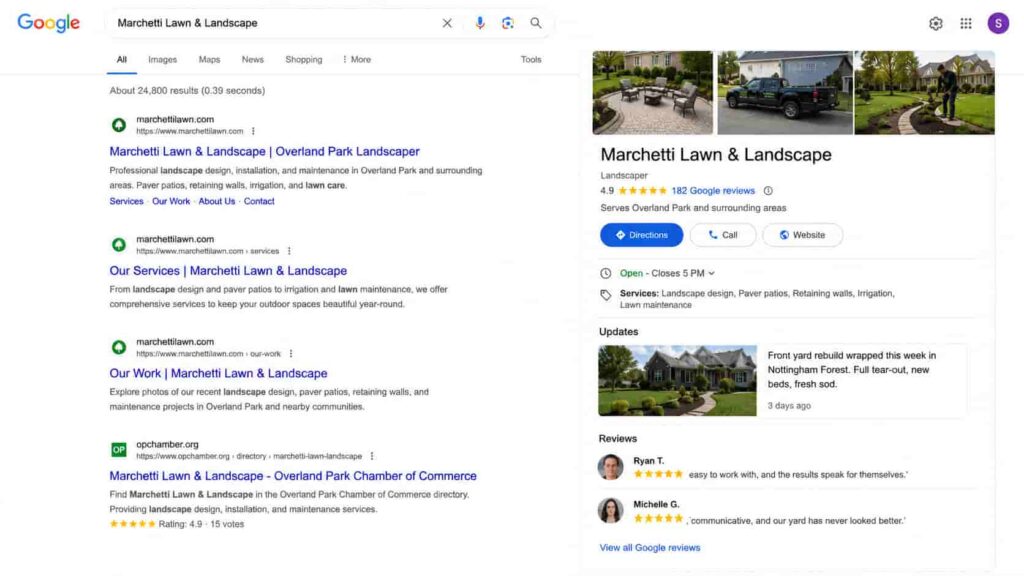
The same photo you posted to Instagram, published where the buying decision is actually happening.
How often to post: a 30-day starter calendar
The standard advice is real, and it is more than you can sustain. Hootsuite recommends 3 to 5 posts a week on Instagram and 1 to 2 a day on Facebook, which is correct for a business with somebody whose job this is.
You do not have that person. So here is the number that matters instead: three a week, every week, all year, beats ten a week for two weeks and then silence until March. Consistency is not a virtue here, it is the mechanism.
Batch it. Sunday evening, twenty minutes, from the footage the crews already captured. That is the whole time commitment, and it is why the capture routine came first.
The mix follows the proportions above: about 40% work, 25% trust, 20% local, 10% replies, and sell capped at one in five.
| Day | Post | Idea # | Platform |
|---|---|---|---|
| 1 | Before-and-after from last week’s job | 1 | FB + IG |
| 2 | Satisfying detail close-up | 3 | IG Reels + TikTok |
| 3 | Neighborhood-tagged project post | 13 | FB + GBP Post |
| 4 | What this project actually cost | 11 | FB + IG |
| 5 | Which one would you pick? | 17 | FB + IG Stories |
| 6 | Plant spotlight for your zone | 7 | IG + FB |
| 7 | Rest | ||
| 8 | Work-in-progress, day 1 of the big job | 5 | IG Stories |
| 9 | Why we do it this way | 8 | IG Reels + FB |
| 10 | Supplier shoutout | 15 | IG + FB |
| 11 | Review over the project photo | 19 | FB + IG |
| 12 | Seasonal offer with a real deadline | 21 | FB + GBP Post |
| 13 | The elevated or drone reveal | 4 | IG Reels + FB |
| 14 | Rest | ||
| 15 | Before-and-after, different service line | 1 | FB + IG + GBP Post |
| 16 | Answer the estimate question | 18 | FB + IG |
| 17 | Time-lapse of an install | 2 | IG Reels + YT Shorts |
| 18 | Local landmark or community project | 14 | FB + Nextdoor |
| 19 | Myth-busting post with an extension source | 9 | FB + IG |
| 20 | Work-in-progress reveal for the big job | 5 | IG Stories + FB |
| 21 | Rest | ||
| 22 | Problem-yard rescue | 6 | FB + IG |
| 23 | Seasonal maintenance checklist carousel | 10 | IG + FB |
| 24 | Weather-reactive post (or #13 if quiet) | 16 | FB + GBP Post |
| 25 | Client tag or reposted UGC | 20 | IG + FB |
| 26 | Licensing and insurance proof | 12 | FB |
| 27 | Satisfying detail close-up | 3 | TikTok + IG Reels |
| 28 | Rest | ||
| 29 | Service spotlight with one next step | 23 | FB + IG + GBP Post |
| 30 | Booking window post | 22 | FB + IG |
Twenty-six posts in thirty days, four rest days, every one sourced from footage the crew already shot on a job you were doing anyway. Run it once and the second month writes itself.
Hook and caption templates you can copy
The first three seconds decide whether the video gets watched. These work in this trade, written the way a contractor talks. Fill the brackets and post.
For the first three seconds of a video:
- “This backyard hadn’t been touched in [X] years.”
- “The homeowner thought this was a grass problem. It wasn’t.”
- “[X] hours, [Y] guys, one very unhappy slope.”
- “Watch what one pass does to a sidewalk this overgrown. Sound on.”
- “Nobody sees this part of the job. It’s the part that decides if it lasts.”
For the opening line of a caption:
- “Same spot, same angle, [X] days apart.”
- “Got asked this on three estimates last week, so here’s the answer.”
- “This is the one everybody skips, and it’s why [problem] keeps coming back.”
- “Finished up in [neighborhood] this week. [X] job on this street this year.”
For the close:
- “If your yard looks like the first photo, message us and we’ll take a look.”
- “Booking [season] work now. Call [phone] or message this page.”
- “Save this one. You’ll want it in [month].”
Two rules. Read it out loud first, and if it does not sound like something you would say in a driveway, rewrite it. And never open with a question the reader can answer “no” to.
How to turn a post into a booked job
A post creates an interested stranger. Four things turn that stranger into a job on the schedule, and this is the part the rest of the internet leaves out.
One: the post has a next step. One sentence, and most operators never write it.
Two: the bio has your phone number and a link. A number he can tap, and a link to a page with a form on it.
Three: the form works on a phone. Go fill out your own quote form on your own phone, standing in the yard, one-handed. A surprising number are broken, or email an address nobody has opened since 2022. That is what quote forms that get answered are supposed to solve.
Four, bigger than the other three combined: answer fast. Pitchit’s landscaping benchmarks put the first company to respond winning the job 72% of the time, with lead value dropping 75% within ten minutes, and 58% of inquiries arriving outside 9-to-5. Those are one vendor’s numbers, not sourced upstream, so take them as directional.
Run it against your own. Twenty inquiries a season, closing one in four, is five jobs. On a $12,000 average install, answering in ten minutes instead of Thursday is not a percentage point, it is one or two of those five, and you know which two you lost last year.
So check messages twice a day, one of those after dinner. And if the posts are good and the calls still are not coming, the problem is upstream in the map position, the reviews or the site, which is why BASEO’s free written audit grades those three rather than the posting.
Mistakes that kill a landscaping social account
- Only posting finished work, with no context. A gallery of nice yards proves nothing. It could be anyone’s photos. The context is what makes it yours.
- Disappearing from November to March. The most common and the most expensive.
- Mixing vertical and horizontal with no logic. Shoot vertical by default. Inconsistent crops read as careless, and careless is what a homeowner cannot risk on a $20,000 job.
- Not answering comments and DMs. An unanswered comment is a public sign that you do not answer. People notice.
- Stock photos of yards you did not build. The worst one here. Somebody will recognize a stock image, and the moment they do, every real photo on your page becomes suspect.
- Selling in every post. One in five, maximum.
- Posting a client’s house without permission. One angry homeowner, one comment thread, and it is the only thing anyone remembers about your page.
Want this run for you?
Everything above adds up to roughly four hours a month once the capture routine is running: twenty minutes on a Sunday, plus two minutes a day answering messages.
Four hours is not nothing during install season. If you would rather spend them bidding, this is a genuinely delegable job: a crew member who is good with a phone, a part-time hire or a freelancer can run the calendar off the footage your crews already shoot. What you should not do is hand it to somebody who has never been on a job site, because the captions will read like it.
Frequently asked questions
Recommend the technical team mark this block with FAQPage schema.
Post before-and-after transformations, short work-in-progress clips, seasonal maintenance tips, crew introductions and customer reviews. Aim for roughly four posts that showcase work or build trust for every one promotional post, and tag the neighborhood so local homeowners recognize where you work.
Three to five times per week is enough for most landscaping businesses. Consistency beats volume: three posts every week all year outperforms daily posting for two weeks followed by silence. Schedule a batch on Sunday evening using footage captured during the week.
Facebook is usually best for residential landscapers because homeowners and local neighborhood groups are already there. Instagram works as your visual portfolio, and TikTok or Reels build brand reach. Pick two platforms and post consistently rather than spreading yourself across five.
Yes, though usually indirectly. Most homeowners find a landscaper through search or a referral, then check social profiles to confirm the business is real and does good work. A current, well-photographed feed helps you win the comparison against the other contractors they contacted.
Get written permission first. Add a short photo-release line to your contract or estimate covering finished project images. Keep house numbers, street signs, vehicles and children out of the frame, and skip the exact location tag. Rules vary by state, so have your contract reviewed.
Repost your best before-and-after projects from the season, share spring planning content that encourages early booking, show equipment maintenance, and promote winter services like snow removal, holiday lighting or dormant pruning. Staying visible through winter is what fills the spring schedule.
Satisfying, sound-on close-ups perform best: the first edger pass on an overgrown sidewalk, mowing stripes, mulch going down. Hook viewers in the first two seconds with the most dramatic frame, keep clips under 20 seconds, and let the equipment audio carry it instead of music.
Combine service hashtags with local ones: #landscaping and #hardscaping alongside #[YourCity]landscaping and the neighborhood name. Five to ten relevant tags is plenty. Local tags matter more than large generic ones, because reaching a hundred nearby homeowners beats reaching ten thousand strangers.
Final thoughts
You were never short on social media ideas for landscapers. You were short on footage, and on a reason to post any of it on a Tuesday in July.
So start with one job this week. Four shots, one marked point, one person responsible for it. Post the before-and-after on Friday and put the same photo in a Google Post. That is the entire first week, and it takes less time than one estimate.
If the phone still is not ringing, the gap is somewhere else: your map position, your review count, or a form nobody answers. BASEO does not run anybody’s social accounts, but the written audit names which of those three is costing you the calls. Two business days, no call attached, yours to keep whether we ever speak again.