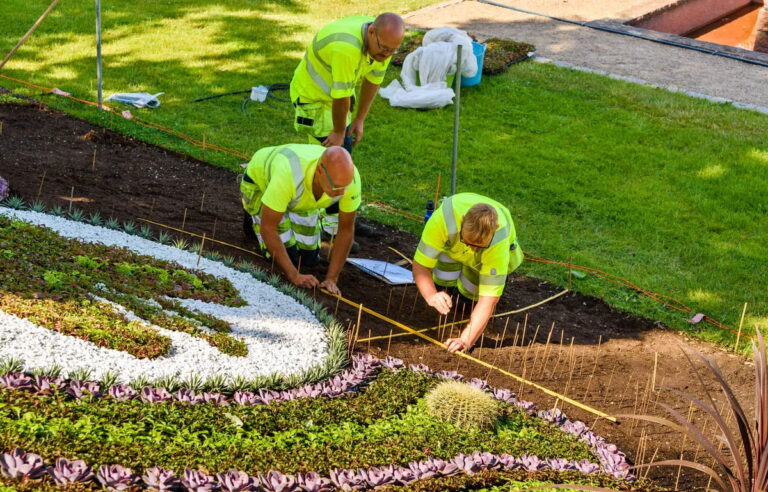
Two landscapers work the same city. One runs forty maintenance accounts at $180 a month. The other builds patios; his last closed at $14,800.
Same crew, same trucks, same town. The channel that pays for one of them quietly burns the other’s budget for the year. The question has no single answer, but it has a method, and it takes two numbers you already have.
The short answer: there is no single best channel, only a best next one
There is no universal best way to market a landscaping business. The best channel is whichever one lowers your cost per booked job at your average ticket, which is why a company on $180-a-month contracts and one selling $15,000 patios need opposite channels.
| Channel | Time to first job | Cost per lead | Cost per booked job |
|---|---|---|---|
| Google Business Profile, map pack | 4–8 weeks | Free | No media cost, ~8 hours to set up |
| Google Local Services Ads | Days | $48–$67 (99 Calls, 2026) | ~$160–$225 at a 30% close |
| Google Search Ads | Days | ~$91 (LocaliQ, 2026) | ~$455 at a 20% close |
| Service and city pages | 4–8 months | No benchmark | Falls every month the page is up |
| Referrals and reviews | Weeks | Cost of the credit | ~$100 on a $50 credit at 1-in-2 |
| Route density (signs, 5-arounds) | Same week | Cost of a sign | ~$12, drive already paid for |
| Shared aggregator leads | Days | $78 in one account (BASEO data) | ~$390 at a 20% close |
| Social media and video | Rarely first-touch | Marginal, filmed on the job | Not attributable alone |
| Direct mail | 2–6 weeks | Postage and print | No reliable benchmark |
Those close rates are placeholders. Yours are the only ones that matter, and working them out is the next two sections.
Why every “18 marketing ideas for landscapers” list fails you
Search this topic and you get lists. Eighteen ideas, fifteen, twenty-one. Every one is true and none helps, because none tells you which to run in February with a half-empty April, or what it costs per booked job. Notice who publishes most of them: field service software companies, whose revenue is the app install.
A list is fine when it is ranked and priced. We publish one, ranked by cost per lead, plus how to market a landscaping business step by step. This one is narrower: eight channels, priced and ranked, split by the business you run.
The two numbers that pick your best next channel
The right channel is not an opinion, and it is not whatever worked for the crew down the block. It falls out of two figures in the notebook in your truck: your average job value, and what a booked job costs you now. The first sets the ceiling for the second.
Number one: your average job value
A $180-a-month contract and a $14,800 patio do not tolerate the same cost to get the job. The rule: what you pay to get a one-off job, your cost per acquisition, stays inside 8 to 12% of the ticket.
A $14,800 patio at 10% gives you $1,480. At roughly $91 a lead, the 2026 home improvement average (LocaliQ), closing one in five, that job costs about $455 to buy. Clears easily.
Now the recurring one. That contract is $4,320 over two years. In month one it reads as $180 against $455, which looks like a loss and gets the channel switched off. Against what the customer is worth over two years, which marketers call customer lifetime value, $455 is 11%. It passes.
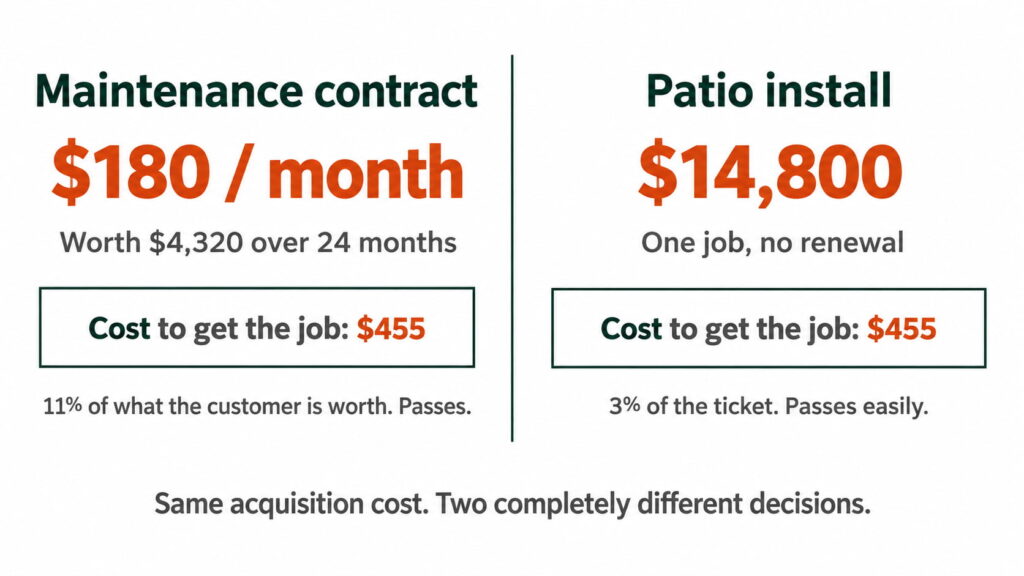
The same $455 is a bargain in one column and a red flag in the other.
Number two: what a booked job costs you right now
Take what you spent on a channel and divide it by the jobs you can trace to it. That is your cost per booked job, and it is not your cost per lead. A channel selling $30 leads that close at 15% costs you $200 a job. A channel selling $90 leads that close at 60% costs you $150. The expensive-looking channel is the cheap one, and no invoice tells you that.
The anchors: landscaping LSA leads at $48 to $67 per charged lead in September 2026 (99 Calls), search ads at $90.92 against an all-industry $66.69 (LocaliQ). More in what a landscaping LSA lead costs.
One San Antonio landscaper was buying shared leads at $78 apiece from an aggregator. That is not a lead source, it is a lead rental: you pay the same $78 whether you win the job or lose it to the four other crews who bought the same phone number. At a one-in-five close, that is $390 behind every booked job. Six months into building pages he owns, the same work arrived at about $11 a lead (BASEO client data): about $55 a job.
The 8 landscaping marketing channels, compared head-to-head
Every channel opens with the same five lines, so you can read them against each other. The order is roughly how BASEO’s green industry team sequences an account: cheapest per booked job first.
Google Business Profile and the map pack
What it is: the free listing that decides whether you appear in the three businesses Google shows above everything else.
Time to first booked job: 4 to 8 weeks.
Typical cost: free to operate.
Best for: both business models.
Where it breaks: a wide service radius with no verifiable address, and a wrong primary category.
Costs nothing to run and the traffic is people already looking to hire. Seventy-one percent of consumers use Google Search somewhere in a local search (BrightLocal, 2026). Three things move it: one primary category matching what you make money on, because a hardscape company filed under “Lawn care service” competes for the wrong search; real photos of the crew working, not stock; and reviews, the input most operators leave to chance. Rebuilding the profile is the first thing BASEO does on an account: fastest visible movement, no media spend (the map pack playbook).
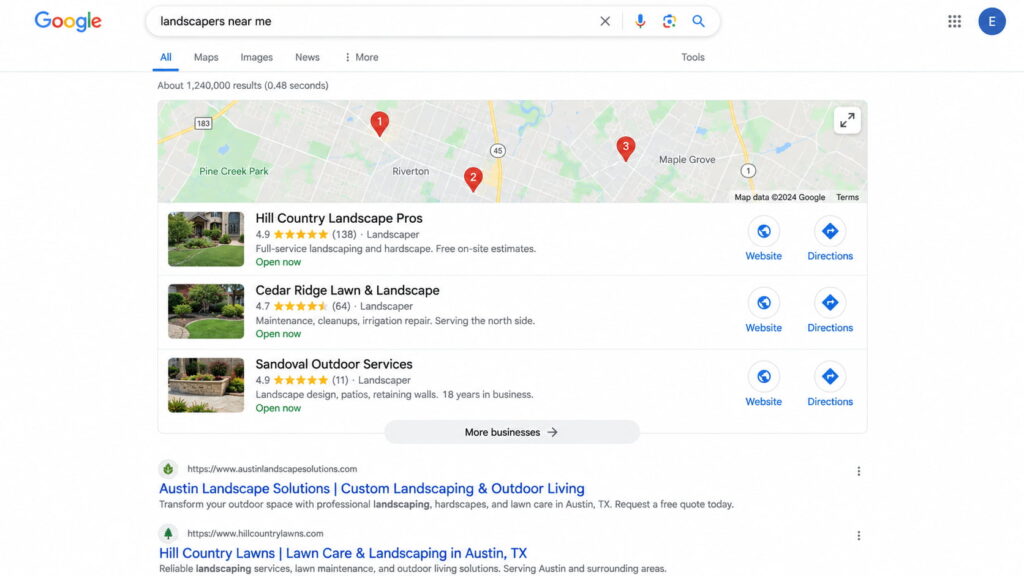
Same star rating, 138 reviews against 11. That gap is most of the distance to position one.
Google Local Services Ads
What it is: pay-per-lead units carrying the Google Guaranteed badge, above the map pack and above regular search ads.
Time to first booked job: days.
Typical cost: $48 to $67 per charged lead, with wide variance by market.
Best for: maintenance and cleanups, where speed beats specificity.
Where it breaks: markets where LSA coverage for landscaping is thin, and budgets that empty by ten in the morning.
Verification comes first and in some markets takes over a week, so it is off-season work. Your reviews feed the LSA ranking, so the profile work above pays twice. And bad leads get disputed rather than absorbed, which is somebody’s weekly job. BASEO manages LSA on the same lens as everything else: cost per booked job.
Google Search Ads
What it is: the auction on regular search results, where you pay per click and control the keyword and the landing page.
Time to first booked job: days.
Typical cost: about $91 a lead, at an $8.33 cost per click and a 6.47% click-through rate.
Best for: installs, hardscape, irrigation, anything high-ticket.
Where it breaks: a small budget spread across too many keywords.
Costs more per lead than LSA and buys what LSA does not: control. “Paver patio austin” and “lawn service austin” are two different businesses, and LSA will not separate them. Three things stop the waste: negatives (“jobs,” “salary,” “DIY,” “free”), or you pay $8 a click for job applicants; maintenance and install campaigns split, so cheap searches do not eat expensive ones; and the click landing on a page for that service in that town, never the homepage (how a landscaping ad account is structured).
Ads are not the enemy: anyone telling you to switch them off has never had to fill a half-empty May. Ads book jobs now; what they do not do is get cheaper, and that is the next channel’s job. When BASEO runs them, the spend goes straight to Google, never marked up.
Service and city pages (local SEO)
What it is: an original page for every service you sell and every town you actually drive to.
Time to first booked job: 4 to 8 months.
Typical cost: no published benchmark exists. Anyone quoting a tidy figure borrowed it from another trade.
Best for: both models, and the only channel here that gets cheaper.
Where it breaks: sites with no authority and no local reviews behind them.
The only channel where cost per booked job falls instead of rising: the page is paid for once and keeps working. Its honest problem is the four to eight months: wrong answer if you need jobs this month. The build is one page per service that clears your margin rule, then one per town where you already have jobs to point at, with photos from that area and the neighborhood names. Forty cloned city pages with the town swapped do not rank: Google sees the same page forty times.
That is what BASEO builds, and the ordering is the point. Ranking is priced by search, not by ticket: the click that ends in a mow and the click that ends in a patio cost about the same to win, and only one clears the 8 to 12% rule (what ranking actually takes).
Referrals and review systems
What it is: the customers you already have, asked properly and on purpose.
Time to first booked job: weeks.
Typical cost: whatever the credit you offer costs you.
Best for: both models, strongest on maintenance.
Where it breaks: you do not have enough customers yet.
Lowest cost per booked job in most landscaping companies and the worst managed, because it is left to luck. The trust statistics circulating in this trade trace back to vendor marketing with no primary source. Ask on site, the moment the job is done and the customer is looking at the work, by text with the review link in it, because a request that makes them go find your profile does not happen. And price the incentive first: a $50 credit closing one job in two puts your cost per booked job around $100, less than a third of the same job on search ads (a referral system that runs on purpose).
BASEO runs the review generation side, because reviews are a ranking input for the map and a gate on whether an AI assistant names you. Configuring your field software is not something BASEO does.
Route density: yard signs, 5-arounds, door hangers
What it is: selling the block you are already parked on.
Time to first booked job: the same week.
Typical cost: the cost of a sign.
Best for: maintenance and route-based work.
Where it breaks: HOAs that ban signs, and rural routes where houses are too far apart.
Best economics per mile of anything here. Two jobs on one block is one drive, one setup, one unload. Two jobs twenty minutes apart is two of each, and the second eats forty minutes of round trip nobody pays for: at $60 an hour of crew cost, $40 of margin gone before anyone touches a mower.
- Put a sign in the yard while the crew is working, not after they leave.
- Knock on the five houses closest to today’s job, before the trailer is loaded.
- Make a neighbor offer with an expiry date, so it is a decision and not a brochure.
- Log which street it came from, so you know whether the block paid.
The second job on a block is worth more than the second across town even when they invoice identically. This is your tactic, not a service anyone sells you.
Social media and video
What it is: the proof a prospect looks at before calling, not the thing that makes them call.
Time to first booked job: rarely the first touch.
Typical cost: marginal, filmed on jobs you already have.
Best for: installs and hardscape, as portfolio.
Where it breaks: when it replaces the intent channels instead of supporting them.
It rarely closes the first job and it does close the big one, because the before-and-after of a patio is the evidence somebody wants before signing for $15,000. Film on the job you are already doing, where the marginal cost is a phone and five minutes, and reuse the footage on your profile and the matching service page. Posting five times a week is an activity count, not a business number (what to post from the job site).
Direct mail
What it is: printed offers dropped into selected neighborhoods.
Time to first booked job: 2 to 6 weeks.
Typical cost: postage and print, too variable by volume for a benchmark.
Best for: high-ticket work, seasonally timed.
Where it breaks: generic drops into bought cold lists.
Works for one reason, and it is not nostalgia: you can target by ZIP code and home value, which correlates with who buys a redesign. The percentages that circulate about mail are association-published with no primary source, so treat them as marketing. Mail before spring into the streets where your signs stood last summer, so you can put a photo of the job at number 14 on the piece landing at number 22. A bought cold list produces none of that.
Best way to market a landscaping business built on maintenance contracts
If your revenue is recurring, the order is not up for debate. Profile and reviews first. Route density second. A referral system that actually runs, third. Paid last, only to fill gaps in a route you already drive.
Your ticket is low, so the channel has to be cheap or free. But what a customer is worth over two years carries an acquisition cost that looks indefensible in month one, which is why operators kill good channels in week six.
Forty customers at $180 a month is $86,400 a year. Ten more on streets you already drive adds $1,800 a month at almost no added drive time. At 5% of revenue, marketing on that route is $360 a month: a sign on every job, a review system, a properly built profile. Not a managed ad account.
Paid comes last, not never: a hole on one street in one month, and $200 of targeted spend fills it faster than the map will.
Best way to market a landscaping business built on installs and hardscape
Invert everything. Lead with Search Ads pointed at a landing page for that service, then service pages carrying real visual proof, then social as the portfolio. Your profile still matters; it just does not close an $18,600 retaining wall (BASEO client data) on its own.
The economics are permissive in a way maintenance economics never are. At $300 a lead and a one-in-four close, that job costs $1,200, about 6% of an $18,600 wall. The 8 to 12% rule has room left, and that room is what lets you compete on the expensive keywords at all.
It also buys patience with an account that is not working yet. One landscaping operator BASEO runs ads for went from $84 to $43 cost per lead on the same budget (BASEO client data). On a $180 mow that difference is a channel or a bonfire. On an $18,600 wall it was never the constraint. Proof is.
Somebody choosing a hardscaper collects three quotes over three to eight weeks, so the proof has to exist before the phone rings: photos from a job like theirs, reviews that describe the work instead of rating it. A fast callback wins a cleanup, not a patio.

On the install side of this business, the photo is the channel.
The channel most landscapers are about to be late on: AI search
A homeowner in your town is asking an assistant who the best landscaper nearby is and getting a short list back. Forty-five percent of consumers now use ChatGPT or another generative AI tool to get local business recommendations (BrightLocal, Local Consumer Review Survey, 2026). Not to research one. To be handed one.
What decides it is unglamorous: name, address and phone consistent everywhere; reviews with descriptive text, because “great job on our patio, on time and cleaned up” tells a machine what you do and five stars does not; pages that answer questions the way people ask them; and mentions in local directories and press.
Same asset the map pack reads, read by a different machine (what changed when AI entered search). BASEO formats content for that citation and tracks where clients get named. No agency can put you on the list, and anyone who says otherwise is selling a placement that is not for sale. Almost nobody here has started.
How to test a landscaping marketing channel without burning a season
Most channels do not fail. They get judged badly, at the wrong time, against nothing.
- Give it 90 days and write the end date down before you spend anything. A test with no end date is a subscription.
- One new channel at a time, or you learn nothing about either.
- Give it its own phone number or form, or every conclusion afterward is a guess.
- Set the kill threshold first: above 12% of your average ticket per booked job at 90 days, it goes off.
- Do not launch at your peak and do not judge at your trough. Landscaping search ads run around $40 to $50 a lead in spring and $150 to $200 or more in winter (Amir Gomez, citing LocaliQ and Evergrow, 2026). Judged in January and in April, the same channel looks like two.
Find your best next channel
The best way to market a landscaping business is not a channel, it is a calculation: your average job value, and what a booked job costs on everything you run.
You do not need us for that arithmetic. What you probably do not have is your competitor’s half: which searches the crew above you owns in your towns, and what they cost. That goes in the audit, next to your two numbers, with the next channel named.
Free. No call. Written, in about two business days.
Frequently asked questions
There is no single best channel. For maintenance-based companies, an optimized Google Business Profile plus reviews and route-density marketing delivers the lowest cost per booked job. For install and hardscape work, Google Search Ads paired with service pages and visual proof wins, because a five-figure ticket absorbs a higher cost.
Referrals and Google Business Profile are effectively free to operate, so their cost per lead is lowest. Among paid channels, Local Services Ads ran roughly $48 to $67 per charged lead for landscaping in September 2026, against about $91 for search ads, per 99 Calls and LocaliQ.
Run ads first if you need jobs this season: they produce leads in days while service and city pages take four to eight months. Build the pages underneath the ads at the same time, since they are the only channel whose cost per booked job falls over time.
Local Services Ads and Google Ads produce leads within a week. Google Business Profile work shows movement in four to eight weeks. Service and city pages take four to eight months. Referral systems compound slowly, then become the cheapest channel you have.
You pay per lead, not per click, and the lead is a phone call rather than a form, which for urgent work is everything. Verification comes first and in some markets takes over a week, so it is off-season work. Your reviews feed the LSA ranking, so the profile work above pays twice. And bad leads get disputed rather than absorbed, which is somebody’s weekly job. BASEO manages LSA on the same lens as everything else: cost per booked job.
For maintenance and cleanup work, usually yes: you pay per lead, appear above the map pack, and cost per lead is lower. For high-ticket installs, Google Search Ads win, because you control the keyword and the landing page and can build a page that sells a patio.