

Most of the people asking whether GEO is real are not marketers. They are the ones deciding where next quarter’s money goes.
Most articles about GEO are definitions. This one is a measurement.
Three things changed, and each has a study and a date attached: where the click goes, which signals decide who gets cited inside an AI answer, and which numbers you can still trust.
The conclusion goes up front, partly because generative systems pull better when the thesis sits at the top, and partly because you have a crew to dispatch. GEO did not replace SEO. It added a layer on top of it, and moved three things underneath.
If someone told you rankings stopped mattering, what actually happened is more specific than that, and more useful to a business that runs on booked work.
Contents
- The short answer
- What GEO actually is (and what it is not)
- Five things GEO genuinely changed
- What GEO did not change
- How the SEO workflow changes in practice
- What GEO means for local service businesses
- How to measure GEO when your old metrics stop working
- A 90-day GEO plan to adapt
- Where SEO and GEO go next
- Get a free audit of how AI search sees your site
- Frequently asked questions
The short answer
GEO did not replace SEO. It changed three things: where the click goes, which signals decide who gets cited inside an AI answer, and which metrics are available to measure any of it. The technical foundations that decide whether a page is eligible at all did not change.
Each of those three has a number behind it.
- The click moved. With an AI summary present, people clicked a traditional result in 8% of visits, against 15% without one. Pew Research Center, 68,879 searches from 900 US adults, March 2025.
- The citation signals moved. AI Overview citations from pages ranking in the top 10 fell from 76% to 38% between July 2025 and March 2026. Ahrefs, 863,000 keywords and 4 million URLs.
- The metrics moved. Visitors from AI search converted 4.4 times better than visitors from traditional organic search. Semrush, June 2025, 500-plus topics.
Fewer clicks, a looser link between ranking and citation, and a smaller but better-qualified stream of visitors.
What GEO actually is (and what it is not)
GEO, or generative engine optimization, means optimizing so your content gets retrieved, cited and summarized inside an answer a language model writes, instead of optimizing to hold a position in a list of blue links.
One thing to clear up immediately, because a lot of people land here looking for something else: GEO in this sense has nothing to do with geographic or local SEO. Same three letters, different subject. If you came looking for how to rank in your service area, that is local SEO, and it is a different article.
What GEO is not is a separate channel. There is no GEO budget line that sits beside your search budget. There is no separate audience. It is a new surface for work most of it you were already supposed to be doing, and a handful of things you were not.
GEO, AEO, and SEO: the terms untangled
Three acronyms, three scopes, one underlying job.
| Term | What it optimizes for | What you measure |
|---|---|---|
| SEO | Position in a ranked list of links | Rankings, clicks, sessions |
| AEO (answer engine optimization) | Being the direct answer: featured snippets, People Also Ask boxes, voice assistants | Snippet ownership, share of answers |
| GEO (generative engine optimization) | Being retrieved, cited and summarized inside a generated answer | Citations, mentions, share of voice across assistants |
Here is the honest part, and it is worth saying plainly because most articles pick a side: the industry has not settled on a word. A Search Engine Land survey of 342 practitioners found 42% use “GEO,” 16% use “AISEO,” and 14% just say “SEO” or “AEO.” Recognition splits the same way: 84% recognize GEO, 61% recognize AEO.
So when a vendor tells you their term is the correct one, that is positioning, not consensus. The same piece lands on the conclusion that holds up best: “These terms aren’t replacements for SEO. They’re scaffolding for the same work that has always driven visibility.”
Where the term came from
GEO did not come out of an agency blog. It came out of a research paper.
“GEO: Generative Engine Optimization,” by Aggarwal and colleagues, was presented at KDD 2024 and is published on arXiv. The authors built a benchmark to test whether specific content edits made a page more visible inside generated answers, and found the right ones lifted visibility by up to 40%. The edits that moved most were citing sources, adding direct quotations, and adding statistics, each in the 25% to 40% range.
The one that failed is the more interesting result. Keyword stuffing, the oldest trick in search, produced “little to no improvement.” What worked on search engines did not carry over on its own.
Five things GEO genuinely changed
Each of the five below has a number, a source, and a date. Each also ends with what it means in the only units that matter to you: quote requests, calls, cost per lead, and jobs on the schedule.
The fifth is the one almost nobody writes about, because it is not frightening enough to sell anything.
1. Clicks stopped following rankings
The clearest measurement comes from Pew Research Center, which tracked 68,879 real Google searches from 900 US adults in March 2025.
When an AI summary appeared, users clicked a traditional result in 8% of visits. Without one, 15%. Only 1% of visits ended in a click inside the summary itself. And browsing sessions ended outright on 26% of pages with a summary, against 16% without.
Ahrefs measured the same pressure from the other side: position 1 lost 34.5% of its click-through rate when an AI Overview was present, across 300,000 keywords, comparing March 2024 to March 2025.
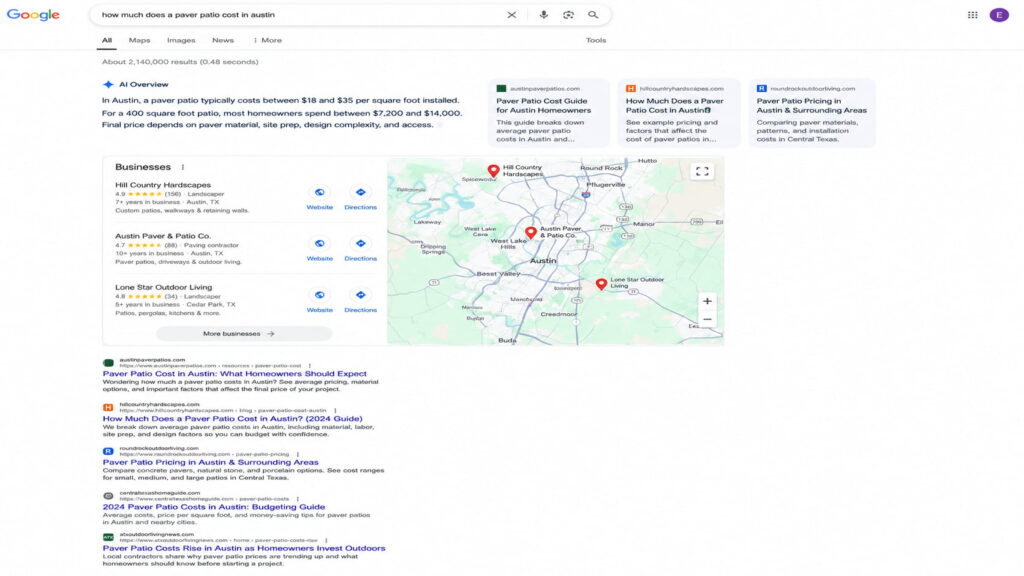
The AI Overview, the map pack, then the first organic result. Same page, different real estate.
Now the part most summaries leave out. The two studies used different methods and neither proves universal causation. More importantly, the Ahrefs study looked only at informational keywords, because 99.2% of the keywords that trigger AI Overviews are informational. Transactional and local searches still produce clicks.
What this means for you: position 1 still exists, it just does not buy the traffic it used to. Ranking and sessions came apart. And neither is the number that makes payroll. That one is still how many quote requests came in and what each cost you.
2. Ranking in the top 10 no longer guarantees you get cited
This is the biggest gap in what is currently written about GEO, and the number worth remembering.
In July 2025, Ahrefs found 76% of the pages cited in AI Overviews also ranked in the top 10. When they reran it in March 2026 across 863,000 keywords and 4 million AI Overview URLs, that figure had fallen to 38%. The rest splits almost evenly: positions 11 to 100 account for 31.2% of citations, and pages outside the top 100 entirely account for 31.0%.
76% to 38% in eight months. Ranking in the top 10 is now a minority path to getting cited.
The likeliest explanation is what the industry calls fan-out queries: the system breaks your question into smaller sub-questions and cites whatever answered each one best. The page that wins is not the one ranking for what you typed. It is the one that answered the piece the system went looking for. Treat that as a hypothesis, though. Ahrefs says fan-out “may now play a larger role,” Google has confirmed nothing, and Ahrefs tested the same theory in July 2025 and could not confirm it then.
There is also a competing number. BrightEdge reports 54% overlap after 16 months of tracking, up from 32% at launch. Their breakdown by industry is more useful than either average: healthcare 75.3%, insurance 68.6%, e-commerce 22.9%. The real number depends heavily on the vertical, which is the only honest answer to “what is it in mine?”
What this means for you: a page at position 40 can get cited, and a page at position 3 can get skipped. If you have a service page that never cracked the top 10, it may be bringing in work through a door you are not watching. Check it before you delete it.
3. The unit of retrieval is the passage, not the page
Generative systems do not read your page the way a person does. They break it into chunks, meaning passages of a few hundred words. Each chunk becomes an embedding, the numeric fingerprint the model builds so it can find that chunk later. When someone asks a question, the system retrieves the chunk that answers it. Not the document. The chunk.
That is passage-level retrieval sitting on top of a page-level web, and it changes one thing about how you write. A heading that asks a question, with a self-contained answer directly underneath, can be pulled and cited. Eight hundred words of runway before the answer cannot, because the chunk holding it does not carry enough of the question to be found.
The difference, in two sentences.
Before: “As the season approaches, many homeowners begin thinking about their outdoor space, and there are a number of factors that determine what a project like this will run…” The price range shows up in paragraph four.
After: “What does a paver patio cost in Austin? Most Austin paver patios run $8,000 to $20,000, depending on square footage, base prep and material.” The answer is the first thing under the heading.
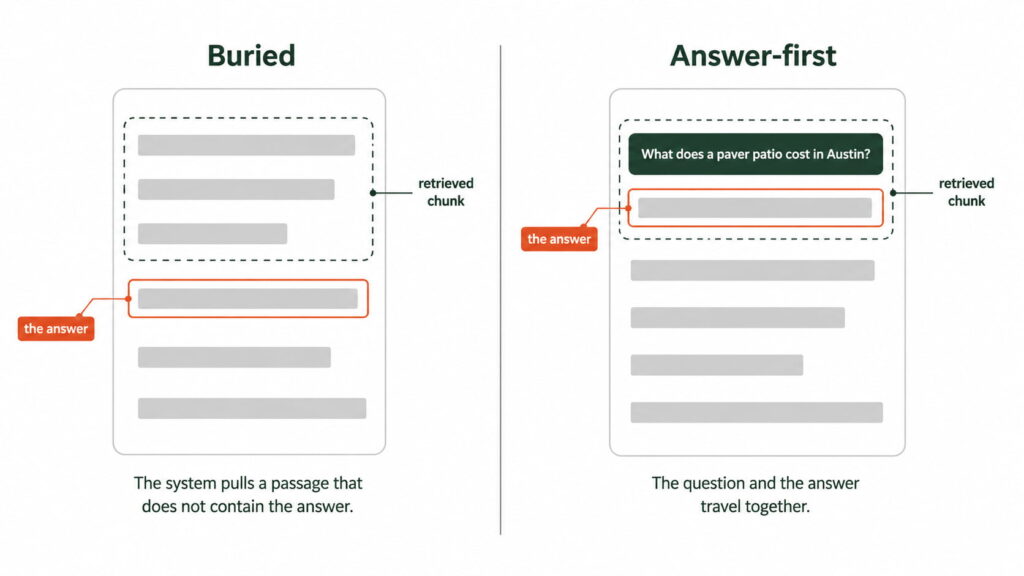
Same words, same page. Only one of these arrangements can be quoted.
What this means for you: the service page you already have can become citable by reordering it, without writing a single new sentence. That is an afternoon, not a redesign.
4. Off-site mentions now do the job backlinks used to do
Models are trained on, and grounded in, text where your business gets named. The link is optional. The mention is not. Reddit threads, YouTube videos, Wikipedia entries, niche forums, trade press and reviews all feed the pool a model draws from when it decides who to name.
The Pew data backs this up. Wikipedia, YouTube and Reddit combined were the three most cited sources on both sides: 15% of all sources in AI summaries, and 17% in traditional results. The same three names dominate whether a model wrote the answer or Google ranked it.
What this means for you: reviews, industry listings and honest presence where your customers already read moved from nice-to-have to a direct input on whether you get named at all. The local chamber of commerce stopped being a plaque on the wall. That is what BASEO builds under reviews and local authority: real citations and editorial links from chambers, trade associations, local news and relevant directories, plus a review system that actually runs, because those are the same signals the map pack reads. No link farms, no PBNs.
One warning, and it is not a formality. Fake Reddit accounts and bought reviews are counterproductive and against the rules of every platform that matters, and the damage outlasts the benefit by years.
5. Less traffic, but higher-intent traffic
Almost nobody quantifies the good side of this, which is strange, because it decides whether any of it hurts.
Semrush found in June 2025 that visitors arriving from AI search converted 4.4 times better than visitors from traditional organic search, across more than 500 digital marketing and SEO topics. The reasoning is straightforward: by the time someone clicks through from an AI answer, they have already compared their options inside the chat. The same research projects AI search traffic could pass traditional search for those topics by early 2028.
Note the sample, because it matters more than the number: digital marketing and SEO topics, not local services. The 4.4x is a signal about direction. It is not your number, and anyone quoting it as if it were has not read the study.
What this means for you: if you only watch sessions, you will conclude the channel is collapsing. Watch quote requests and calls by source instead, which means segmenting referrals from chatgpt.com, perplexity.ai, gemini.google.com and copilot.microsoft.com and looking at what those people actually did.
And the counterweight: absolute volume from those referrals is still small for most sites. A 4.4x conversion rate on 30 visits a month is still 30 visits a month.
What GEO did not change
This is the section most coverage skips, because it is hard to sell a new service on top of it.
- Indexability is still the prerequisite. If Google cannot crawl the page, no generative system is going to cite it. Nothing downstream matters until this is true.
- Search intent still rules. What the person is actually trying to do still decides which format wins, exactly as it did before.
- E-E-A-T is still the quality frame, and it now does double duty. The signals that make a page trustworthy are the same ones that make it citable.
- Transactional and local searches still produce clicks, because the person needs to call, book or get a price. The data supports this directly: 99.2% of the keywords that trigger AI Overviews are informational.
- Technical SEO did not become optional. Speed, structure, sitemaps, canonicals. The fundamentals still decide whether you are eligible to appear anywhere at all.
Almost everything that worked still works. What changed is what you have to do on top of it.
How the SEO workflow changes in practice
What follows is the same process you had, with five pieces rewritten. These are actions, not principles.
Keyword research becomes question and prompt research
Prompts are long, conversational, and full of context. They look nothing like keywords.
“Best landscaper in Austin for a small backyard with clay soil” is a real thing someone types. No keyword tool has it. No volume estimate exists for it. And yet it is closer to how people actually ask than anything in your current keyword list.
So the research changes. Mine People Also Ask boxes and autocomplete. Read the questions people ask in Reddit and Quora threads about your trade. Pull the questions your own sales conversations and customer emails are already full of, which is the source nobody uses and the one you already own. And run your own queries in ChatGPT and Perplexity, then write down who gets named.
Mention-tracking tools exist for this, including Ahrefs Brand Radar and Semrush’s AI toolkit. They are useful once the basics are handled, and premature before that.
Content structure becomes answer-first and chunk-friendly
Open the city page for the town you get the most work from. Somewhere in it is the answer to what that service costs there, and it is probably in paragraph six, wrapped in a chunk nobody will ever retrieve. That is the whole problem in one page.
The rules that fix it are concrete. One heading, one question. A self-contained answer of 40 to 60 words directly underneath. Tables for anything comparative. Every figure with a source and a date. No walls of text. If the retrieved unit is the passage, the passage has to stand on its own.
One caution that Impact makes well in their coverage of this topic, and it is worth repeating: do not rewrite pages that already rank. Restructure them. Moving the answer to the top of the section is a different job from starting over, and starting over is how sites lose rankings they had. If you want the section-by-section version of that, we wrote up what to write on a service page separately.
Technical SEO adds a second set of crawlers
There is a persistent belief that blocking AI crawlers removes you from AI citations. For half of them that is not true. All three major providers separate training from search, and use a different crawler for each.
| Crawler | What it does | Blocking it removes you from |
|---|---|---|
GPTBot | OpenAI model training | Training. Not ChatGPT search |
OAI-SearchBot | Surfacing sites in ChatGPT search | ChatGPT search |
ClaudeBot | Anthropic model training | Training |
Claude-SearchBot | Claude search result quality | Claude’s search results |
Google-Extended | Gemini training and grounding | Gemini. Not Google Search or AI Overviews |
Googlebot | Google Search | Google Search and AI Overviews |
Google states it directly in its crawler documentation: “Google-Extended does not impact a site’s inclusion in Google Search nor is it used as a ranking signal in Google Search.” OpenAI and Anthropic publish the same split.
So the real decision is not whether to block AI crawlers. It is: block the training crawler if you want to, and let the search crawler through if you want to be cited.
The rest of the technical list is short. Add schema markup, the labelling that tells Google exactly what a page is: Organization, Article, FAQPage, and LocalBusiness, the one that matters for a service business. Render server-side, meaning the content exists in the HTML before any JavaScript runs, because many AI crawlers handle JavaScript badly. And keep your NAP consistent: same name, address and phone number on every page and listing.
On llms.txt, a proposed file for telling models how to read your site: emerging proposal, not adopted standard. Adoption grew 8.8 times in twelve months, and 97% of those files received zero requests in May 2026. Google says it has no effect on rankings. Add one if you like, but nobody should sell it to you as required.
Link building becomes mention building
Translate the off-site point above into things you can do this month.
Get listed in industry directories and association listings. Answer journalist requests through HARO or Qwoted and get quoted in trade press. Participate honestly where your customers talk. Publish case studies with your own numbers in them. Put video on YouTube.
The key point sits under all of those: original data is the currency. If you publish a number nobody else has, you get cited for it.
For a service business that is more available than it sounds. Your chamber of commerce, your trade association, your local paper. And the numbers only you have: what a job in your market actually takes end to end, what share of your estimates close in peak season, what a customer is worth over three years on your books. Nobody publishes those. You could.
Reporting rebuilds around visibility, not sessions
The new metrics are share of voice in AI answers, meaning what fraction of relevant answers name you at all; citation frequency by prompt; referrals segmented by AI domain; quote requests by source; and branded search volume as a proxy for exposure that never produced a click.
That last one is worth sitting with. Somebody can see your name in an AI answer, never click, and search your business by name three days later. The old report calls that Direct traffic and takes no credit for it.
The expectation this creates is uncomfortable: traffic can fall while the business grows. There is no CMO to explain that to. It is you, looking at a chart that goes down while the phone rings the same or more. Which is why BASEO’s monthly reporting counts quote requests and calls with phone numbers attached, cost per lead, map position and AI citations on one page in plain English, instead of handing you a dashboard to learn.
None of that is abstract. If you run lawn care routes, the number that moved is how many of this month’s quote requests came from a chat instead of a search bar, and whether they signed a monthly contract or a one-time cut. If you run tree work, it is whether the storm calls still land on the phone. Same question, different unit.
What GEO means for local service businesses
Local and transactional searches are the least eroded part of all this, and the reason is not complicated. No AI assistant is going to walk the property, measure the yard, or put a crew on the schedule. The person still has to call somebody. The data lines up: 99.2% of the keywords that trigger AI Overviews are informational, not transactional.
Here is where it actually costs you something.
The research questions that come before the call are moving into the chat. “How much does a paver patio cost.” “How do I choose a tree service.” “What should lawn care run per month.” Those used to land on somebody’s page, and whoever owned that page got a head start on being considered. Now the answer often arrives without anyone visiting a website at all.
You are not losing the call. You are losing the part where you got to shape the question before the call.
Five things move that, and none are new work invented for AI.
Keep your Google Business Profile complete and active, and treat it as the entity record for your business rather than a form you filled out once. That profile is what both the map pack playbook and the assistants lean on to decide you exist and are real.
Keep your NAP consistent across every listing. Contradictory records make a business look less certain to a system deciding who to name.
Keep review volume and freshness up. Reviews from three years ago read as a business that used to be busy.
Build service pages and city pages that answer price and process with real numbers. If your page will not give a range, the generated answer will give one anyway, and it will not be yours.
Publish content that answers your customer’s questions before the call, not after.
That is what AI search optimization covers on the BASEO side, and this article is the argument for it. If citations now come from outside the top 10 more often than from inside it, ranking work alone stops being enough. If the retrieved unit is the passage, pages have to be built passage-first. And if the assistants lean on the same reputation signals as the map pack, the review work was never a separate project. Those three facts are the service. Almost nobody in the trades is set up for it yet, which is the argument for doing it now instead of in two years.
One honest note on scale. The effect in local is still smaller than what publishers and purely informational sites are seeing. If someone is telling you your local business is in crisis over this, you are being sold something. Fix the cheap things now and watch the trend.
Then put your own numbers on it before you decide it does not matter. Take the searches you used to win before the phone rang: the cost question, the how-to-choose question. If ten of those a month used to land on your page and now land in a chat, and one in five of those visitors used to ask for an estimate, that is two estimates a month you are no longer in the room for. Multiply that by whatever an average job is worth on your books. The number is different for a mowing route than for a removal, which is exactly the point: run it on yours, not on an industry average.
How to measure GEO when your old metrics stop working
The old numbers did not stop being true. They stopped telling the whole story.
| Metric | How to measure it | How often |
|---|---|---|
| Brand citations in AI answers | Brand monitoring tools, or manually run a fixed set of 20 to 30 prompts and record who gets named | Monthly |
| Referrals from AI domains | GA4, filtered to chatgpt.com, perplexity.ai, gemini.google.com and copilot.microsoft.com | Weekly |
| Impressions vs clicks | Search Console. Flat impressions with falling clicks is CTR erosion, not a ranking drop | Monthly |
| Quote requests by source | Your form and call tracking, segmented by referrer | Monthly |
| Branded search volume | Search Console, your own business name as the query | Monthly |
The third row is worth explaining, because it is the one people misread. If your impressions hold steady and your clicks fall, you did not lose rankings. You lost the click to something above you on the page. Those are two different problems with two different fixes, and the report will look identical if you only watch traffic.
There is one real limitation on all of this. Model answers are non-deterministic, meaning the same question can produce different answers in different sessions and for different users. So you measure trends across a fixed set of prompts, never single snapshots. A screenshot of one good result is not data.
Which leads to the only recommendation in this section: set a baseline today. Thirty prompts, a spreadsheet, an hour of your time. In three months that file is worth more than any tool you could buy before you had it.
A 90-day GEO plan to adapt
Three blocks of thirty days. Everything below is something you can tick off, not something to think about.
Days 1 to 30, baseline and plumbing.
- Write your fixed set of 20 to 30 prompts, the ones a customer would actually type before calling you.
- Run all of them and record who gets named today. That is your baseline.
- Segment AI referrals in your analytics so the traffic stops hiding in Direct.
- Audit your robots.txt against the crawler table above and decide, deliberately, which ones you allow.
- Audit your schema. Organization, LocalBusiness, FAQPage where relevant.
- Fix anything blocking crawling. This one comes first if it turns up.
Days 31 to 60, content.
- Take your 5 to 10 pages with the highest impressions and restructure them answer-first. Restructure, do not rewrite.
- Add FAQ sections with schema to your main service pages.
- Publish one piece built on data only you have.
Days 61 to 90, authority and re-measurement.
- Run a mentions and reviews push: listings, associations, local press, and the review requests you have been meaning to send.
- Build one genuinely citable asset. A study of your market, a calculator, a benchmark.
- Re-run the same 30 prompts and compare against your baseline.
Now the honest expectation. Citation movement typically shows up in weeks, because these systems re-crawl and re-retrieve often. Authority takes months, the same way it always has, because it depends on other people doing things. And anyone guaranteeing you citations in ChatGPT in 30 days is selling you something they cannot deliver, because nobody controls what an assistant says.
Where SEO and GEO go next
Three predictions, labelled as predictions.
The terms will probably converge. SEO, GEO and AEO look increasingly like one discipline with three vocabularies, and the survey data above already points that way.
Search likely gets agentic, meaning the assistant carries out the task rather than just answering it: comparing, booking, buying. For a service business that would be a real shift, because the form and the phone would stop being the first point of contact.
And pressure on the economics of open content is likely to keep building. Licensing deals, crawler blocking, paywalls. How that resolves is genuinely unclear, and anyone who tells you they know is guessing.
None of that changes the work. The stable job is to be the clearest, most verifiable source on your subject in your market. That survives every interface change, because every interface has to get its answer from somewhere.
Get a free audit of how AI search sees your site
You do not need a new channel for any of this. You need to know which of your existing pages a machine can quote, and which of your crawlers you closed by accident.
That is what the audit answers: the prompts that name you today, the pages structured to be pulled, the robots.txt line nobody has read since the site went up, and the searches where your impressions held while your clicks fell.
Written, about two business days, no call. Keep it either way.
Frequently asked questions
No. GEO extends SEO rather than replacing it. The technical foundations, crawlability, site structure, intent matching, and E-E-A-T, still decide whether a page is eligible to appear anywhere. What GEO adds is optimizing for retrieval and citation inside AI-generated answers, which is a new surface, not a new discipline.
SEO optimizes a page to rank in a list of links. GEO optimizes content to be retrieved, cited and summarized inside an AI-generated answer. SEO measures rankings and clicks. GEO measures citations, mentions and share of voice across AI assistants. The underlying content quality work overlaps heavily.
Not in the traditional sense, because there is no ranked list of results. You can increase how often you are cited by publishing clearly structured, answer-first content, earning mentions on sources these systems trust, and allowing AI search crawlers to access your site. Results vary by prompt and are not deterministic.
No, when done properly. The main GEO tactics, clearer structure, direct answers, schema markup and stronger topical authority, are also ranking factors in traditional search. The one real risk is rewriting pages that already rank well from scratch. Restructure them instead of replacing them.
Structural changes can affect citations within weeks, because AI systems re-crawl and re-retrieve frequently. Authority-driven gains, brand mentions, reviews and earned coverage, take months, similar to link building. Anyone guaranteeing ChatGPT citations in 30 days is overselling. Results depend on prompt, model and competition.
Usually not a separate agency. Most of the work belongs to whoever already owns your organic channel. Tracking tools help once the fundamentals are fixed, but buying an AI-visibility tool before your site is crawlable, structured and authoritative measures a problem you have not addressed yet.