It’s Tuesday. Two crews finish by noon, the trailer is back at the shop by one, and the phone hasn’t rung since Friday. So you go looking for leads. You buy a lead package, boost a post, or call the SEO company that keeps emailing you. Six weeks later the schedule still has holes.
Here’s the part nobody tells you about how to get more landscaping jobs: every lead source has a delay built in, and the delay is never on the list. Some book work this week. Some in ninety days. Some take a season, then keep paying. This guide sorts them by when the first job lands.
In this guide
- Why more leads won’t get you more landscaping jobs
- The 3-speed landscaping job pipeline, explained
- Speed 1: Landscaping jobs you can book in 7 days
- Speed 2: Landscaping jobs you can book in 30 to 90 days
- Speed 3: Local SEO for landscapers, the jobs that compound
- How to get commercial landscaping contracts
- Close more landscaping jobs from the leads you have
- Track booked landscaping jobs, not traffic
- Your 90-day plan for more landscaping jobs
- Get a lead system built for your market
- Frequently asked questions
Why more leads won’t get you more landscaping jobs
Booked jobs come out of three numbers multiplied: how many quote requests you get, how many you close, and what the average job is worth. Most operators only pull on the first.
Run your own numbers. Say you get 40 quote requests a month, close one in four, at an average job of $1,800. That’s $18,000 a month on the schedule.
Now leave the leads where they are and take your close rate from 25% to 40%. Same phone, same ad spend, same forty quote requests. That’s $28,800.
You just found $10,800 a month without buying a new lead.
Doubling lead volume costs money every month, forever. Raising your close rate costs a phone call on day two and a text on day five.
One of those is free, and it’s the one nobody works on. Chasing leads feels like doing something. Following up on an estimate you sent feels like admitting you dropped it.
This guide covers both, sorted by something more useful than “online” and “offline”: how long until the first job lands.
The 3-speed landscaping job pipeline, explained
Every way of getting work has a delay baked in. A text to a customer you finished for last spring can turn into a booked job Thursday. A page you publish today about paver patios might not bring a call until March.
Both are worth doing. Neither substitutes for the other. Sort by speed, not channel.
| Speed | What’s in it | When the first job lands | What it costs |
|---|---|---|---|
| Speed 1 | Past-customer reactivation, quote follow-up, route density, Local Services Ads | Days | Free, except Local Services Ads at about $39 a lead |
| Speed 2 | Google Business Profile, reviews, paid search, referrals | 30 to 90 days | Free to about $88 a lead on paid search |
| Speed 3 | Local SEO, a page per service and a page per city | 3 to 12 months, then it compounds | Front-loaded work, falling cost per job |
These run at the same time. Not a sequence, not a ranking.
Two ways to get it wrong, mirror images. The first is building the slow thing with no cash coming in, waiting on rankings through a season you needed to survive. The second is running only the fast thing, so five years in your business stops the day you turn off the card.
Both at once is the honest version. Ads book jobs now. The pages you own make every job after that cheaper.
Speed 1: Landscaping jobs you can book in 7 days
Nothing here needs a new website, a budget approval, or a wait. No agency, no page that has to rank.
All of it runs off two things you already have: the phone in your pocket and the customer list in whatever software you invoice from. This is the part you run yourself, this week, from the truck.
Reactivate past and lapsed customers
Pull your customer list for the last 24 months and filter to everyone who hasn’t bought in six months or more. That list is always bigger than you expect, and it’s the cheapest work in the business.
Then send one specific offer with a real deadline. Not “we have availability.” A named service, a price or range, and a date set by crew capacity.
A two-line text:
Hi Karen, it’s Mike at [company]. We’re doing fall cleanups on your street the week of the 14th and have two slots left. Want me to put you down?
Four lines by email, same structure: who you are, the job, the window, one question answerable in a word.
No cold lead can match this. They already trust you. They already know what you charge. You already have the address, the gate code, and the note about the dog.
One warning. “Just checking in” is not an offer. It gives them nothing to say yes to, so they say nothing, and you decide the list is dead when what died was the ask.
Answer fast and follow up on every quote you already sent
Two things are happening in your pipeline right now and both cost you jobs.
The first is response time. When a homeowner fills in three forms on a Sunday night, the crew that calls back first usually walks the property, and the crew that walks it gets the job. Not always. Usually.
The second is the quote graveyard. Count the estimates you sent in the last ninety days that nobody answered. Most aren’t a no. They’re a homeowner who read it in a parking lot and meant to talk to her spouse.
Field data from landscape proposal software shows 43% of proposals close within 24 hours of being opened, and average time from first open to close is about 51 hours (SynkedUP). Miss that window and you’re bidding against your own silence.
Give every open quote a three-touch cadence:
- Day 2: a phone call, not a text. Ask if anything in the scope needs adjusting.
- Day 5: a text with a photo of a similar job nearby. “This is the wall we did on Oakmont last month.”
- Day 10: a last note with a smaller version. Phase one only, or the patio without the fire pit.
That’s the practical answer to how to get landscaping customers when the ad budget is spent: the ones you want are in a folder marked “sent.” As the same source puts it, a quick turnaround on a quote wins more jobs than the lowest price ever will.
Work route density instead of driving across town
Two properties on the same block are worth more than two twenty minutes apart, even at the same price. The second costs almost no drive time, no second mobilization, no trip back for the thing you forgot. Drive time is margin you already paid for and never billed.
So sell where the truck already is. While the crew is on a job, walk the ten nearest houses and leave a card or hanger that says something specific: we’re on your street Thursday, here’s what we do, here’s the number.
The yard sign works the same way, with permission, and better with an offer on it than with just a logo. Nobody ever called a landscaper because they admired his logo.
Old-school, about forty dollars, and it still books work.
Turn on Google Local Services Ads
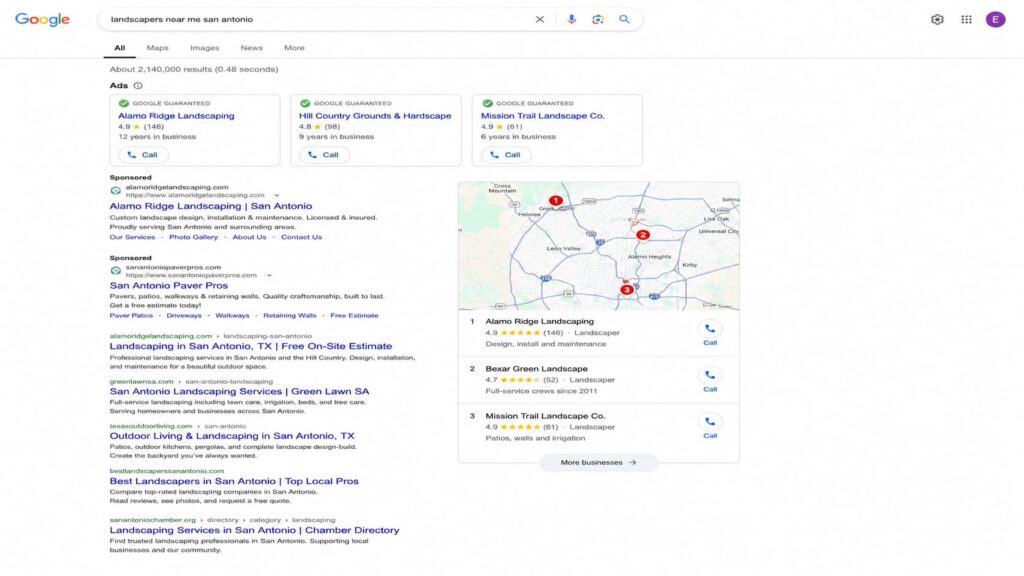
Local Services Ads sit above everything else on a local search. Above the map, above the regular ads, with a green Google Guaranteed check next to your name. Google verifies your license and insurance, then charges per lead, not per click.
What that means on a job site: it rings. She’s looking at a retaining wall coming apart, taps the top result, and your phone goes off while you’re unloading the truck.
They average about $39 per lead for landscapers with roughly a 31% booking rate, against about $104 per lead on standard Google search ads (99 Calls and Blue Grid Media data, compiled by Sideways8).
Do that math in your own units. At $39 a lead and one booking in three, that’s about $125 per booked job. On a $2,400 cleanup, five percent. On a design-build job it disappears.
Two things to get right. Your categories must match what you actually sell, because that’s where a Local Services Ads budget leaks. And dispute the leads that were never your work: almost nobody does, the credit is real money, the form takes two minutes.
One warning that makes the rest honest. If nobody answers the phone, this is burned money. You pay for the ring, not the job.
Speed 2: Landscaping jobs you can book in 30 to 90 days
These are the levers that fill next month and the month after, and keep filling it once running. None pay off this week, and all stop needing your attention once set up.
If you’re reading this in January, this block decides what April looks like.
Fix your Google Business Profile so you show up in the map pack
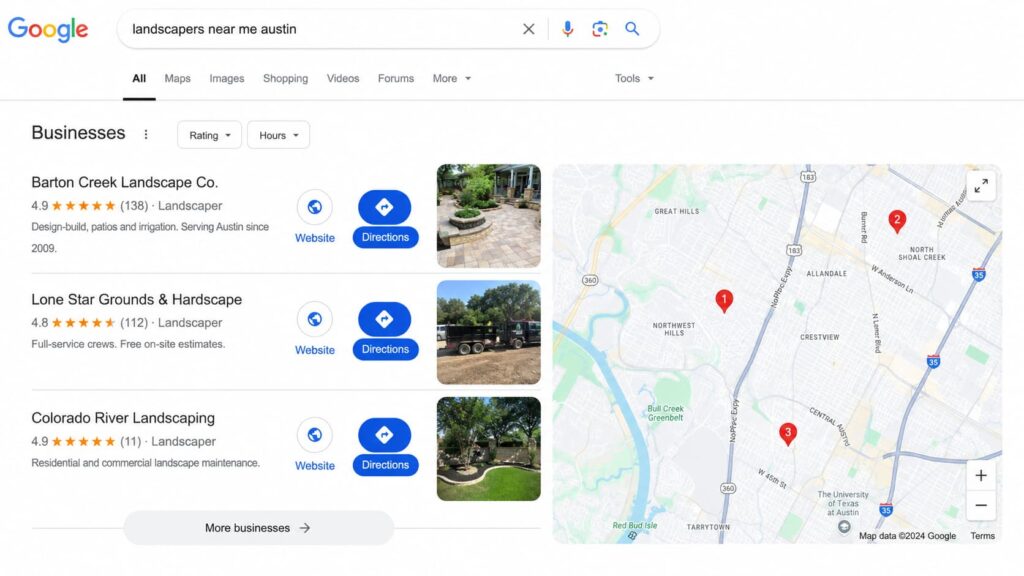
The map pack is the three businesses Google shows above everything else on a local search. That’s the real estate that matters for “near me” work, and about 42% of searchers click one of the three (Backlinko via BrightLocal).
Your Google Business Profile decides which three, and it’s the most neglected asset in most landscaping companies. Google’s own numbers: on a complete profile customers are 2.7 times more likely to consider a business reputable and 70% more likely to visit (via BrightLocal).
The checklist, in the order that moves the needle:
- Set the primary category to what you actually sell. A design-build company filed as “Lawn Care Service” competes for the wrong search all year, and primary category is among the strongest influences on map pack rankings (Local Search Ranking Factors 2025).
- Set a real service area. The towns your trucks reach, not a fifty-mile circle.
- List every service individually, with its own description. Not “landscaping.” Paver patios. Retaining walls. Irrigation repair. Sod.
- Load project photos, before and after. Same angle, both shots. This is the trade where the photo closes the job.
- Post weekly. A finished job, a seasonal service, a scheduling note.
- Seed the Q&A section. You can ask and answer your own questions, and most operators don’t know it.
- Match your name, address and phone everywhere else. A mismatch reads to Google like two businesses.
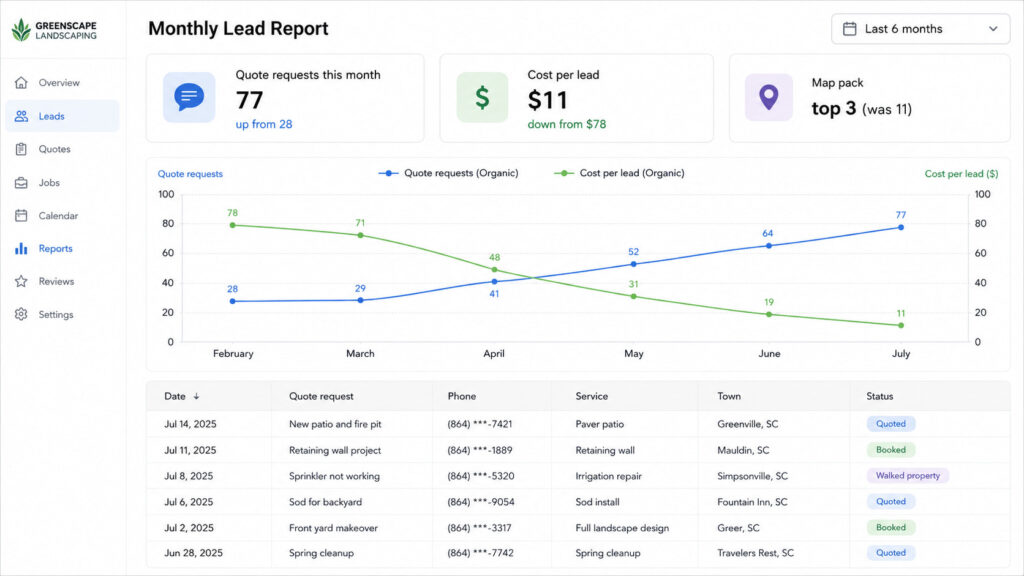
Rebuilding that profile is one of the first things BASEO does on a landscaping account, along with call tracking on every number first. A channel you can’t count is one you’ll argue about in month six. For one San Antonio landscaper it moved the money keyword from position 11 to the top three of the map pack in under six months (BASEO client data).
Build a review engine, not a review request
A review request is a good intention. A review engine happens whether anybody remembers or not, which matters because the day you forget is the day the crew is slammed and the customer happiest.
Ask on site, the same day, while you’re both looking at the finished work. Put the short link on a QR card in the truck, or have your invoicing software text it at ticket close. Give the foreman one line: “If you’re happy with it, a quick Google review helps us more than anything.”
The reason to bother isn’t reputation in the abstract. It’s the number in front of your name. 97% of consumers read reviews for local businesses, and 47% won’t use one with fewer than 20 (BrightLocal 2026).
Nearly half your market filters you out before they read a word you wrote. Not on price. On review count.
The average consumer now checks six review sites, and Google’s share dipped from 83% in 2025 to 71% (BrightLocal). So Google first, then Facebook, Yelp, and the directories including Angi. Being reviewed there is worth something. Buying leads there is a different transaction, answered below.
Answer every review, bad ones included, and name the service in the reply. That gives Google a sentence with a service and a location in it.
BASEO runs review generation as a system, not a reminder, alongside real local citations and editorial links. No link farms, no PBNs, no bought reviews. The software that texts your customer is your field system’s job.
Run paid search on your high-ticket services only
Do not bid the same budget on a $200 mow and a $20,000 patio. That’s the rule, and breaking it is how landscaping ad accounts waste money. Bid the paver patio, the retaining wall, the irrigation install, the sod job.
Three mechanics. Match types control how loosely Google reads your keyword, and broad match unsupervised is how you pay for “landscaping degree.” Negative keywords block a search outright: jobs, salary, DIY, free, cheap. And each service needs a landing page per service, because a retaining-wall click landing on your homepage makes her hunt for what she came for.
What it costs here: across 61 landscapers spending $225,000 in 2024, average cost per click was $3.65 and cost per lead $87.80, with spend bottoming near $315 in January and peaking near $1,070 in April (Green Industry Pros).
The whole market bids up in the same eight weeks. Build the profile and the pages before the season.
Run properly, the same budget buys a different result. One landscaping operator went from $84 to $43 cost per lead in six months on the same budget, and from 18 to 54 leads a month (BASEO client data). That’s the work BASEO does on the paid side, and ad spend goes straight to Google, never marked up.
Paid buys you this week. The pages buy you every week after.
Give referrals a real reason to happen
“We appreciate referrals” is not a referral program. It’s a feeling.
A program is a number you say out loud, the same way, every time. Twenty-five dollars of credit for any referral that becomes a booked job, or a free spring cleanup once someone sends three. Pick one and give every crew leader the exact sentence.
Ask while you’re standing on a finished install with the customer looking at it and the truck still in the driveway. Not in February, not by mass email.
The customers who come in this way are also better customers. A study in the Journal of Marketing found the average referred customer is worth at least 16% more over time than a non-referred one, and is roughly 18% less likely to leave (Schmitt, Skiera and Van den Bulte, 2011).
That study looked at a bank’s customers, not a landscaper’s, so read it as direction. What a referred customer is worth over three years beats what a bought lead is worth.
Then the partner version most operators leave on the table. Irrigation, tree service, pool builders, nurseries, and the realtors who need a property to show well in eleven days. Two-way and explicit, or it stops after the second job.
Speed 3: Local SEO for landscapers, the jobs that compound
Everything above stops when you stop. Turn off the ads and the phone goes quiet Thursday. That’s not an argument against ads. It’s a description of what you’re renting versus what you own.
And here’s the straight answer promised earlier. A shared lead isn’t a lead source. It’s a lead rental: you pay the same whether you close it or lose it to the four other crews who bought that number the same morning.
That San Antonio crew was paying $78 a shared lead and ended around $11 off pages it owns (BASEO client data). Not a reason to cancel anything Monday. A reason to make it optional.
Expect three to six months before this carries weight.
Not sure which of the three speeds is actually broken in your business? Send us the domain and you get back a written review of your site, your profile, your map position and your top local competitor, plus the job math for your market. Free, about two business days, no call required. Send Me the Marketing Audit →
One page per service, one page per city you actually serve
The architecture that produces organic quote requests isn’t complicated and almost nobody builds it. A page per service you sell, a page per town you drive to, crossed where there’s real volume behind the pair.
One page cannot do this. Google will not rank a single page for eleven suburbs, and she types her own town into the box, not yours. The common version of the mistake is a “Service Areas” page listing nineteen towns and ranking for none.
Now the decision that determines whether the channel pays you back. “Paver patio [your city]” and “lawn mowing [your city]” cost about the same to win. Same research, same page, same week of your life.
For that San Antonio crew, one of those pages produced a $14,800 patio (BASEO client data). Put that against what identical effort returns on a mowing page and the two aren’t in the same business. Same input, one job worth forty of the other coming out.
Which makes build order the whole decision. Hardscape and design-build first, irrigation next, recurring work after. Not because mowing doesn’t matter, but because when the page costs the same either way, build the one that changes your year.
The trap on the city side is the doorway page: forty near-identical pages with the town swapped. Every page needs something only it can say. Jobs you finished there. The neighborhoods your crews work. How fast you get a truck out.
That’s what BASEO builds on the organic side: service and city pages for landscapers written original per town, and service pages ordered by what the job is worth.
Photos and project pages that prove the work
Landscaping sells with a picture, so the pictures have to be evidence, not decoration.
Shoot before and after from the same spot, same time of day, every job. The pair is what does the work. A beautiful “after” with no “before” is a stock photo as far as she’s concerned.
Then turn six to eight finished jobs into project pages. Scope, materials, duration, town. A page about a specific retaining wall in a specific neighborhood out-converts a gallery every time, because it answers what she’s actually asking: “have you done mine.”
Three technical notes worth ten minutes each. Compress the files, because she’s loading them on a phone in her driveway. Name each file for the service and the town instead of IMG_4471. And write alt text, the short description that loads in place of the image.
One more reason to write those pages as questions and answers: that’s the format AI assistants pull from when someone asks who to call. They name two or three businesses. Nobody controls whether you get named. You control whether there’s anything to name.
Stay visible in the off-season
Here’s the pattern in the snow belt and half the sun belt. Work dries up in October. The posting stops, the photos stop, the review asks stop, the pages stop.
In March it all switches back on and he finds three crews across town published all winter and now sit above him, going into the only eight weeks that matter.
A profile that goes dark in October doesn’t just look neglected. It stops collecting the reviews, photos and posts it’s judged on, and walks into spring behind whoever kept going. Same shape in the ad data above: spend bottoms near $315 in January and quadruples by April.
So don’t sleep. Keep posting the winter services you sell: leaf removal, snow and ice, hardscape that doesn’t care about frost, spring design consultations.
Count backwards. To rank in April, the pages go up in December.
How to get commercial landscaping contracts
Commercial work gets its own section because it’s the ticket jump, and because nothing about winning it resembles a homeowner filling in a form.
Who actually decides. Property managers running multi-site portfolios. HOA boards voting on a recommendation. Apartment complexes, school districts, municipalities, and the facilities person who has never googled “landscapers near me.” They don’t shop the way homeowners do, which is why the Speed 1 and Speed 2 playbook barely touches them.
What gets you allowed to bid. Commercial clients typically require a certificate of insurance for general liability or workers’ compensation, you may need to be bonded for commercial and government contracts, and depending on state and scope you may need a contractor’s license just to submit (Insureon). Sort it before you find the opportunity: it takes weeks and bid windows don’t wait.
Where the work is. Municipal and school district procurement portals list open solicitations publicly, and most operators have never opened one. Beyond that: drive-by audits of under-maintained properties, chamber rooms where the property managers are, and a list of the commercial properties on your route.
When to ask. Most commercial landscaping contracts renew on a fixed cycle, so the useful question is never “are you taking bids.” It’s “when does your window open, and who do I send it to.” Ask a season early.
Why bids are won. Not on price. On specificity and reliability, and on looking like a company that still answers the phone in year three. A client may drop you over a sloppy proposal regardless of price (Insureon).
A bid package taken seriously has:
- Pricing broken out by acreage, estimated labor hours, materials and service frequency
- A current certificate of insurance
- Every applicable license
- Your written safety procedures
- The full service list, with what’s included and what isn’t
- The service schedule, by month
- Any permits the scope requires
HOA landscaping bids run the same way with one addition: you’re presenting to a volunteer board, so the proposal has to be readable by someone who must defend the choice to neighbors.
Close more landscaping jobs from the leads you have
Back to the formula from the top. You’ve seen what a lead costs in every channel, so here’s the variable that stays free.
Turn the estimate around in 24 to 48 hours. Not a text with a number in it. A document with your logo, the scope, and what’s excluded. You saw the proposal data in Speed 1: the window is days, not weeks.
Give three options instead of a discount. Good, better, best. The base scope, the scope with the thing you’d recommend, and the full build. Price the middle to be the obvious choice. Cutting price moves the formula the wrong way; a customer picking the middle moves it the right way, on a lead you already paid for.
Sell the second thing while you’re already on the property. Mulch with the cleanup. Lighting with the hardscape. Drainage with the regrade. An annual maintenance agreement at the end of an install, when the customer is looking at something they’re proud of.
That last one is worth more than it looks. Installs are the spike in your year; maintenance is the floor underneath. A business living on one-offs starts every January at zero; one with contracts starts with a number on the board. That floor turns a half-empty Tuesday into a scheduling problem, not a cash problem.
Don’t let anybody hand you a conversion rate benchmark, including us. Close rates move with market, service mix and who’s selling. Track your own against last quarter.
Track booked landscaping jobs, not traffic
Measure four things by source: calls off your profile, direction requests, form fills, and cost per booked job.
That last one is the only one that decides anything. Visits and impressions are what a marketing company shows you when it has nothing else. They’ve never made a truck payment.
Three moves make this real, none needing software you don’t have. Put a tracked number on each source. Ask “how did you hear about us” on every call and write it down in the same place. Review one sheet, once a month.
Here’s what that review will tell you. The cheapest source per lead is not the cheapest source per booked job. A $39 lead that books one in three costs you about $125 a job. An $11 lead that books one in twenty costs you $220. The cheap lead lost, and you’d never see it on a report that stops at cost per lead.
So the report we send opens with phone numbers. Quote requests and calls first, cost per lead by channel underneath, map position for the keywords that pay, next month’s plan. One page.
If a report never uses the words “quote requests” and never shows a phone number, it isn’t a report. It’s a receipt for nothing.
Your 90-day plan for more landscaping jobs
Everything above, sequenced. Screenshot it.
| Days | Do this | Owner |
|---|---|---|
| 1–30 | Pull the 24-month customer list and send one seasonal offer with a real deadline · Call every open quote older than a week · Set the Google Business Profile primary category and list every service individually · Turn on Local Services Ads · Put a tracked number on every source | Owner + office manager |
| 31–60 | Ask for a review on every completed job, same day · Answer every review with the service named · Start paid search on your two highest-ticket services only · Leave hangers on the ten houses nearest each job · Name one referral offer and say it out loud every time | Office manager + crew leads |
| 61–90 | Build service pages in margin order, hardscape first · Build a page for each of your top three towns · Turn six finished jobs into project pages · Review cost per booked job by source on one sheet | Agency, or the owner in the off-season |
Now the expectation, honestly. The first jobs land in week one or two, out of Speed 1, because that work was already in your phone. Ads typically start booking inside two to three weeks. Organic quote requests usually show up in month three to five, real volume between six and nine. “Typically” and “usually” are doing real work there.
Get a lead system built for your market
You don’t have a lead problem. You have three clocks running at different speeds, and most operators wind one.
Here’s the diagnostic, and it costs ten minutes. Open the last six months of closed jobs and write down where each came from. If they all came from one place, you’re running one speed, and the half-empty Tuesday isn’t a mystery. It’s arithmetic.
That’s the first thing our audit hands back: which speed is dead, what your top competitor built that you didn’t, and the job math for your market.
Send a domain, nothing else. It comes back in writing in about two business days, yours whether we work together or not. Once running, twenty minutes a month from you.
Frequently asked questions
Four sources: their Google Business Profile and the map pack, referrals from past clients, paid channels like Local Services Ads, and neighborhood presence such as yard signs and door hangers. The fastest results come from reactivating past customers and following up on unanswered quotes.
Start with the leads you have. Call every customer who hasn’t booked in six months with a seasonal offer, follow up on every open estimate, and turn on Local Services Ads. Those three can book work inside a week, while reviews and local SEO build behind them.
For most landscapers, yes. About $39 per lead with roughly a 31% booking rate, against about $104 on standard search ads (Sideways8). You pay per lead, sit above the map pack, and can dispute unqualified leads for credit. Only if you answer the phone.
No universal percentage is worth trusting. Across 61 landscapers in 2024, average cost per lead was $87.80, with spend bottoming near $315 in January and peaking near $1,070 in April (Green Industry Pros). Start from cost per booked job.
Identify the properties you want, then ask the property manager when they accept new bids. Commercial work usually requires a formal proposal, proof of insurance and licensing, sometimes bonding (Insureon). Reliability and a readable proposal win more often than a low price.
At least 20 to clear the credibility bar. 47% of consumers won’t use a business with fewer than 20, and 97% read reviews before choosing (BrightLocal, 2026). Recency matters as much as volume, so aim for steady flow, not one push.
Three to six months before it carries real weight. Profile fixes and review growth can move map position within weeks, while service and city pages take a full season to compound. First organic quote requests typically land in month three to five.
Sell winter services to your client list first: leaf removal, snow and ice, hardscape builds, lighting, spring design planning. Keep the profile active through the slow months, since one that goes quiet stops collecting the signals it’s judged on right before the spring rush.