Most guides on how to market a landscaping business hand you thirty tactics and no order. So you try three at random, none of them stick, and you go back to word of mouth.
This one is ordered by cost and speed. You get what a landscaping lead actually costs with the sources attached, the sequence to build the channels in, and a 90-day plan you can run from a truck.
In this article
- The short answer: what actually gets landscaping jobs in 2026
- Before any tactic: pick your customer, your services, and your map
- Step 1: Own the map: your landscaping Google Business Profile
- Step 2: Turn your landscaping website into a lead machine
- Step 3: Buy landscaping leads with Local Services Ads and Google Ads
- Step 4: Market the street you’re already parked on
- Step 5: Make referrals and reviews a system, not luck
- Step 6: Show the landscaping work in photos, video, and social
- Step 7: Stop losing the customers you already have
- How much should you spend on marketing a landscaping business?
- How to know what’s working: landscaping lead source tracking
- Marketing mistakes that quietly cost landscapers money
- Your first 90 days marketing a landscaping business
The short answer: what actually gets landscaping jobs in 2026
Build the channels in this order: Google Business Profile and reviews first, then a site with real service and city pages, then Local Services Ads and Google Ads, then route marketing like yard signs and door hangers, then referrals, then photos of real jobs, then reactivating past customers.
The order is not arbitrary. The free and fast channels go first because they cost you time instead of money. Paid goes next because it books work while everything else is still warming up. The pages you own go last in sequence and first in value, because they take the longest to land and they are the only thing that gets cheaper per job every year you keep them.
| Channel | Time to first lead | Typical cost per lead |
|---|---|---|
| Google Business Profile + reviews | Days to weeks | $0 plus your time |
| Yard signs, door hangers, referrals | Same day | Near $0 plus printing |
| Local Services Ads | Days | About $39–$60 per charged lead |
| Google Search Ads | Days | About $88–$118 per lead |
| Service and city pages (SEO) | 3–6 months | Fixed monthly cost, falling cost per lead |
| AI search (ChatGPT, AI Overviews) | Months | Fixed monthly cost, no per-lead charge |
The two paid rows carry a wide spread because they move with your market, your season and how well the account is built. Local Services Ads for landscaping contractors average $47.69 per charged lead with a typical range of $39.20 to $59.72, according to 99 Calls, based on their own client data as of July 2026.
On regular search ads, LocaliQ’s home services benchmarks put landscaping at $117.92 per lead, while a set of 61 landscaping accounts analyzed in Green Industry Pros came in at $87.80.
Before any tactic: pick your customer, your services, and your map
Landscaping marketing fails from lack of focus far more often than from lack of channels.
Promote every service you have ever performed to everyone inside a 60-mile radius and you will get leads. You will also get a schedule full of low-margin work in towns your crews spend an hour driving to, which is a slower way of losing money than not marketing at all.
Two decisions come before you spend a dollar. What you sell, and where you sell it.
Choose the two or three services with the best margin
Campaigns built around two or three services beat campaigns built around your whole catalog. A focused campaign reaches a person who wants that specific job, and the page he lands on can talk about nothing else.
The shapes are different enough to matter. Maintenance contracts are recurring, mid-margin and sticky. Hardscape and patio work is high-ticket and one-off. Irrigation is technical and repeatable. Lawn treatment is a program. Seasonal cleanups are the door-opener that turns into everything else.
Pull your last 20 jobs and calculate margin per crew hour, not per ticket. That single number reorders most companies’ priorities, because the biggest invoice is rarely the best job.
Run it: an $18,000 patio at 30% margin returns $5,400 on one build. Twelve maintenance contracts at $1,800 a year return roughly the same in year one, then renew. Neither answer is wrong. They are different businesses, and you should know which one you are marketing before you write a single ad.
One landscaping crew we work with closed a $14,800 patio and an $18,600 retaining wall from pages built for exactly that work (BASEO client data). Those jobs did not come from ranking for “landscaping.”
Draw your service radius before you spend a dollar
Route density is the quiet number behind every profitable landscaping company. A lead 40 minutes off your route destroys the profit on a job that looks identical on paper to one three streets from a crew you already have out.
Pick two or three core zones. Draw them by zip code or by neighborhood, not by a circle on a map, because a circle includes the highway and the industrial park.
That one decision then configures everything downstream. It sets the radius on your Local Services Ads. It sets the geo targeting on Google Ads. It decides which city pages you build on your site and which ones you do not. It tells the crew which streets get door hangers on the way out.
A service area you can defend beats a service area you can reach.
Step 1: Own the map: your landscaping Google Business Profile
This goes first because it is free and because it is where local landscaping searches actually land.
When someone types “landscapers near me,” Google shows a map with three businesses above everything else. Most of the clicks are gone before the organic results get a look. Your profile is how Google decides which three.
It also carries further than the map. A thin profile drags on Local Services Ads too, because both lean on the same reputation signals.
One landscaping operator moved from position 11 to the top three of the map in under six months (BASEO client data). He did not add trucks that year. The crew above him was not better at landscaping.
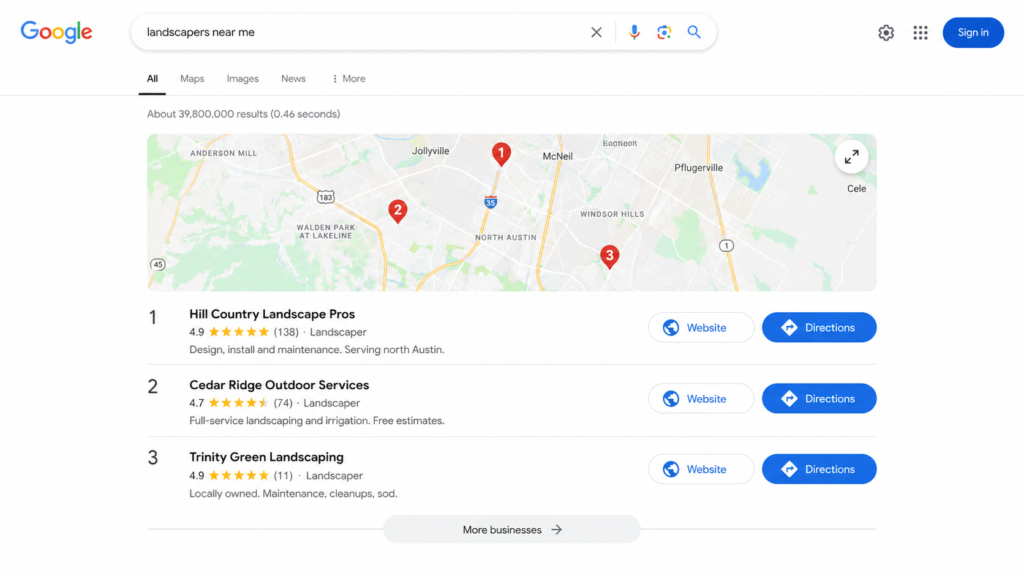
The gap between the top result and the third one is 127 reviews, not 127 trucks.
One more thing the profile now feeds. When a homeowner asks an assistant for a landscaper in his town, it names a short list, usually two or three companies, and it leans on the same reputation signals that decide the map. Almost nobody in the green industry has done anything about that yet, which is the entire reason to do it now. BASEO tracks which assistants are naming you, town by town, and recovers the AI referrals that land in your analytics mislabeled as Direct.
The profile fields that actually move rankings
Most landscaping profiles are half-filled. These are the fields that carry weight, and why each one does.
- Primary category. “Landscaper,” “Lawn Care Service” and “Landscape Designer” are three different categories and Google treats them as three different businesses. A design-build company categorized as a lawn care service will surface for mowing searches and disappear from the searches it makes money on.
- Secondary categories. Add the ones you genuinely serve. They widen the queries you are eligible for without diluting the primary signal.
- Service areas. Match them to the core zones you drew, not to everywhere you would drive for the right job. An honest, tight service area outperforms a hopeful, wide one.
- A written service list. Every service, with a real description you wrote. Empty service names do nothing.
- Photos, uploaded continuously. Real finished work, geo-relevant, added as jobs finish. A batch of 40 photos uploaded once and never touched again is a dead signal.
- Weekly Posts. Short, current, about actual work. This is the field almost nobody in the trade uses.
- A seeded Q&A section. Post the questions customers actually ask you and answer them. If you leave it blank, someone else fills it in.
- Hours and phone that match your website exactly. Mismatched details across the web make Google less confident it knows who you are.
This is the layer BASEO rebuilds first on a landscaping account, before anything else gets touched, because the profile is often the fastest visible movement in the whole engagement and because there is no point ranking a site while the map is still pointing at the wrong category. The same work sits underneath landscaping SEO generally: get the profile right, then get the pages right.
How to get reviews without begging for them
Reviews are a ranking input and a closing tool. Most companies treat them as a favor to ask when they remember, which is why the crew above you has 138 and you have 11.
Make it a system instead.
The moment. Ask when the job is finished and the customer is standing there looking at it. Not by email three days later, when the feeling has faded and the message is in a promotions tab.
The person. The foreman asks, not the office. He did the work, he is in front of the customer, and the ask costs him fifteen seconds.
The script. Two sentences a crew lead can actually say: “Really glad you’re happy with it. If you have a minute, a quick Google review helps other people in the neighborhood find us, and I can text you the link right now.”
The link. Send the short review link by text the same day, from the truck. Every hour you wait costs you reviews.
The response. Reply to all of them inside 48 hours, including the bad ones. A two-star review answered well converts better than no two-star review at all. Something like: “Thanks for telling us. You’re right that we left the side bed unfinished on Thursday and that shouldn’t have happened. Mike is scheduled to come back Tuesday to finish it and there’s no charge. If that timing doesn’t work, call me directly.”
One rule with no exceptions: never buy reviews and never trade a discount for one. Both violate Google’s policies and both put the profile you just built at risk. Running the review system properly is part of what BASEO handles on an account, along with the local citations and editorial links that sit underneath it. What we do not do is reach into your field software, because that is your system, not ours.
Step 2: Turn your landscaping website into a lead machine
Your website is not a brochure. It is where the click from your Google Business Profile lands, where the Local Services Ads click lands, and where the referral goes to check you are real before he calls.
Most of that traffic is a phone in someone’s hand while they stand in a yard looking at a problem. The page has a few seconds to make calling you the obvious next move.
Service pages and city pages: how many and what goes on them
The structure that books jobs is simple and almost nobody has it.
One page per main service. Not a single “Services” page listing nine things in bullet points, because Google will not rank one page for nine different searches and neither will a homeowner reading it.
One page per core town you actually work in. The person in the next town searches with his town’s name in the query, and Google will not rank one page for eleven suburbs.
Here is the rule that keeps this from turning into a penalty: only build a city page for a town where you have real jobs and real photos. Two hundred auto-generated city pages with the town name swapped is doorway content. Google has been demoting that pattern for years, and it is the single most common way a landscaping site gets worse after someone “did SEO” on it.
Each page needs the same five things:
- An H1 with the service and the city in it
- Before and after photos from work you did in that area
- Two or three reviews from customers in that area
- Price ranges where you can honestly give them
- A short form, and a tappable phone number in the header
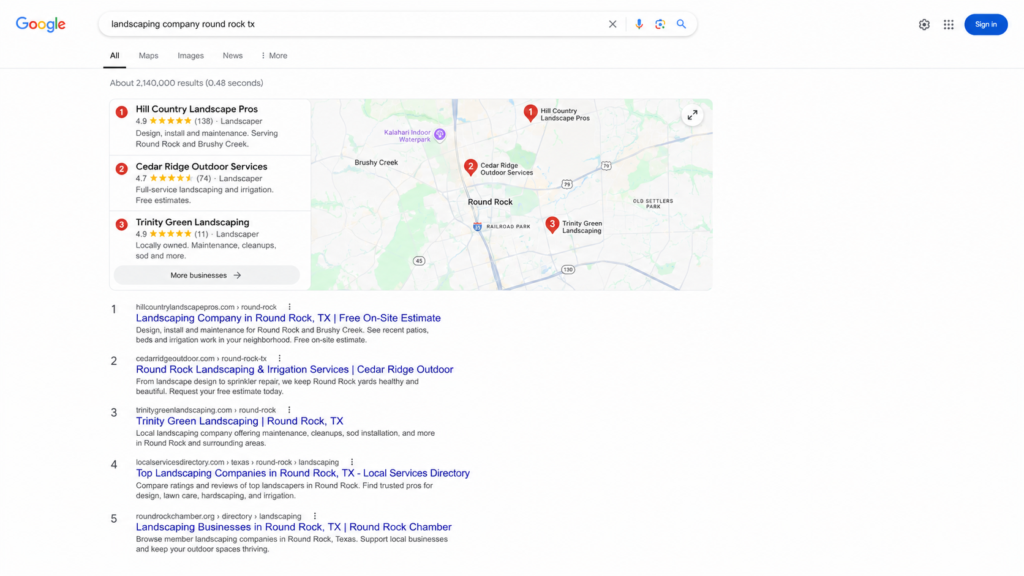
One page per town you actually drive to, with work from that town on it. That is the whole difference between a city page and a doorway page.
That ordering is the part most agencies get backwards, and it is where BASEO starts on a landscaping site: the pages get built in margin order, so the patio page exists before the mow page does. It is also why a site built to book jobs looks different from a site built to look good: the money pages are the town pages and the service pages, not the homepage.
The five things every landscaping site is missing
- A tappable phone number pinned in the mobile header. Not in the footer, not as an image. The person reading is standing outside holding a phone and wants to press one thing.
- A form with four fields or fewer, and an option to upload a photo of the yard. Every extra field costs you submissions, and a photo lets you qualify and rough-price the job before you drive out.
- A before and after gallery sorted by job type. Sorted matters. A patio buyer wants to see patios, not a scroll of mulch beds.
- Proof you are real. License number, insurance, years in business, the equipment you run. This reader has been burned by someone with a truck and a business card.
- Load speed on mobile. Uncompressed gallery photos are the number one cause on landscaping sites, and they are self-inflicted. A site that takes eight seconds to load loses the person who tapped your ad.
Step 3: Buy landscaping leads with Local Services Ads and Google Ads
There are two paid products at the top of local search, and neither one is Angi. That distinction matters before anything else: Angi is not a lead source, it’s a lead rental, where you pay the same whether you close the job or lose it to the four other crews who bought the same lead. What follows is how you buy leads nobody else gets.
The two real products work differently.
Local Services Ads sit above everything, including the map. You pay per lead rather than per click, you carry the green Google Guaranteed badge, and you have to pass license and insurance verification to run them at all (Google Local Services Ads Help). That verification is a barrier, and the barrier is the point: it keeps the field smaller than a regular ad auction.
Google Search Ads are pay-per-click. You get full control over which searches you show up for, what the ad says, and which page the click lands on. That control is what makes them work for high-ticket jobs, where the difference between “landscaping” and “paver patio Round Rock” is the difference between a price shopper and a $30,000 build.
Start with Local Services Ads. They are simpler to run, the cost per lead is lower, and it is a phone call rather than a form. Add Search once the phone is ringing and you want to reach the specific high-margin searches that LSA cannot target precisely.
Both do one job: they book work now. What they do not do is get cheaper. The pages you own do that, which is why the two run together rather than instead of each other.
Ads fill next month’s schedule while the service and city pages compound underneath. BASEO runs Local Services Ads and Google Ads for landscaping crews on the same lens as the organic work: quote requests and calls with phone numbers, cost per lead, cost per job. Ad spend is separate and goes straight to Google, never marked up.
What a landscaping lead actually costs
This is the number nobody in the search results will give you, so here it is with the sources attached.
Local Services Ads. Landscaping contractors average $47.69 per charged lead, median $44.83, with a typical range of $39.20 to $59.72, according to 99 Calls as of July 2026, based on their own client data.
Google Search Ads. LocaliQ’s 2025 home services benchmarks put landscaping at $117.92 per lead, off an $8.76 cost per click and a 6.42% conversion rate. A separate analysis of 61 landscaping accounts published in Green Industry Pros landed at $87.80 per lead off a $3.65 cost per click.
The spread between those two datasets is real and it is mostly account quality, market competition and season.
There is one landscaping-specific number worth knowing, because it explains a lot of the cost. Landscaping has the lowest click-through rate of every home services category, 4.69% in LocaliQ’s data. You compete in the same auction as roofers and plumbers and fewer people click your ad. That is why the ad copy and the landing page matter more here than in trades where the search is an emergency.
Now the calculation that actually decides anything:
Cost per lead ÷ close rate = cost per booked job.
Use your own close rate. If you do not track it, that is the first thing to fix, and you will have it in 30 days from the intake field in Step 7. For the example below, assume one in three, and replace it with your real number.
At $48 a lead and a one-in-three close, a booked job costs you about $144 in lead cost. Set that against the work:
- On a $2,400-a-year maintenance account, $144 is 6% of the first year and roughly 2% across three.
- On an $18,000 patio, $144 is under 1%.
Same lead cost. Two completely different decisions. That is why the service you point the budget at matters more than the budget.
The account quality piece is not theoretical either. One landscaping operator running paid with us went from $84 per lead to $43 in six months on the same ad budget, and from 18 leads a month to 54 (BASEO client data). Nothing about the spend changed. What changed was what the spend was pointed at.
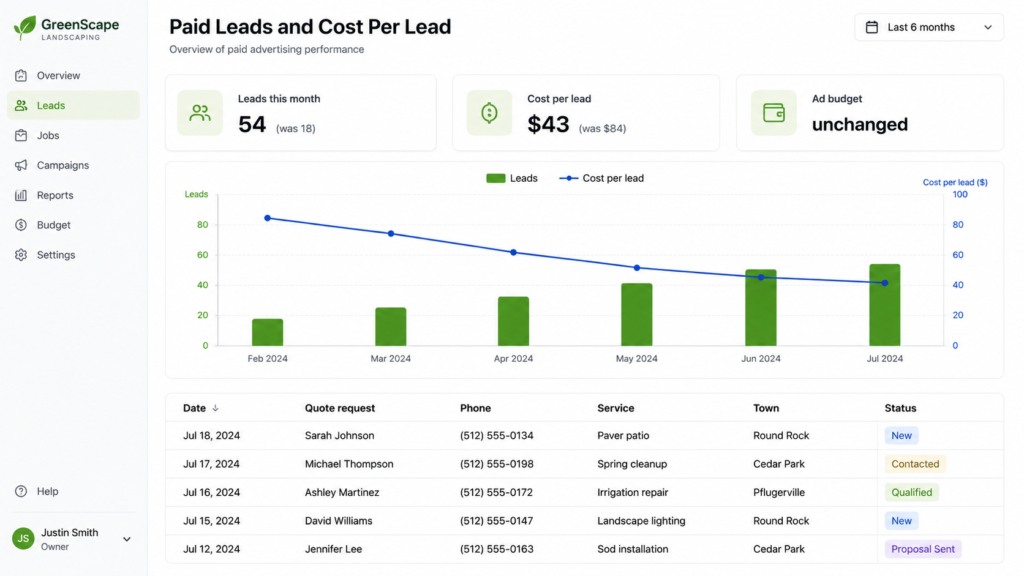
08-Same budget, three times the leads, half the cost each. The budget was never the problem.
When to turn paid on and off during the season
Turn the spend on three to four weeks before the season wakes up, not when it wakes up. People start searching when they look out at the yard, not after they have already hired somebody. If you go live the week your phone starts ringing on its own, you paid full price to compete with everyone else who waited.
Hold through the peak. This is the worst possible moment to save money, because it is the only window where demand is doing half the work for you.
Then move the budget rather than cutting it:
- Summer: shift toward irrigation and hardscape, where the searches keep coming after the spring rush ends.
- Fall: cleanups and aeration campaigns, plus the first push on next year’s maintenance contracts.
- Winter: snow and ice if you are in a market that has it. If you are not, put the budget into selling the maintenance contracts that fund next February.
The expensive mistake is switching everything off in January and back on in April. You lose the account history that makes the campaigns perform, and you arrive at the peak bidding against companies who never left. A small budget running year-round beats a big budget running four months.
If you are in the Sun Belt, run the same calendar earlier and flatter. The peak is softer and the off-season is shorter, but the “start before the searches start” rule does not change.
Step 4: Market the street you’re already parked on
The cheapest lead in your business is the neighbor of the customer you are already serving.
Same style of house. Same budget range. Same street your truck is already on, which means zero extra drive time and a job that improves your route density instead of stretching it.
Yard signs, 5-arounds, and route density
The tactic is called 5-arounds. When a job finishes, a crew member walks a door hanger to the five closest houses. Same day, while the work is fresh and the yard looks like the best version of itself.
The copy on the hanger is short and specific:
We just finished the landscaping at [address] on your street. We’re back in the neighborhood on [day]. If you want a free estimate while we’re here, call or text [number].
That works because it is true, it is local, and the proof is thirty feet away.
Yard signs run on the same logic with three rules. Ask the customer first, every time. Leave it up for one to two weeks, not one to two months, or it becomes part of the scenery. And put one offer and a large phone number on it, not a list of eight services in six-point type, because it gets read from a moving car.
Then do the part almost nobody does. Photograph the finished job, post it to your Google Business Profile that week, and run a tight-radius ad in that zip code while the sign is still up. The same job now works three channels at once and the incremental cost is a few dollars in print.
Get a real print quote before you dismiss this, then finish the math on your own numbers. Five door hangers per finished job, at whatever your printer charges per piece, against one maintenance contract worth $1,800 a year on a street your truck is already on. Divide a year of print cost by one signed contract and you will have the cheapest cost per job in your business, by a margin no ad platform can touch.
Step 5: Make referrals and reviews a system, not luck
Most landscaping companies say referrals are their best source of work and then do nothing to cause one.
What the referrer gets. Service credit outperforms cash in this trade. A $75 credit toward the next cleanup keeps the relationship going, where $75 in cash ends the conversation.
What the referred customer gets. Something small and immediate. A free first cleanup, a discount on the first month, priority scheduling in the spring.
When you ask. After the second job, or at the close of the season when they can see a year of work. Not on the first visit, when they have no idea yet whether you show up.
How you track it. You do not need complicated software. You need one required field on your intake: “How did you hear about us?” Required, not optional, and filled in by whoever answers the phone. That one field is the entire reporting system for this channel.
Then there is the referral network the competing guides barely mention: other businesses that stand next to homeowners at the exact moment your work comes up.
Nurseries and garden centers. Tree services. Pool builders. Property managers. Realtors staging listings. General contractors who finish a build and leave a dirt lot behind.
Approach them by bringing work, not asking for it. Send a tree service two removals before you ever mention that you would like the referral back. In this trade the reciprocity is the relationship, and everyone can tell the difference between a partner and someone collecting business cards.
Step 6: Show the landscaping work in photos, video, and social
Here is the honest version, which is not what most social media advice will tell you.
For most landscaping companies, social media is not a lead channel. It is the proof that closes leads that came from somewhere else, and it is the photo library that feeds your Google Business Profile, your city pages and your ads. Judge it on that, and it earns its time. Judge it on leads and you will quit in three months, correctly.
So build a capture system, not a posting schedule:
- The before shot, always, before a tool comes off the truck. You cannot go back and get it, and without it the after shot is just a photo of a yard.
- The after from the same position, at the same time of day. Same angle is what makes the pair land. Different light makes it look like two different properties.
- A 20-second vertical video of the final walkthrough. No narration required. The pan does the work.
Then put them where they pay:
Google Business Profile and Facebook carry the most weight for residential work, because that is where local homeowners actually look for a crew. Instagram is worth real effort if you sell hardscape and design, where the buying decision is visual and the ticket justifies the time. YouTube and Nextdoor are support, not priority.
The mistake to avoid is posting daily generic content because a calendar says to. Nobody hired a landscaper because of a stock photo with a quote on it. Three real jobs a week beats thirty pieces of filler, and the three real jobs also become gallery images, ad creative and profile photos.
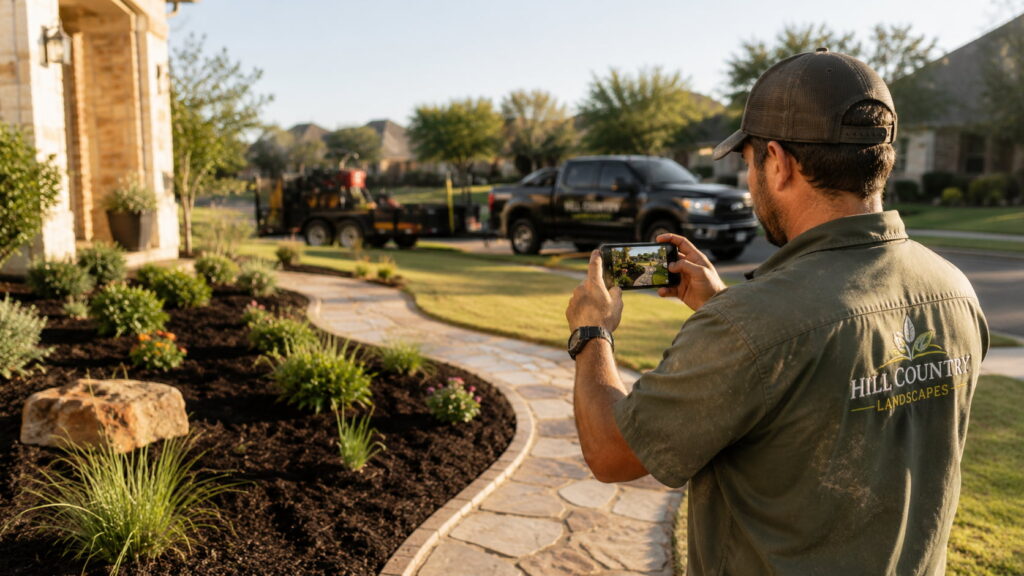
The two minutes at the end of the job that feed the profile, the city page and the ad.
Step 7: Stop losing the customers you already have
The biggest hole in most small landscaping companies is not a missing tactic. It is follow-up.
The customer hires you, the job goes well, everybody is happy, and then nobody contacts him again for eighteen months. Meanwhile he hired somebody else for the fall cleanup because they called and you did not.
Put a number on it with your own list. Two hundred past customers, a 10% response to one seasonal offer and a $900 average cleanup is $18,000 from a list you already own, with no lead cost attached to any of it. Your three numbers are different from those three. Run yours, because this is the only channel in the article where the leads are already paid for.
Email and SMS to your past customer list
You do not need a complicated campaign. You need five sends a year, on the calendar, tied to what the season is about to make people think about.
- March: spring cleanup and irrigation startup
- May: mulch and plantings
- August: irrigation check and weed control
- October: fall cleanup, aeration and overseeding
- November: next year’s maintenance contract, and snow where it applies
The message that works has three parts and nothing else. One offer. One deadline. One button. “Spring cleanups are booking now. Book before March 15 and we hold last year’s price. Reply CLEANUP or tap here.”
The deadline is not a sales trick in this trade, it is true. Your March is genuinely full by the second week, and the customer who waits genuinely gets scheduled in April. Say that, because it is the rare urgency line in marketing you can use without lying.
Two compliance points, briefly. Get written consent before you text anyone, because SMS rules are stricter than email rules and the penalties are real. And keep a visible unsubscribe link in every email. A list you built over nine seasons is the cheapest asset you own, and it is the one asset a compliance complaint can take away from you.
Maintenance plans and recurring revenue
The maintenance plan is the most underrated marketing asset in the trade, and it is not really a service question.
It does three things marketing cannot do on its own. It turns a one-time customer into revenue you can forecast, because a maintenance book behaves like a route rather than a pipeline: recurring maintenance contracts renew instead of having to be won again.
It funds the marketing budget through the months where nothing is coming in. And it buys you recurring access to a property, which is where hardscape and planting upsells actually come from, because you are the person already standing in the yard when they start thinking about a patio.
Package it good, better, best. Price it monthly and level it across twelve months instead of billing per visit, because a flat monthly number is easier for the customer to say yes to and easier for you to forecast against.
Present it when you finish a large job, not cold. He just watched you do good work. That is the highest-trust moment you will ever have with him.
Then watch retention as a number, month over month. It is the earliest warning system you have, and it moves before revenue does.
How much should you spend on marketing a landscaping business?
There is no single agreed percentage for this industry. Published guidance for landscaping companies runs anywhere from roughly 3% to 15% of revenue depending on who is publishing it and how fast you want to grow, which is a wide enough range to be useless on its own. Set the number from capacity instead.
The more useful formula, laid out in Lawn & Landscape, works backwards from what you can actually service:
Marketing budget = the customer capacity you can add × what it costs you to get one customer.
If you can service another 1,000 customers this year and it costs you $100 to acquire one, your budget is $100,000. If you can only service another 200, your budget is $20,000 and the other $80,000 would have bought you leads you cannot answer.
That framing matters more in landscaping than in most trades, because crew capacity is the harder constraint. Leads are easier to buy than a foreman is to hire. A campaign that outruns your schedule does not produce revenue, it produces missed calls and one-star reviews.
Once you have the number, here is a reasonable starting split for a $1M operation budgeting $100,000 a year:
| Line item | Share of budget | What it buys |
|---|---|---|
| Paid (LSA + Search) | 35–45% | Jobs this month, and the seasonal push before the peak |
| Website and SEO | 25–35% | Service pages, city pages, the profile, the compounding asset |
| Print and route materials | 5–10% | Door hangers, yard signs, truck graphics |
| Software and tracking | 5–10% | Call tracking, the intake form, the CRM you already run |
| Content and photography | 10–15% | The before and after library that feeds everything above |
Whatever the number is, spend it steadily. A modest budget spent every month beats a large budget spent in two bursts, because landscaping decisions mature over weeks and months. Somebody sees your truck, then a door hanger, then your listing, then finally calls in April. Consistency is what makes that sequence possible.
BASEO does not publish a price for this work, because it is genuinely custom to the market: a three-town service area and a twenty-town service area are not the same job. The number for your market comes in the audit, and the audit comes before any invoice.
These are reference ranges, not financial advice. Your accountant knows your business and this article does not.
How to know what’s working: landscaping lead source tracking
Almost none of the marketing guides written for this trade explain the part that makes everything else repeatable, so here it is.
A required source field on every intake. “How did you hear about us?” answered on every call and every form, no exceptions, filled in by whoever picks up. If it is optional it will be blank on 70% of your leads and the data is worthless.
A different tracking number per channel. One on the Google Business Profile, one on the ads, one printed on the yard signs and door hangers. That last one is the whole reason to bother: route marketing is the channel every landscaper swears by and nobody can prove, and a separate number on the hanger settles the argument in one season. Without it you are guessing, and you will guess in favor of whatever you already believe.
Four numbers, reviewed once a month. Leads by channel. Cost per lead by channel. Close rate by channel. Average job value by channel.
Now the part that surprises people. The cheapest cost per lead is not automatically the best channel.
| Channel | Leads | Spend | Cost per lead | Jobs booked | Avg job value | Revenue |
|---|---|---|---|---|---|---|
| Local Services Ads | 25 | $1,200 | $48 | 4 | $400 | $1,600 |
| Google Search Ads | 10 | $1,180 | $118 | 4 | $12,000 | $48,000 |
The $48 lead looks like the winner right up until you finish the row. That is why close rate and job value sit in the same table as cost per lead, and why the owner who tracks all four reallocates budget correctly while the owner who tracks one reallocates it backwards.
This is also what the source field eventually shows you about the leads you are renting. One landscaping crew we worked with was paying $78 for a shared lead that four other companies bought the same morning. Six months later the same work was coming from pages he owns, at about $11 a lead (BASEO client data). He did not find that out from an opinion. He found it out because the source field made the comparison possible.
Reporting like that is what BASEO sends every account monthly: quote requests and calls with the phone numbers, the cost per lead trend, the map position, and next month’s plan in plain English, on one page. If you would rather see where your own numbers stand before building any of this, the free written audit is the shortest path to a prioritized list.
Marketing mistakes that quietly cost landscapers money
- Switching marketing off when you are busy. It feels responsible in July and it builds the seasonal roller coaster you complain about in February. Keep a floor running year-round.
- Competing on price instead of proof. The homeowner getting three bids on a patio cannot tell whose base prep is right, so he defaults to the number at the bottom. The only thing that changes that is showing him work you did on his street: before and after photos from his zip code, reviews with his town’s name in them, and a page that names the neighborhood. Crews that show the work stop getting compared on price, because there is nothing left to compare them on.
- Buying leads with no fast-response system. A shared lead went to five companies at the same second. If you call back at six o’clock, you are calling fourth. Answer inside minutes or do not buy them.
- Bad photos, or stock ones. A homeowner can tell the difference instantly, and a stock image says you have nothing of your own to show.
- Mass-generated empty city pages. It looks like coverage and reads like spam. Google agrees.
- No follow-up on estimates you did not close. Half of them did not say no, they said not yet, and nobody ever called them back. Run it on your own numbers: if you bid twenty patios last season and closed six, the fourteen you never called again are worth more than every lead you bought that month. You already paid the acquisition cost on all twenty. Fourteen of them are sitting in a folder.
- The same message for a $200-a-month maintenance customer and a $30,000 patio. Two different buyers, two different pages, two different campaigns.
- Judging SEO at six weeks. Service and city pages typically start producing quote requests somewhere in month three to five. Judging them in week six is judging a build before the base is in.
Your first 90 days marketing a landscaping business
Nothing in this plan needs a marketing employee. It needs you for a few hours up front and your foreman for fifteen seconds per job.
| Days | What you do | Who owns it | What you should see |
|---|---|---|---|
| 1–30 | Complete the Google Business Profile: primary category, secondary categories, service areas, full service list, photos, first Posts. Brief the crew on the review ask. Put a tappable phone in the mobile header and cut the form to four fields. Add the required source field to your intake. | Owner, with the foreman on reviews | First new reviews arriving. Profile views and calls from the map starting to move. |
| 31–60 | Turn on Local Services Ads in the core zones only. Start 5-arounds and yard signs on every finished job. Send the first email to your past customer list. | Owner sets up ads, crew runs the route marketing | First LSA calls within days. Route leads from the neighborhoods you already work. First reactivated customers. |
| 61–90 | Publish the service pages for your two or three best-margin services, plus two or three real city pages with local photos. Launch the referral program with the intake field tracking it. Run the first monthly review of leads, cost per lead, close rate and job value by channel, then move budget. | Owner, or whoever builds the site | Pages indexed and starting to rank. Referrals arriving with a source attached. A budget decision based on numbers instead of feel. |
Two notes on running this honestly. The 61–90 block is the one that slips, because it is the only one with no immediate feedback. Put the dates in the calendar now. And do the monthly review even when the numbers are ugly, especially then, because the first review is the only one that tells you what you have been wasting.
Where to go from here
The order matters more than the number of tactics, and consistency matters more than the size of the budget. A landscaping company doing four of these things every month beats one doing all fourteen for six weeks in the spring.
Start where the sequence starts. Finish the Google Business Profile this week, put the source field on your intake, and you will know more about your own marketing in 30 days than you do right now.
Some owners run this entire playbook themselves in the off-season and do fine. Most would rather spend those hours bidding jobs. If you want to know which pieces your business is missing before you decide either way, that is what the audit is for. The team on your account works only with landscapers, so it already knows your competitors, your keywords and your season. Free, in writing, about two business days, no call required, and it is yours to keep even if we never speak again.
Frequently asked questions
Most landscapers get customers from local search and word of mouth. A fully optimized Google Business Profile with steady reviews drives the largest share, followed by referrals from past clients, yard signs and door hangers in existing service routes, and paid channels like Local Services Ads for filling gaps in the schedule.
Published guidance on marketing budgets for landscaping companies ranges from about 3% to 15% of revenue, so set yours from serviceable capacity instead. On paid channels, landscaping Local Services Ads average around $48 per charged lead and Google Search Ads run roughly $88 to $118 per lead.
Yes, for companies planning to operate in the same service area for more than a year. Local SEO takes three to six months to gain traction, but cost per lead drops over time instead of rising, and the traffic keeps arriving when paid budgets are paused during the off-season.
The fastest lead sources are Local Services Ads, which can produce calls within days, and route marketing, meaning yard signs plus door hangers on the five closest houses to every finished job. Both work immediately because they reach homeowners who already see the need or the result.
Social media rarely generates landscaping leads directly, but it closes them. Before-and-after photos and short walkthrough videos give prospects proof before they call, and the same photo library feeds your Google Business Profile, website galleries and ads. Facebook and Google Business Profile matter most for residential work.
Use the off-season to sell next year. Email past customers with early-bird maintenance contracts, publish service and city pages while crews are slow, collect and respond to reviews, and keep a small paid budget running so account history and rankings do not reset before spring demand arrives.
Angi is not a lead source, it’s a lead rental. You pay the same whether you close the job or lose it to the four other crews who bought the same lead. Do not cancel it Monday, it is feeding your crew this week. Use it as a supplement, answer within minutes, and track close rate by source.