
You run five trucks. You’ve been doing this twenty years and half the town has your number in their phone. There’s a crew three miles away running two trucks and eighteen months of history, and when somebody searches landscapers near me, they’re in the top three on the map and you’re on page two.
That gap isn’t the work. Landscaper local seo marketing is what closes it, and almost none of it is what you’d guess.
Here’s what this covers: the order to do things in, sorted by how fast each one pays back. What a landscaping lead actually costs on Google today, with the source attached. Why starting in April is the most expensive month of the year to start. And a 90-day plan you can run without hiring anybody.
6:30am, before the first stop. This is the reader this article is written for.
- The short version: what local SEO does for a landscaping company
- What “local SEO” actually means for a service-area business
- Local SEO starts on the map: your Google Business Profile
- Landscaper SEO pages built for margin, not for volume
- The technical floor: what has to be true before content works
- Off-site local SEO signals: citations, NAP, and local links
- Getting cited by AI search, not just ranked
- Where paid fits: ads book jobs now, SEO makes every job cheaper
- How long local SEO takes for a landscaping company
- What to measure in local SEO (and what to ignore)
- Landscaping local SEO: doing it yourself vs hiring it out
- The mistakes that keep landscapers on page two
- Your first 90 days of local SEO
- What to do next
- Frequently asked questions about landscaper local seo marketing
The short version: what local SEO does for a landscaping company
Local SEO for landscapers is the work that gets a landscaping company into Google’s map pack and into “near me” results across its service area. It runs in three layers: the Google Business Profile and reviews, which move in weeks; service and service-area pages, which compound over months; and off-site signals and AI search, which run continuously.
Every guide you’ve read lists roughly those same items. Almost none of them tell you what order to do them in, and the order is most of the value. One layer can show movement before your next invoice. Another takes a season. Doing them in the wrong sequence is how operators spend eight months building pages while a half-finished profile sits there costing them the map.
| Layer | When you typically see movement | What it produces |
|---|---|---|
| Google Business Profile + reviews | Weeks | Map position in the areas you actually serve, and the calls that come with it |
| Service pages + service-area pages | Months | Quote requests for the jobs you want, town by town |
| Off-site signals + AI search | Continuous | The trust that holds the first two in place, and the citations AI answers pull from |
None of that replaces your ads, and this isn’t the article where somebody tells you to shut them off. Ads fill next week’s schedule. The pages make every job after that cheaper. Both run at once, and the rest of this explains how they split the work.
What “local SEO” actually means for a service-area business
Almost every piece of SEO advice you’ve read was written for a business with a front door or a shopping cart. That’s why none of it landed.
You don’t have a storefront. You have fourteen zip codes, a drive time that decides your margin, and no interest whatsoever in homeowners showing up at your shop. “Optimize for foot traffic” means nothing to you. “Add your address to every page” is advice that can get your listing suspended.
Google treats what you run as a different kind of business, and once you understand how, the rest of this stops feeling arbitrary.
Why landscapers rank differently than a storefront
Google calls what you have a service-area business. No visible address, a radius instead of a room. It ranks you differently on purpose.
The practical consequence is the one nobody explains: the map behaves differently depending on where the person searching is standing. There is no such thing as your position. There is a position per area.
Search “landscapers near me” from the north end of your service area and you might sit second. Search the same words eight miles south, same day, same phone, and you’re fourteenth. Both are true. Neither is “your ranking.”
Which is why the report your last marketing company emailed you every month, the one with an average ranking on it, measured nothing you could act on. An average across fourteen zip codes hides the only thing worth knowing: which towns you own and which ones you’ve never shown up in. A report worth reading breaks map position out by area, for the keywords that actually bring money, and shows you the gap. An averaged number is a number you can’t do anything with on Monday.
The three things Google weighs: proximity, relevance, prominence
Google publishes what drives local results. In its words, they’re based primarily on relevance, distance, and prominence. Distance is what most operators call proximity. Same thing.
Two of the three you can move. One you can’t. Sorting them that way is how you decide where the work goes.
Distance. Not controllable. You can’t be closer to a searcher than you are. What you can control is the radius you claim and whether you have real evidence of work in the areas inside it. A service area you set to sixty miles because it felt ambitious is sixty miles of territory you’ve given Google no reason to believe you serve.
Relevance. Very controllable, and it’s the cheapest work on this list. Your primary and secondary categories, the services actually listed on your profile, and pages that match what people type. Most operators are invisible for their best service because they never told Google they sell it.
Prominence. Controllable, slowly. Reviews, mentions across the web, links from real local sites, and the same business name, address and phone everywhere it appears. This is the layer that takes a season and holds everything else up.
Two things that are not strategies. Stuffing keywords into your business name is not a trick, it’s a violation, and Google gets better at catching it every year. And putting a fake address in a town you want to rank in is the fastest route to a suspended profile, which costs you every area at once. Operators still do both. Their competitors report them.
Local SEO starts on the map: your Google Business Profile
Your profile goes first for three reasons. It’s free. It’s where landscaping searches actually resolve, because homeowners look at the map before they look at anything else. And it’s the only layer that usually shows movement in weeks instead of months.
Here’s the part almost nobody connects: a thin profile drags your Local Services Ads down too. Both lean on the same reputation signals, so operators who fix the profile for organic often find the paid side gets easier too. They were starving on the same input.
The map shows three businesses above everything else, and the profile is how Google decides which three. Most operators have one that’s half filled out under the wrong primary category. That’s the core of the map pack work BASEO does, and call tracking goes on every number first, so from day one every call the profile generates is a call somebody counted.
The fields that move map rankings for landscapers
Nine fields. What each one does, and why it matters.
- Primary category. Decides which searches your profile is eligible for at all. Get this wrong and nothing else on the list can save you.
- Secondary categories. Cover everything else you sell without diluting what the primary is telling Google.
- Service areas set to where the trucks actually drive. Not a sixty-mile circle. A radius you can’t service is a radius you have no proof in.
- The service list, written by hand. Use the words a homeowner types, not Google’s suggested defaults. “Paver patio” is a service. “Landscaping” is a category.
- Real job photos, uploaded continuously. One batch from 2021 reads as an abandoned business. A few photos a month beats fifty photos once.
- Google Posts, weekly. A live profile beats a dormant one, and this is the cheapest thing on the list. A finished job and two sentences takes four minutes.
- Q&A seeded with the questions your phone already asks. You answer the same six questions every week. Put them where they earn something.
- Hours and phone identical to your website. This is the same consistency problem the off-site section covers. It starts at the source.
- The profile’s website link pointed at the right page. The service page or the city page, not always the homepage. Send the click to the page that answers the search.
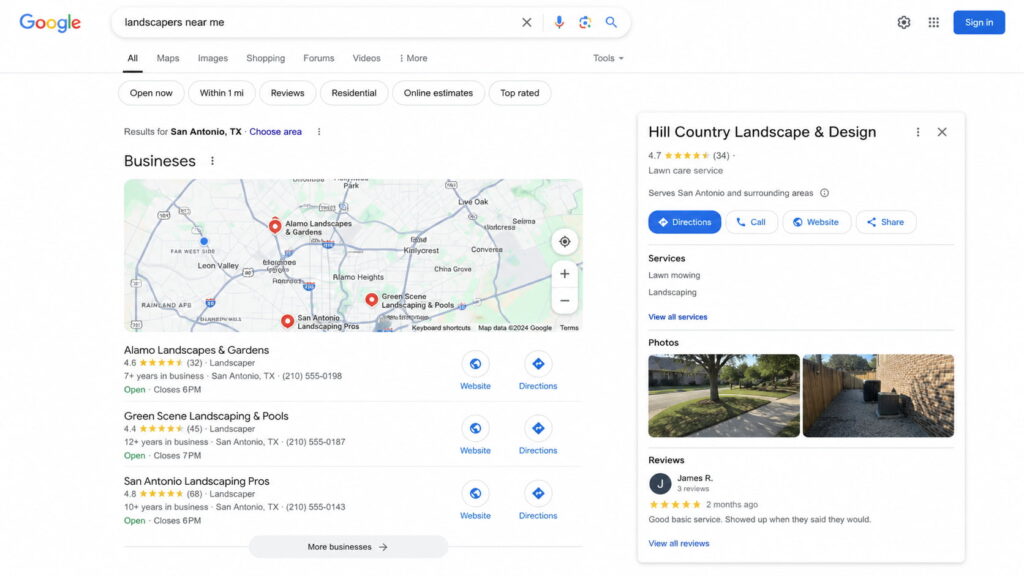
A design-build company filed under “Lawn care service.” It will compete for mowing all day and never surface for the work that pays.
Categories: Landscaper vs Lawn Care Service vs Landscape Designer
Your primary category isn’t a label. It’s a gate. It decides which searches your profile is eligible to appear in at all, before relevance or reviews or anything else gets a vote.
Pick “Lawn care service” when your money is in design-build and you’ve entered yourself in a competition for mowing. You’ll win some of it. That’s the problem.
The rule is simple: your primary category follows the highest-margin service you actually want to sell. Secondary categories cover everything else you do.
Run the math on what that choice costs. One San Antonio landscaper closed a $14,800 patio off an organic search (BASEO client data).
Somewhere in the same week, somebody else searched for a mow. Those two searches cost roughly the same amount of work to win. Your category decides which one you’re eligible for.
Reviews: the system, not the ask
You already earned these. You’ve been doing good work for twenty years. The reason the crew above you has 138 reviews and you have 34 isn’t that they’re better. It’s that they ask, every time, at the right moment, and you don’t.
Reviews aren’t a task. They’re a system with four parts:
Who asks. The foreman, at the end of the job, with the customer standing there looking at the finished work. Not the office. Not you, three days later.
When. Same day. The gap between finishing a patio and asking about it is the gap between a five-star review and no review.
How. A short link by text, sent from the crew lead’s phone before he pulls off the property.
What happens after. Every review answered inside 48 hours. The good ones and the bad ones. A copy-paste “Thanks!” on forty reviews reads exactly like what it is.
The script is two sentences and your crew lead can memorize it in a morning: “Glad you’re happy with it. If you’ve got thirty seconds, a quick review helps other folks around here find us.” That’s the whole thing.
Here’s the detail almost nobody explains. A review that names the service and the town does double duty. “They built our paver patio in Boerne and the base work was solid” is a review and it’s also content, sitting on a Google property, saying the exact words a neighbor is going to type. Which means the question you ask changes what the review is worth.
Ask “how’d we do?” and you get “great job.” Ask “what did we build for you?” and you get the version that works.
It matters because reviews are doing the closing. BrightLocal’s 2026 Local Consumer Review Survey, which polled 1,002 US adults, found 85% say positive reviews make them more likely to use a business and 77% say negative ones make them less likely.
One warning, and it’s not a small one. Offering a discount, a free service, or anything else in exchange for a review violates Google’s policy. Buying them is worse.
And the consequence isn’t that the bad reviews get quietly removed. Google can restrict the profile itself, block new reviews for a stretch, or unpublish the ones you already have. You’d be risking twenty years of reputation to shortcut a system your foreman could run in thirty seconds a job.
That system is what BASEO builds and runs, fired off completed jobs so the ask happens when the customer is happiest and you never have to remember it. What we don’t do is touch your Jobber or your ServiceTitan setup. That’s your software and your business.
Same rating. Twelve times the reviews. That’s the gap between position one and position three, and it compounds, because position drives volume drives reviews.
Landscaper SEO pages built for margin, not for volume
Most landscaping websites get built in the order of what’s easy to sell. Mowing page first, because that’s what the phone asks about. Then maintenance. Then, eventually, maybe, a paragraph about hardscape buried on a services page.
That’s backwards, and it’s expensive.
The map brings you the mow. The pages bring you the patio. If your site was built in the wrong order, you’ve been paying for traffic that books your worst work.
One page per service, written for the job you want to sell
One page per service you actually sell. Never one “Services” page with eight bullets on it. Google can’t rank a bullet, and a homeowner comparing three companies can’t tell from a bullet whether you’ve built forty of these or one.
Build them in order of margin per crew hour, not search volume. For a full-service landscaping company that order is hardscape and design-build first, then irrigation, then lawn care, then tree work, then snow.
Hardscape leads for three reasons. The ticket runs $10,000 to $50,000. The decision cycle is long, which means a real page has time to do work on somebody before they call anyone. And almost nobody has written a good one, because everybody wrote the mowing page instead.
The numbers make the case better than the argument does. That same San Antonio landscaper closed a $14,800 patio and an $18,600 retaining wall from organic pages (BASEO client data). Two jobs. And the search that brought the patio cost about the same amount of work to win as the search that brings a mow. That’s the entire ordering argument: same effort, wildly different ticket.
What has to be on the page:
- The problem in the words he uses when he calls you. Not “hardscape solutions.” Something closer to “the slope behind the house is washing out into the pool.”
- The process, start to finish. Estimate, design, timeline, what happens to his yard while you’re in it.
- Before-and-after photos of that service. A patio page needs patios, not a gallery of everything you’ve ever done.
- A price range, if you can give one honestly. Most competitors won’t. That’s why it works.
- Reviews that mention that specific service.
- A short form.
Where that order lands for your business depends on your actual margin and your crew capacity, which is what the audit works out before anybody writes a page.
Service-area pages that are not doorway pages
A service-area page done right is one page per town where you genuinely have work. Photos from that town. Reviews from customers who live there. Details a resident would recognize on sight: what the soil does, which HOAs run which rules, what the watering restrictions look like in July. And the service that actually sells there, which is not the same service in every town.
One page cannot cover eleven suburbs. The homeowner types his own town’s name, and Google will not rank a list of towns for a search about one of them.
Now the part almost no guide tells you, because it’s the part that costs them a sale.
Generating 200 city pages by swapping the town name is not SEO. It’s doorway content, and Google names it directly. Its spam policies define doorway abuse to include “multiple domain names or pages targeted at specific regions or cities that funnel users to one page.” The same policy covers scaled content abuse: “generating many pages primarily to manipulate search rankings, regardless of whether the content is AI-generated, human-written, or scraped.”
That last clause matters more every month. Writing them by hand doesn’t make them safe. Volume plus sameness is the violation.
This is the number one reason a landscaping site goes flat after somebody “did SEO” on it. The pages went up, the count looked impressive on a report, and nothing happened, because the whole batch was one page wearing different hats.
Start with three to five core areas. Real ones, where you have jobs, photos and customers. Expand one town at a time, and only when the last one has proof on it. Ten real pages will beat two hundred fake ones, and they won’t put the rest of your site at risk.
BASEO builds those pages against your real footprint and your drive time, not against a keyword list. A crew covering four towns and a crew covering twenty get completely different builds, and pretending otherwise is how the 200-page problem starts.
What belongs on every page before it can rank
Six things. Open your own site on your phone and check.
- An H1 naming the service and the town. So somebody knows in half a second he’s in the right place. Half your bounce rate is people who couldn’t tell.
- A tappable phone number pinned on mobile. He’s standing in his yard holding a phone one-handed. If he has to scroll to find your number, he calls whoever he had open in the other tab.
- A form of four fields or fewer, with an option to attach a photo. Every extra field costs you submissions, and a photo of the slope cuts a site visit out of your estimating cycle.
- A before-and-after gallery, compressed. Proof that loads. Proof that doesn’t load is not proof.
- Evidence you exist. License, insurance, years in business, the equipment you run. He’s about to let strangers into his backyard with machinery.
- Internal links to the related services. The patio page should reach the retaining wall page, because that’s the second job on the same property.
None of this is exotic. It’s just a site built to convert instead of a brochure, and a surprising number of landscaping sites have a quote form that emails an address nobody has opened since 2022.
The technical floor: what has to be true before content works
This section is about what has to be true, not how anybody fixes it. Six items. If one of them is broken, everything above this is running at half strength.
Mobile speed. In this trade the cause is almost always the same thing: a before-and-after gallery of full-resolution job photos straight off somebody’s phone. Your best proof is what’s making the site too slow to see it. Compress the gallery and half the problem is gone.
Pages that can actually be indexed. A page Google can’t reach ranks nowhere, no matter how good it is. This is worth checking after any site rebuild, because it’s the most common thing a rebuild breaks.
A unique title and description per page. Eleven city pages sharing one title is eleven pages telling Google they’re the same page. It will pick one and ignore the rest, and it won’t be the one you wanted.
Flat URL structure. A patio page four folders deep is a patio page Google treats as less important than your homepage. It isn’t.
LocalBusiness schema with the right name, address and phone. Labels that tell Google exactly what your business is and where it works. Same details as everywhere else, which is the whole point.
HTTPS. The lock in the address bar. He’s about to type his phone number into your form.
None of this earns you a job on its own. It’s the floor.
Run the math on what a slow page costs you. At $117.92 a lead and a one-in-five close rate, a booked job costs about $590 in lead cost. Halve the rate at which that page turns visits into quote requests and the same job costs $1,180, on traffic you already paid for.
That’s what a six-second load time buys, and you paid to build the content either way. This layer goes in before the pages go up, because publishing onto a broken foundation is how eight months disappear.
Off-site local SEO signals: citations, NAP, and local links
Two things happen off your website that decide how much Google trusts it.
The first is your name, address and phone, identical everywhere. Same spelling, same suite number, same formatting. Prioritize the listings that carry weight: Apple Maps, Bing Places, Yelp, the BBB, and the green industry associations you already pay dues to.
The silent killer here is history. You changed your number in 2019. You moved the shop. The old listing is still sitting there, and now there are two of you, disagreeing. Duplicates are the most common version of this and the least noticed, because nobody goes looking for a listing they forgot they made.
The second is links from real places in your county. Not a package of 500 links from a website in another hemisphere. The nursery and the garden center you buy from. The chamber. The little league team whose banner already has your name on it. The pool builders, tree crews and property managers you already trade work with. Local press, when a project earns it.
Chambers, trade associations, local news, real directories. Those are the links BASEO chases for clients, and the reason is boring: they’re the only ones a human at Google would recognize as a real business in a real county. No link farms, no PBNs, nothing bought in bulk. Bought links aren’t a shortcut, they’re a liability with a delayed fuse.
Which brings up Angi, HomeAdvisor and Thumbtack, because they sit in both halves of this section.
As a listing, they’re a citation. Worth having, worth keeping accurate.
As a lead source, take the position seriously: you’re paying for a phone number that four other crews bought the same morning, you pay whether you close it or lose it, the price goes up every year, and the day you stop paying, it all stops. That’s not a channel. That’s rent.
And no, don’t cancel it Monday. It’s feeding your crew this week and anybody telling you otherwise has never made payroll. The goal is to build something that makes it optional, where the leads are yours and nobody else bought them.
Getting cited by AI search, not just ranked
A homeowner in your service area opens ChatGPT and types “who does paver patios near me in San Antonio.” He gets back two or three names. He calls one of them.
He didn’t look at a map. There was no position three to be in. There was a list, and either you were on it or you weren’t.
This stopped being hypothetical fast. BrightLocal’s 2026 survey found that the share of consumers using AI tools for local business recommendations went from 6% to 45% in a single year, which makes it the third most popular source of local business recommendations behind Google and Facebook.
Here’s what makes you eligible to be named, and notice that you’ve already read all four of these:
Direct, self-contained answers on your own pages. What a service includes, how the process runs, what it roughly costs, how long it takes. An assistant can only quote an answer that exists somewhere in a form it can lift.
Consistent data across your profile, your site and the directories. The same NAP work from the last section. When your phone number disagrees with itself in three places, the model has no reason to trust any of them, and it names somebody it can verify.
Local specificity a machine can check. The towns, the neighborhoods, the actual jobs. Vague copy is unverifiable copy.
Reviews that describe the work. The reviews section again. “They built our paver patio in Boerne” is exactly the kind of sentence an assistant leans on when it’s deciding who does paver patios in Boerne.
Which is the honest headline here: this is not a separate project. It’s the same profile, the same pages, the same reviews, formatted so a machine can use them.
This is a young channel and it should be sized like one. It’s measured in mentions and citations, not positions. Nobody controls whether an assistant names a business, and anybody who tells you they can is selling something. What you can do is optimize the inputs and watch the outputs. BASEO formats content for citation, tracks who gets named across the major assistants in every town a client works in, and recovers the AI referrals that GA4 quietly files under “Direct.” The one thing worth saying about timing: almost nobody in this trade is set up for this yet.
Where paid fits: ads book jobs now, SEO makes every job cheaper
This is not the part where the article tells you to turn the ads off.
There are two real enemies here and neither one is Google Ads. The first is shared leads, covered above. The second is ads run badly: broad match with no negative keywords, no geo fence on a service area, one campaign covering six services with wildly different tickets, and clicks landing on a homepage that never names the town he searched from.
Run properly, the split is clean. Ads put you at the top of the search the week you turn them on, which is the only thing that matters when next month’s schedule is half empty. What ads don’t do is get cheaper. The pages do. The ads pay for this season, the pages lower the cost of every season after it.
Together, not in sequence. Waiting for organic before you touch paid means six months of an empty calendar you didn’t have to have.
Local Services Ads are worth understanding separately. You pay per lead instead of per click. They sit above the map pack, at the very top. They carry the Google Guaranteed badge, which does real work when a homeowner is choosing between three companies he’s never heard of. And the difference that matters most in this trade: it’s a phone call, not a form.
What “run properly” looks like in numbers: one landscaping operator went from $84 to $43 cost per lead in six months on the same ad budget, and from 18 to 54 leads a month (BASEO client data). The budget never changed. The account did.
One more thing, because it’s the question every operator has and nobody asks. Ad spend goes straight to Google. It’s never marked up.
What a landscaping lead actually costs
Start with the number that reframes everything else.
LocaliQ’s home services benchmarks, drawn from thousands of client accounts, put the average cost per lead for landscaping search ads at $38.47 on 2020–21 data. The same publisher’s 2025 benchmarks put it at $117.92. The click went from $4.10 to $8.76 over the same stretch.
Roughly triple in five years.
That is not an argument against ads. Ads still book next week’s jobs and nothing else does. It’s the argument for owning something alongside them, because the rented channel gets more expensive every year and the one you own gets cheaper.
Current landscaping search ad benchmarks, same source: $117.92 per lead, $8.76 a click, 6.42% conversion rate.
Now the honest part about organic. There is no credible published benchmark for what a mature organic landscaping lead costs. Anybody quoting you a tidy range made it up or borrowed it from another trade. What exists is what happened to specific companies. That San Antonio landscaper was paying $78 for an Angi lead, and six months later was getting leads from pages he owns at about $11 (BASEO client data). That’s what happened to him. It is not a projection for you, and the audit will tell you what your market actually supports.
| Channel | What a lead costs | Exclusive to you? | When it starts working |
|---|---|---|---|
| Google Ads (search) | $117.92 average for landscaping in 2025, up from $38.47 in 2020–21 (LocaliQ) | Yes | The week you turn it on |
| Local Services Ads | Pay per lead, priced by market. No benchmark worth publishing. | Yes | Days to weeks, after verification |
| Shared aggregator leads | You pay whether you close it or not. So do the other crews who bought it. | No | Immediately, and it stops the day you stop paying |
| Organic pages you own | No published benchmark exists. One San Antonio landscaper went from $78 to about $11 (BASEO client data) | Yes | Months 3–5 typically, compounding after |
Two of those cells are blank on purpose. Nobody publishes a landscaping LSA benchmark worth repeating, and an invented range is worse than an honest gap.
Here’s the formula that actually decides which channel wins:
Cost per lead ÷ close rate = what a booked job costs you.
Then compare that against the gross margin on the job. Not against another channel’s cost per lead.
Run it. At $117.92 a lead and a one-in-five close rate, a booked job costs you about $590 in lead cost. On a $14,800 patio, that’s 4% of the ticket and it doesn’t register. On a maintenance account at a few hundred a month, $590 eats most of the first quarter before you’ve paid for a single visit.
Same channel. Same spend. Completely different answer.
Which is exactly why the pages get built in the order of margin. The channel isn’t good or bad. It’s good or bad for a specific job, and if the only pages you have are for your cheapest work, you’ve decided the answer before you started.
Both numbers come from the same landscaping company, six months apart. What changed was where the lead came from.
How long local SEO takes for a landscaping company
Profile and review work usually shows movement in four to eight weeks. Ranking and lead gains typically land between months three and six on a site that already exists. Six to nine months if the site is new or you’re in a dense metro where three companies have been at this since 2019.
The gap between those two timelines has a reason. Your profile is a signal Google already has and can re-read this week. Your pages are signals it has to find, crawl, evaluate and then trust, and trust is the slow part. Nobody has found a way to hurry it that doesn’t eventually get caught.
Which is why nobody can promise you a position, and you don’t have to take that from an agency. Google says it plainly: “No one can guarantee a #1 ranking on Google. Beware of SEOs that claim to guarantee rankings.” If somebody guarantees you the map pack in ninety days, they’re promising something the company that owns the map has publicly said is impossible. That’s the whole evaluation.
What can be described is what happened. That San Antonio landscaper went from position 11 to the top three of the map pack in under six months (BASEO client data). Six months, on an established site, in a competitive metro. That’s the timeline this section is about, and it’s roughly what the ranges above describe.
So here’s the arc to plan against. Ads book jobs inside the first two to three weeks, which is a different channel and a different sentence. First organic quote requests typically month three to five. Real volume, month six to nine. Anybody promising organic leads in thirty days is describing ads or describing nothing.
Why you start in the off-season, not in April
Run the arithmetic and this section writes itself.
The pages take three to six months. Your demand peak is spring. Start in April and you’re ranked in August, paying for a season that already happened, going into the slow half of the year with your best asset finally warmed up and nobody searching.
Count backwards instead. To be ranked in April, the work starts the previous fall.
Snow belt: November through February, while the plows are covering the payroll. Sun Belt: October through January, before the season turns.
But the better argument isn’t the calendar. It’s your hours.
Winter is the only time you have any. Photographing finished jobs, running the review system with your crews, approving pages, answering the questions for your profile: none of it takes much, but it takes some of your attention, and in July you have exactly none to give. In January you’re doing equipment maintenance and staring at a half-empty April.
For reference on how much attention “some” is: about an hour to kick off, then roughly twenty minutes a month. That number matters more than anything else on this page, because you’re reading it from a truck.
What to measure in local SEO (and what to ignore)
Five numbers matter, and your current report probably has none of them.
Quote requests and calls, counted by channel. Not total. By channel. “We got 40 leads” is not information.
Cost per lead by channel.
Close rate by channel. The number that turns leads into a business.
Average job value by channel. Because a $40 lead that books mows and a $118 lead that books installs are not comparable and everybody keeps comparing them.
Map position by area. Never averaged. Which towns you own, which ones you’ve never appeared in.
What doesn’t pay payroll: impressions, total keywords ranking, bounce rate, follower counts. None of these have ever put a truck on a job. If they’re the headline of your report, that’s a report designed to look like work.
The technical minimum to measure any of this is smaller than you’d think. A different tracking number per channel. A source field on your quote form. And one page you look at once a month.
| Channel | Quote requests | Cost per lead | Close rate | Avg job value | Cost per booked job |
|---|---|---|---|---|---|
| Google Ads | |||||
| Local Services Ads | |||||
| Organic / map | |||||
| Referral |
Fill that in for three months and something counterintuitive usually shows up: the cheapest lead doesn’t win.
A channel at $40 a lead closing one in ten on small jobs loses, badly, to a channel at $118 a lead closing one in four on installs. You are not buying leads. You are buying booked jobs, and only one of those two numbers pays you.
A report worth reading fits on one page: quote requests and calls with the phone numbers, cost per lead trend, map position for the keywords that carry money, pages published, AI citations, and next month’s plan in plain English. That’s the whole document BASEO sends, and there’s no dashboard to learn and no login you’ll never use. If a report doesn’t contain the words “quote requests” and an actual phone number, it isn’t a report. It’s a receipt for nothing.
Landscaping local SEO: doing it yourself vs hiring it out
Some of this you can do yourself, and it’s not the consolation list.
What an owner can genuinely run: finish the Google Business Profile properly, run the review system with your crews, keep real job photos going up, answer the questions, and clean up the old listings and duplicates. That’s most of the fastest-moving layer in this entire article, it’s free, and nobody knows your service area better than you do.
Where it turns into a full-time job: the architecture of service and city pages, producing that content month after month without it going stale or samey, the technical work, the links, and the measurement that makes any of it legible. Not because it’s hard. Because it never stops, and you already have a job.
Three questions decide it, and you can answer them tonight:
- How many hours a week do you actually have, honestly, in season?
- How big is your market? A three-town service area with low search volume is a real answer, and it’s sometimes “don’t.”
- Is there already a crew dug into the top three who’s been at this for two years? That changes the timeline and the budget, and anybody who says otherwise hasn’t looked.
If you do hire, four red flags:
- A 12-month contract. If the work is good, it doesn’t need a lock.
- A guaranteed position. Google says nobody can promise one. Somebody promising you one is telling you what they think you want to hear.
- An agency that keeps the site, the content, the links or the data. You paid for it. Leaving should cost you a login, not your website.
- The same package sold to dentists, plumbers and landscapers with the noun swapped. Nobody who’s never bid on “paver patio” is going to build you a page about one.
For what it’s worth, here’s where BASEO stands on those four. Month to month, cancel with thirty days’ notice, and zero clients have ever been placed on a 12-month contract. No ranking guarantees, because Google is right. You own the site, the content, the links and the reports, and the leads are exclusively yours, never shared with anybody. And the team on your account works only with landscapers. Not dentists, not plumbers.
Plenty of operators run that whole first list themselves over the winter and do fine. Most would rather spend those hours bidding jobs. Both are defensible, and you’re the only one who knows which one you are.
The mistakes that keep landscapers on page two
Eight of them. Every one shows up in a site audit almost every week.
- One “Services” page carrying eight services. → A page per service, built in order of margin.
- City pages cloned in bulk with the town name swapped. → Three to five real ones with real jobs, photos and reviews on them.
- A sixty-mile service radius on the profile. → The areas your trucks actually reach.
- The wrong primary category. → The category for the service you want to sell, not the one you happen to do most often.
- Stock photos of somebody else’s crew. → Your own finished work, uploaded continuously. Homeowners can tell, and so can Google.
- A name, address and phone that never got updated after the number changed. → One set of details everywhere, duplicates killed.
- Judging it at six weeks. → The profile moves in weeks, the pages move in months. You knew that before you started, and six weeks is right about when it feels like nothing is happening.
- Shutting it all off in June when the schedule fills, then restarting in March. → This is the expensive one. The compounding stops, the pages go stale, and next spring starts from zero instead of from where you left off. Two seasons of that and you’ve paid for the same first three months twice.
Your first 90 days of local SEO
This is your plan, not a deliverables schedule. An owner with no marketing department can run it.
| Days | What you build | What you should see |
|---|---|---|
| 1–30 | Finish the Google Business Profile: primary and secondary categories, real service areas, the full service list, job photos. Start the review system with your crews. Clean up NAP and kill the duplicates. Tappable phone and a short form on the site. A source field on every intake. | The profile starts appearing in areas it didn’t. First new reviews. For the first time, you know where a call came from. |
| 31–60 | Pages for your two or three highest-margin services. Fix mobile speed, starting with the photo galleries. LocalBusiness schema with the right details. The first two service-area pages, built on jobs you actually did there. | Pages indexed and starting to move. Nothing dramatic. This is the patient month and it’s where most operators quit. |
| 61–90 | Two more areas. The first real local links: the chamber, the nursery, the team you already sponsor. Direct-answer content for the questions assistants get asked. The first monthly review of quote requests, cost per lead and close rate by channel. | First organic quote requests typically land month three to five. The measurement is what tells you which of this to do more of. |
Notice the shape. Everything in the first thirty days is free or nearly free, and it’s the fastest-moving work in the article. Days 31 through 90 is where the compounding starts and where the patience is required, and it’s also where the jobs you actually want come from.
If you only ever do the first block, you’ll still be better off than the crew running a sixty-mile radius and a stock photo.
What to do next
The order matters more than the number of tactics, and the pages get built in the order of what the jobs are worth. That’s the whole article, and you now know that sequence, which is more than most operators in your market do.
What you don’t know is which two of these are actually broken on your own site, and no article can tell you that. Send the domain and the audit will: the three biggest holes, the keywords and map positions your top local competitor holds that you don’t, and the job math for your market. Two business days, in writing, no call. And if your market turns out not to support the math, the audit says that too.
Frequently asked questions about landscaper local seo marketing
Local SEO for landscapers is the work that makes a landscaping company show up in Google’s map pack and in “near me” searches inside its service area. It covers your Google Business Profile, reviews, service and service-area pages, technical health, and consistent business information across the web.
Google Business Profile and review work usually shows movement in four to eight weeks. Ranking and lead gains typically land between months three and six on an established site, and six to nine months for a new site or a dense metro. No one can guarantee a position or a date.
Ignore the monthly invoice and calculate cost per booked job instead: cost per lead divided by your close rate, measured against the gross margin on that job. A number that looks expensive against a mow can be trivial against a patio. Pricing depends on your market and is included in the free audit.
They do different jobs. Ads book work next week, and landscaping search ads averaged $117.92 per lead in 2025 according to LocaliQ. Organic pages take months to arrive but keep producing when the budget pauses. Most landscaping companies run both, because each one covers the other’s weakness.
Complete your Google Business Profile with the right primary category and realistic service areas, publish real job photos continuously, collect and answer reviews every week, and back it with service and city pages that match what people search. Consistent name, address and phone data across the web supports all of it.
Only for cities where you actually work. A page needs real jobs, local photos, reviews from that area and specifics a resident would recognize. Mass-produced city pages with the town name swapped are treated as doorway pages and can stall the whole site. Start with three to five core areas.
Yes for the fastest-moving parts: your Google Business Profile, a review routine with your crews, real job photos, and cleaning up inconsistent business listings. Page architecture, content at scale, technical fixes, local links and channel-level measurement usually outgrow what an owner running crews can maintain.