Green industry only · Month to month, no 12-month contract · You own the domain, the hosting and the files
Your site looks fine. It just doesn’t book work.
Landscaper web design has one job: turn a homeowner standing in his yard holding a phone into an estimate on your calendar. That means fast mobile pages, a page for every service you sell and every town you drive to, quote forms people finish, and the whole thing wired to Local Services Ads, Google Ads and your Google Business Profile from launch.
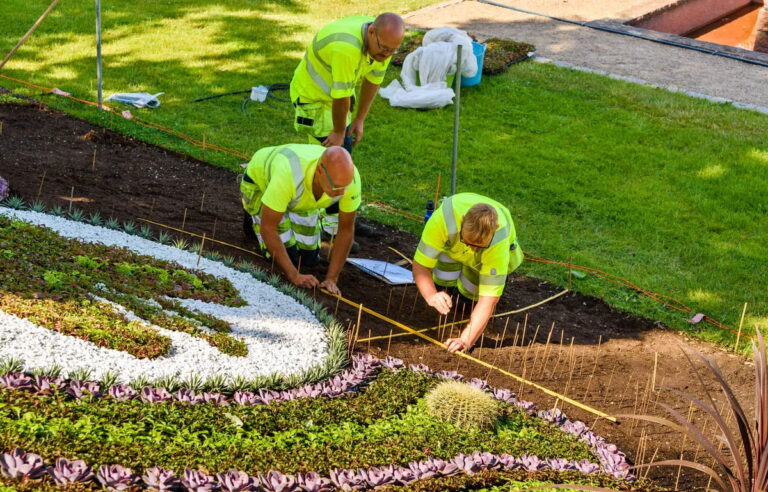
Six in the morning, before the first job. This is who your website answers to.
In this article
- Why Most Landscaping Websites Never Ring the Phone
- What a Lead-Generating Landscaping Website Design Includes
- Our Landscaping Web Design Runs at Two Speeds
- Our Landscaping Web Design Process, Step by Step
- Landscaping Web Design Cost: What You Should Expect to Pay
- Why Landscapers Pick TheBaseo Over a Generic Web Design Company
- Get a Free Teardown of Your Current Landscaping Website
- Landscaping Web Design FAQs
Why Most Landscaping Websites Never Ring the Phone
Most landscaping websites are not ugly. They are disconnected.
Five symptoms, all checkable from the truck in ninety seconds.
- It’s a brochure, not a salesman. It describes the company and never asks for the job.
- It takes five seconds to load because the gallery is full of phone photos nobody compressed. Google’s own data puts 53% of visits at risk of being abandoned when a page takes longer than three seconds.
- The phone number is in the footer. A homeowner standing in his yard will not scroll there.
- There is one “Services” page with a bullet list. It will never rank for “patio installation” plus a city, because it is not about patio installation.
- The photos are stock. Somebody else’s patio, somebody else’s crew. Stanford’s credibility research found visual design was the most mentioned reason people gave for believing a site, appearing in 46.1% of what they said. A stock photo says you have nothing of your own.
Speed is not cosmetic. When Deloitte and Google measured 37 brand sites across 30 million sessions, a tenth of a second of mobile speed moved lead-generation form submissions 21.6%.
None of this is a design problem. It’s a plumbing problem. The pages, the forms, the tracking and the channels pointed at them are the plumbing, and on most landscaping sites none of it was connected.
What a Lead-Generating Landscaping Website Design Includes
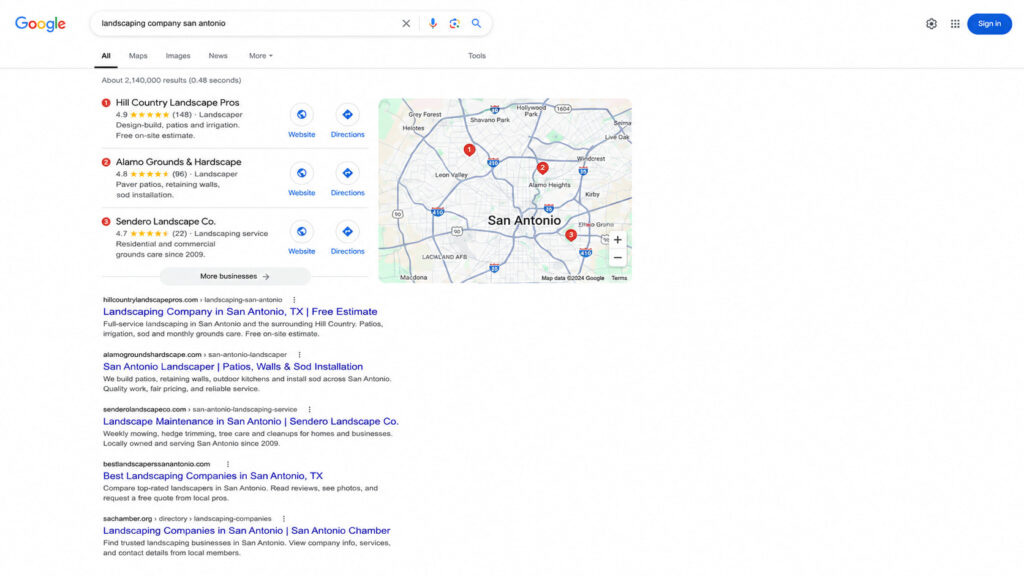
Six things separate a landscaping website design that books estimates from one that collects compliments. If your site is missing three of the six, that is your leak.
Fast mobile pages. A real project gallery. Click-to-call with follow-up behind it. A page per service, a page per town, and trust signals above the fold.
Every agency will tell you the same six. The difference shows up in the third and the fourth, which almost nobody builds. That is why landscaping websites built to convert look different under the hood from the ones that just look good on a laptop.
Mobile-First Pages That Load in Under Three Seconds
What makes a landscaping site slow is the gallery. Twenty photos straight off a phone, three megabytes each, loading whether the visitor scrolls to them or not.
The fix is unglamorous: modern image formats, lazy loading so pictures load as the visitor reaches them, hosting above the cheapest tier, and CSS that isn’t carrying a theme’s worth of dead weight.
Two numbers to check, and check them on your gallery page, not your homepage. Mobile PageSpeed above 70, and Largest Contentful Paint, meaning how long until the main image appears, under 2.5 seconds. Google has confirmed those act as a tie-breaker between otherwise equal pages.
The homepage usually passes. The page with forty patio photos doesn’t.
We test on a real phone on cellular data, standing outside, not on the office WiFi. That is the connection your customer has.
Project Galleries and Before-and-After Proof
The gallery is the highest-value page type in this trade and most landscapers treat it as an afterthought.
The homeowner is not buying grading and drainage. He is buying the picture of what his back yard looks like in June, and your gallery is the only place he sees that picture with your name under it.
Filter it by service, so patios, lighting, sod and hardscape are separate. Shoot before and after from the same angle, because a matched pair beats ten glamour shots. Get drone footage on the big installs. Put the town in every caption, which proves you work there and gives Google a local signal.
No stock photography. Not one image. You are selling the fact that your crew built that wall, and a stock photo says the opposite.
Click-to-Call, Quote Forms and Speed-to-Lead Follow-Up
Everybody builds the form. Almost nobody talks about the ninety minutes after it is submitted, which is where most landscaping leads die.
Start with the mechanics. A sticky click-to-call button that stays on screen while he scrolls, and a quote form above the fold on the home page, every service page and contact.
Then the fields. ZIP code, service, timeline, budget band, so you know whether it’s worth the drive. Cap it at six or seven; the eighth is where people quit.
Then the part nobody sells you: an automatic reply inside five minutes and a notification to whoever owns the schedule. A homeowner who hears nothing for half an hour has already filled out two more forms. You did not lose that job on price. You lost it on silence.
Last, call tracking on every number and form tracking on every submission. That is where BASEO starts a build, before anything gets designed, because if you can’t attribute the quote request to the page that produced it, you can’t scale the channel that produced it.
A Service Page for Every Job You Actually Sell
One page per service. Lawn maintenance, hardscape and patios, irrigation, landscape lighting, sod, tree and shrub care, snow removal where the season calls for it. Each with its own keyword, its own photos, its own form.
The competitor error is on almost every site in your market: one “Services” page with seven bullets. Google has no reason to send a paver patio search to a bullet.
Order matters, and it isn’t alphabetical. Build by margin, not by search volume.
Both searches cost roughly the same to win, and one of them is a $14,800 patio. The shorthand in this trade is that one patio is worth forty mowings, and there is no version of your calendar where forty mowings is easier to sell. One BASEO client closed that patio and an $18,600 retaining wall off pages built in that order (BASEO client data).
The structure is boring on purpose: /services/paver-patios/, /services/retaining-walls/, /services/irrigation-repair/. One job, one URL.
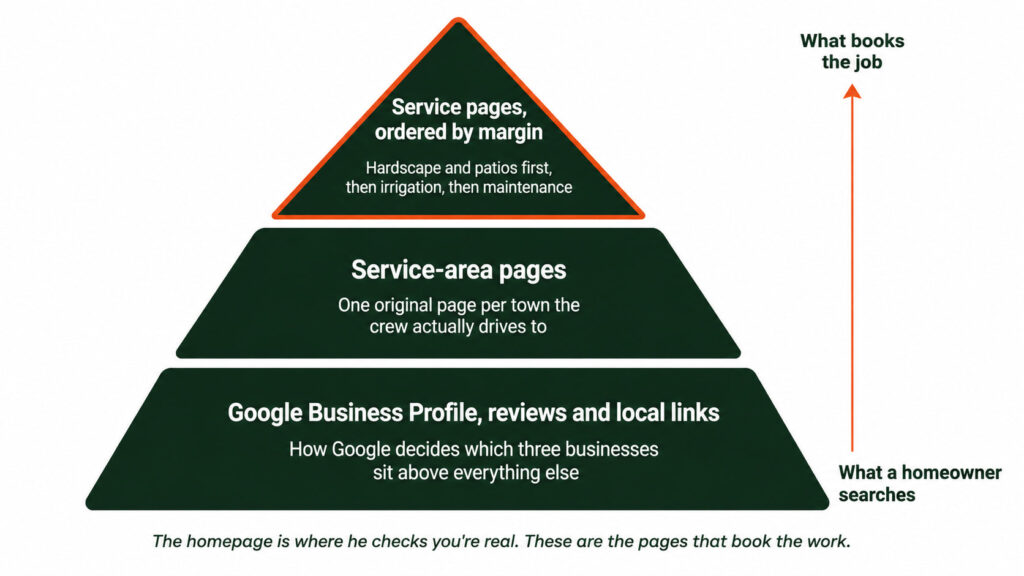
Service-Area Pages That Rank in the Towns You Serve
A service-area page and a doorway page look identical in a sitemap and nothing alike on the screen.
The template version swaps the town name into the same 300 words eleven times. The real version names actual neighborhoods, says what the water restrictions there do to what people buy, mentions the HOA rules that come up on every bid, shows work you did in that zip code, and carries reviews from customers who live there.
The mechanics are simple. The homeowner types his own town into the search, and Google will not rank one page for eleven suburbs no matter how many town names you list on it.
This is also the part of the site that scales, and scaling it well is the second of the two speeds we run.
Trust Signals: Reviews, Licensing and Real Crew Photos
He has two other tabs open. He decides in thirty seconds.
What belongs where he can see it without scrolling:
- Your Google rating and review count on the home page, not buried on a testimonials tab
- Three to five reviews carrying a name, a town and the specific service
- “Licensed, bonded and insured” stated plainly, above the fold, not in the footer
- Real photos of your crew and your trucks
- Association badges like NALP, if you carry them
“Great job, highly recommend” proves nothing. “They rebuilt the retaining wall on our slope in Cibolo in four days and hauled everything out” proves everything. When you ask for reviews, ask people to name the job.
Our Landscaping Web Design Runs at Two Speeds
Here is what usually happens. The site launches, everyone says it looks great, then nothing happens for four months.
A website on its own is a boat with no engine. It’s the right hull and it goes nowhere.
So we run two speeds in parallel from day one. One fills next month. The other makes every month after that cheaper. We do not give you a single 60-to-90-day number for both, because they do not move at the same rate, and pretending they do is how your last agency bought itself four quiet months.
Fast Lane: LSA, Google Ads and Google Business Profile
The site goes live already connected. Local Services Ads are running, the pay-per-lead units carrying the Google Guaranteed check that sit above both the ads and the map. Google Ads is structured by service, not one bucket labeled “landscaping.” The profile has been rebuilt: primary category, service list, service area, current photos.
That is why calls start in weeks while the pages mature.
The category numbers are public and worth knowing. Across landscaping search campaigns between April 2024 and March 2025, the average cost per click ran $8.76, the average conversion rate 6.42%, and the average cost per lead $117.92. Run it on your own numbers. A hundred clicks at $8.76 is $876 spent, and the category average buys about six quote requests with it.
At half that rate it buys three, and the same $876 now costs nearly $300 a lead instead of $118. The budget didn’t change. The page did.
Which is why we don’t hand Local Services Ads and Google Ads to somebody else after launch. The page and the click are one problem. Ad spend goes straight to Google, never marked up.
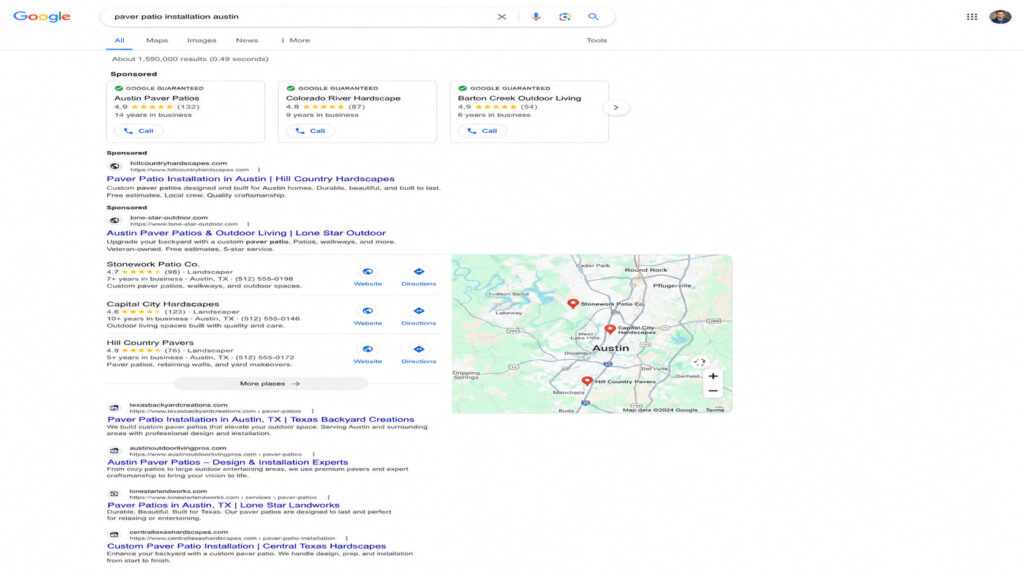
The stack a homeowner sees. The fast lane buys the top of that screen; the long lane earns the bottom.
Long Lane: SEO and Programmatic Service-by-City Pages
The second speed builds the asset you keep.
It is a silo of service crossed with city: paver patios in each town, irrigation repair in each town, grounds maintenance in each town. Underneath goes schema markup, labels telling Google what a page is about, then seasonal content and local links from chambers, associations and local press.
Those combinations get generated programmatically and reviewed before publishing. A normal web designer does not offer that. A normal SEO agency offers it but does not connect it to the build, so you pay twice for two halves of one thing.
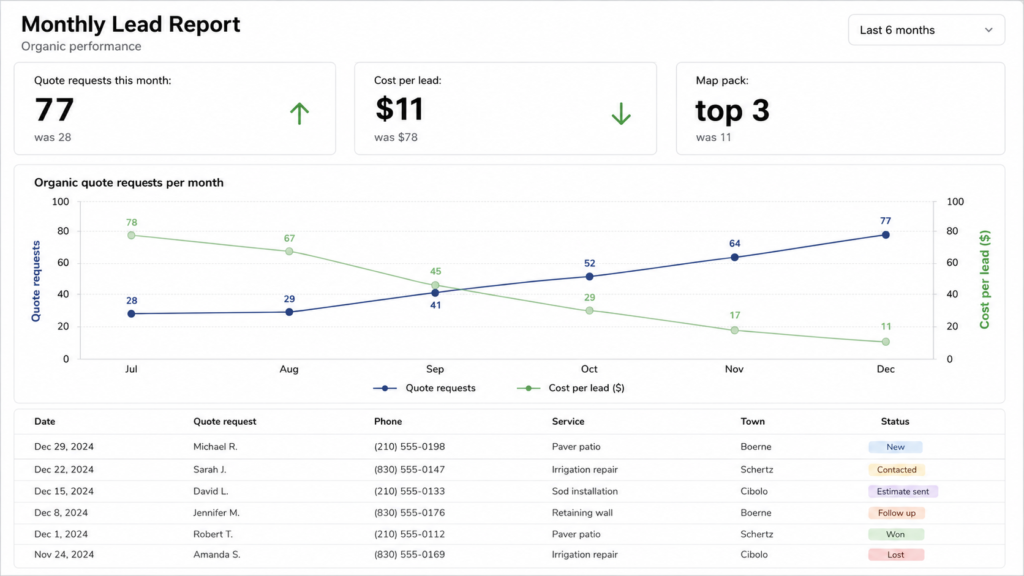
One San Antonio landscaper went from 28 organic quote requests a month to 77 in six months (BASEO client data). Not a campaign, not a rebrand. They arrived on pages, and the pages were the website.
Now the trade-off. Ads stop the month the funding stops, and that is what you are buying: speed, on demand, this week. The pages keep producing estimates after the budget moves. Expect the first organic quote requests between month three and month five, and real volume between month six and month nine.
Our Landscaping Web Design Process, Step by Step
The fear is specific and you have probably lived it. The agency goes quiet, and when you chase them, nothing has shipped.
So here is the timeline in weeks, and what it costs you: about an hour to kick off, then roughly twenty minutes a month. That second number matters more than anything else here, because you are reading it from a truck.
| Phase | Weeks | What happens | Your time |
|---|---|---|---|
| Audit | Week 1, free | Written findings: speed, rankings, competitors, profile, where leads come from now | 15 minutes to send the domain |
| Sitemap and wireframes | Weeks 1–2 | Every URL gets a keyword and an intent. Wireframes approved before design | About 30 minutes to approve |
| Design, copy, photography | Weeks 3–4 | Design on the approved wireframe, copy written to book jobs, shot list sent to your crew | Photos from your phone |
| Build, speed, tracking | Weeks 5–6 | WordPress build, compression, caching, SSL, schema, GA4, call and form tracking | None |
| Launch and monthly work | Week 6 onward | 301 redirects, real-device QA, then one report a month | 20 minutes a month |
1. Market, Competitor and Current-Site Audit
We check what your site does today: load speed, what you already rank for, the three crews dominating your market, your Google Business Profile and the review gap, and where your leads come from now.
The output is a written document: the three biggest holes, the competitor gap, and the job math for your market. This step is the free teardown. You can have it without hiring anyone, and you keep it either way.
2. Sitemap, Keyword Map and Wireframes
Every URL gets a keyword and an intent before anything gets designed. That sounds like process for its own sake until you see a site where it wasn’t done and four pages compete for the same search.
The service-by-city map gets prioritized by what those jobs are worth, not by raw volume. Wireframes get approved before a single pixel, which is what keeps scope from creeping.
3. Design, Copy and Photography
Design sits on the wireframe you approved, so there is nothing to relitigate at the end.
Copy gets written to book a job. Not “committed to excellence since 1998.” What the crew does, what it costs to find out, and where to click. Then we send a shot list: which jobs to photograph, from which angle, and what needs a before shot.
4. Build, Speed Work and Lead Tracking
Built on WordPress. Image compression, caching, SSL, schema markup on service and location pages.
Then the measurement layer: GA4, Search Console, call tracking on every number, form tracking on every submission, and a notification telling whoever runs the schedule a quote request came in. If it isn’t measured it isn’t optimized.
5. Launch, Then Optimize Every Month
Launch day is mostly one thing: 301 redirects, meaning every old URL points at its replacement. Miss them and the page quietly bringing in patio jobs from three towns over stops existing, along with every link built to it. It happens in the first hour.
Then QA on real devices. After that, one report a month: calls and forms, traffic by service area, rankings by service and city, site speed, and cost per lead on the paid side.
Step one of all of that is the audit, and the audit is free. Send Me the Site Audit →
Landscaping Web Design Cost: What You Should Expect to Pay
Almost every page competing with this one answers the cost question with “contact us.” Here are the real ranges, including the ones that are not ours.
There is no correct price, only a correct fit, and it comes down to one question: brochure, or lead channel? Both are legitimate depending on where the business is.
| Option | Typical price range | Time to launch | Who it fits |
|---|---|---|---|
| DIY builder (Wix, Squarespace, GoDaddy) | About $9 to $70 a month, plus 10 to 40 hours of your own time | Days to a few weeks | A newer crew running on referrals, no ranking ambition yet |
| Freelance designer | A few hundred to five figures, one time | 3 to 8 weeks | You want it to look right and you’ll handle the traffic yourself |
| Landscaping web design agency | Four to five figures to build, monthly after that | 4 to 8 weeks | You want the site, the pages and the ad channels run together |
| Full program: site plus SEO plus ads | Monthly, priced to the market | Site in 4 to 8 weeks, paid channels live in week 1 or 2 | The schedule needs filling now and cheaper leads later |
Those track the broader market: small-business builds run roughly $500 to $8,000 plus $600 to $5,000 a year to run, freelancers span a few hundred to five figures, and agencies start in the high hundreds. Pricing for your market comes inside the free audit, in writing. A call is optional.
DIY Website Builders
Roughly $9 to $70 a month, plus 10 to 40 hours of your time.
The honest verdict: if you are two years in, running on referrals, and you need a place for people to check you are real, a builder is fine. Wix and Squarespace have gotten good.
The limits show up later. You are on a template four other landscapers in your county also use, and building a page for eleven towns stops being fun around page fifteen.
Freelance Web Designers
A few hundred to five figures, one time, and the good ones are good. A strong freelancer will out-design most agencies for less.
The trade-off is scope. Keyword mapping, city pages, call tracking and maintenance are rarely in a freelance quote, and not because anyone is hiding anything.
The structural risk is the one to watch. When the freelancer takes a full-time role and stops answering, the site is orphaned and the next person quotes a rebuild.
Landscaping Web Design Companies and Agencies
What the premium buys is not design. It is the page architecture, the ad channels, the tracking, and somebody iterating monthly instead of handing over a file.
Run the break-even yourself. One BASEO client closed a $14,800 patio off an organic page (BASEO client data), and one hardscape job that size covers a serious piece of a year. For scale, the median landscape company books 355 customers at about $14,682 of revenue each. Do the division on your own average.
Then run the lead number. Shared leads cost around $78 for a phone number four other crews bought the same morning, closed or not. That same client got to about $11 a lead once the pages were his (BASEO client data). That gap is renting a lead versus owning the page that made it.
And the honest part: if your service area is three small towns and the volume isn’t there, this tier is the wrong spend. The audit will say so before you pay anything.
Is Affordable Landscaping Web Design a Trap?
Not necessarily. Cheap is a price; cheaply expensive is a structure. Three questions separate them.
- Do you get the domain, the hosting and the files in your name? If the answer takes more than one sentence, it’s a no.
- Is there an exit fee, or a clause that keeps the site if you leave? Ask to see that paragraph before you sign anything else.
- Does it include tracking, or only the design? With no call tracking you cannot tell whether the patio page or the mowing page produced the estimate, so you keep paying for both. That suits whoever built it.
Some companies do charge you to leave, or keep the site when you go. We don’t: month to month, 30 days’ notice, and BASEO has never placed a client on a 12-month contract (BASEO client data). The domain, hosting, content and data are yours from day one.
Why Landscapers Pick TheBaseo Over a Generic Web Design Company
A team that works only in the green industry. The team on your account works only with landscapers and lawn care companies. Not dentists, not plumbers, not “all industries.” It already knows your keywords, your competitors and your season before the kickoff call.
The site ships connected. Ads, Local Services Ads and the Google Business Profile go live around the launch, not as a separate project six months later. One landscaping operator went from $84 to $43 cost per lead in six months, and from 18 to 54 leads a month, on the same ad budget (BASEO client data). Same money in, different plumbing behind it.
Service and city pages at real scale. Built programmatically, prioritized by what the jobs are worth, reviewed before they publish. Most web design companies stop at eight pages, because eight pages is what a design project is.
You own everything. Domain, hosting, files, content, data. BASEO has never placed a client on a 12-month contract (BASEO client data), and cancelling takes 30 days’ notice.
The report counts leads, not impressions. Quote requests and calls with the phone numbers on them, cost per lead, where you sit on the map, what got published. One page, in plain English, once a month. Same lens we run across the whole marketing program.
Get a Free Teardown of Your Current Landscaping Website
Send us the domain and you get a ten-minute recorded teardown: where the leads leak, what the three crews above you built that you didn’t, and the three most profitable service-and-city keywords nobody in your market is working.
Free. In writing and on video. About two business days. No call required, and yours to keep whether we ever speak again.
If nothing is badly broken we will say so and you keep the video anyway. And if your market doesn’t have the search volume to support this, the audit says that too. That answer costs us a client and saves you a year.
One button. No twelve-field form.
Or call the office if you would rather talk it through.
Landscaping Web Design FAQs
A professional landscaping website typically runs between $2,000 and $20,000, depending on page count, custom photography, and whether SEO is included (market ranges). DIY builders cost $12 to $40 per month plus your own time. Agencies that bundle design, SEO, and ads usually charge a monthly retainer instead of a one-time fee.
Every landscaping website needs six things: mobile-first pages that load under three seconds, a project gallery with before-and-after photos, a separate page for each service you sell, service-area pages for the towns you cover, visible click-to-call and quote forms, and trust signals like Google reviews and licensing.
WordPress is best for landscaping companies that want to rank and own the site, because the strategy depends on a page per service and a page per town, and closed platforms get painful around page forty. Wix and Squarespace launch faster and suit crews on referrals, but the rankings live on their system.
A custom landscaping website usually takes four to eight weeks from kickoff to launch: one to two weeks for audit and keyword mapping, two to three for design and copy, and two for build, speed work, and tracking. Template-based sites can go live in days.
Yes, when they are built to book work rather than to look good. Paid landscaping campaigns convert at about 6.4% on average, and all that traffic has to land somewhere. A site with fast pages, real project photos and a short quote form captures that demand instead of losing it.
We work at several price points, and we’ll tell you honestly which one fits your market. Affordable becomes expensive when the site has no tracking, no service-area pages, or a contract that keeps your domain hostage. Ask any provider those three questions before you sign.
Yes. Your domain, hosting account, content, and files are yours from day one, and you can take them anywhere with no exit fee. Some landscaping web design companies include clauses that charge you to leave or keep the site entirely, so always read that section of the contract.
We build websites for landscaping and lawn care companies across the United States and Canada, and the team works in English and Spanish. Everything runs remotely, so your location doesn’t change the process, the timeline, or the price. One operator per market, so we only take one crew in yours.
Final thoughts
A landscaping website is not a design object. It is the place the leads arrive, and almost everything deciding whether they arrive is plumbing: how fast the page loads, whether there is a page for the job and the town, whether the form gets finished, and whether anything is pointed at it the week it goes live.
You already know whether yours is doing that. You knew before you opened this article, because the phone tells you every month.
What you probably don’t know is which of the six pieces is missing, and that is a twenty-minute answer, not a project. Send the domain and you will have it in writing in about two business days. If the fix is one page and a form, we will say that, and you can go build it with the crew you already have.