A referral landed on your schedule this month. You probably can’t say which customer sent it, what job it turned into, or what it cost you to get.
That’s the whole problem. Not that referrals don’t work. That they work by accident, so you can’t repeat them on purpose.
Here’s the system that makes them repeatable.
- Why a landscaping referral is your cheapest customer
- Why most landscaping referral programs quietly die
- Step 1: Decide what a referral is worth to you
- Step 2: Ask in the three windows where customers say yes
- Step 3: Make referring take less than 60 seconds
- Step 4: Work the street, not just the list
- Step 5: Build referral partners who send you work every month
- Step 6: Track referrals like a lead source
- The step almost every landscaper skips: your referred lead still Googles you
- Your 30-day referral system rollout
- Referrals have a ceiling. Local search is what raises it.
- Landscaping referral FAQs
- Final thoughts
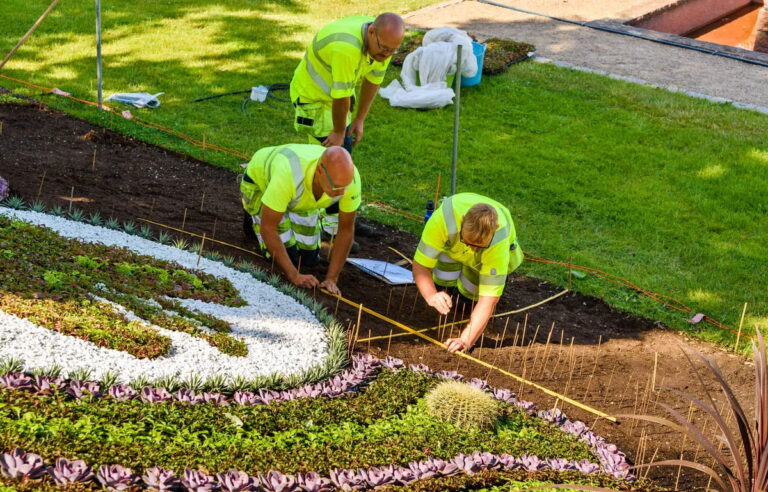
The final walkthrough: the highest opinion of your company a customer will ever hold, and the cheapest moment to ask.
Why a landscaping referral is your cheapest customer
Start with what it costs you, not how it feels. Most of your work already arrives this way: in a 2026 survey of 1,050 US home service business owners, 59% said referrals and repeat work are their top sources of leads. That’s the majority of the book, running on nobody’s plan.
A referred homeowner isn’t running a three-estimate race. He’s confirming a decision he’s made. Nielsen’s 2021 trust research found 88% of respondents trust recommendations from people they know more than any other channel, which is why the cycle collapses from three weeks of estimates to one phone call.
They also stay. A 2011 Journal of Marketing study of roughly 10,000 customers found the average value of a referred customer is at least 16% higher than a nonreferred one, with a retention advantage that holds instead of fading.
In maintenance, retention is the business: one extra season is thirty more cuts on a route you already drive.
What one referred client is actually worth over a full season
A weekly mow at $55 across a 30-week season is $1,650. Hold that customer three seasons and you’re at $4,950. Add one mulch install and a fall cleanup and it clears $6,000.
Put a $100 referral reward next to $6,000. That’s under 2% of what that customer is worth to you over three years.
Compare that to buying the same job. One landscaping crew we worked with was paying $78 for a shared Angi lead and about $11 for a lead from pages he owns (BASEO client data). At a one-in-five close rate, that $78 shared lead is roughly $390 of lead cost per booked job.
Angi is not a lead source. It’s a lead rental. You pay the same $78 whether you close the job or lose it to the four other crews who bought the same phone number, and the day you stop paying it all stops.
Nobody is telling you to cancel it this week. It’s feeding your crew. But a $100 reward on that $6,000 customer buys a job that arrived pre-sold, and nobody bought a copy.
A $100 reward on a customer worth $6,000 isn’t a marketing expense. It’s the cheapest commission you’ll ever pay, on a job that was already sold.
Why most landscaping referral programs quietly die
Four failures, none of them the customer’s fault.
It lives on a page nobody visits. The program is a paragraph on the website with a form under it, never said out loud on a job site. A program that only exists in writing is a policy. Somebody has to ask, standing on the grass, with the trailer still loaded.
The incentive is a discount on the next service. He hears that as nothing, because collecting it costs him another purchase. He did you a favor and you handed him a coupon. Make the reward something he receives, not something he unlocks.
Nobody defined when it gets paid. He refers the neighbor in April, you close the $5,000 sod job in May, and by the time the crew is three weeks into the spring rush nobody has told him anything. He won’t complain and he won’t ask. He just never does it again, and he was on a street your trucks already drive. Name the payment window before you make the offer, pay inside seven days of closing, and report back even when it doesn’t close.
There’s no record. Two months in you can’t tell whether it worked, so you stop paying attention and it dies without anyone announcing it. One line per referral prevents this.
Step 1: Decide what a referral is worth to you
The number comes off the margin of the job it brings in, not off what feels generous standing in a driveway.
The working rule: pay between 1% and 3% of the value of the referred work, or the equivalent of one service on recurring maintenance, whichever is smaller. That isn’t an industry statistic. It’s arithmetic off job margin, and you should redo it with your own numbers.
One flat number for everything is the error. The $100 that’s generous on a weekly mow is an insult on an $18,000 patio, and a flat $300 bleeds the maintenance side dry by June.
How much to pay per referral, by job type
| Job type | Typical job value | Suggested referral reward |
|---|---|---|
| Recurring mowing or maintenance | $1,500–2,500 per season | $50–100, or one month of service |
| Mid-size install (mulch, sod, irrigation repair) | $2,000–6,000 | $150–250 |
| Commercial or HOA maintenance contract | $8,000–25,000 per year | 2% of first-year value ($160–500) |
| Hardscape or design-build | $15,000 and up | $300–500, or 1–2% of project value |
The job values in that middle column are our own working bands for this trade, not published industry figures. Check them against what you closed last season.
The bottom row is where flat rewards break down. Two of the hardscape jobs one landscaping crew closed off pages they own were a $14,800 patio and an $18,600 retaining wall (BASEO client data).
Put that $14,800 patio next to the $55 weekly mow: one job is worth nine full 30-week mowing seasons. A flat $300 on the patio is 2% of it, while a flat $100 on the mow is 6% of the season. The number that felt generous on the small job is the expensive one.
Pay a percentage on that row instead. Two percent of the $18,600 wall is $372, on work that runs from $3,000 to $50,000. One band across that range is arithmetic nobody did. Then tier it: the reward goes up on the second and third referral from the same customer inside a year, because a handful of people refer four times and those are the ones to overpay on purpose.
Cash, account credit, or gift card: what customers actually redeem
Account credit is cheapest for you. It comes out of margin instead of the bank account and only costs you if he books again, which is also why it’s the weakest motivator. Cash or a prepaid Visa feels like a gift and gets remembered, and a card to a home improvement store or a local restaurant costs the same and gets talked about at a dinner table, where the next referral starts.
Better still, give him something to hand the neighbor. Field experiments in the Journal of Marketing Research in 2020 found referrals where the reward benefited the friend recruited more new customers than referrals where the reward benefited the sender. Handing a neighbor $50 off his first fall cleanup is a favor. Asking him to call the crew you use so you can collect $50 is a pitch.
Our recommendation: account credit for active maintenance customers, a gift card with a handwritten note for everybody else.
Step 2: Ask in the three windows where customers say yes
The window is days wide, not months. Nobody schedules around enthusiasm, so it expires unused.
- The final walkthrough. Asked by the crew lead, in person, on site.
- 24 to 48 hours after a five-star review or thank-you text. Asked by the office, by text, replying to what he sent.
- The start of the season. Asked by the owner, by email, to the whole maintenance list.
The walkthrough is the strongest and the most wasted. He’s looking at the finished bed work for the first time, standing next to the person who did it, and most crews spend that moment loading the trailer.
The second is easiest to systematize because he started it: answering a five-star review with a question two days later never feels cold. The third is a numbers play, because in March everyone on that street is looking at their own yard at once.
Without a specific ask, assigned to a specific person, on a specific trigger, all three windows close on their own.
Referral scripts your crew leads can use without sounding like salesmen
Three sentences, maximum. A crew lead says these with a blower in his other hand.
Crew lead, in person, at the walkthrough:
“Glad you’re happy with it. We pay $100 if you send us someone who books. Is there a neighbor on this street you’d want us to give a quote to?”
Office, by text, 48 hours after a five-star review:
“Thanks for the review, it really helps us. If you send us a neighbor and they book, we’ll put $100 credit on your account. Anyone you’d want us to reach out to?”
Owner, by email, at the start of the season:
“We’re building next season’s route now. Send us a neighbor who books and we’ll credit you a month of service. Who’s first on your street?”
Every one ends in a closed question, and that’s deliberate. “Do you know anyone who needs us?” makes him do memory work across everyone he’s ever met, and he’ll say he’ll think about it. “Anyone on this street?” hands him eight houses he can see from his driveway.
Step 3: Make referring take less than 60 seconds
Friction kills programs people actually like. Every step between wanting to help and helping loses willing referrers.
- Referral cards the crew leaves at the end of a job. Cheapest on the list.
- A short form link the office texts, so nobody has to have a conversation to introduce anyone.
- A pre-written message he only has to forward.
- A QR code on the invoice, for the customer paying on his phone anyway.
The rule underneath all four: your customer should never have to explain your business. He isn’t going to describe your drainage work or your paver base correctly. Hand him the sentence already written, with your phone number in it.
Skip the points apps. For a crew of six that’s a system to maintain instead of one that works.
Step 4: Work the street, not just the list
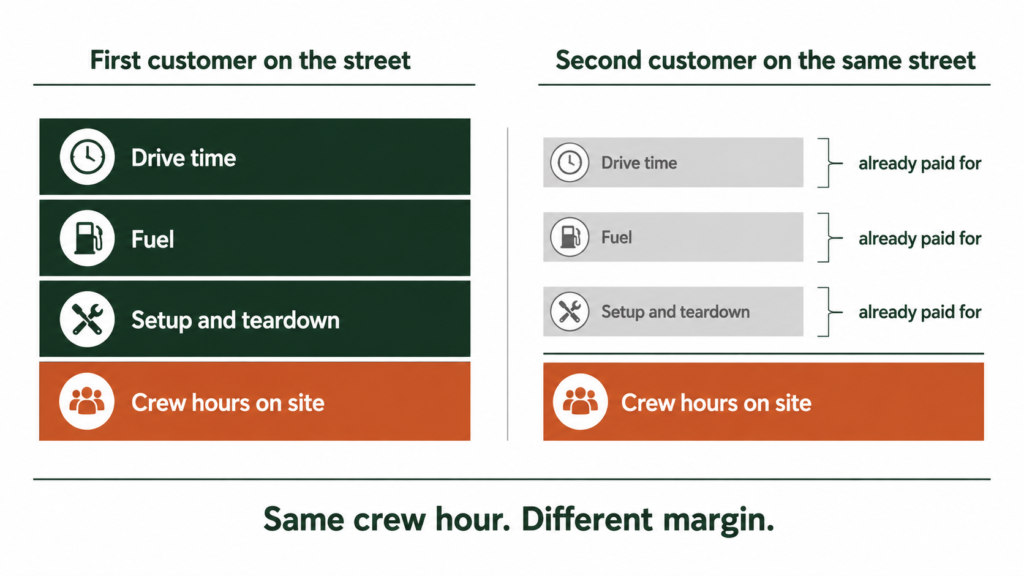
Two customers on the same street share the drive, the fuel and the setup. The first stop pays for all of it. The second pays for the crew hour and little else.
Run it on a number you have. That $55 weekly mow is $1,650 across a 30-week season, and a second $55 stop three doors down adds another $1,650 without a second drive, setup or teardown. Whatever your drive time and fuel per stop works out to on last month’s route sheets is what the first stop spends and the second keeps.
Almost nobody prices referrals accordingly. One three doors down is worth more than one twenty minutes across town. So pay for proximity:
- A higher reward inside the same subdivision or ZIP. Say it in the offer: “$100, or $150 if they’re on your street.”
- Yard signs while the crew is on site, not after they leave. The sign works hardest with a truck next to it.
- “We’re on your street this week” cards to the five houses either side of an active job. Not a mailer. A card, that day, while the trailer is still visible.
- Ask while the trucks are on that block, on every job, not just the big ones.
This is maintenance-route arithmetic, and it sits underneath the install and hardscape work rather than replacing it: a tight route keeps the crews paid between design-build jobs.
Worked this way, referrals stop being a volume play and become a margin play.
Step 5: Build referral partners who send you work every month
A customer refers once. A business refers every month.
Six categories already have your ideal customer in front of them:
- Realtors needing a yard that photographs well before a listing goes up.
- General contractors and home builders finishing a project with bare dirt around it.
- Nurseries and garden centers talking to homeowners who just realized the job is bigger than a Saturday.
- Pool companies who leave a hole surrounded by nothing.
- Irrigation specialists who see every failing system in the county.
- Property managers and HOA boards who need somebody reliable on contract.
Lead with reciprocity, not money. Tell them what you can send them before you ask what they pay. A partner who has already received work from you takes your call in the spring rush.
Four partners who genuinely recommend you beat forty who have your card in a drawer. A recommendation only carries weight if the person making it has something to lose.
The mechanics are boring and they work: one new contact a week, one coffee, and a written note of what gets paid and when. Written, because the verbal arrangement is the one forgotten in March.
One caution: real estate referral fees are regulated in ways landscaping rewards are not. Ask the realtor what they can accept before you offer.
Step 6: Track referrals like a lead source
Five fields. That’s the whole system.
Who referred, what job came out of it, what it closed for, what reward you paid, and the date you paid it.
Those five fields buy you one number: what it costs you to get one booked job through this channel. Set it next to what a shared lead costs you and what your ads cost you, and compare the three honestly for the first time. Twelve referred jobs closed at $100 each is $1,200 in rewards, against the $390 per booked job the shared leads were running.
Start with a “how did you hear about us” field on your quote form and the same question on the phone. If you already run field software it’ll produce the report, but none of this waits on software you don’t have.
One discipline rule: pay inside seven days of closing, and tell the referrer the outcome either way. “We quoted your neighbor, he went another direction, thanks for sending him” keeps a referrer. Silence loses one.
The step almost every landscaper skips: your referred lead still Googles you
You’ve been at this twenty years. You run five crews, you’ve got a name people say at a barbecue, and half the street you grew up on is on your maintenance list.
Here’s what happens to a referral you earned. Your customer tells his neighbor about you at the mailbox, and the neighbor doesn’t call from the driveway. He goes inside, types your company name and his town into his phone, and looks at what comes back.
That search is where the referral is won or lost, and you weren’t in the room for it.
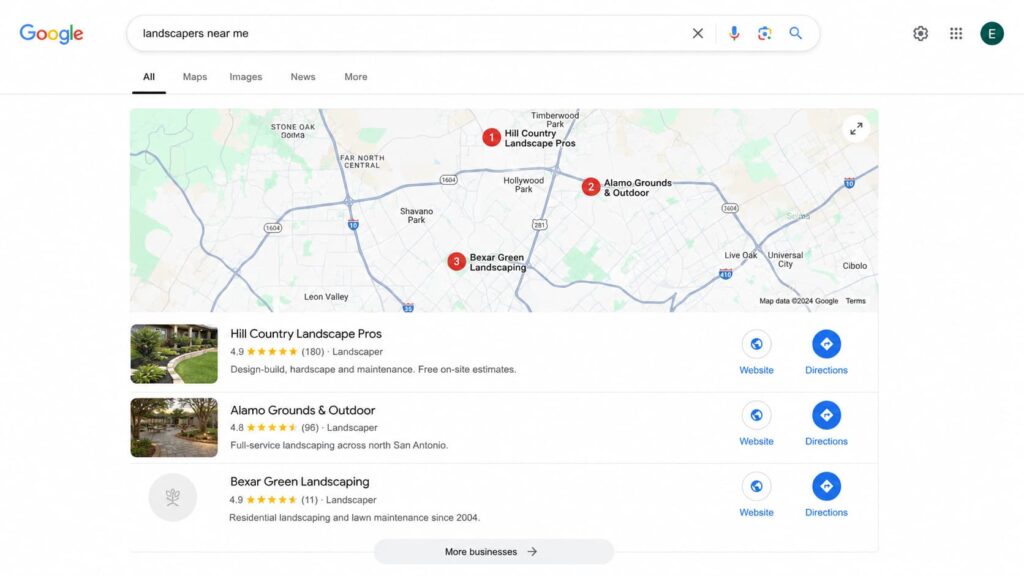
What he finds is often a Google Business Profile (the listing with your hours, photos and reviews beside the map) with eleven reviews, the newest from two years ago, four photos and blank hours. Above it sits a crew he’s never heard of with 180 reviews and forty photos of finished patios in his zip code.
He calls the one that looks alive.
The reviews are his only second opinion. BrightLocal’s 2026 consumer survey found that 49% of consumers trust online reviews as much as a personal recommendation. For about half the people your customers send you, the reviews weigh as much as the neighbor who sent them.
A referral program working perfectly on top of a half-built profile isn’t a channel. It’s a leak, and you paid for it twice: once in the work that earned it, once in the reward you were ready to hand over.
Rebuilding that profile, and getting the reviews and job photos current, is what showing up in local search means for a landscaper. Eleven reviews and four photos against 180 and forty isn’t a quality gap. It’s a profile nobody finished filling out.
BASEO does that work, and it’s worth doing for one reason: the profile that decides whether the referred neighbor picks up the phone is the same one that decides whether the homeowner with nobody to ask ever finds you. One rebuild, both doors.
The three things a referred homeowner checks before they call
- Your Google Business Profile. Recent reviews, real job photos, services and service area filled in. This week: read the date on your newest review.
- Photos of work like his, ideally from a street near him. This week: pull ten job photos off your crews’ phones and post them.
- A site built to convert, that loads with a tappable phone number. He’s standing in his own yard holding a phone. This week: open your site on cellular and count the seconds.
Your 30-day referral system rollout
Four weeks. Each one ends in something somebody can check.
- Week 1: set the payout and write it down. Four job types, four numbers, one page. Done when: you’d read that page out loud to a customer.
- Week 2: put it in the trucks. Train the crew leads on the scripts, print the cards, set up the form link. Done when: every truck has cards and every crew lead has said the script once.
- Week 3: work the phone. Call the twenty best customers from last season and four potential partners. Done when: twenty conversations happened and four coffees are booked.
- Week 4: pay and clean up. Settle what’s outstanding, report back to every referrer, fix the profile and the photos. Done when: every reward is paid and ten new job photos are posted.
Anything that hasn’t produced a deliverable by the end of its week didn’t happen.
Referrals have a ceiling. Local search is what raises it.
Referrals are the best channel you have, and the ceiling is the size of your customer list. You can’t refer your way to a homeowner who doesn’t know anybody you’ve worked for.
Local search fills that gap: a profile that holds a spot in the map, Local Services Ads, and real pages for the towns your crews drive to, catching the person searching “landscapers near me” with nobody to ask. It also makes every referral you already earn convert better.
Ads put you at the top of that search the week you turn them on. The pages and the profile make every job after it cheaper. They run together.
Landscaping referral FAQs
Ask right after you deliver a visible win, and ask small. Instead of “know anyone who needs us?”, say: “We’re on this street this week, is there a neighbor you’d want us to quote?” A closed question feels like a favor, not a pitch.
Match the reward to job size: $50 to $100 for a recurring maintenance client, $150 to $250 for a mid-size install like sod or irrigation, $300 to $500 (or 1% to 2% of project value) for hardscape. On a customer worth $6,000 over three years, $100 is under 2%.
For landscaping, yes. It’s standard practice and isn’t restricted the way real estate referral fees are. Keep records of who you paid: the IRS reporting threshold for these information returns rose to $2,000 for tax years beginning after 2025. Confirm details with your accountant.
Within days of peak satisfaction: at the final walkthrough, within 48 hours of a five-star review, and at the start of the season when neighbors are all looking at their yards. That window is short, and missing it makes the ask land flat.
Reward both. It changes what your customer is doing: instead of asking a favor so he can collect, he hands a friend a real discount. A common structure is $50 credit to your customer and $50 off the neighbor’s first service.
Start with the base you have. Ask every one of your first customers directly, leave yard signs on active jobs, and build partner referrals with realtors, nurseries and pool companies. Pair it with a complete Google Business Profile.
Final thoughts
The referrals are already happening. What’s missing is a number, a person whose job it is to ask, and one line of record per referral so you can tell at season’s end whether any of it worked.
Pick one job type this week, set the payout, and have your crew lead run the walkthrough script on the next job. Then search your own company name on your phone and look at what a neighbor would find.
If you want to know what he’s finding and what the crew above you built instead, that’s what the audit is for. The team on your account works only with landscapers, so it already knows your market. Free. Written, in about two business days. No call required. Yours to keep, even if we never speak again.