You have read the lists. Twelve ideas, eighteen ideas, twenty-five ideas. Not one of them told you which one to do on Monday.
Marketing a landscaping business does not fail because you are short on tactics. It fails on sequence, and on nobody ever working out what a booked job actually costs by channel.
So this page does three things instead of handing you another list. What a lead really costs on every channel worth running. Which two to run first based on the size of your business, and which to leave alone until you are bigger. And the calendar, season by season, because in this trade the month you spend the money decides whether it works.
The short version:
- Budget 5 to 10% of revenue, and decide first whether the owner’s hours count inside that number.
- Local Services Ads are the cheapest exclusive lead in the trade at roughly $48. Search ads run about $118 for landscaping.
- Cost per lead decides nothing. Cost per booked job decides everything, and you cannot calculate it unless every channel is tracked to a job on the schedule.
- Under $250K, run two channels and ignore the rest. Above that, add them in order, one at a time.
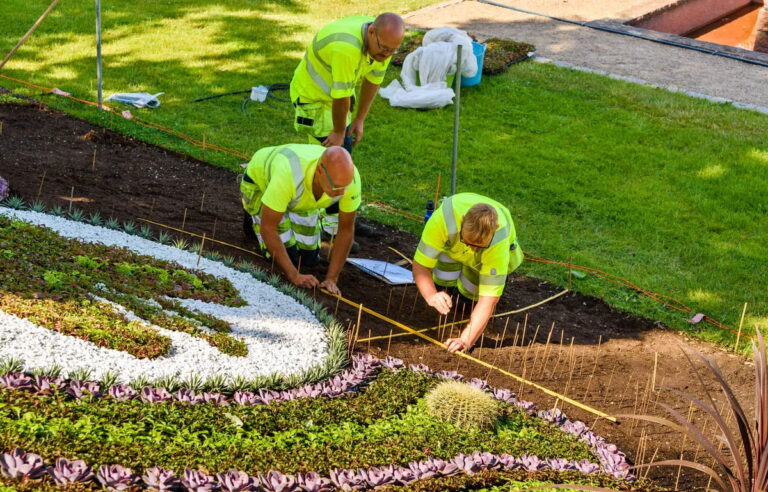
A landscaping business owner at the start of the day. Everything below is written for him, not for the homeowner who hires him.
On this page
- What landscaping marketing actually costs
- Pick the customer before you pick the channel
- The foundation: getting found when someone searches “landscaper near me”
- Paid channels that fill the schedule fast
- Getting cited in AI search: the channel nobody is optimizing for
- Marketing that compounds: referrals, retention and repeat work
- Offline landscaping marketing that still works
- Social media and content for landscapers
- Your landscaping marketing calendar, season by season
- What to do first: a marketing sequence by revenue stage
- How to track your marketing so you know what to cut
- Want a marketing plan built for your market?
- Landscaping marketing FAQs
What landscaping marketing actually costs
Most owners cannot tell you whether their marketing is expensive or cheap. They know what the shared lead invoice says every month. They have never worked out what that comes to per job they actually booked, which is the only version of the number that means anything.
It goes first because it is the hole in every other page ranking for this search: plenty of advice about what to do, almost none about what it costs. Three questions decide it. What share of revenue belongs in marketing, what a lead costs by channel, and which two numbers you should actually watch.
How much of your revenue should go to marketing?
A landscaping business should spend 5 to 10% of total revenue on marketing. That range comes from Landscape Leadership and holds across most of the green industry. A crew holding the accounts it already has sits near the bottom. A crew pushing into a new town needs the top.
Phil Risher of Phlash Consulting puts it slightly wider: “Ideally we see companies spending 3 to 10% of their revenue on their marketing spend,” he told Jobber, spelling out the arithmetic at $100,000 in revenue meaning $3,000 to $10,000 a year.
Translate it and the number stops being abstract.
| Annual revenue | Conservative budget (5%) | Growth budget (10%) |
|---|---|---|
| $250,000 | $12,500/yr ($1,040/mo) | $25,000/yr ($2,080/mo) |
| $500,000 | $25,000/yr ($2,080/mo) | $50,000/yr ($4,170/mo) |
| $1,000,000 | $50,000/yr ($4,170/mo) | $100,000/yr ($8,330/mo) |
| $2,000,000 | $100,000/yr ($8,330/mo) | $200,000/yr ($16,670/mo) |
Here is the part nobody argues about because nobody defines it. Does the salary of the person doing the marketing sit inside that budget or outside it? If you spend ten hours a week on it yourself and count zero, you are not at 5%, you are at 5% plus a quarter of an owner. Decide which way you are counting before you argue about the percentage.
What a landscaping lead costs by channel
| Channel | Typical cost per lead | Exclusive? | What it’s good for |
|---|---|---|---|
| Google Local Services Ads | ~$48 | Yes | Fastest exclusive phone leads. Sits above everything else on the page |
| Google Search Ads (landscaping) | $118 measured average, past $300 in competitive metros | Yes | Controlling the message, and high-ticket services that deserve their own pitch |
| Home services category average | $91 | Yes | A cross-trade reference point when you are judging a quote |
| Shared lead marketplaces | ~$78 | No. Sold to four other crews | Volume when the schedule is empty |
| Organic search and Google Business Profile | ~$11 variable | Yes | Compounds. Costs months rather than dollars |
| Referrals and yard signs | No variable cost | Yes | Highest close rate you will ever see. Capped by job volume |
Cost per lead swings brutally by market, and the table proves it on its own. LocaliQ measured landscaping search campaigns at $117.92 per lead across thousands of accounts, while quotes in competitive metros run past $300. Same channel, nearly triple the price. Even inside Local Services Ads, where landscaping averages $48, the range runs $39 to $60 (99 Calls, July 2026). A lead in Phoenix and a lead in a rural county are not the same purchase, and anybody quoting you a national average as a promise is selling you something.
Use these to judge an agency’s numbers, not to predict your own.
The exclusivity column is doing more work than the price column, and it is worth being blunt about why. Angi is not a lead source. It is a lead rental. You pay the same $78 whether you close the job or lose it to the four other crews who bought the same phone number that morning. The price goes up every year. And the day you stop paying, all of it stops, because you never owned any of it.
One landscaping crew that moved its lead generation onto pages it owns went from $78 per Angi lead to about $11 per organic lead (BASEO client data), and every one of those was his alone. That is not a discount on the same product. It is a different product.
None of these numbers mean anything on their own, though. They only start to matter when you know how many of them turned into work.
The only two numbers that matter: cost per booked job and LTV:CAC
Cost per lead is the number everybody quotes at you and the number that decides nothing.
The one that decides is cost per booked job: what you spent on a channel, divided by the jobs you actually closed from it. Run it once and the whole picture changes.
Say you put $1,000 into Local Services Ads. At $48 a lead that is about 21 leads. Six turn into an estimate you actually drive out and write. Two close. You did not pay $48 a job. You paid $500 a job, and $500 is the only number worth arguing about.
Now put it against what the customer is worth. Say your average maintenance customer runs $300 a month and stays three years: $10,800 over the life of the account. Paying $500 to get him is not expensive, it is the best money in the business.
Design-build works differently under the same cost. A $4,500 install absorbs $500 comfortably but does not repeat, so the margin on that one job has to carry it. Same customer acquisition cost, meaning what it costs you to get one job, two completely different decisions. One business, two sets of math.
The rule of thumb is three to one: a customer should be worth at least three times what he cost to get. Rough instrument, still better than what most operators have.
There is a condition on all of it, and it is why the arithmetic never gets done. Cost per lead is only comparable across channels when every channel is tracked to a job on the schedule, and most are not. That is what a monthly report is supposed to fix, and why BASEO builds reporting around quote requests and calls with phone numbers, cost per lead trend, map position, and what got published. If a report does not contain the words “quote requests” and an actual phone number, it is not a report. It is a receipt for nothing.
Pick the customer before you pick the channel
The list of eighteen tactics fails as a document because it lines up tactics that serve completely different customers and presents them as interchangeable. That is a routing problem, not a branding problem. Two questions settle most of your marketing before you pick a channel: what do you actually sell, and how far will you drive to sell it.
Maintenance contracts vs. design-build: two different marketing problems
Not one page ranking for this search segments by what you sell, and that is the biggest miss in the category. Recurring maintenance and design-build are two businesses, and running one budget across both is why the budget feels like it disappears.
Maintenance customers compare very little and decide fast, usually on proximity. Somebody’s guy stopped showing up, they search, they call one of the three names on the map. That work is won on route density, review count and being the closest credible option.
Design-build is an $8,000 to $60,000 decision with a three to eight week cycle, two or three quotes, and an aesthetic judgment nobody makes off a phone number. It is won on portfolio, on process content that makes the build feel less risky, and on remarketing.
Look at what that second funnel returns. One landscaping crew closed a $14,800 patio and an $18,600 retaining wall off its own organic pages (BASEO client data). Two jobs, $33,400, from pages that took months to rank and then kept ranking. A maintenance customer at $300 a month takes nine years to match them. That is not an argument for dropping maintenance, which renews and carries the crews through the year. It is an argument for not funding both funnels out of one budget and hoping.
| Maintenance contracts | Design-build and hardscape | |
|---|---|---|
| Sales cycle | Days. Often one call | 3 to 8 weeks, multiple quotes |
| Typical ticket | $150 to $400 a month, recurring | $8,000 to $60,000, one time |
| Primary channel | GBP, Local Services Ads, yard signs | Portfolio, Instagram, remarketing |
| Key asset | Review count and route density | Before-and-after photography |
| The number to watch | Contracts added per month | Cost per booked job against margin |
So if you sell both, you need two funnels and two budgets. Most operators run one, point it at whatever keyword is cheapest, and then wonder why every lead that comes in wants a quote on mowing.
Draw your service area before you spend a dollar
A margin argument wearing a marketing hat. Drive time is the cost that never appears on an invoice, and it is why two crews doing identical revenue can have completely different years.
Draw the honest radius first, usually 20 to 30 minutes from the yard, then find the point where the truck eats the job: the drive where a two-hour visit becomes three and a half and the margin goes with it.
That line decides four settings you were going to configure anyway. The service area on your Local Services Ads. The geo-targeting on Google Ads. Which city pages get built and, more importantly, which do not. And which ZIP codes come off the mail list before you pay to print.
Route density is the same idea from the other end. Eight houses on one block and eight spread across the county are the same revenue and two different businesses.
The foundation: getting found when someone searches “landscaper near me”
Everything in this block is table stakes, so the difference is order and depth rather than novelty. The rule that governs it: do this first, always, whatever size you are. Nothing else on this page works if a homeowner two streets over cannot find you when he types those four words.
For a lot of established operators this is the entire gap. Twenty years of reputation, a name everyone in town recognizes, and a crew with two trucks sitting above you on the map.
Your Google Business Profile is your real homepage
Around 96% of consumers use the internet to find local services, per Moz data compiled by Loopex Digital. What matters more is what happens next: for most of them the profile is the visit. They read it, they tap Call, and they never see the website you paid for.
Start with the primary category, because it is load-bearing and almost everyone gets it wrong. Landscaper, Lawn Care Service and Landscape Designer are three separate categories and Google treats them as three separate businesses. A crew doing $40,000 hardscape builds, filed under Lawn Care Service, is competing for mowing searches and losing the ones it wants.
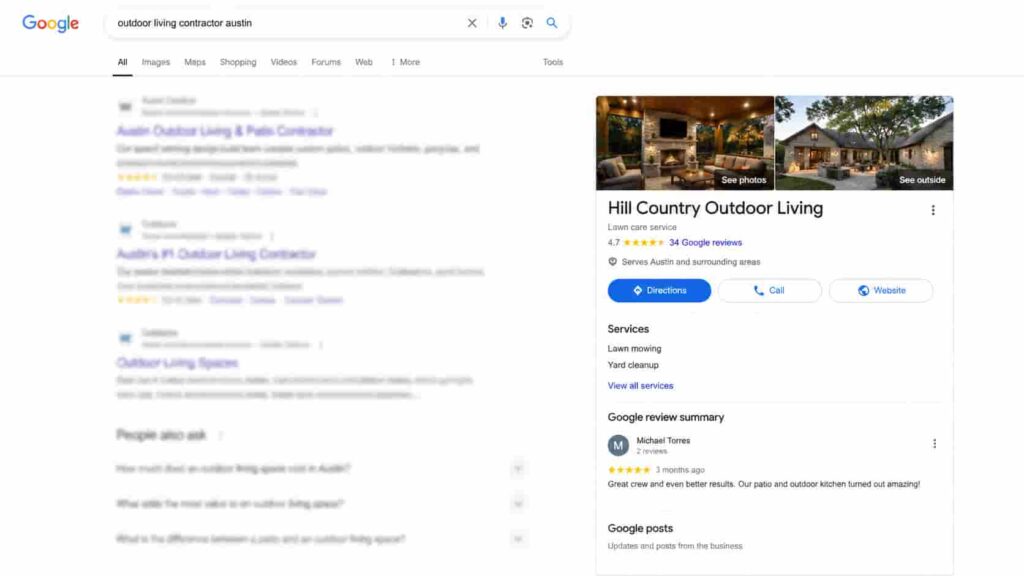
A hardscape company filed under “Lawn care service.” The category is not a detail. It decides which searches you are even eligible for.
The rest is a checklist short enough to finish in an afternoon:
- Primary category set to what you actually sell most of.
- Secondary categories filled in for everything else you do.
- Service areas set to the towns you genuinely drive to, not every town within an hour.
- Real hours, including the ones where somebody actually answers the phone.
- Photos of real finished jobs, added weekly, not a folder dumped once.
- A Google Post every couple of weeks.
- Messaging turned on and answered in minutes, because Google is watching how fast you reply.
- The services section filled out, with price ranges wherever you are willing to publish them.
One warning: a fake address or a virtual office is not a shortcut, it is a suspension. Service-area businesses hide the address, they do not invent one, and Google’s Business Profile guidelines are specific about it.
BASEO starts every engagement here for a mechanical reason: three businesses sit above everything else on the page, and this profile is how Google picks them. Rebuilding it properly is usually the fastest visible movement of the whole engagement. The longer version is in the map pack playbook.
Reviews: the cheapest lead source you already have
The numbers moved sharply in the last year. 97% of consumers now read reviews for local businesses, and 85% say they are more likely to use a business after reading positive ones, per BrightLocal’s 2026 Local Consumer Review Survey. The bar moved too: 31% will only use a business rated 4.5 or higher, nearly double the 17% a year earlier.
But the stat that should change what you do is this one. 74% want reviews written in the last three months, and a third want something from the last two weeks.
That kills the strategy most operators use, which is asking everybody at once every couple of years. A wall of ninety reviews from 2022 does not read as a busy company, it reads as a company that stopped. Two to four new reviews a month, forever, beats thirty in one push, and it is the only cadence a crew can sustain.
So it is a system problem, not a willpower problem, and it comes down to four decisions. When: at completion, while the customer is standing in front of the work, not three days later from the office. Who: the crew lead who did the job, because he is the one the customer just thanked. How: a text with a direct link, because email gets read tomorrow or never. How often: every job, which is what makes two to four a month happen without anyone having to remember.
Here is the text, short enough to send from a truck:
Hey [Name], thanks for having us out today. If you’re happy with how it turned out, would you mind leaving us a quick Google review? Takes 30 seconds: [link]
Negative reviews need a system too, and speed beats eloquence: 81% expect a reply within a week, 19% the same day. Three sentences:
Thanks for telling us, [Name]. You’re right that we [specific thing that happened], and that’s on us. We’ve [specific change] so it doesn’t happen again, and I’d like to make it right if you’ll give me a call at [number].
Answer the complaint, say what changed, stop. Never argue in public, and never pay for reviews or offer a discount for one. It violates Google’s review policies outright, and the penalty is not a warning, it is the removal of reviews you already earned.
A website that answers three questions in ten seconds
Most landscaping websites are brochures. Attractive, a hero video of a lawn nobody in your market has, and no answer to the three questions the visitor arrived with.
The three are always the same. Do you serve my street. Do you do the thing I need. What does your work look like.
Answer those and the rest is decoration. They have to be fast for a behavioral reason: 57% of local searches come from phones and tablets, and 76% of people searching on a phone visit a business within a day, per Statista data compiled by Loopex Digital. He is holding the phone in somebody’s driveway. He is not going to hunt.
Five things, and the list really is that short. A phone number pinned in the mobile header that dials when tapped. The towns you serve, visible without scrolling. A before-and-after gallery of real jobs, yours, not stock. A quote form with four fields, not eleven. And a page that loads before he gives up on it.
The number to watch is the share of visitors who call or fill out the form. Not traffic, not rankings, and measured against your own last quarter rather than an industry average you read somewhere. If you cannot say what it was last month, that is the finding, and it is bigger than anything on the design.
If fixing the site is a rebuild rather than an edit, that is a project measured in a few weeks, not months. We build a site built to book estimates around exactly those five things.
Local SEO and service-area pages
Two things happen on the same search page and most operators think they are one thing. The map pack, meaning the three businesses Google shows above everything else, is won on the profile, on proximity and on reviews. The blue links underneath are won on pages, relevance and links. Different mechanics, different timelines, same search.
For the blue links the structure is boring and specific: one page per service you sell, one page per town you actually drive to. Forty pages for towns you have never worked in is a doorway page pattern, Google has penalized it for a decade, and it is the most common thing a cheap agency sells a landscaper who does not know to ask.
What separates a real city page from a template is what only you could have written. Jobs you did there. The local conditions that change the work, water restrictions or the turf types common in that market. The services that actually sell in that town. The test: if you could swap the town name and it still reads true, it is not a city page.
Citations matter too. Name, address and phone on Yelp, Angi, Thumbtack and Nextdoor have to match the profile character for character. And since this page argues against buying shared leads: the listing is a citation, the lead purchase is a separate product, and you can want the first without the second.
Now the timeline, honestly: four to eight months before organic produces real lead volume. Here is what those months looked like for one landscaping crew. 28 organic quote requests a month at the start, 77 six months later, and a move from position 11 to the top three on the map inside those same six months (BASEO client data). Nothing visible for two months. Movement in the map around month three. The count roughly tripling by month six.
Anyone promising organic leads in 30 days is talking about ads. Ads do book jobs in the first two to three weeks. Organic does not, and the two get confused constantly.
So the build order is not alphabetical and it is not by search volume. It is by what a booked job off that page is worth: service pages built around margin, hardscape first, then irrigation, then the recurring work. BASEO sequences it that way because a crew that ranks for mowing in month four and for patios in month nine has just spent five months earning its worst margin first, and you cannot get those five months back.
Paid channels that fill the schedule fast
SEO and reviews are the asset. Paid is the switch.
Ads book jobs the week you turn them on, which is the only thing that matters when next month is half empty. What ads do not do is get cheaper. Organic does, and that is the whole reason to run both: the ads pay for this season while the pages you own lower the cost of every season after.
Two things are worth being against in this business. Shared lead marketplaces that sell the same phone number to five crews, and ads run badly. Not ads.
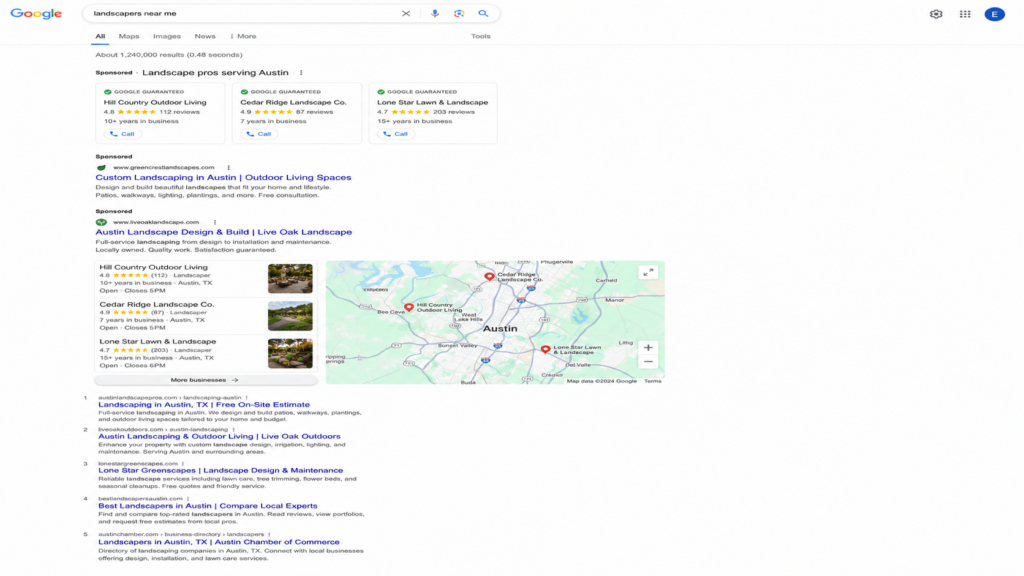
The stack a homeowner sees for “landscapers near me.” Local Services Ads sit above the ads, which sit above the map, which sits above everything you spent six months earning.
Google Local Services Ads
Local Services Ads go first because they are the cheapest exclusive lead available to a landscaping business. Landscaping contractors average $47.69 per charged lead, median $44.83, with a typical range of $39.20 to $59.72, according to 99 Calls as of July 2026, based on their own client data.
That sits below the cross-trade picture, which is the useful part. Searchlight Digital tracked 126,650 leads across 888 contractors and $6.72M in Local Services Ads spend in February 2026 and found a blended average of $53, with the spread running $39 to $71 by trade. Landscaping sits at the cheap end of that range, well under the emergency trades. Either way it is roughly half what a search ad lead costs.
The model is the difference. Search ads charge for the click. Local Services Ads charge for the lead. You pay when the phone rings, not when somebody browses and leaves.
The Google Guaranteed badge is the other half, and getting it requires a background check plus verification of your license and insurance, per Google’s documentation. That friction is why it is worth having. A homeowner choosing between three names he has never heard of takes the one Google vouched for.
Then the tactic that moves your ranking and that almost nobody does: answer the phone. Responsiveness and review score feed the ranking directly, so a crew sending calls to voicemail at two in the afternoon is paying for placement and throwing it away. It is a phone call, not a form.
Disputes are the second unused lever. Some share of pay-per-lead volume is not a lead. Wrong service, wrong town, wrong number. Those are disputable under Google’s own rules and most operators have never filed one.
Two caveats. Availability and eligible categories vary by market. And nobody, Google included, can promise you a placement or a cost per lead.
Google Search Ads
Search ads make sense in three situations. When you want to control the message. When you are selling something high-ticket that deserves its own pitch, hardscaping or irrigation install or artificial turf. And when Local Services Ads are not available in your category or market.
The measured reality is worth having in front of you, because nobody else writing about this publishes it. LocaliQ analyzed 3,211 home services search campaigns and found landscaping running a 4.69% click-through rate, an $8.76 cost per click, a 6.42% conversion rate and a $117.92 cost per lead, against a $90.92 average across all sixteen categories.
One finding deserves its own sentence: landscaping has the lowest click-through rate of all sixteen home services categories. People scroll past your ad more than a plumber’s, which means the copy and the landing page carry more weight in this trade, not less.
Negative keywords are where the waste lives. At minimum, exclude:
- jobs, hiring, salary, careers
- DIY, how to, tutorial
- free, cheap
- courses, school, training, license
- equipment, mower, for sale
Every one is a click you paid for from somebody who will never hire you. Some are people looking to work for you, which is a different budget.
Intent matters more than volume, and the auction prices it that way. “Landscapers near me” gets 107,000 searches a month at about a $2 click. “Retaining wall contractor” gets 2,200 at $4 (Ahrefs, US). Fifty times the volume, half the price, and you can guess which one closes. That gap is why your measured cost per click lands near $8.76 rather than $2: the terms worth bidding on are not the ones with the traffic.
Then the place most landscaping ad budgets quietly die: where the click lands. If the ad says paver patio and the page says full-service landscaping serving the greater metro area, the click is spent. Every advertised service needs its own page saying the thing the ad promised.
That is the shape of how landscaping ads get built properly: campaigns split by service, geo-targeting tight to the real service area, negatives managed rather than set once, copy that mirrors the search, landing pages built to convert, and call tracking on every number so the report counts booked jobs instead of clicks. Ad spend stays separate and goes straight to Google, never marked up.
Run cost per booked job on a real account and you can see what structure is worth. One landscaping operator’s campaigns produced 18 leads in a month. Six months later the same monthly budget produced 54, and cost per lead had come down from $84 to $43 (BASEO client data). Nobody added a dollar. Which means that for six months he had been paying full price for a third of the work his budget could do, and nothing in his reporting would have told him.
Facebook and Instagram ads
Search finds people who already decided they need a landscaper. Meta interrupts people who did not.
Facebook and Instagram are demand generation. Google is demand capture. So judge Meta on cost per booked job, never on cost per lead, because the leads will be cheaper and softer and comparing them straight across will tell you the wrong thing.
It wins in three cases. Design-build with before-and-after creative, because that is a decision people make with their eyes. Remarketing to people who came to your site and left without asking for a quote, which is most of them. And targeting by geography plus home value plus homeowner status, which no search ad can do.
One condition, not a tip. A Meta lead that sits overnight is not a lead. He was not looking for you when he filled the form and he will not remember doing it. If nobody can respond inside ten minutes during working hours, this channel is not ready for you. We broke down what Facebook ads cost per lead separately.
Getting cited in AI search: the channel nobody is optimizing for
Here is the number that changed this year and that nothing else written about landscaping marketing has caught up to yet. 68% of local searches now trigger an AI Overview, against 39% that show the traditional map pack, per a Whitespark study reported by Search Engine Journal in July 2026.
That reads like the map is finished. It is not, and the reason is the most useful thing on this page. The split runs on intent. Informational searches show an AI Overview 92% of the time, hybrid ones like “average cost of a paver patio in Phoenix” 97%. But the search that ends in a phone call, “landscapers near me,” still resolves to the map. So the shift is real, and it is happening on the searches that decide whether a homeowner considers you, not the one that decides whether he calls.
The adoption curve is the part that should get your attention. Consumer use of ChatGPT and similar tools for local business recommendations went from 6% to 45% in a single year, per BrightLocal’s 2026 survey. 31% used ChatGPT for a business recommendation in the past twelve months. Among adults aged 30 to 44, the people buying most of the hardscape work in your market, it is 64%. And 82% read AI-generated review summaries.
Six percent to forty-five percent. One year.
Your money search is still won in the map, so your Google Business Profile is still priority one. What changed is that the two projects turned out to be one project. The same Whitespark research found 77% of AI citations come from off-page sources, with name, address, phone and service consistency across directories acting as a named citation factor. Those are the map pack inputs. You are not choosing between optimizing for Google and optimizing for an assistant. You are doing the same work and getting counted twice.
Four things actually move it:
Put the answer first. In every section, on every page, the first two or three sentences should answer the question in the heading. seoClarity found that 44.2% of citations pulled by large language models come from the first 30% of the text. If your answer is in paragraph six, it does not exist.
Structure content as questions and answers. Not because it reads better, though it does, but because it matches the shape of what an assistant is trying to extract.
Add FAQ schema. Frase found pages carrying it are 3.2 times more likely to appear in a Google AI Overview. A one-time technical job on pages you already have.
Keep your details identical everywhere. Name, address, phone, service list, hours, on every directory and your own site. An assistant reading three different phone numbers for the same business has no reason to name it.
The upside is real: Seer Interactive found sites cited inside an AI Overview get 35% more organic clicks than sites that are not.
That is the layer BASEO adds from month three, and it comes third rather than first for the reason above: the profile wins the call, the citation wins the consideration. Question-and-answer formatting, citation-friendly schema, and a running record of which assistants name a client in which town, month over month. Nobody controls whether an assistant names a business, and anybody telling you they can guarantee it is selling something.
One note on timing. Almost nobody in the green industry is doing any of this yet, which is the whole argument for doing it now. A window rather than an emergency.
Marketing that compounds: referrals, retention and repeat work
Getting a new customer cost $500 in the arithmetic four sections back. Renewing a maintenance contract costs a phone call. That is the whole argument for putting this block here instead of at position nine of sixteen. Lists get organized by novelty. Budgets should get organized by return.
A referral program your crews will actually run
The problem was never the idea. Every landscaper knows referrals close fastest. Programs die because nobody asks, and nobody asks because asking never got assigned to a person.
Four decisions make one that runs. A two-sided incentive, $50 in credit both ways or a free service, so your customer is offering his neighbor something rather than asking a favor. A physical card the crew leaves in the driveway when the job is done. One trackable link, or you cannot tell a referral from a coincidence. One automated reminder about two weeks later, while the yard still looks new.
The card can be short. This is the whole thing:
Know somebody who needs us?
Give them this card. They get $50 off their first service, and so do you.
[Company] | [phone] | [referral link]
Watch the share of new jobs that came from a referral. A quarter to a third means it is working. If you cannot answer at all, that is the finding, and there is a breakdown of what to pay for a referral by job type worth reading first.
One line of care: the incentive is for referrals, never for reviews. Paying for a Google review breaks policy and costs you the reviews you already have.
Email and SMS to the customers you already have
This is the cheapest list you will ever own and most landscaping businesses use it once a year, badly, in April.
The minimum viable program is four messages:
- The seasonal service reminder. Before the work is due, not after they noticed.
- The pre-season contract renewal offer. Sent before they start thinking about it, which is the whole trick.
- The seasonal upsell. Aeration in the fall, mulch in the spring, holiday lighting in the winter. Different message, different month.
- A short monthly note. One useful thing and one photo of a job you just finished. Two paragraphs, not a newsletter.
Texting has rules and they are not suggestions. Consent has to be real and documented, which the TCPA is specific about, and “he’s a customer” is not consent.
The error that kills the channel is sending the same message to an active contract customer and to a cold lead from eighteen months ago. The first hears a business that does not know him. The second hears spam. Segment by relationship first.
Win-back campaigns for lapsed accounts
The easiest revenue on the page, and almost nobody runs it.
Export everyone who has not bought in twelve months, sort by what they last bought, then run three touches: an email, a text a few days later, a call from a person after that. Each needs a specific reason to come back, not a discount. The reason that works best is the one that also protects your margin:
“We’re routing crews through your street on the 14th. Want us to add you?”
A discount costs margin and reads as a slow month. A truck already on the street costs nothing and reads as convenient. Route density again, aimed at people who already know your name.
Offline landscaping marketing that still works
Offline sounds dated until you remember what this business is. The work is visible, local, and sitting in a front yard where forty neighbors walk past it. Almost no other business advertises itself by being done. So this section is short and only covers what has evidence behind it.
Vehicle wraps
Start with the cost, because it settles the argument. Fleet graphics run as little as $0.15 per thousand impressions while online ads can cost up to $21 for the same thousand, per Outdoor Advertising Association of America figures published by 3M.
What the wrap has to carry: the name, big. One service, not a list. A phone number readable from the next lane. The town you serve. What kills it is what most wraps do instead: eight services in eight-point type, social handles nobody will type from a moving truck, an email address, a QR code at 45 miles an hour.
The math decides it. A full wrap runs $2,500 to $5,000 and magnets with door lettering $500 to $1,200. A $3,000 wrap over five years is $50 a month. One maintenance contract covers it and keeps covering it.
Yard signs and route density
Dollar for dollar this is probably the highest-return marketing a landscaping business can do, and it shows up ninth on every list.
Four steps. Ask when you book the job, not while standing in the flower bed with a sign in your hand. Set it while the crew works. Take it at completion, or leave it 48 hours if he says yes. One sign per job, every job. The sign says three things: company name, one service, phone number. Nothing else fits at 25 feet.
Then the multiplier, which is why this section is named what it is. Every job you win on a block where you already work cuts drive time and raises margin on the work you were already doing. The sign does not just bring leads, it brings the profitable kind.
The arithmetic is not close. A sign costs $8 to $15. A booked job from Local Services Ads cost $500 in the example above.
Direct mail to targeted neighborhoods
Do not mail the city. Mail the two hundred houses around a job you just finished.
That single change is the whole tactic. The piece shows a photo of a yard on their street, done by a truck several of them watched go by last week, and says so:
“We just finished this yard on Maple Ridge Drive.”
A generic postcard asks a stranger to trust a stranger. This one shows local, recent, checkable proof, and half the recipients can walk down and look at it.
Format is simple. One offer, one deadline, a card big enough that it does not get sorted in with the coupons. And the part people skip: put a dedicated phone number or URL on the piece, or you will never know whether it worked.
Local partnerships and community events
“Network locally” is useless advice. The partners that actually produce work are realtors staging a property before it lists, custom builders finishing a house with dirt around it, HOA boards and property managers, nurseries, pool contractors and irrigation companies. Each of them is standing next to a homeowner at the exact moment the yard becomes a problem, which is worth more than any chamber breakfast.
The structure is the part everyone skips: cross-referrals with a stated commission or service trade, written down. A handshake produces one referral and then quietly stops, because neither of you agreed what it was worth.
And the honest warning. Community events build recognition, not booked jobs, and they cost the one thing you have least of, which is your own Saturday. Sponsor the little league team because you want to. Do not expect the phone to ring on Monday.
Social media and content for landscapers
Social media is rarely where a landscaping job starts. Worth saying plainly rather than hedging.
But it is almost always where one gets confirmed. He found you on Google or through a neighbor, then went and looked at your profile to see whether your work is any good before asking for a price. So judge it on whether it closes, not on whether it grows. Follower count is not a number that appears anywhere in your business.
Before-and-afters: your highest-performing asset
This is the only marketing asset you own that a competitor cannot copy, and most operators have twenty years of it and almost no photographs.
The capture system is the part every other guide leaves out. Five rules a crew can follow:
- Same spot, same angle, both times.
- Shoot before anyone touches anything, not after the first hour.
- Shoot again after cleanup, not after the last shovel goes in the truck.
- One designated phone, so the photos live in one place instead of five.
- Three photos minimum per job, no exceptions.
Without a system there is no content, and the system is five rules rather than an initiative. Reuse is what makes them worth it: one set of job photos feeds the Google Business Profile, the site gallery, the postcard, the Meta ad and the estimate you email on Thursday. You shot it once.
One thing to be clear about: this is job photography. The finished patio, the retaining wall from the same angle as the mud pit it used to be. Not a crew lineup in matching polos, not a stock lawn with a sprinkler on it. Nobody hires you because of a group shot.
Content that ranks and sells
The filter is a test, not a list. Every page you publish should answer a question somebody has actually asked you on the phone. If no customer has asked it, no customer is searching it either.
What works, and all four are pages you publish for your customers. Cost guides by service and region, like “how much does sod installation cost in Texas,” which people search constantly and almost nobody in the trade will answer. Seasonal problems specific to your market, the thing that goes wrong in your climate in August. Material comparisons, because somebody choosing between two options wants a straight answer from a contractor rather than a manufacturer. What to expect after an install, the questions you answer by phone every week for a month.
What does not work: “10 benefits of a beautiful lawn,” and everything else written to fill a calendar rather than answer a person.
Two second-order returns: this is the content an assistant quotes about your market, and it is what you send a hesitant prospect instead of writing the same email for the fortieth time. Realistic frequency at your size is one or two good pages a month. Eight thin ones perform worse and take longer. There is a page-by-page breakdown of what to write on a service page if you want the templates.
Your landscaping marketing calendar, season by season
Marketing has to run four to eight weeks ahead of demand. By the time the phone rings on its own, the window to influence that quarter has closed. Which is why April feels frantic: the work that should have filled it was supposed to happen in January, and January did not feel like a marketing month.
One note before the table. This calendar is shaped for a snow belt season. Sun Belt operators run the same sequence four to eight weeks earlier, with a shorter and busier winter block.
| Season | What you’re trying to do | Channels running | Share of annual budget |
|---|---|---|---|
| Late winter (Jan to Mar) | Book spring before it starts | Renewals, prepay offers, reactivation, ads switched on early | ~30% |
| Spring (Mar to May) | Capture demand, fast | Ads at full budget, review push, speed to answer | ~35% |
| Summer (Jun to Aug) | Upsell and protect margin | Base upsells, referrals, photo capture | ~15% |
| Fall (Sep to Nov) | Renew and sell winter | Cleanup campaigns, renewal push, winter services | ~15% |
| Winter (Dec to Feb) | Build the asset | Site, city pages, content, systems | ~5% |
Recommended allocation, not an industry statistic. Adjust for your market and your service mix.
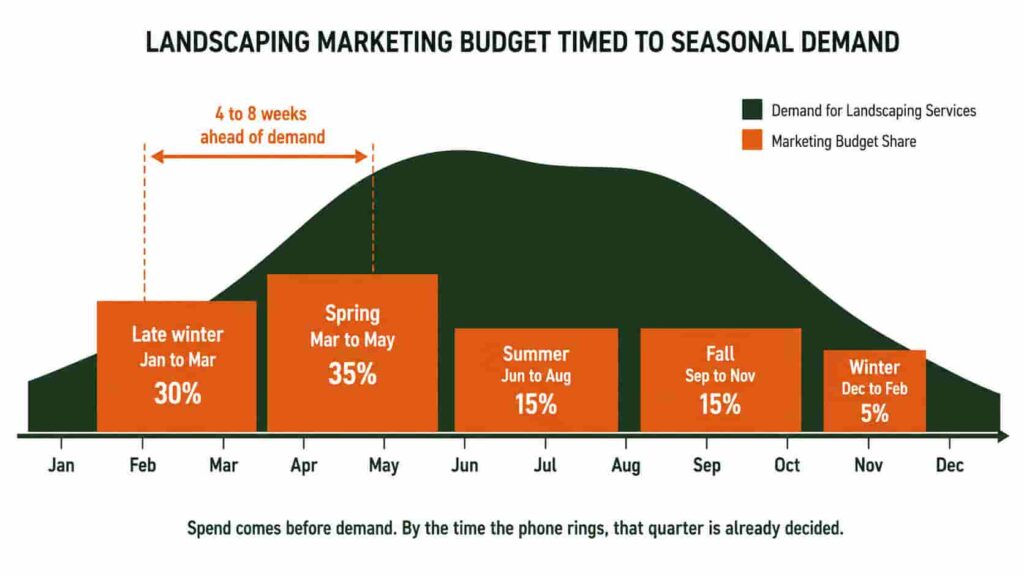
The budget has to arrive before the demand does. That is the entire calendar in one picture.
Late winter (Jan–Mar): book the spring before it starts
The most profitable window of the year, and almost everybody sleeps through it because there is no work on the schedule and it does not feel like a month for marketing.
Five things, in this order. The renewal campaign to your base, before they start thinking about it. Prepay offers, which fix cash flow in the leanest month you have. Reactivation of last year’s customers who quietly did not come back. Google Ads and Local Services Ads switched on four to six weeks before the first warm day, not the week after. And the Google Business Profile updated with the seasonal services you want to sell this year.
Roughly 30% of the annual budget, and the reason is competitive rather than seasonal: you are bidding against operators who have not woken up yet.
Spring (Mar–May): capture demand, don’t create it
Everything changes in March. Everyone searches at once, every competitor’s budget comes back online, and costs rise accordingly.
Four moves. Answer faster than anyone else, because in spring the first credible callback usually wins, and that is worth more than anything you could spend the money on. Raise the paid budgets while cost per booked job still holds, checking it weekly rather than monthly. Push hard for reviews, because you will never have more finished jobs to ask about. Stop spending on anything that builds recognition rather than booking work, not because recognition is worthless but because spend follows demand and demand is here right now.
The operational warning is the real one. Do not sell more than the crews can execute. A lead you get to in three weeks is worse than a lead you never bought, because it costs you the money and the reputation at once. Roughly 35% of the budget.
Summer (Jun–Aug): upsell and protect margin
Demand flattens, the crews are full, and the opportunity moves off acquisition and onto the customers already on your route.
Three things. Upsell the installed base: irrigation, hardscape, treatments, the work your maintenance customers do not know you do. Ask for referrals now, because the yard will never look better than it does in July. And capture the year’s best photo content.
On budget, pull paid back if, and only if, the schedule is genuinely full. That is a capacity call, not a channel call. Paying for leads you cannot service burns money and annoys the customer, and the channel was never the problem. Roughly 15%.
Fall (Sep–Nov): renewals and cleanup
Two campaigns run at once and one matters more. The obvious one is the seasonal work: cleanups, aeration, overseeding, sold in September.
The one that matters more is the renewal push for next year. A maintenance customer decides whether you are still his landscaper somewhere between the last cut and the first snow, usually without mentioning it. Ask before he decides.
Then sell winter services to the base where your market has them, snow and ice or holiday lighting. Easiest margin of the year, because the acquisition cost is zero. These people already pay you. Roughly 15%.
Winter (Dec–Feb): build the asset that pays next year
The month with no work is the month for marketing that compounds. Everything on this list takes real time and produces nothing this quarter, which is precisely why it never happens in June.
- Rewrite the site, or at least the five pages that matter.
- Build the city pages for the towns you actually drive to.
- Produce the year’s content, in one sitting if you can stand it.
- Clean up the customer list so the win-back campaign has something to run against.
- Stand up the review system, so it runs itself when the season starts.
- Write down the partnership agreements you shook hands on in August.
Here is the sentence that makes the whole calendar work: if you want to rank in April, the pages went up in December. Organic takes four to eight months. That is arithmetic, not effort, and the calendar decides it before the work does. The full SEO timeline is worth reading in January rather than May.
Roughly 5% of the budget in spend, and most of the owner’s available attention. Worth saying that the version BASEO runs takes about an hour to kick off and roughly twenty minutes a month after, because a plan needing more than that does not survive contact with a mowing season.
What to do first: a marketing sequence by revenue stage
Doing eighteen things halfway loses to doing two things properly. Every time. Nobody writes that down because “do less” makes a terrible listicle, but it is the answer to the question you came here with. So here it is as a sequence rather than a menu, and each stage assumes the one before it is running.
| Revenue stage | What to run | Budget | The one number to watch |
|---|---|---|---|
| Under $250K | Google Business Profile + reviews. Yard signs + referrals | $500 to $1,500/mo, mostly your hours | New reviews this month |
| $250K to $1M | Add LSA, then the site, then service and city pages, then referrals, then email | 5 to 8% of revenue | Cost per booked job by channel |
| $1M+ | Content, full SEO buildout, segmented ads, remarketing, partnerships, attribution | 6 to 10% of revenue | Booked jobs by source, every month |
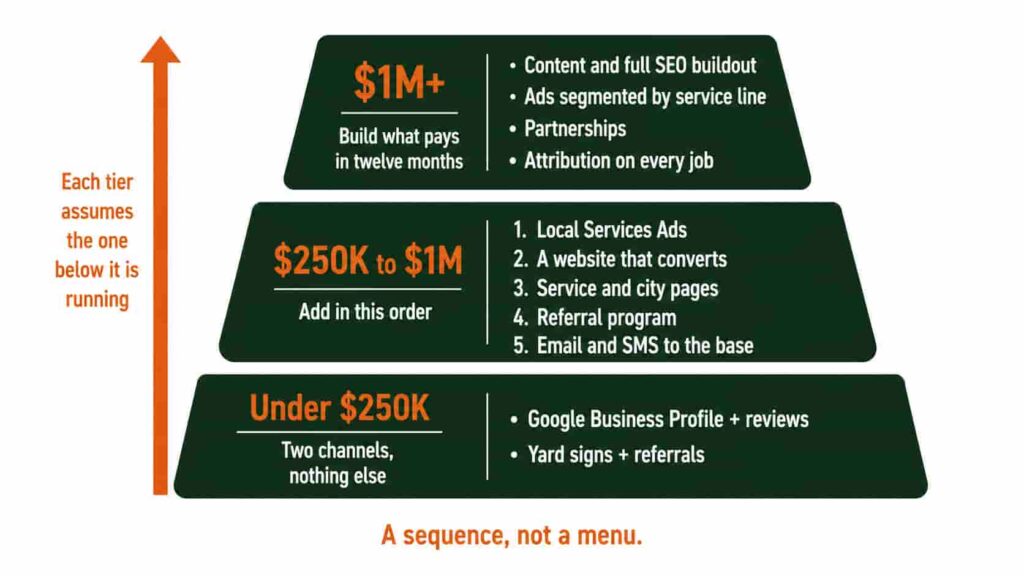
The order matters more than the list. Almost every operator who feels stuck on marketing is running a tier he has not earned yet.
Under $250K: two channels, nothing else
Two things. An optimized Google Business Profile with a review system that actually runs, and yard signs plus referrals. That is the entire list.
What not to do matters more, and this is the part worth money to you: no agency, no ads, no blog, no daily Instagram. Every one competes directly with payroll and none of them fixes what is limiting you. At this size the bottleneck is almost never demand, it is capacity. You do not have a marketing problem, you have two trucks, and spending $2,000 a month to generate work you cannot execute makes both worse.
Budget is $500 to $1,500 a month, mostly your own hours, which is why the list has to be short enough to happen between estimates.
One metric: new reviews this month. If it moves, everything else follows. If it does not, nothing you buy will matter. There is a breakdown of work you can book in seven days at this stage, and none of it involves hiring anybody.
$250K–$1M: add paid and systematize referrals
The order is the content here, so take it literally:
- Local Services Ads. First, because it is the only thing on this list that produces a booked job this month.
- A website that converts. Second, because the ads have to land somewhere.
- Service and city pages. Third, because this is where the compounding starts.
- A written referral program. Fourth, because you now have enough completed jobs for it to run on.
- Email and SMS to the base. Fifth, because you now have a base.
Budget is 5 to 8% of revenue. On a $600K operation that is roughly $2,500 to $4,000 a month across everything, which is a real number worth planning around rather than guessing at monthly.
The first marketing hire is the question everybody at this stage gets wrong. It is not a full-service agency. It is somebody who answers the phone fast, plus a contractor who runs the ads. Speed of answer is worth more at this revenue than anything an agency does for you in year one.
Two numbers run the stage: cost per booked job by channel, and the share of new work from referrals. If the site is step two, what a landscaping site costs is worth reading before the first quote.
$1M+: brand, content and a real attribution stack
Above a million two things change. You can afford assets that pay in twelve months, and you can no longer hold the whole picture in your head, which makes measurement the constraint rather than budget.
The build list is familiar: consistent content, service and city pages built out properly, ads segmented by service line, remarketing, wraps across the fleet, and written relationships with property managers and builders.
What is not optional, and what most operations this size still lack, is attribution, meaning knowing which channel gets the credit for each job. Call tracking on every number. The source captured at intake, every time. And a monthly report tying what you spent to what got booked. Budget is 6 to 10% of revenue.
Which brings up agencies, since at this size you are probably talking to one. Ask for cost per booked job by channel. Not impressions, not clicks, not “traffic is up 40%.” If they cannot produce that number they are not hiding it, they do not have it, which means nobody has been measuring the thing you are paying for. It is the minimum ask. If you want the compressed version of all this, we wrote a 90-day version of this plan separately.
If you would rather know which of these levers is already broken on your own site before you decide anything, that is what the audit is for. Free, in writing, about two business days. No call required. Send Me the Marketing Audit →
How to track your marketing so you know what to cut
The minimum setup is three things and none requires software anybody has to learn. A call tracking number per channel, or at minimum one for paid and a different one for the site. “How did you hear about us” as a required field on the form and a required question in the phone script. And a spreadsheet, updated monthly.
That is the spreadsheet:
| Channel | Spend | Leads | Booked jobs | Revenue |
|---|---|---|---|---|
| Local Services Ads | ||||
| Google Search Ads | ||||
| Organic / GBP | ||||
| Referrals | ||||
| Yard signs | ||||
| Direct mail |
Six rows and five columns will tell you more than any dashboard you were ever given a login for.
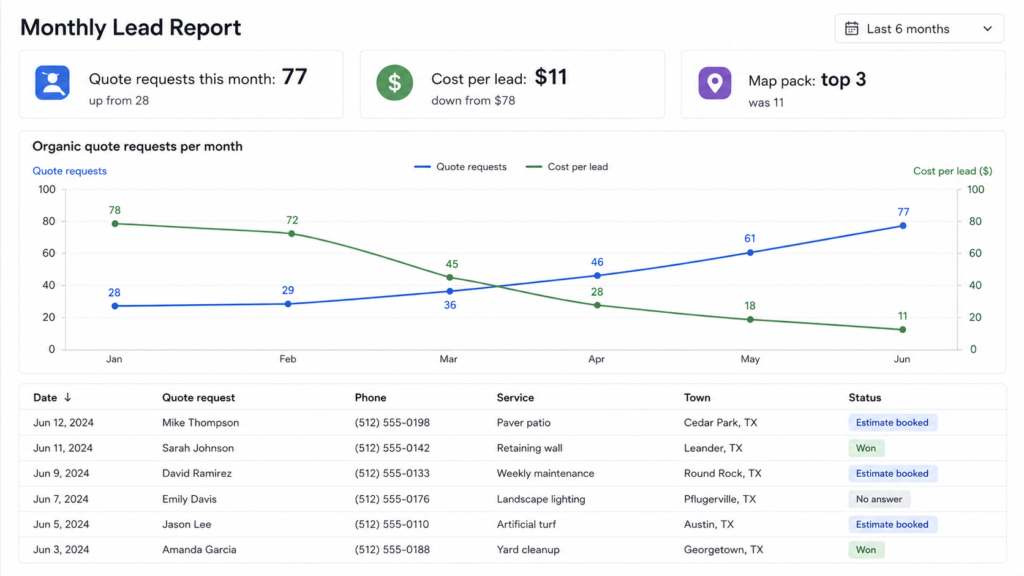
A report built around quote requests and booked work. If yours does not have a phone number in it anywhere, it is measuring the wrong thing.
Then the trap that makes people cut the wrong channel. He saw your truck for three weeks, searched your business name, then called. Your analytics files that under organic search and the truck gets nothing. Last-touch attribution credits whatever happened most recently, which in this trade is almost never what did the work. Which is why the imprecise question still matters: “how did you hear about us” is a bad instrument, and the only one you have that catches the wrap, the sign and the neighbor.
The decision rule: review every 90 days, not every week. Paid gives a real signal in weeks. Organic needs quarters, and cutting it at month three because the line is flat is how operators start over every year and never get past month three.
And cut on the right number. The channel to kill is the one with the worst cost per booked job across two quarters, not the one with the fewest leads last month.
Want a marketing plan built for your market?
The order in this article is right in general and wrong for somebody reading it. It depends on what you sell, how far you will drive, and what is already working that you have not measured.
So before you change anything, send the domain and get back a written answer to three questions: what is broken right now, what the crew above you on the map built that you did not, and whether the math in your market supports any of this. If it does not, the audit says so, which is the part nobody expects.
Free, in writing, about two business days. No call required, yours to keep whether we ever speak again or not. We have never put a client on a twelve-month contract and are not going to start with you.
Landscaping marketing FAQs
Most landscaping businesses should spend 5 to 10% of total revenue on marketing. Companies focused on keeping existing accounts sit near the bottom of that range; businesses pushing into a new market need the top. On $500,000 in revenue that is roughly $2,000 to $4,200 a month.
The fastest paid channel is Google Local Services Ads, which delivers exclusive leads at roughly $48 and sits above regular search results. The fastest free move is asking every customer you finish with this week for a Google review, and putting a yard sign on every job.
There is no single best channel, because it depends on what you sell. Maintenance contracts are won through Google Business Profile, reviews and route density. Design-build and hardscape are won through visual portfolios and remarketing. Start with whichever matches your highest-margin service.
Yes. Around 96% of consumers use the internet to find local services, and your site is where they confirm you serve their street and check whether your work is any good. It does not need to be elaborate: a tappable phone number, a service-area list, a before-and-after gallery and a short form.
Social media rarely generates leads directly for landscapers, but it closes them. Prospects who found you through Google or a referral check your profile before requesting a quote. A steady feed of before-and-after photos beats posting daily on four platforms.
Ask in person the moment the job is finished, while the customer is looking at the result, then send a text with a direct review link within the hour. Have the crew lead ask, not the office. Two to four a month steadily beats a one-time push of thirty.
Expect four to eight months before local SEO produces meaningful lead volume, though Google Business Profile work can move map rankings within weeks. Run paid in the meantime. SEO is the asset you build while paid keeps next month’s schedule full.
Below roughly $250,000 in revenue, handle it yourself. The wins at that size are your Google Business Profile, your reviews and your referrals. Above $500,000 an agency makes sense if it can report cost per booked job by channel. If it only reports clicks, keep looking.
Final thoughts
The operators winning this are not running more tactics than you. They are running two or three, in the right order, and they can tell you what each one costs per job on the schedule.
So here is the thing to do this week, and it costs nothing. Pull the last ten jobs you booked and write down where each one came from.
If you can account for eight of them, you have a tracking problem you can fix in an afternoon with a spreadsheet and a phone script. If you can account for three, you have been buying marketing you cannot grade, and you have been doing it for years. That second version is the expensive one, and it is the more common one.
The audit grades it for you before you spend another dollar. Free, in writing, about two business days. No call required.