
It’s Sunday afternoon and you’ve finally sat down to fix the website. You search for how to write strong SEO copy for landscaping and you get nine articles that say the same three things: use your keyword naturally, keep density around one to two percent, and write for humans first.
Not one of them tells you what sentence to put on the patio page.
The reason is that there is no such thing as landscaping copy in the abstract. There is service page copy, city page copy and hardscape page copy. They get read differently, they get written differently, and they succeed at different things.
What follows is a template for each page type, a method for getting the words out of your own mouth instead of inventing them, and a checklist you can run in ten minutes before anything goes live.
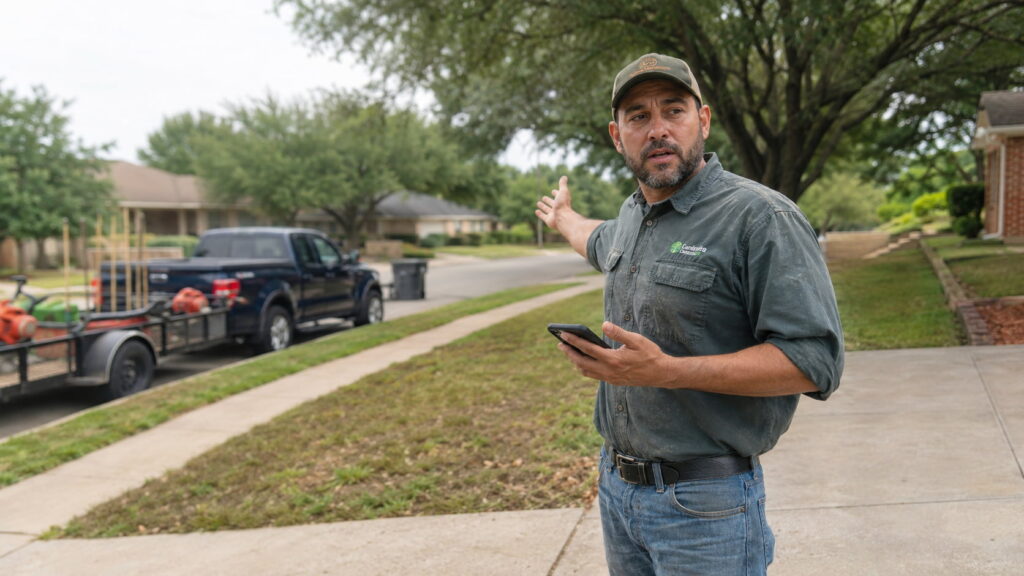
The best copy on most landscaping sites was spoken out loud in a driveway and never written down.
- The short answer: what strong landscaping SEO copy does
- Why most landscaping copy reads the same, and why Google ranks none of it
- Before you write a word: know which page you’re writing
- The driveway transcript: your copy is already written
- How to write a landscaping service page
- How to write a service area page without writing spam
- Keywords: how to use them without sounding like a robot
- Meta titles and descriptions for landscaping pages
- Writing landscaping copy an AI assistant will quote
- Proof beats adjectives in landscaping copy
- The landscaping copy words that quietly cost you jobs
- Run this landscaping copy checklist before you publish
- Write it yourself or hand it off?
- Where to go from here
- Frequently asked questions
The short answer: what strong landscaping SEO copy does
Strong landscaping SEO copy does three things at once. It uses the words homeowners actually type into Google, it describes the job in enough detail that Google can tell what the page is for, and it answers on the page the questions you normally answer on the phone. Everything else is formatting.
The first one is why “landscape enhancement solutions” loses to “paver patios.” Nobody searches the way a brochure talks.
The second one is why a page that says “we handle all your outdoor needs” ranks for nothing. Google has no idea what the page is about because the page never says.
The third one is the one most operators skip, and it’s the one that turns a visitor into a quote request. Every question you answer standing in a driveway is a question somebody else is asking at eleven at night on a phone, with nobody there to answer it.
Which of those three matters most depends on which page you’re writing.
| Page type | What the copy has to do | Sign it’s written wrong |
|---|---|---|
| Service page | Convince someone who already wants the work that you’re the crew to call | It opens with your company history instead of the job |
| Service area page | Prove you actually work in that town | Swap the town name and it still reads fine |
| Hardscape / money page | Qualify a decision worth five figures that takes weeks to make | It’s the same length as the mowing page |
| Blog post | Answer the question that comes before the job, then send the reader to the pages above | It ends without linking to anything you sell |
Why most landscaping copy reads the same, and why Google ranks none of it
Your site probably isn’t badly written. It’s identically written.
Open the sites of the nine other crews bidding against you this spring. Same opening about family ownership. Same promise of quality and satisfaction. Same list of services in the same order. Nobody copied anybody. They all filled in the same template.
Here’s what that costs. When ten pages in one market say the same thing, Google has no reason to prefer any of them, so it mostly doesn’t. The homeowner comparing three tabs has the same problem and solves it the same way, by calling whoever shows up first or looks cheapest.
That’s the whole mechanic. Your pages look like everyone else’s, so Google ranks none of you and the homeowner picks on price. Fixing it doesn’t take better writing. It takes more specific writing.
The three sentences on almost every landscaping site
You’ll recognize all three of these, because at least one of them is probably on your homepage right now.
“We’re a family-owned business with over 20 years of experience.”
“We take pride in quality workmanship and customer satisfaction.”
“We offer a wide range of landscaping services to meet all your needs.”
None of them is false. That’s what makes them hard to spot. The problem is that every one of them is unverifiable and undifferentiated at the same time. The reader can’t check any of it, and your competitor says it word for word.
Each one has a specific version hiding behind it. Same fact, told so it can only be about you.
| Instead of this | Write this |
|---|---|
| “We’re a family-owned business with over 20 years of experience.” | “We’ve been rebuilding drainage on the clay soil in Cedar Park since 2004.” |
| “We take pride in quality workmanship and customer satisfaction.” | “Every patio we build gets excavated and compacted before a single paver goes down, and we photograph that stage so you can see what’s underneath it.” |
| “We offer a wide range of landscaping services to meet all your needs.” | “Three quarters of what we do is paver patios, retaining walls and drainage. If you need a lawn mowed every week, we’ll point you to someone who does that better than we would.” |
Look at what changed. The years became a place, a soil type and a date. The quality claim became a stage of the work that the cheapest bidder in your market skips, described plainly. The service list got shorter and gained a sentence about what you don’t do, which is the single most credible thing a contractor can put on a page.
None of that is writing talent. It’s just refusing to round off the details you already know.
What “write for humans first” means when the human has a dead lawn and one afternoon to decide
Every guide says to write for humans first and then stops, as if that were an instruction.
Here’s the human. He’s already decided he needs the work done. He isn’t deciding whether to hire a landscaper, he’s deciding which one to call. He has two or three tabs open, he’s on a phone, and he’ll give each site somewhere between ten and thirty seconds.
That single fact decides your layout. The first screen answers what you do, where you do it, and what happens when he gets in touch. Your company mission does not go at the top. Nothing goes above the answer.
Then write it so it survives scanning. Short paragraphs, two to four sentences each, subheadings that make sense read on their own, bold on the phrases that carry the point, and the answer before the explanation (Semrush).
The rule worth stealing: the first sentence under any subheading should directly answer what the subheading promised, with the background coming after (Vazoola).
That isn’t a trick for search engines. It’s also what Google says it’s grading: whether the page gives a substantial, complete description of the topic, and whether the reader leaves having learned enough to do what they came to do (Google Search Central).
Write for the guy with thirty seconds and you’re writing for both readers at once.
Before you write a word: know which page you’re writing
The decision that comes before writing isn’t which keyword to use. It’s what job this page has to do.
A service page and a blog post are opposite instruments. One is built to make somebody act today. The other is built to answer a question and hand the reader off. Writing a service page like a blog post is the most common reason a genuinely well-written page produces zero quote requests in six months.
So before the first sentence: which of the four is this?
The four page types that carry a landscaping site
Service pages. Search intent is transactional. Somebody types “paver patio installer” because they want a paver patio installed. The copy’s job is to close the gap between wanting it and calling you. Success is measured in calls and quote requests, nothing else.
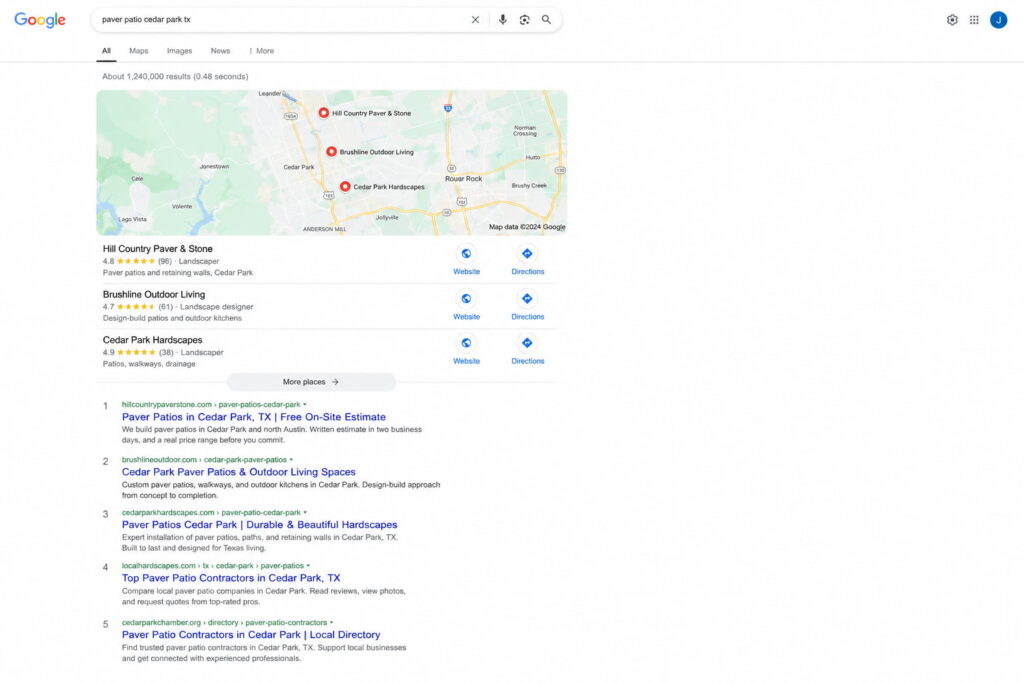
Service area pages. Search intent is “near me” plus a town name. Somebody in the next suburb over searches with their own town in the query, because that’s how people search for anything local. The copy’s job is to prove you actually work there. Success is appearing at all when someone in that town searches.
Hardscape and money pages. These are the high-ticket ones: patios, retaining walls, outdoor kitchens, full design-build. The decision takes weeks and involves two people, not one. The copy’s job is to qualify, not to convince. Success is a smaller number of better quote requests, not volume. A page that brings ten serious inquiries beats one that brings forty tire-kickers.
Blog posts. Search intent is informational. Somebody wants to understand something before they’re ready to hire. The copy’s job is to answer honestly and then send the reader to the service page or the town page. Success is trust and internal links, not direct sales. A blog post that tries to close reads like a pitch and does neither job.
The tone changes across all four, and so does the length. A hardscape page earns twice the words a mowing page does, for reasons that have nothing to do with word counts and everything to do with how long the decision takes.
Your homepage is not your most important page
This is the belief worth correcting first, because it decides where your effort goes.
Your homepage ranks for your company name. That’s mostly it. The people finding it already know who you are: past customers, referrals, the guy your neighbor told them about. Those people were going to call you anyway.
The jobs come from somewhere else. Someone searches “paver patio Cedar Park” and lands on a page about paver patios in Cedar Park. They don’t land on a homepage that mentions eight services and a family history, because that page isn’t about paver patios in Cedar Park specifically enough for Google to send anyone to it.
The driveway transcript: your copy is already written
Here’s the part that changes how hard this is.
You think you can’t write. You give the single best version of your copy about three times a week, standing in somebody’s driveway, explaining why the neighbor’s wall is leaning and what you’d do differently. You’re specific, you use real numbers, you name the thing that went wrong, and you never once say “quality workmanship.”
That is the copy. It already exists. Your job isn’t to invent it, it’s to transcribe it.
So do that literally. On the next estimate, ask the customer if you can record the walkthrough on your phone, then put it in your pocket and give the estimate exactly the way you always do. Later, play it back and type out what you said.
The five questions you answer on every estimate
Listen to any recording of yourself on a walkthrough and you’ll hear the same five questions get answered, in roughly the same order. Each one has a home on the page.
- Can this be fixed? This belongs at the top of the service page. It’s the question underneath every search, and answering it fast is what keeps someone reading.
- How long will it take and what happens on the property while you’re here? This is the process section. Access, machines, noise, how many days, what the yard looks like on day three.
- Roughly what does something like this cost? This is the price range section, and skipping it is the most expensive habit in the trade. More on that below.
- Have you done this on a house like mine? This is proof: before and after photos from that town, two or three reviews from people nearby, how long you’ve been at it.
- What happens if something goes wrong later? This is warranty, insurance and license. It’s the last thing standing between a serious buyer and a phone call.
Those five aren’t just what the homeowner wants. They’re the same five that Google and the AI assistants are trying to resolve when they work out what your page is actually about and whether it’s worth showing to anybody. Answer them plainly and you’ve done the on-page work and the sales work in the same pass.
Turning a job walkthrough into a page section
Here’s what the whole method looks like end to end, on a leaning retaining wall.
What came off the recording:
“So yeah, see how it’s leaning out at the top there? That’s not the block failing, the block’s fine. What happened is whoever built it didn’t put any drainage behind it, so every time it rains that whole hillside is pushing water into the back of that wall and it’s got nowhere to go. So it just pushes. Uh, we’d take it down, that’s a day, day and a half. Put a drain line in behind it, gravel backfill, then rebuild with the same block if it’s in decent shape, which it looks like it is. Probably four days total. And it won’t move again.”
Typed out and cleaned up, filler removed:
Leaning at the top. Block is fine, the block didn’t fail. No drainage behind the wall. Rain pushes water off the hillside into the back of the wall, water has nowhere to go, wall moves. Take it down, one to one and a half days. Drain line behind it, gravel backfill. Rebuild with the same block if it’s in decent shape. Four days total. Won’t move again.
Edited into something publishable:
Why retaining walls in Cedar Park start to lean
Most of the leaning walls we get called out to look at aren’t failing because of the block. They’re failing because nobody put drainage behind them.
When it rains, the hillside pushes water into the back of the wall, and the water has nowhere to go. So it pushes. You’ll usually see it at the top first, and by the time it’s visible from the street it’s been moving for a while.
Rebuilding a retaining wall in Cedar Park usually takes about four days. We take the existing wall down, which is a day to a day and a half of that, install a drain line and gravel backfill behind it, then rebuild using the original block if it’s still in good shape. It usually is.
Done that way, it doesn’t move again.
If you’ve got a wall that’s starting to lean, send us a photo and we’ll tell you whether you’re looking at a rebuild or a repair.
That’s 150 words, it contains the phrase somebody would actually search, and you didn’t write a word of it. You said it. Somebody typed it.
Three editing rules make the difference. Keep every technical detail and every number he said, because those are the parts nobody else’s page has. Cut the filler, the “uh” and the “so yeah.” And do not professionalize the language until it sounds like a brochure, because the reason it works is that it sounds like a person who has done this before.
How to write a landscaping service page
This is the page that closes. Everything else on the site exists to get somebody here.
It has four moving parts, and they go in this order: scope, process, proof, price. Then a decision about which service page you build first, which is where most of the money in this whole exercise actually sits.
The first 100 words (and the keyword that belongs in them)
Open with a formula, not a story: what you do, where you do it, who it’s for, and what happens next.
“We build paver patios in Cedar Park and the surrounding Williamson County area, for homeowners who want the backyard usable, not just prettier. Every project starts with a walk of the site and a written estimate, usually within two business days.”
Forty-one words. Somebody scanning on a phone now knows the service, the area, the fit and the next step, which is more than most landscaping homepages communicate in a full screen.
That opening is also where the main phrase for the page belongs. Put it in the H1, in the meta title, and in the first hundred words, which is the placement convention most practitioners still agree on (GTECH). Not because Google counts positions, but because those are the three places both a reader and a crawler check first to work out what a page is about.
Do not open with the company history. “Founded in 2004, we’ve grown from a single truck into one of the area’s most trusted names” is a fine second paragraph on an About page and a bad first paragraph anywhere else. The reader hasn’t decided he cares about you yet.
The body of a landscaping service page: scope and process
Scope. Say what the service includes, then say what it doesn’t. The second half is what separates your page from every other result. “Patio installation includes excavation, base prep, the patio itself and haul-off. It doesn’t include drainage correction, which we’ll quote separately if the site needs it.” That single sentence about what’s excluded does more for trust than any adjective on the page, and it kills the argument on day two of the job.
Process. Walk through the real steps with real timing, in the language you’d use on site. Day one is layout and excavation. Day two the machines are here and it’s loud. Day four the crew is out. Somebody deciding whether to put five figures into their backyard wants to know how long their driveway is blocked.
Proof and the price question on a landscaping page
Proof. Before and after photos from the town this page names, not stock images and not your best job from four years ago in a different county. Two or three reviews from people in that area, quoted in the text where they’re relevant, not just parked in a widget at the bottom. Your license and insurance. How long you’ve been doing it. What equipment you run, if it matters to the job.
Price. This is where most operators flinch and write “call for pricing,” and it’s the costliest two words on the site. The homeowner isn’t going to call to find out if you’re in range. He’s going to close the tab and call somebody who told him.
Give a real range and name the variables that move it: how much square footage, whether a machine can reach the backyard or it all goes through a gate by wheelbarrow, what’s under the existing surface, and whether drainage has to be solved first. Now the range is honest instead of a guess, and it does the thing a range is actually for, which is qualifying. The people who call you have already accepted the number. The people who were never going to spend it didn’t call, and that’s the point.
Finish with the form and a tappable phone number, and make sure both work. A quote form that emails an address nobody has opened since 2019 is the most common way a genuinely good page produces nothing, which is the whole argument for a site built to convert rather than one that just looks finished.
That last part matters more than it sounds if you’re also running ads, because this is the same page your ads point at. A paid click landing on a homepage that names neither the town nor the service is the most expensive way to say nothing. Ads book jobs this week and the pages make every job after that cheaper, and both halves of that depend on where the click lands.
A page that covers all four parts usually runs somewhere between 600 and 1,000 words. Treat that as an orientation range, not a target and definitely not a minimum to pad up to. Google’s own standard is whether the page covers the topic completely enough that the reader leaves able to act, which is a coverage test, not a length test (Google Search Central). Cover the four parts honestly and the length takes care of itself.
Write the page for margin, not for volume
Here’s the editorial decision almost nobody makes, and it’s worth more than everything above it.
Write the pages for your best-margin services first.
Most operators build the site in the order the business grew: mowing page first, because mowing came first. But a design-build job in this trade runs anywhere from $3,000 to $50,000, and the search that brings in a patio costs about the same to win as the search that brings in a weekly cut. One patio is worth forty mowings. You spend the same evening writing either page, and most sites spend it on the mow.
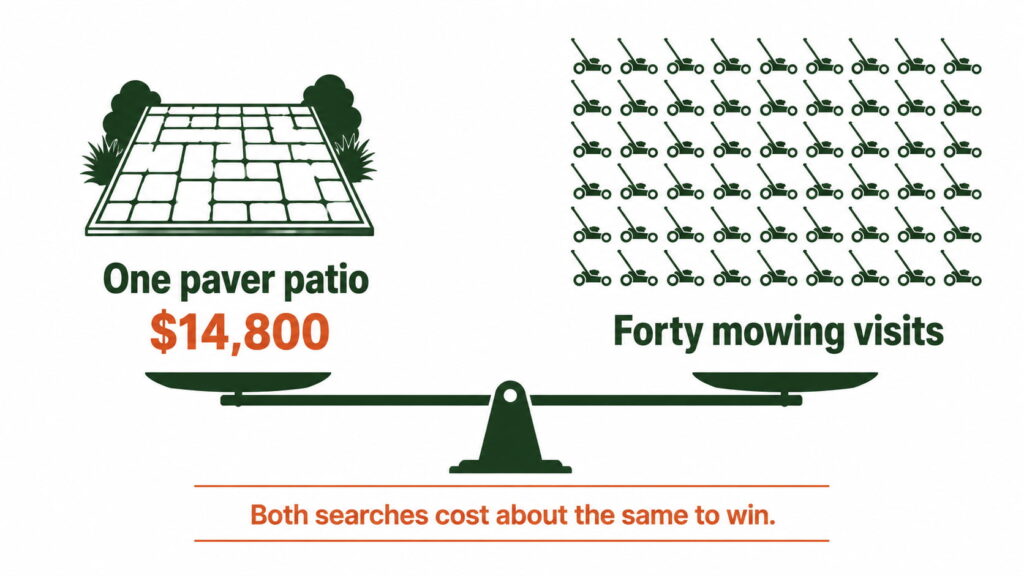
Two searches, roughly the same effort to rank for, very different jobs at the end of them.
That gap is not theoretical. A landscaping crew’s hardscape work closed a $14,800 patio and an $18,600 retaining wall out of organic search (BASEO client data; the client’s name is withheld at their request). Those came off pages built for the hardscape work specifically, not off a homepage that happened to mention patios.
Put that next to the other half of the same business. A maintenance account at $150 a month is $1,800 a year, and $5,400 over three years if it renews. That is real money and it is the floor the whole operation stands on. It is also why the patio page and the mowing page cannot get the same effort: one $14,800 job is worth more than eight of those accounts running for a full year.
So the hardscape page gets the longest copy, the best photos, and the most writing time. That ordering is the entire idea behind hardscape pages that rank, and it’s the first thing BASEO builds for a landscaping crew, because ranking for the mow and not the patio is the most expensive ordering mistake in this industry.
The mowing page can be short. Recurring maintenance work sells on route density and a monthly contract rather than on a single job, so it needs a different pitch and a lot less convincing.
None of that means you’ll close a $14,800 patio because you rewrote a page. It means that if you’re going to spend two evenings writing, spend them on the page attached to the bigger job.
How to write a service area page without writing spam
The city page is where operators burn down the whole site, usually on somebody’s advice.
The advice sounds reasonable. You serve eleven towns, so you need eleven pages, so you write one good page and swap the town name eleven times. Or a tool does it forty times while you sleep.
What happens next is that none of the forty pages rank, and the damage doesn’t stop at those forty. Google’s read on the whole site changes. You spent a weekend making your site less trustworthy.
The fix isn’t fewer pages. It’s pages with something in them.
What has to be genuinely different on every town page
Something real has to change on each page, and “the town name” is not something real. Here’s what actually counts, and why each one earns its place:
- Jobs you’ve actually done there, with your own photos. This is the only thing on the list a competitor can’t fake, and it’s the reason the page exists.
- Neighborhoods and roads your crew actually drives. The homeowner reading it knows immediately whether you work here or you bought a list of zip codes.
- The local condition that changes the work. Clay soil, slope, water restrictions, an HOA with rules about what you can plant, the frost window. Name the one that changes how you bid in that town.
- Reviews from customers in that area. A review from across the metro is proof you exist. A review from three streets over is proof you’re the local option.
- Your real response time from the shop. If you’re twelve minutes out, say so. If you’re forty, say that instead of pretending.
- Which services you actually run there, and which you don’t. Plenty of crews take hardscape jobs across the whole metro but only run maintenance routes in three towns. Say so.
Here’s the opening formula for a town page. Same shape as the service page one, pointed at the place instead of the job: what you build + the town + the proof you actually work there + what happens next.
“We build patios, retaining walls and drainage systems in Cedar Park, and we’ve been doing it on the clay out here since 2004. Most of our Cedar Park work sits in Buttercup Creek and out along Brushy Creek. Send a photo of the spot and we’ll come walk it, usually within two business days.”
Forty-eight words, and a crew two towns over could not publish that paragraph without lying.
Then the rule that governs all of it: only build a page for a town where your crew genuinely works and where you have photos. If you can’t fill it honestly, the page shouldn’t exist yet. BASEO builds them one town at a time for that reason and not for a page count, because a thin town page doesn’t just fail on its own, it drags what Google thinks of the eleven pages around it.
The template-swap trap that gets a whole site ignored
It’s worth knowing exactly what you’re risking, because this isn’t a matter of opinion.
Google’s spam policies name this directly. Doorway abuse covers pages targeted at specific regions or cities that funnel users to a single destination, along with substantially similar pages that sit closer to a set of search results than to anything a person would want to read. The same document covers scaled content abuse: many pages generated mainly to game rankings rather than to help anybody (Google Search Central).
Mass-generated town pages with nothing original in them land in both categories at once.
There’s a ten-second test for whether you’re over the line. Open the page, mentally swap the town name for a different town, and read it again. If it still reads perfectly fine, that page is telling the reader nothing about that town, which means it isn’t adding anything, which is precisely the definition above.
So the count rule runs backwards from what everybody assumes. Five real town pages will beat forty empty ones, and they’ll do it without putting the rest of your site at risk. Build the five towns you actually work in. Add the sixth when you’ve got photos from it.
Keywords: how to use them without sounding like a robot
This section contradicts the most repeated advice on the first page of Google for this exact topic, so it’s worth being clear about why.
The advice isn’t malicious and it isn’t even entirely wrong. It’s just been carried forward from a version of Google that hasn’t existed for a long time, and it sends people off to count things instead of covering things.
Forget keyword density. Cover the topic instead
The honest version is messier than either camp admits. Plenty of current sources still recommend keeping your keyword density in the range of one to three percent, and the same sources will tell you in the next paragraph that there’s no magic number (GTECH). That contradiction is the whole story of this metric.
Density came from a period when search engines largely counted words on a page to work out what it was about. That era is over. What replaced it is a set of systems that read context and related terms, which is why writing about drainage, base prep, block and frost naturally tells Google you’re writing about retaining walls without you saying “retaining wall” fourteen times.
The number has one legitimate use, and it isn’t the one it gets used for. It’s a ceiling. If a density check on the patio page comes back high, what you’ve actually found is a page that says “paver patio Cedar Park” nine times and never says what goes under the pavers, how many days the driveway is blocked, or what the thing runs. That page doesn’t have a density problem. It has nothing to say, and the repetition is what’s filling the gap. Fix the page, not the percentage.
Semrush’s own guidance puts it plainly: use the main phrase in the intro, the first H2 and the body, and stop short of overusing it (Semrush).
The replacement is coverage, and it’s a much better use of an evening.
Before you write the page, list the eight to twelve things a homeowner genuinely needs to know before hiring somebody for that service. For a retaining wall that list includes what makes walls fail, how long it takes, what it costs, whether they need a permit, what happens to the plants that are there now, and whether you’ll be back if it moves. Write the page. Then go back and check that every item on the list got answered.
That’s the same standard Google describes when it asks whether a page gives a substantial and complete account of its topic, and whether the reader finishes it knowing enough to act (Google Search Central). Coverage is checkable, it improves the page for the person reading it, and it never once requires you to open a percentage calculator.
The phrases homeowners actually type before they call
Homeowners search in four recognizable patterns, and only one of them looks like the name of your service.
Service plus city. “Landscaping company in Cedar Park,” “paver patio Austin.” The most obvious pattern, the most competitive, and the one your service and town pages are built for.
Service plus near me. “Landscapers near me,” “retaining wall contractor near me.” Location comes from the phone, not the query, which is why the profile and the town pages carry this one more than the copy does.
The problem instead of the service. “Backyard floods when it rains.” “Retaining wall leaning.” “Grass won’t grow under my oak tree.” This is somebody who has a problem and doesn’t yet know what the solution is called or who fixes it. Almost nobody writes for this, which is why it’s the cheapest traffic in the trade.
The same job under a different name. Paver patio, stone patio, backyard patio, brick patio. Four names, one job, and the homeowner picks whichever one he grew up hearing.
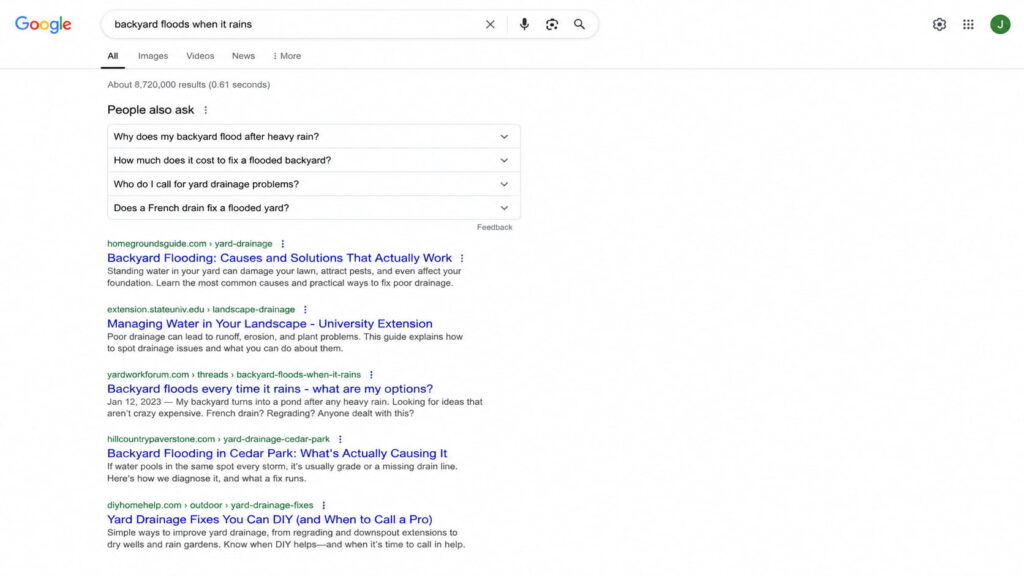
Problem-phrased searches mostly return articles. There’s usually no contractor in sight.
The technique that comes out of this is small and it works: write the problem version as a subheading inside the service page you already have. Your drainage page gets a section headed “Why the backyard floods in the same spot every storm.” Your retaining wall page gets one headed “Why a retaining wall starts leaning at the top.” You’re not building new pages, you’re answering the question in the words it gets asked in.
One warning, because this is where people go generic. Do not invent the list. Pull it from Search Console, which is free and shows you the actual phrases that already brought somebody to your site. Pull it from the questions you get on the phone. Pull it from what people typed into your quote form, which is the closest thing you have to a transcript of how your customers describe their own problems.
Guessing produces a list that looks like every other crew’s list, which is where this whole problem started.
Meta titles and descriptions for landscaping pages
Three rules and then three worked examples, because examples are more useful here than theory.
Meta title: 60 characters or fewer, with the service and the town at the front. The back half gets cut off on a phone, and “Cedar Park” is the word that makes somebody stop scrolling past four other crews. Meta description: 155 or fewer, carrying the reason to click rather than a summary of the page. On a results page where everyone else wrote “quality landscaping services since 1998,” a written estimate in two business days is the only line on the screen that actually says something.
One H1 per page, and it delivers whatever the title promised.
| Page | Meta title | Meta description | H1 |
|---|---|---|---|
| Service page | Paver Patios in Cedar Park, TX | Free On-Site Estimate | We build paver patios in Cedar Park and north Austin. Written estimate in two business days, and a real price range before you commit. | Paver Patios in Cedar Park, TX |
| Service area page | Landscaping in Cedar Park, TX | Patios, Walls, Drainage | Landscaping crew working Cedar Park since 2004. Patios, retaining walls and drainage on the clay soil out here. See recent jobs and a price range. | Landscaping in Cedar Park, TX |
| Hardscape page | Retaining Wall Contractor in Cedar Park, TX | Retaining walls built with drainage behind them, so they don’t start leaning in five years. Cedar Park and north Austin. Photos of recent walls. | Retaining Wall Contractor in Cedar Park, TX |
Notice what the descriptions do. None of them summarizes the page. Each one gives a reason to click: a real estimate timeline, a date, a specific technical reason the wall won’t fail. That’s the job.
Google rewrites descriptions when it thinks a different snippet fits the search better, which happens often enough that people ask why bother writing them. Two reasons. When Google does use yours, it’s the only sales copy you get in the search results. And when it doesn’t, it’s pulling from your page instead, so a page written in specifics gives it better material to pull from than one written in adjectives.
Writing landscaping copy an AI assistant will quote
Your copy has a second reader now.
Before a homeowner opens a single website, there’s a decent chance he’s asked ChatGPT or Google’s AI Overviews something like “who does retaining walls in Cedar Park” and gotten back a short list. The list is short, usually two or three names, and getting on it is not something anybody can sell you.
What you can do is write pages that are easy to quote, and the mechanics of that are refreshingly boring. Google’s own documentation says there are no additional requirements and no special optimizations for appearing in AI Overviews or AI Mode. A page needs to be indexed and eligible to show with a snippet, and the important content has to actually be in the text rather than locked in an image or a video (Google Search Central).
So the writing moves are the ones you’d make anyway:
Put the question in the subheading, in the words somebody would ask it. Answer it directly in the first forty to fifty-five words underneath, before any context. State facts that can be checked: the towns you serve, the services you run, your license, how long you’ve been operating, how fast you respond. Put a short question-and-answer block at the bottom of every service page, using the five questions from the driveway walkthrough.
That’s the same structure that wins featured snippets, which is not a coincidence.
One measurement note worth knowing. Traffic that arrives from an assistant frequently lands in GA4 labeled “Direct,” because there’s no clean referrer on the way in. So if your direct traffic has been climbing and nobody can explain why, some of that may already be assistant referrals you’re getting without knowing it. BASEO formats service pages this way and tracks which markets get named, because the reputation signals an assistant leans on are the same ones that decide the map pack, which makes the review work and the AI work the same project rather than two.
Nobody controls whether an assistant names a business. Anyone who tells you they can guarantee it is selling something. What’s controllable is whether your page contains a quotable, checkable answer, and today most landscaping pages in most markets don’t.
Proof beats adjectives in landscaping copy
There’s one edit that improves a landscaping page more than any other, and it takes about twenty minutes: go through and replace every adjective with a fact.
| Instead of | Put this |
|---|---|
| “Experienced” | “We installed 34 paver patios last year.” |
| “Reliable” | “You’ll have a written estimate within two business days.” |
| “Affordable” | “Most patios we build land between $9,000 and $22,000.” |
| “Fully licensed and insured” | The license number itself, printed on the page. |
The numbers in that table are the operator’s, not anybody else’s. That’s the point: you already know all four of yours, and the moment they’re on the page they do work that no adjective can, because the reader can check them and your competitor’s copy can’t match them without lying.
Four kinds of proof matter, and each one needs framing rather than just placement.
Your own before and after photos, with one line under each saying what problem got solved. A gallery of nice-looking patios is decoration. A photo captioned “this corner held water after every storm; we regraded it and put in a drain line” is evidence.
Reviews quoted inside the text, at the point they’re relevant, not only in a widget at the bottom. A review that mentions how you handled a change order belongs in the paragraph about change orders.
Numbers from the business. Years running, jobs completed last season, crew count, response time. Any of them beats “trusted.”
Process details the cheapest bidder can’t claim. Not because they’re secret, but because he doesn’t do them. Whatever step you take that the low bid skips, describe it plainly and let the reader work out the rest.
There’s a second effect people don’t expect. Proof does not just win jobs, it filters. A page carrying a real price range, a real process and real photos gets fewer calls, and the ones it gets are from people who already accepted the number and want you specifically.
Run that against your own week. Count the estimates you drove out to last month that were never going to close, multiply by the hours each one cost you door to door, and that is what a published price range buys back. The page does the qualifying before anybody gets in a truck.
The landscaping copy words that quietly cost you jobs
Nine phrases and habits worth searching your own site for tonight, each with what to do instead.
- “We offer a wide range of landscaping services.” Name the three that fill your schedule. The rest can live on a list.
- “Quality workmanship.” Describe one step of the work instead, and let the reader conclude it.
- “Call for pricing” as the only answer about money. Give a range and the variables that move it, or you’re asking him to call your competitor first.
- Talking about your company before the customer’s problem. He’ll care about your history right after you show him you understand his wall. Not before.
- The same paragraph on eight pages. If it’s true everywhere, it’s persuading nowhere, and it’s the exact pattern that flattens a whole site.
- Untranslated industry jargon. “Segmental block,” “permeable base,” “hardscape softscape integration.” If you’d explain it in the driveway, explain it on the page.
- Copy written to impress another landscaper. You’re not being graded by a peer. The reader can’t tell a good base from a bad one and is looking for reasons to trust you instead.
- “Best in Cedar Park.” Nobody can verify it, everybody claims it, and it reads as noise. A number he can check beats a superlative he can’t.
- A first mobile screen that never says what you do. Big photo, logo, tagline, and thirty seconds later he still doesn’t know if you build patios. Scroll it on your own phone tonight.
- AI-generated copy published without passing through your mouth. It’s genuinely useful for structure and a first draft. Published as-is, it produces exactly the undifferentiated page this article opened with, because it was trained on ten thousand of them.
Run this landscaping copy checklist before you publish
Ten minutes, any page, no paid tools. Open the page on your phone and work down the list.
It’s clear
- [ ] Without scrolling, does the page say what you do?
- [ ] Without scrolling, does it say what town or area you cover?
- [ ] Without scrolling, does it say what happens after somebody gets in touch?
- [ ] Is the phone number tappable, not just typed out as text?
It’s yours
- [ ] Could you paste this text onto another crew’s site and have it still make sense? If yes, it isn’t finished.
- [ ] Is there at least one photo of work your crew actually did?
- [ ] Is there at least one real number on the page: a year, a job count, a price range, a response time?
- [ ] Is there a neighborhood, road or town name that a crew two towns over couldn’t honestly use?
- [ ] Is there one detail of how you work that the cheapest bid in your market can’t claim?
- [ ] Does the page say anywhere what you don’t do?
It can be found
- [ ] Is the main phrase for this page in the H1?
- [ ] Is it in the meta title, near the front?
- [ ] Does it appear in the first 100 words?
- [ ] Is there exactly one H1 on the page?
- [ ] Does the page link to the relevant town page and to a related service page?
If a page fails anything in the second block, fix that before you touch anything else. The first and third blocks are mechanics and take minutes. The second block is the only one your competitors can’t copy off you.
Write it yourself or hand it off?
Writing it yourself works, and for the first three or four pages it’s genuinely the better option. The material comes out of your mouth, you know the work better than any writer will, and the pages that come out of a recorded walkthrough are more specific than anything an agency could produce without sitting in your truck for a month. Plenty of operators do exactly this in the off-season and do fine.
Where it stops working is volume. Four pages is a couple of weekends. Twenty-five service and area pages, each with its own local proof, its own photos and its own metas, is a different kind of project, and the bottleneck stops being the writing and becomes the sequencing: which page first, which town next, what links to what, and how any of it gets measured.
That’s the point where BASEO takes it over, building the service pages in margin order and the town pages with original local content per market rather than a template with the town name changed, because at thirty pages the problem is architecture rather than sentences.
The number that probably matters more to you than any of that: your own time. Roughly an hour to get started, then about twenty minutes a month. Set that against the four pages you just wrote yourself. If those took two weekends, twenty-five pages at the same pace is most of a winter, and the winter is when the pages have to go up if they are going to be settled by April.
You’re reading this from a truck or a kitchen table at the end of a long day, and any marketing arrangement that needs more of your attention than that isn’t going to survive May.
If you want to know which pages your site is missing before you decide either way, that’s what the audit is for. It’s free, it’s written, it comes back in about two business days, and there’s no call required.
Where to go from here
The copy that ranks is the copy that could only be about you. Not better written, just more specific: a town, a soil type, a date, a number, a step of the work that the low bidder skips.
The good news is you’re not starting from nothing. You already produce that copy three times a week, standing in a driveway, explaining to somebody why their wall is leaning. All that’s left is moving it onto the page. Start with the service that pays the most, record the next estimate you give, and write that page first.
If you want to see which pages your competitors have built and you haven’t, that’s what the audit covers. Free. No call. Written, in about two business days. Yours to keep, even if we never speak again.
Frequently asked questions
What is SEO copywriting for a landscaping business?
SEO copywriting for landscaping means writing website pages that use the words homeowners actually search, service plus city, or the problem itself, while giving enough specific detail about the job that both Google and the reader understand what you do. It applies mainly to service pages and service area pages.
How long should a landscaping service page be?
Most landscaping service pages land between 600 and 1,000 words, which is enough to cover scope, process, proof and price range without padding. Length is a result, not a target. A high-ticket hardscape page usually runs longer because the buying decision takes longer.
What keyword density should landscaping pages use?
Treat keyword density as a ceiling, not a goal. The commonly cited 1–2% range is a warning sign for keyword stuffing rather than a ranking factor. Use your main phrase in the H1, the meta title and the first 100 words, then write naturally and cover the topic completely.
How do I write city pages without duplicate content?
Only build a page for a town your crew actually works in, then write what is genuinely different there: real jobs and photos from that town, neighborhoods you drive, local soil or slope conditions, reviews from those customers, and your real response time. If swapping the town name still reads fine, the page adds nothing.
Can I use AI to write my landscaping website copy?
AI is useful for structure, outlines and first drafts, but published copy needs your specifics: actual jobs, actual conditions, actual process details. Pages that read like every other landscaper’s site do not rank or convert. Record yourself explaining a job and edit that into the draft.
How many pages does a landscaping website need?
One page for every service you sell and one for every town you truly serve, rather than a single “Services” page covering eight offerings. Most operators start with three to five service pages, prioritized by margin, plus the towns where they already have completed jobs and photos.
How long before new copy starts ranking?
New or rewritten pages generally take a few months to gain traction in local search, and competitive service-plus-city terms take longer than niche ones. No one can guarantee a position or a date. Write the pages in the off-season so they have time to settle before the spring rush.