Every SEO guide for landscaping businesses starts by telling you to get a website. You have one. Search your own business name and there you are, first result, phone number and all.
That’s the one search that proves nothing. The people typing your name already know you. The work comes from the homeowner two towns over who has never heard of you, and in March, when your schedule has holes in it, he is typing “landscapers near me” instead.
This guide is ordered differently from the others you’ll find on this search. Instead of a pile of tactics, it runs by how fast each one puts calls on the phone: what can move inside 30 to 90 days, what takes six to twelve months and then keeps paying, what the whole thing costs with the sources attached, and how to tell whether it worked using booked jobs instead of screenshots of rankings.
Written by a team that works only with green industry operators, so the examples are patios and route density, not widgets.

The person this guide is written for, at the hour he actually reads things like this.
What you’ll learn
- What landscaping SEO actually is, and which of the four blocks on a search results page your leads come from
- The fast work: the Google Business Profile, review and conversion fixes that can move the phone in 30 to 90 days
- The compounding work: keywords, service pages, location pages, content and links, and why it takes six to twelve months
- What it costs, with sourced market numbers, and the red flags that tell you a provider is wasting your money
- How to measure it in booked jobs, and how to build the publishing calendar around your season
Jump to a section
- What SEO actually does for a landscaping business
- Where landscaping leads come from on a search results page
- Fast wins: what can bring calls in 30 to 90 days
- The compounding layer: what takes 6 to 12 months
- Technical SEO checklist for a landscaping website
- Getting cited by AI Overviews, ChatGPT and Gemini (AEO)
- Building your SEO calendar around the season
- What landscaping SEO costs and how long it takes
- How to measure it: track booked jobs, not rankings
- 7 SEO mistakes that quietly cost landscapers jobs
- DIY, hire in-house, or hire an agency?
- Get a free landscaping SEO teardown
- Frequently asked questions about landscaping SEO
What SEO actually does for a landscaping business
Landscaping SEO is the work of getting your business to show up when homeowners in your service area search for the services you sell: in Google’s map results, in the organic listings, and in the AI answers that increasingly sit above both.
That definition has a load-bearing phrase in it, and it’s “in your service area.” Being on Google is not the goal. Being on Google at the moment somebody in a town your trucks already drive to is looking for the exact service you make money on, that’s the goal. Everything in this guide is a way of narrowing that gap.
The difference between this and running ads is mechanical, not moral. An ad puts you at the top the day you turn it on and stops the day the budget stops. A page you own takes longer to get there and then keeps working after you stop paying attention to it. Most operators who are winning run both, and the order matters: ads book jobs now, the pages make every job after that cheaper.
Where landscaping leads come from on a search results page
Here’s the thing most landscapers have never had explained to them. “Google” is not one thing you either win or lose. One search returns four separate blocks, and each one is won with a different kind of work.
Run “landscaping company near me” in your own market and look at it top to bottom. Local Services Ads first, with the green Google Guaranteed checkmarks. Then the map with three businesses pinned on it. Then the regular blue links. On some searches, an AI-written summary sitting above all of it.
Four contests. Most landscaping companies are competing in exactly one of them, usually the blue links, usually by accident, and have no idea the other three are separate events with separate rules.
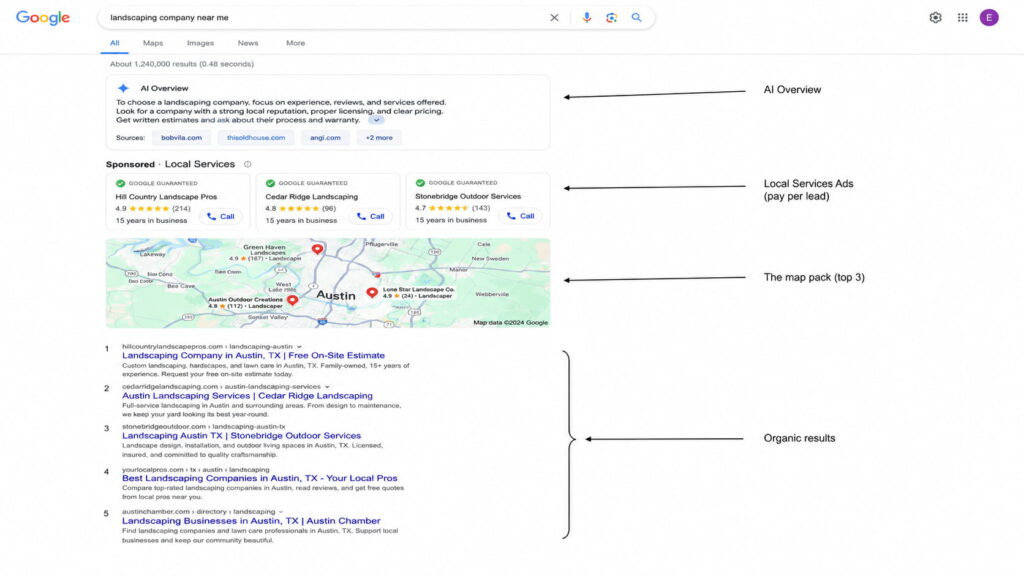
Four blocks, four different contests. Most landscaping companies are only entered in one of them.
The Map Pack (where most of the calls are)
The map pack, meaning the three businesses Google pins on the map above everything else, is where the high-intent clicks go. When somebody searches “near me” or “paver patio [city],” they are not researching. They are looking for somebody to call today, and the top three on the map are the ones they call.
Google is unusually direct about how it picks those three. According to Google’s own Business Profile documentation, local results are based primarily on relevance, distance and prominence.
Distance is the one you cannot do anything about. Your shop is where your shop is. Relevance and prominence are the two you can move, and the whole first half of this guide is about moving them.
Prominence is worth reading twice, because Google spells out what feeds it: how many websites link to your business, and how many reviews you have. That single sentence is why the review section and the backlink section further down exist. They are not separate hobbies. They are the two inputs Google named.
And prominence moves faster than operators expect. One San Antonio landscaper went from position 11 to the top three of the map in under six months (BASEO client data). He did not move his shop, hire better crews or buy a bigger truck. He fixed the two factors on Google’s list that were actually his to fix.
Organic results and service pages
The blue links catch two things the map does not. The first is the research that happens weeks before anybody calls: “how much does a paver patio cost,” “hardscaping vs landscaping,” “sod or seed.” The second is the service-plus-city search in towns far enough away that distance keeps you off the map no matter what you do.
The click is not the job, though. What turns a click into a quote request is the page it lands on. And on most landscaping sites, that page is a homepage listing eleven services, naming no town, with a contact form buried at the bottom.
A homeowner searching “irrigation repair Round Rock” who lands on a page about irrigation repair in Round Rock will fill out the form. The same homeowner landing on a general homepage will hit the back button and call the next crew. That’s the entire argument for service pages, and it applies just as hard to paver patios, tree trimming and sod installation.
Local Services Ads and AI Overviews
Local Services Ads for landscapers are the cards at the very top with the green Google Guaranteed badge. They work differently from regular ads: you pay per lead instead of per click, Google verifies and screens the business first, and what arrives is a phone call, not a form. Requirements vary by state and by category.
They are the fastest lever on this page. Nothing in the organic half of this guide can put a call on your phone next week. LSA can.
Paid is not free, and the honest number is public. Landscaping search ads averaged $117.92 per lead at an $8.76 average cost per click in LocaliQ’s home services benchmark, across more than 16,000 campaigns running from April 2024 through March 2025.
Run your own close rate against that. If you win one estimate in four, every booked job is carrying about $470 in ad cost before a single paver comes off the truck. On a $14,000 patio that disappears into the deposit. On a $180 cleanup you just worked for free and paid for the privilege, which is why the service you advertise matters more than the ad does.
That number is not fixed, which is the part most operators never get told. A second landscaping operator went from $84 to $43 in cost per lead over six months on the same ad budget, and the volume went from 18 leads a month to 54 (BASEO client data). Nothing was added to the spend. The campaign was just built by somebody who knew the difference between a patio search and a mow search.
Then there’s the AI question, which you have probably been told is the end of the world. Here’s the part that gets left out: Ahrefs, analyzing 300,000 keywords, found that 99.2% of the keywords that trigger an AI Overview have informational intent. “Landscaper near me” is not informational. The searches that actually book work are still decided by the map pack and by LSA.
Where they do appear, AI Overviews cost the top result real traffic: Ahrefs measured a 34.5% lower click-through rate for position one on informational keywords in April 2025. That’s the research phase, not the hiring phase, and there’s a section further down on what to do about it.
Fast wins: what can bring calls in 30 to 90 days
The rest of this guide splits into two halves, and the split is by speed, not by importance. This half is the work that can change your phone volume inside a season. The next half is the work that takes most of a year and then keeps paying every season after.
None of this is a guarantee, and anybody who gives you one is telling you something they cannot know. How fast it moves depends on how competitive your market is and how bad your profile is right now. A half-finished profile in a three-town market moves fast. A decent profile in a metro with forty crews does not.
One channel note, because this is where guides lie: what can move in 30 to 90 days is the profile, the reviews and paid. Pages take longer. Anybody promising organic leads in 30 days is either talking about ads or talking nonsense.
Fix your Google Business Profile first
It’s free, you already own it, and it feeds the map pack you just read about. There is no better first move.
Work through this in order:
- Set the right primary category. It carries more weight than every secondary category combined. “Landscaper,” “Lawn care service” and “Landscape designer” are three different businesses as far as Google is concerned, so pick the one that matches the work you want more of, not the work you started with.
- Add secondary categories for services you actually sell. Not the ones you’d like to sell someday.
- Set the service area by town. List the places your trucks actually go. A radius wide enough to cover half the state tells Google nothing about where you belong.
- List every service individually, with a real description. Each one is another thing Google can match a search against.
- Upload project photos weekly. Real jobs, shot on a phone, from the properties you finished this month.
- Post. It doesn’t have to be clever. It has to be regular.
- Seed the Q&A with the questions your office actually answers on the phone. You can ask and answer them yourself.
- Set your hours, and set special hours before the holiday, not after somebody drives out to a closed shop.
- Decide the address question. If you go to customers rather than customers coming to you, hide the address and set the service area instead.
Two of those come straight out of Google’s own published advice rather than agency folklore: keep your hours accurate, and add photos. Google says the same about replying to reviews, which is the next section.
One warning that costs people their listings every year. Stuffing keywords into your business name, turning “Vasquez Landscaping” into “Vasquez Landscaping Austin Paver Patios Lawn Care,” is against Google’s rules and it is a suspension risk. It is also the most common shortcut in this trade.
This is the first piece BASEO rebuilds for a client, and it goes first for the same reason it goes first here: the map shows three businesses above everything else, the profile is how Google decides which three, and most operators are running a half-filled profile with the wrong primary category. On most accounts it is the first thing that visibly moves. Call tracking goes on every number before that, so the calls it produces are countable from day one.
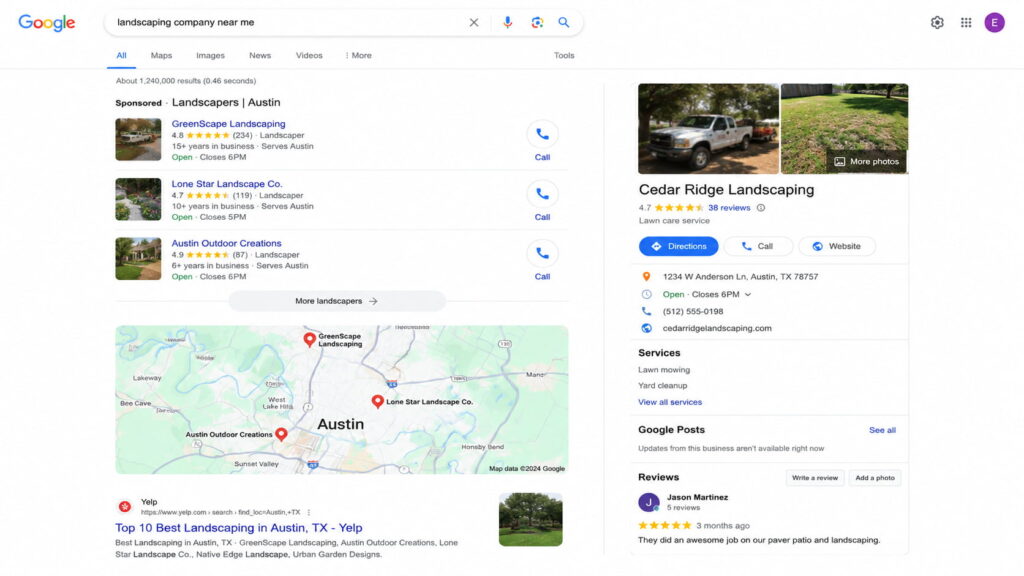
A hardscape company filed under “Lawn care service.” Google ranks it for what the profile says it is, not for what the trucks actually do.
Build a review engine your crews can run
Everybody knows they should ask for reviews. Almost nobody has turned it into something that happens without the owner remembering to do it. That gap between a good intention and a system is the entire section.
Here’s the system:
- Ask the day the job closes, while the “after” photo is still on somebody’s phone and the customer is standing in the finished space. A week later the feeling is gone.
- Put a short review link in your email signature and in the invoice text message. Not a paragraph of instructions. A link.
- Put a QR code on the truck and on the printed invoice. Costs nothing, works on the people who never open email.
- Reply to every single review inside 48 hours, naming the service and the town the way a person would talk, not the way a template would.
That last one is not a nicety. In BrightLocal’s 2024 consumer survey, 88% of consumers said they would use a business that replies to all of its reviews, against 47% for a business that doesn’t respond. Replying roughly doubles the number of people willing to consider you. And since reviews are half of what Google named as prominence, the replies are doing two jobs at once.
The hard line: do not offer a discount for a review, and do not buy them. Incentivized reviews are against Google’s policies, purchased ones are worse, and both are the kind of thing that surfaces at exactly the wrong moment. There is no clever version of this.
BASEO runs a review generation system for clients that works off completed jobs, so the ask lands when the customer is happiest and the owner is not the one who has to remember. What that does not mean, and what you should be suspicious of anybody claiming, is setting up automations inside your Jobber or Aspire account. That’s your software and your process. The review system sits alongside it.
Clean up your NAP and core citations
NAP means name, address and phone, and the rule is that all three should be identical everywhere on the internet Google can see them.
Quality beats volume here, badly. The ones worth having:
- Google Business Profile
- Apple Business Connect
- Bing Places
- Yelp
- Angi, Thumbtack and the other directories, listed for the citation value
- Better Business Bureau
- Your local chamber of commerce
- NALP and your state nursery and landscape association
Ten that matter will do more than five hundred that don’t, which is the whole problem with the “500 citations for $99” packages. They build listings on sites nobody visits and Google barely counts, and half of them get your details slightly wrong.
The other trap is putting a different tracking number in every directory. That is worse than having no tracking at all, because now Google sees six phone numbers for one business and trusts none of them. One consistent primary number everywhere, and layer any tracking on top of it.
Ten minutes of homework: search your business name plus your old phone number. Whatever comes back is a zombie listing with stale information, and it’s costing you.
Make the phone number and quote form impossible to miss
This one is conversion, not SEO. It’s in the fast half anyway, because it decides whether any of the traffic from everything else is worth having.
Three things:
- A tap-to-call number fixed in the mobile header, visible without scrolling. The homeowner is outside, holding a phone, deciding between you and the next result.
- A quote form with four fields, maximum: name, phone, what they need, and the address or zip. Every field past the fourth costs you submissions.
- An explicit response time on the form itself. “We’ll call you back within one business day” converts better than the best-designed form with no promise on it.
Then the part no plugin fixes: answer the phone. The speed you respond decides more estimates than the difference between position one and position three ever will, and a site that turns clicks into quote requests is worth more than a site that ranks and sits there. If your current one doesn’t, that’s a site built to convert clicks problem, not a ranking problem.
The compounding layer: what takes 6 to 12 months
Everything above rents attention. The profile can be suspended, the ad budget runs out, and the reviews need feeding forever.
This half builds something you own. A page built properly keeps producing next season and the season after, without another dollar going into it. That’s the real difference between paid and organic, and it isn’t that one is good and one is bad: ads stop the day the spend stops, which is exactly why they’re the right tool when next month is half empty. Pages take longer and then lower the cost of every job after them. Run both.
Here’s what it looks like when it works. That same San Antonio operator went from 28 organic quote requests a month to 77 in six months (BASEO client data). Read that as what it is: not a traffic chart, but 49 more people a month calling to ask him what something would cost. And unlike the map position, that number kept climbing after the pages were finished.
Keyword research for landscaping and lawn care
Keyword research sounds like a software problem. For a landscaping company it’s mostly a listening problem.
There are four kinds of search worth chasing, and they belong on different pages:
Service searches (“paver patio installation”) tell you what to build a service page about. Service plus city (“lawn care Tampa”) is where location pages live. Seasonal searches (“spring cleanup service,” “fall leaf removal”) spike and vanish, which is why the calendar section further down matters. Problem searches (“how to fix standing water in yard”) are people who don’t know yet that they need you, and they belong in blog content.
| Example keyword | Rough demand | Difficulty | What the job is worth | Page it belongs on |
|---|---|---|---|---|
| paver patio installation | High | Hard | Highest ticket you sell | Service page |
| paver patio [your city] | Low to medium | Medium | Same job, warmer buyer | Service page or city page |
| landscaping company [your city] | Medium | Hard | Anything, including price shoppers | Homepage or main service page |
| lawn care [your city] | Medium | Medium | Recurring, low per visit | Service page |
| retaining wall contractor [your city] | Low | Medium | High ticket, few searches, worth all of them | Service page |
| irrigation repair [your city] | Low | Easy to medium | Small job, opens the door | Service page |
| spring cleanup service [your city] | Seasonal spike | Easy | Small job, best contract lead-in you have | Seasonal service page |
| fall leaf removal [your city] | Seasonal spike | Easy | Small job, same reason | Seasonal service page |
| sod installation cost | Medium | Medium | Researching, weeks out | Blog post |
| how to fix standing water in yard | High | Medium | Drainage work, and they don’t know it yet | Blog post |
Look down the fourth column before the second. The retaining wall keyword with the lowest demand on this table is the one worth the most per search, and it is the one your competitor has not bothered to build a page for.
Demand and difficulty are shown as ranges on purpose. Exact volumes move month to month and vary enormously by market, and a precise-looking number for your town that came from a national average is worse than an honest range.
Ahrefs, Semrush and Google Keyword Planner will all give you real numbers when you want them. But the fastest first pass costs nothing: write down every service you quote separately, then write down the questions your office answers on the phone every week. That list is 80% of your keyword research and it is already sitting in your head.
One thing to avoid. Chasing “landscaping” as a keyword is volume with no intent and no geography. You will spend a year and a lot of money to rank for a word that brings you price shoppers from four states away.
One page per service, not one page for all of them
The rule is one sentence long: if you quote it separately, it deserves its own page.
Then the ordering, which is where most landscaping sites lose money without knowing it. The search for a paver patio costs about the same to win as the search for a mow. One of them is a $14,800 job. That figure isn’t hypothetical, it’s a patio one landscaping crew closed from an organic page (BASEO client data), along with an $18,600 retaining wall from the same site.
So the order isn’t “whatever has the most searches.” It’s margin first. One patio is worth forty mowings, and ranking for the mow while your competitor ranks for the patio is the most expensive ordering mistake in this trade. That ordering is the core of what BASEO builds for a landscaping client: a page for every service, sequenced by what the job is actually worth rather than by what gets typed most often.
A service page that converts has all of this on it:
- An H1 that names the service and the area
- The direct answer in the first paragraph, not the third
- A price range or a “starting at” figure, which almost nobody publishes and which filters out the tire-kickers before they eat an hour of your time
- The process in three or four steps, so they know what happens after they call
- A before-and-after gallery, with descriptive alt text on the photos
- FAQs specific to that service
- Proof from that service specifically, not a general testimonial wall
- A call to action at the top and again at the bottom
One warning: two pages that are nearly identical will compete with each other and Google will rank neither of them well. “Paver patios” and “patio installation” are one page, not two.
Location pages that are not doorway pages
Location pages exist to catch “service plus city” in the towns where distance keeps you out of the map pack. That’s the specific job. Which means the number of them follows your route, not your ambition.
Most of them fail, and they fail the same way: somebody takes one page and swaps the town name. That’s a doorway page, and it isn’t a grey area. Google publishes the test itself, asking whether pages are “intended to rank on generic terms yet the content presented on the page is very specific” and whether they duplicate something already on the site just to capture more traffic. Forty of those is not forty times the traffic. It’s a liability.
A location page that earns its place has four things a template can’t fake:
- Two or three real projects from that town, with photos
- Reviews from customers in that town
- Local specifics you already know: the soil you’re dealing with, the watering restrictions the city enforces, the HOA rules that come up on half the bids
- The crew that actually covers it
Start with three to five towns. The ones where you already have finished work and happy customers, because those are the only pages you can write honestly today. Forty thin pages built in a weekend is precisely the thing the policy was written to catch.
Blog content that earns the job, not just the click
The filter is one sentence: write what a customer asks before they sign, not what a hobby gardener googles at midnight.
“How much does a paver patio cost in Texas” is written by somebody who is about to spend money. “10 types of ornamental grass” is written by somebody who will never call you. Both of them can rank. Only one of them shows up on your schedule.
Two to four pieces a month is a realistic cadence for a company whose actual job is landscaping. And before you publish anything new, update what’s already there. An outdated cost page is doing more damage than a missing one, because it’s ranking and telling people the wrong number.
The three types that consistently pay for themselves: cost and pricing content, material comparisons (pavers versus concrete, sod versus seed), and post-install maintenance guides. That last one is a retention asset. The customer who reads your guide on caring for a new patio is the customer who calls you for the next project.
Backlinks a landscaping company can realistically get
Skip the guest posting advice. It was written for software companies and it does not survive contact with a crew schedule in June.
Here’s what a busy owner can genuinely do:
- Sponsor a local sports league or community event. Most of them list sponsors on a website with a link.
- Get into the certified installer directories the manufacturers run. Belgard, Techo-Bloc and Unilock all list the contractors who work with their products.
- Join the trade associations, nationally and in your state.
- Call the local paper when a project is genuinely notable, or when your crew donates work.
- Build relationships with the builders, architects and realtors who are already sending work to somebody in your market.
- Enter the local “best of” awards. They link to winners, and they run every year.
Why bother: Google already told us prominence is partly a function of how many sites link to your business. This list is that, executed by somebody who owns a truck instead of a content team.
It is also the slowest thing in this guide, which is why BASEO starts the link and citation work in month two rather than month six. A sponsorship that goes live in February is a link that has been aging since February, and there is no way to buy that time back later. What nobody should pay for is the shortcut: link farms, private blog networks and the thousand-links-for-two-hundred-dollars offers all buy the same thing, which is a liability and a cleanup job.
That’s the full build. Profile, reviews, citations, conversion, keywords, service pages, location pages, content, links. Nine things, and most sites are missing four of them and running the other five badly. If you want the list for yours, with the three competitors in your map pack lined up next to it, that’s what the audit is for. Send a domain, get it back in writing, and do whatever you want with it. Send Me the Map Pack Audit →
Technical SEO checklist for a landscaping website
This is the layer that decides whether any of the above gets read by Google properly. You should not have to do it yourself, but you should know what to ask about.
- Speed and Core Web Vitals (Google’s grades for how fast and steady a page feels while it loads). This matters more for landscaping sites than for almost anybody, because your portfolio gallery is your sales argument and it’s also what’s sinking your load time. Compress the images, serve them in a modern format, and load the ones below the fold only when somebody scrolls to them.
- Mobile first. He’s standing in the yard holding a phone.
- HTTPS. The padlock. Still non-negotiable, and still missing on a surprising number of sites built by a cousin in 2016.
- A clean URL structure.
/services/paver-patios/and/service-areas/round-rock/, not/page.php?id=47. If you cannot read your own site map out loud, neither can Google. - Internal links from every service page to the towns that buy it. The paver patio page should link to the four city pages where you actually sell patios. That is how Google learns which of your towns goes with which of your services, and almost no landscaping site does it.
- An XML sitemap (a file that lists your pages for Google) submitted in Search Console. Twenty service and location pages Google has not found yet are twenty pages you paid for and nobody is reading.
- No duplicate content across location pages. Same doorway problem as above, seen from the technical side.
- Descriptive alt text on project photos. “Paver patio with fire pit in Round Rock” beats “IMG_4471.jpg.”
- LocalBusiness schema (labels in the code that tell Google exactly what your business is) with the service area and the service list filled in properly.
Two free tools do most of the checking: PageSpeed Insights for the speed items and Google’s structured data documentation for the schema. This is the foundation layer BASEO installs before content scales, tracking first, because pages without tracking is how the last marketing company stayed invisible for eight months.
If half of this reads like another language, that’s fine. It’s not your trade. It is, however, the first thing whoever runs your site should be able to answer for without changing the subject.
Getting cited by AI Overviews, ChatGPT and Gemini (AEO)
Answer engine optimization is the work of becoming one of the two or three local businesses an AI assistant names when somebody asks it for a crew in their town. Same goal as ranking, different surface, and almost nobody in this industry is doing it yet.
Start with the mechanism, because the hype skips it. An assistant asked for a landscaper in Round Rock does not have a ranked list of ten. It returns two or three names, and the signals it leans on to pick them are the same reputation signals that drive the map pack: the profile, the reviews, the consistency of your information across the web. Which is why the review work and the AI work are not two projects. They’re the same project with two outputs.
What to actually do:
- Answer each question in the first 40 to 55 words under its heading. The FAQ section at the bottom of this page is built that way deliberately.
- Use question-form headings, because that’s the shape of what people ask assistants.
- Put prices and timelines in tables and lists, not buried in paragraphs. Structured information gets pulled; prose gets skimmed past.
- Keep the profile and the reviews impeccable. That’s the entity data the assistants are reading about you.
- Keep your name, services and service area identical everywhere. Contradictory information doesn’t get resolved, it gets skipped.
Now the expectation, which is the part worth more than the tactics. Remember that 99.2% of AI Overview keywords are informational. “Landscaper near me” isn’t one of them. AEO wins you the research phase, weeks before anybody is ready to hire, and the map pack and LSA still decide the search that actually books the job. Anybody selling you AEO as a replacement for local SEO in this trade is selling you the wrong product.
BASEO does this work as part of the program: content formatted so it can be cited, tracking of which markets you’re being named in and which competitor is getting named instead, and recovering the AI referrals that GA4 quietly files as “Direct.” The one thing nobody can offer, and you should walk away from anybody who does, is a promise that an assistant will name you. The inputs are controllable. The output is measurable. It is not purchasable.
Building your SEO calendar around the season
Here’s the idea that no other guide on this topic connects, and it’s the one that fits your business best.
A page needs time to age before it ranks. Which means it goes up 60 to 90 days before the demand it’s meant to catch. Your publishing calendar isn’t a content calendar. It’s your season, run backwards.
| Quarter | What the market is buying | What to publish, and when |
|---|---|---|
| Q1 (Jan–Mar) | Spring cleanups, mulch, irrigation startup | Publish in January. Spring cleanup, mulch install, irrigation startup pages |
| Q2 (Apr–Jun) | Maintenance programs, hardscape, irrigation | Publish in February and March. Maintenance program pages, paver patio and retaining wall pages |
| Q3 (Jul–Sep) | Fall prep, sod, aeration and overseeding | Publish in July. Fall cleanup, sod installation, aeration and overseeding pages |
| Q4 (Oct–Dec) | Leaf removal, winterization, snow and ice where it applies | Publish in September and October. Then use the quiet weeks for location pages and technical cleanup |
And the business half of it, which is the actual point. The off-season isn’t dead time, it’s the only time you have. Winter is when the location pages get written and the technical debt gets paid.
Run it as a trade. Four pages written across January and February is maybe three weekends you were not billing anyway. If one of them lands a single patio in May, you can look up what that is worth two sections above this one. The pages that book April work were built in December, and the operators staring at a half-empty April schedule are the ones who spent December waiting for the phone.
One caveat: the snow belt and the Sun Belt do not run the same calendar. If somebody hands you a content calendar that doesn’t ask which one you’re in, they’ve never lost a November.
What landscaping SEO costs and how long it takes
Every other page on this topic dodges this question, so here it is straight.
There is no landscaping SEO price list, and anybody who quotes you one without looking at your market is guessing. But the market has a shape, and the shape is public. In Ahrefs’ survey of 439 SEO professionals, 78.2% bill by monthly retainer, the most common agency tier was $500 to $1,000 a month, and agencies averaged around $3,209 when you assume they charge at the top of the range they state. Average retainers rise with experience, from about $1,540 a month for providers under two years in business to about $2,023 past that.
That’s the market. What should actually drive your number is narrower: how many service pages and location pages are being built, and how competitive your towns are. A crew serving four towns and a crew serving twenty are not the same job and should not cost the same.
| Your scope | What the money should be buying | What to expect first | What should worry you |
|---|---|---|---|
| One town, a few services | Profile rebuild, review system, 3–5 service pages, tracking | Map movement and more calls from the profile | A proposal with no page list in it |
| A handful of towns | The above plus location pages, content, local links | Organic quote requests starting around month 3–5 | Being told to wait quietly for six months |
| Multi-city, multi-service | Full page build ordered by margin, links, AI search work, monthly reporting | Compounding volume from month 6–9 | Reports full of rankings and no phone numbers |
For context on the paid side, that landscaping search ad benchmark was $117.92 per lead. On the owned side, one landscaping operator’s cost per lead went from $78 on Angi to about $11 from pages he owns (BASEO client data).
The $78 is the number worth sitting with. What Angi sells you is not a lead, it is a rental on one. That homeowner’s phone number lands with four other crews the same morning, the invoice arrives whether you win the work or lose it, and the rate climbs every year you stay. Turning it off on Monday just gives you a light week, so nobody is suggesting that. The reason to build the side you own is to get to where turning it off is a choice.
Read the two figures carefully, though, because they are different kinds of number: the first is a market average across thousands of campaigns, the second is one client’s result. Neither one is a prediction for you.
On timing, there are two clocks and they run at different speeds:
- Profile and review work: can move calls inside 60 to 90 days.
- Service and location pages: generally 6 to 12 months to settle. First organic quote requests tend to land around month 3 to 5, real volume around month 6 to 9.
- Ads: booked jobs inside the first two to three weeks.
Keep those channels straight when you’re being sold to. “Leads in 30 days” is an accurate claim about ads and a false one about organic.
Four things that should end the conversation:
- They guarantee a #1 ranking. Google says nobody can, and Google would know.
- A 12-month contract with no way out. BASEO has never put a client on one, and there is no version of this work that requires locking someone in for a year.
- They won’t tell you which pages they’re building. If the deliverable can’t be named, it can’t be checked.
- The report shows rankings instead of calls. A ranking that produced no calls is a screenshot.
As for what BASEO charges, that depends on your market and it’s in the free audit, along with the job math for your specific service area. What’s worth saying here instead of a number: one patio covers a long stretch of this, and the audit comes before the invoice.
How to measure it: track booked jobs, not rankings
A ranking is not a result. Position three that produced eleven calls beats position one that produced two, and if your provider can’t tell you which happened, you’re not being reported to, you’re being reassured.
Count these: calls from your profile, forms submitted, estimates booked, jobs closed, and revenue by channel. That last one ends every argument.
| Metric | What it actually tells you | Where you see it | How often |
|---|---|---|---|
| Calls from your profile | Whether the map work is producing | Google Business Profile insights | Monthly |
| Quote requests submitted | Whether the site converts the traffic | GA4, plus your inbox | Monthly |
| Estimates booked | Whether the quote requests are real | Your own schedule | Monthly |
| Jobs closed and revenue by channel | Whether any of this made money | Your books, plus the “how did you find us” answer | Monthly |
| Cost per lead by channel | Which channel to feed next season | Spend divided by quote requests | Quarterly |
| Search queries and impressions | What Google thinks your site is about | Search Console | Quarterly, as a diagnostic |
The minimum setup is four things: GA4 with events on the form submit and the click-to-call, call tracking on a dynamic number (keeping your published NAP number consistent everywhere), Search Console connected, and the “how did you find us” question on the form and asked on the phone. That last one is unglamorous and it beats every tool on the list.
Then the discipline: look monthly, judge at six months. Not six weeks. And the honest inverse, which is the part that makes the rest of it credible: if month six looks like month one, that’s an answer too, and you should act on it.
This is the shape a monthly report should take, and it’s what BASEO sends: quote requests and calls with the actual phone numbers, cost per lead over time, map position on the keywords that matter, pages published, AI citations, and next month’s plan in plain English. One page. No dashboard to learn.
The only report that matters: quote requests with phone numbers attached to them.
7 SEO mistakes that quietly cost landscapers jobs
- One page listing every service. Google can’t rank a list. Build a page for every service you quote separately.
- Location pages built by find and replace. That’s a doorway page and it’s against the rules. Three real ones beat forty cloned ones.
- The wrong primary category, or no service area set. Ten minutes inside your profile, and it’s the fastest-moving fix on this list.
- Reviews asked for only when somebody remembers. Tie the ask to job completion instead of to your memory, and reply to all of them.
- A photo gallery that weighs more than the rest of the site. Your portfolio is the sales argument. Compress it so people actually see it.
- A different phone number in every directory. One primary number everywhere, with tracking layered on top rather than replacing it.
- Content written for hobby gardeners instead of buyers. Write for the homeowner about to spend $14,000, not the one about to buy a trowel.
DIY, hire in-house, or hire an agency?
| Do it yourself | Hire in-house | Hire an agency | |
|---|---|---|---|
| What it costs | Tools and your time | A full salary plus benefits | A monthly retainer |
| What it costs you | Real hours, weekly, in your busiest months | Managing somebody | About an hour to start, then roughly 20 minutes a month |
| How fast it moves | Slowly, and it stalls in April | Depends entirely on the hire | Fastest, if the sequence is right |
| When it makes sense | Smaller operation, real winter downtime | Enough volume to keep somebody busy every month | The bottleneck is time, not knowledge |
Here’s the honest version. If you’re a smaller operation with genuine downtime in winter, the Google Business Profile, the review system and your first two or three service pages are absolutely something you can do yourself. This guide is enough to do them properly. Plenty of operators run exactly that far and do fine.
Where it plateaus is location pages at volume, the technical work and the links. Not because any of it is mysterious, but because it takes hours you do not have in April, and April is when it matters.
In-house makes sense at a size most crews never reach. The honest test is whether there’s enough work to keep somebody busy every single month, and for most operators there isn’t.
Hiring somebody is the right answer when the bottleneck is time rather than knowledge. And if you’re weighing it, the number to ask about isn’t the fee, it’s what it costs you in hours: about an hour to get started and roughly twenty minutes a month after that is what being a client should take. That number matters more than anything else on this page to somebody reading it from a truck. If you want to see what a full landscaping marketing program covers before deciding either way, that’s the place to start.
Get a free landscaping SEO teardown
Here’s a concrete offer with nothing attached to it.
Send us your domain and you get a written teardown of three things: your Google Business Profile, your website, and the three competitors currently sitting in the map pack in your market. Plus the three fixes that would move the needle first, in order.
Free, in writing, in about two business days, and no call required at any point. If you read it and never reply, the document is still yours and you can hand it to whoever you hire instead. The audit comes before any invoice, which is the part most people ask about twice.
If your market doesn’t support the math, the teardown will say so. That happens, and you’re better off knowing.
The team on your account works only with green industry operators, landscaping and home services, so it already knows your competitors and your season.
Frequently asked questions about landscaping SEO
There’s no landscaping-specific price list, but the market has a shape. In Ahrefs’ survey of 439 SEO professionals, the most common agency retainer was $500 to $1,000 a month, and agencies averaged around $3,209. What you pay should track how many service and location pages get built, not a package tier.
Expect two timelines. Google Business Profile and review work can produce more calls within 60 to 90 days. Service pages, location pages, and links usually take six to twelve months to settle into steady lead flow, and then keep producing season after season.
For most local landscapers, yes, but only if the basics are handled first. A fully optimized Google Business Profile plus a consistent review habit costs nothing but time and drives the majority of early calls. Content and link building make sense once those are running.
Local SEO targets searchers in your service area and competes for the Google map pack, driven by relevance, distance and prominence. Regular organic SEO competes for standard blue-link results, driven mostly by page content and backlinks. Landscapers need both, but local usually pays first.
Not to rank in the map pack. That comes from your Google Business Profile, reviews, and citations. A blog helps you rank for research queries like paver patio costs or lawn treatment schedules, capturing homeowners weeks before they request a quote.
Set the right primary category, define your service areas by city, list every service individually, add project photos weekly, collect and reply to reviews consistently, and keep your name, address, and phone identical everywhere. Distance to the searcher matters too, which is why coverage is built city by city.
There is no fixed number. What matters is having more recent, service-specific reviews than the competitors currently in your map pack. Check the three businesses ranking for your main service in your city and treat their review count and recency as your working target.
Both, in sequence. Local Services Ads buy leads immediately and are useful while you are still building rankings, but the cost per lead never goes away. SEO takes longer and then keeps producing without per-lead cost. Most established landscapers run LSA and SEO together.
Final thoughts
The crew sitting above you on the map is not better at landscaping than you are. They finished a profile you left half-empty and built pages for the towns you both drive through, and they did it before the season started rather than during it.
Pick the two fastest items from the first half of this guide, the profile and the review system, and do them in the next two weeks. Then count calls for ninety days instead of checking your position. If the phone moves, you know the rest of the build is worth funding. If it doesn’t, you’ve learned something real for the cost of two afternoons.
And if you want to know exactly which pieces your site is missing and what the crew above you built instead, that’s what the teardown is for. Free, in writing, about two business days. No call required.