
Google Ads put you in front of people who are searching to buy or sell a house right now. Not next year. Today. That is the whole appeal, and it is why real estate keeps spending on paid search even as clicks get pricier.
The good news: real estate has some of the cheapest clicks of any industry. The average cost per click sits around $3.22 in 2026 (WordStream), and more than 90% of buyers use the internet somewhere in their search (NAR data via Axios). The bad news: cheap clicks are not the same as cheap leads.
This guide covers what Google Ads actually cost in 2026, the four campaign types, the keywords that convert, and the one policy that quietly shuts down new investor accounts: the Housing Special Ad Category. No promises of easy money. Just the math.

Do Google Ads actually work for real estate?
Yes, but only if you have three things first: a landing page built to capture leads, a CRM to follow up, and the discipline to call every lead within five minutes. Google Ads reach buyers and sellers with high, bottom-of-funnel intent. Without those three, the clicks convert to nothing.
Start with the landing page. Your homepage is not it. A homepage asks the visitor to browse. A landing page asks for one thing: the phone number or the address. Send paid clicks anywhere else and you pay for traffic that wanders off.
Then the follow-up. A lead you do not call is money you set on fire. Responding within five minutes makes you roughly 900% more likely to reach the lead than waiting even a little longer (speed-to-lead research). A CRM is how you make that happen every time instead of when you remember.
When all three are in place, the numbers get good. Well-run real estate campaigns report a return near 8:1 (Avenue). That is eight dollars back for every dollar in. But read the word “well-run” twice. The 8:1 is the ceiling for operators who did the boring prep, not a starting point.
What Google Ads cost for real estate in 2026
There is no single price. What you pay depends on three levers: the keyword you bid on, the campaign type you run, and how competitive your market is. A buyer click in a quiet market and a “sell my house fast” click in a major metro are not in the same universe. Here is how each one breaks down.
Cost per click by keyword type
Real estate clicks are cheap on average. The 2026 average cost per click is about $3.22, one of the lowest of any industry (WordStream). But the average hides a wide spread, because a buyer browsing listings and a seller in distress are worth very different amounts.
| Keyword type | Example | Typical CPC | Why |
|---|---|---|---|
| Buyer intent | “homes for sale in phoenix” | $0.50–$5 | High volume, lower urgency, plenty of free organic competition |
| Seller intent | “sell my house fast dallas” | $5–$65 | Each lead can be a deal worth thousands, so investors bid hard |
| Premium niche | “luxury waterfront homes” | $100+ per lead | Small audience, high value, few advertisers willing to pay |
Seller keywords cost the most for a simple reason: a motivated seller can turn into an assignment fee or a flip. The commercial value per click is high, so more investors crowd the auction and the price climbs. That is the trade. You pay more per click for the searches most likely to become a deal.
Cost per lead: seller vs. buyer campaigns
Cost per click is not cost per lead. The gap between them is your landing page and your follow-up. In a well-optimized campaign, seller leads run about $15–$20 each in the US and Canada. That is the low end, and it takes tight message match and fast follow-up to hit it.
Buyer campaigns work differently. At a $20–$25 cost per click and a 10–15% conversion rate, your cost per lead lands closer to $200–$250. Higher, because buyer intent is softer and the sales cycle is longer.
Generic industry averages sit in between, around $100 to $116 per lead (WordStream). The spread is enormous because cost per lead real estate Google Ads numbers depend on everything downstream of the click: keyword intent, page quality, market, and how fast you call. Two investors bidding on the same keyword can see a 10x difference in cost per lead based on nothing but their landing page and phone habits.
How much should you budget per month?
You need enough budget to give Google’s algorithm data to learn from. Too little and it never optimizes.
A working floor is $500 to $1,000 per month just to start collecting real numbers. A solo operator who wants consistent lead flow usually needs $900 to $2,000 per month. In large, competitive markets, expect $2,000 to $3,000 or more to stay visible against investors who have been bidding for years.
The trap is going in under the floor. On a tiny budget, you get a handful of clicks, almost no leads, and no signal for the algorithm to improve on. You are not testing Google Ads at that point. You are just donating to Google.
The 4 Google Ads campaign types for real estate
Google gives you four ways to run real estate ads: Search, Local Service Ads, Performance Max, and Display or Remarketing. They are not equal for lead generation. If you are starting out, put your money into Search and Local Service Ads first. That is where the intent, and the ROI, live.
Search Ads
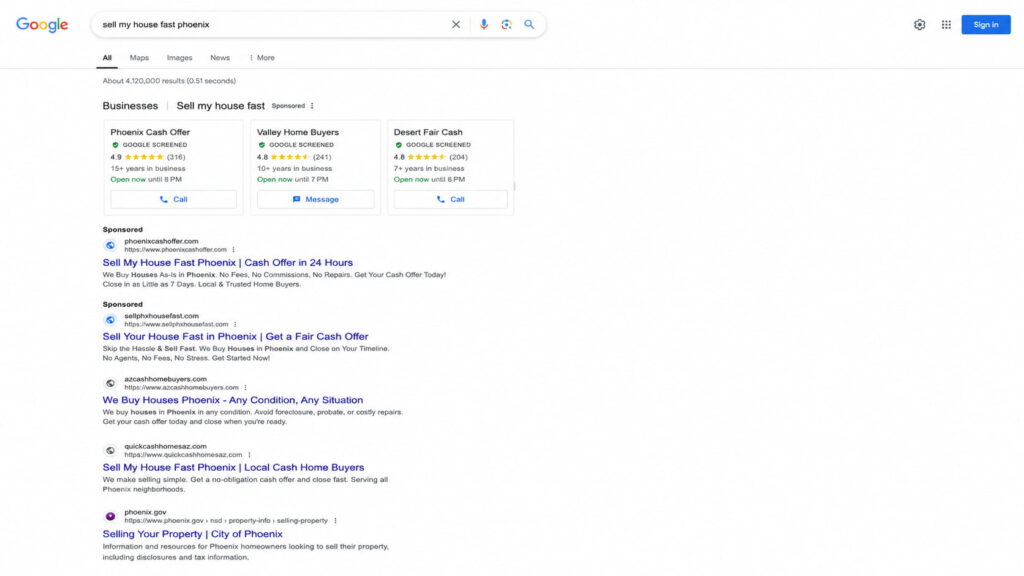
Search Ads are the text ads that show when someone types a query. They carry the highest intent of any ad type, because the person is actively searching for exactly what you offer. Typical cost per lead runs $50 to $70. Use them as your foundation. A seller-intent Search Ad for “sell my house fast Dallas” might read: “Sell Your Dallas House Fast, Fair Cash Offer in 24 Hours, No Repairs, No Fees.” Keyword in the headline, promise in the description, one clear action.
Local Service Ads (LSAs)
Local Service Ads run on a different model. You pay per lead, not per click, so you only pay when someone actually calls or messages you (Google). They sit above the regular Search Ads at the very top of the page, and they carry a “Google Screened” badge once you pass Google’s verification. For a local operator, that badge plus the top spot is close to gold. The catch is the verification step, which takes time and documentation, so start it early.
Performance Max
Performance Max is Google’s fully automated, multichannel campaign. It spreads your budget across Search, Display, YouTube, and more, and lets the algorithm decide. It only works once you already have solid conversion data loaded, because the automation needs something to optimize toward. This is not a beginner tool and it is not for small budgets. Run it after your Search campaigns are producing steady leads, not before.
Display & Remarketing
Display and Remarketing ads are the banners that follow people around the web. They are best for awareness and for re-touching visitors who came to your site and did not convert. Clicks are cheap, but intent is low, so treat these as a support layer, not a lead source. The right job for Display is reminding a seller who already visited your page, not finding a new one cold.
Best keywords for real estate Google Ads
Your keyword list is really three lists: seller-intent keywords, buyer-intent keywords, and the negative keywords that stop you from paying for junk. Seller keywords convert hardest and cost most. Buyers are cheaper but slower. And negatives protect the whole budget.
Seller-intent keywords
These are the searches a motivated seller types when they want out. They convert best and cost most, so bid on them deliberately:
- “sell my house fast [city]”
- “what is my home worth [zip]”
- “home value estimate”
- “cash offer for my house”
Every one of these signals a person ready to act, which is why the click is expensive and worth it. If you want the full channel picture around these searches, our guide on how to get motivated seller leads covers where paid fits next to free and referral sources.
Buyer-intent keywords
Buyer keywords pull more volume at a lower cost per click, but the sales cycle is longer, so plan for more follow-up before a deal:
- “homes for sale in [city/neighborhood]”
- “best real estate agent near me”
- “[city] condos for sale”
These are cheaper to click but softer in intent. A buyer searching listings may be months from a transaction, so nurture beats hard-sell here.
Negative keywords you must add
Negative keywords tell Google which searches to ignore. Skip them and you pay for clicks that will never become a deal. Add these on day one, at minimum:
- “jobs”
- “salary”
- “careers”
- “free”
- “zillow”
- “realtor.com”
- “for rent”
- “rental”
- “how to become a realtor”
- “real estate license”
- “real estate school”
- “diy”
Each of these catches a searcher who wants a job, a rental, or a course, not your service. Blocking them is the fastest way to stop your budget from bleeding on the wrong clicks.
The Housing Special Ad Category: what breaks most accounts
This is the part most new real estate advertisers miss, and it is the one that costs them their account. Google classifies real estate as a Special Ad Category for housing in the US and Canada (Google Ads policy). That classification changes the rules on you.
Two things happen. First, Google restricts how you can target. Second, and this is the one that surprises people, Google reviews both your ad and your landing page for compliance (Google Ads policy). Your ad can be spotless and still get flagged for what is on the page it points to.
Ignore this and the consequences escalate fast: ad disapprovals, limited delivery, or a full account restriction that is painful to reverse. Carrot has warned investors about exactly this in its Housing policy coverage. Treat the Special Ad Category as the first thing you handle, not a surprise you discover after your account gets limited.
What targeting you lose
Under the Housing category, you cannot target or exclude people by age, gender, parental status, marital status, or ZIP code, and housing-related interest targeting is restricted (Google Ads policy). The fine-grained audience controls other advertisers rely on are off the table.
That sounds like a handicap. It is really a forcing function. Since you cannot win with narrow targeting, you win with message and keyword instead. The right keyword already filters for intent, and a sharp ad does the qualifying that demographics used to. Build around the search, not the person.
Fair Housing language on your landing page
Because Google reads your landing page too, the words on it matter as much as the words in your ad. Certain phrases trigger a Fair Housing flag on sight. Never use language like:
- “exclusive community”
- “no children”
- “English-speaking only”
- “Christian neighborhood”
The rule reaches further than most people expect. Even a testimonial that mentions a demographic characteristic can violate the policy. Audit every line of your landing page copy with a Fair Housing lens, cut anything that describes who a neighborhood is “for,” and use inclusive imagery. When in doubt, describe the house and the offer, never the buyer.
How to set up your first campaign (step by step)
Setting up a compliant, lead-focused campaign is a sequence. Follow it in order, and do not skip step two.
- Create your Google Ads account. Use a business email and set your billing before you build anything.
- Declare the Housing Special Ad Category at campaign creation. This is non-negotiable. Real estate campaigns must be flagged as housing when you create them. Skip it and you are out of compliance from the first click.
- Choose your objective. For lead generation, pick Leads or Website traffic, not brand awareness.
- Set your geography and daily budget. Draw the target area around the markets you actually buy or sell in, and set a daily budget that adds up to your monthly floor.
- Build ad groups by intent. Keep seller keywords and buyer keywords in separate ad groups so each gets its own tailored ad and its own budget.
- Write responsive search ads with the keyword in the headline. Match the ad to the search. “Sell My House Fast [City]” in the headline tells both Google and the seller they are in the right place.
- Connect conversion tracking before you spend a dollar. Track calls and form fills. Without conversion tracking, you are flying blind and the algorithm has nothing to optimize toward.
Step two is the one that saves accounts. Declare the Housing category up front and the rest of the build is ordinary Google Ads work.
Landing pages that convert real estate ad clicks
A great ad pointed at a weak page is wasted money. The page is where the click becomes a lead, and a few rules decide whether it does.
Start with message match. The headline on your landing page should echo the ad and the keyword almost word for word. If the ad said “Sell Your Dallas House Fast,” the page should open with the same promise. When the message matches, Google rewards you with a higher Quality Score, and a higher Quality Score lowers your cost per click. Message match is not just conversion hygiene. It is a discount on every click.
Then, one audience per page. A buyer running an IDX property search and a seller wanting a home valuation need different pages. Do not make one page try to serve both. Keep the form short, load fast on mobile, and make the single next action obvious.
Keep the social proof compliant. Reviews and results are fine, but per the Housing rules above, drop any testimonial that references demographics. Describe the outcome, never who the customer was.
How to know if your campaigns are working
Give it time before you judge it. Most operators see their first leads within 7 to 14 days. The first 30 to 60 days are the learning phase, when Google collects conversion data and figures out who to show your ads to. Full efficiency usually arrives around 60 to 90 days. The biggest early mistake is tinkering with the campaign every day during the learning phase, which resets the algorithm’s progress.
Watch the numbers that actually predict deals, not vanity metrics. Here is where a healthy real estate campaign lands:
| Metric | 2026 real estate benchmark | What good looks like |
|---|---|---|
| Click-through rate (CTR) | ~7.6–8% (WordStream) | At or above benchmark means your ad and keyword match |
| Conversion rate | ~3.3% (WordStream) | Above 3.3% means your landing page is doing its job |
| Cost per lead | ~$100+ average; $15–$20 for tight seller campaigns | Falling over time as the algorithm learns |
| Cost per acquisition | Your CPL divided by close rate | The number that tells you if a deal actually pays |
CTR and conversion rate tell you if the front end works. Cost per lead and cost per acquisition tell you if the business works. If clicks are cheap but leads are not converting, the problem is almost always the landing page, not the bid.
Should you run Google Ads yourself or hire help?
You can absolutely run this yourself. If you have the time to learn the platform and a budget you can afford to spend while you figure it out, DIY is a real option, especially for a single market. Plenty of operators run their own Search campaigns and do fine.
Hiring help makes sense when the cost of mistakes outweighs the fee. The Housing Special Ad Category, wasted spend on the wrong keywords, and a slow landing page can quietly cost more than a manager would. This is the lens BASEO uses on paid: motivated-seller campaigns run under the same measure as everything else, leads and cost per deal, never clicks or impressions as a scorecard. If your current PPC manager does not know a real estate account from a plumber’s, that is usually where the money leaks. Whatever you decide, the honest math should drive it, not a sales pitch.
Get more leads without paying per click
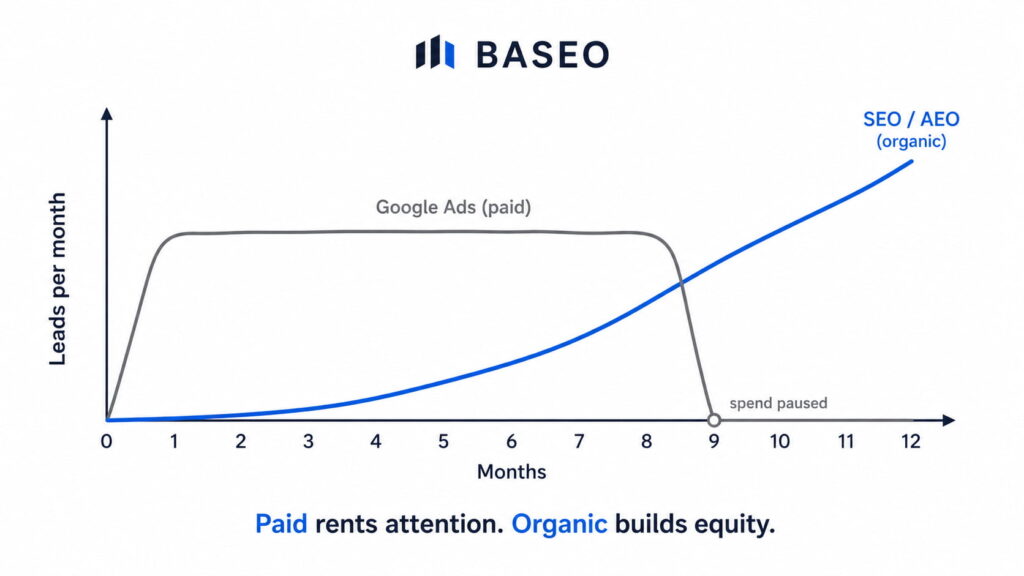
Here is the limit of Google Ads, and it is a real one. The day you pause your spend, the leads stop. Paid search rents attention. You are only visible while the meter runs.
Organic search works the other way. SEO and AI search optimization (AEO) build traffic that compounds, so the pages you rank keep pulling leads at a falling cost per lead long after they are published. One Florida cash buyer we work with went from 3 to 28 motivated seller leads a month in nine months, same market, no extra ad spend (BASEO client data). That is the difference between renting attention and owning the asset.
The strongest setup uses both: ads for immediate flow while your organic engine builds. If you want to see what your market’s organic lead math looks like next to your ad spend, that is what our free audit is for. It covers SEO for a real estate website and how to rank in AI Overviews in your specific market. Written, delivered in about 2 business days, no call required, yours to keep.
Frequently asked questions
Quick answers to the questions real estate advertisers ask most about Google Ads.
Yes, if you have three things first: a lead-capture landing page, a CRM, and the discipline to call every lead within five minutes. Well-run real estate campaigns report ROI near 8:1 because Google Ads reach buyers and sellers with high, bottom-of-funnel intent. Without those prerequisites, results disappoint.
Seller leads typically cost $15 to $20 each in well-optimized US and Canadian campaigns, while buyer leads run higher, often $200 to $250, because of longer sales cycles. Generic industry averages land around $50 to $110 per lead. Premium niches like luxury or waterfront homes can exceed $100 per lead.
Most agents see their first leads within 7 to 14 days of launching a Search campaign. The first 30 to 60 days are the algorithm’s learning phase, when Google collects conversion data. Expect 60 to 90 days before a campaign reaches full efficiency, so avoid major edits early on.
It is Google’s rule that treats real estate ads like credit and employment ads. You lose targeting by age, gender, ZIP code, and housing-related interests, and Google reviews both your ad and landing page for Fair Housing compliance. Ignoring it risks disapprovals or account restrictions.
Google Ads deliver leads fast but stop the moment you pause spending. SEO and AEO build compounding organic traffic that keeps generating leads without per-click costs. The strongest approach uses ads for immediate flow while SEO builds a durable, lower-cost lead engine over time.