
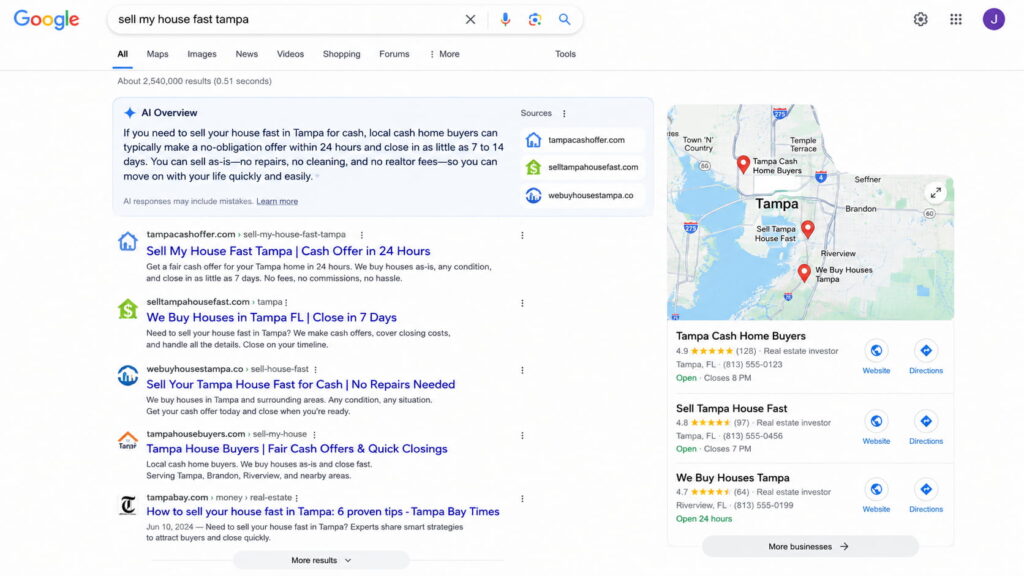
A seller in your city asked Google how to sell her house fast for cash last week. Google answered for her at the top of the page, named a few buyers, and you weren’t one of them. She never scrolled to your site.
That is what an AI Overview does. It now shows on about 48% of searches as of March 2026 (The Stacc), and for top-ranking pages it cuts clicks by roughly 58% (Ahrefs, 863,000 keywords). Ranking on page 1 no longer means the phone rings. This guide explains what triggers an AI Overview, how Google picks the sources it cites, and how to rank in AI Overviews as the cited answer, not just a blue link nobody clicks.

What Are AI Overviews (and Why Your Traffic Dropped)
An AI Overview is the AI-generated summary Google puts at the top of the results page. It answers the query in a few sentences by pulling together three to five web sources, with links, so the searcher often gets what she needs without clicking anything. You’ll also see it called SGE, generative search, or the thing AEO (answer engine optimization) is built to win.
Here is why your organic traffic dropped. The AI answer eats the click before the seller ever reaches your site. In real usage, people clicked a traditional result only 8% of the time when an AI summary was present, against 15% when it wasn’t, and only about 1% clicked a link inside the summary (Pew Research, 68,879 searches).
Don’t panic, though. The click is coming back. AI Overview click-through recovered from 1.3% in December 2025 to 2.4% by February 2026 (Seer Interactive). The catch: it comes back mostly to the pages that get cited. Which is the whole game now.
Ranking vs. Getting Cited: The Mental Shift
Here is the shift that changes everything you do next. “Ranking in AI Overviews” really means “getting cited as one of the three to five sources the AI summarizes.” Those are not the same job.
You’ve spent years chasing the blue #1 spot. That’s still worth having, but it’s no longer the target by itself. Only about 38% of the pages cited in AI Overviews sit in the top 10 organic results (Authoritas via Search Engine Land). The Overview pulls from a wider pool, so a clear, specific, well-structured page can get cited without ranking first.
And the citation is worth chasing. Pages cited in an AI Overview get about 120% more clicks per impression than the uncited pages sitting on the same results page (Seer Interactive).
For a cash buyer, the target is simple: be the cited buyer when a seller in your metro asks the AI how to sell fast. One seller-situation page that earns that citation and brings even a couple of extra motivated-seller leads a month pays for itself in a single assignment fee.
Only about 38% of cited pages sit in the top 10. The game is being the answer, not just the position.
What Triggers an AI Overview in the First Place
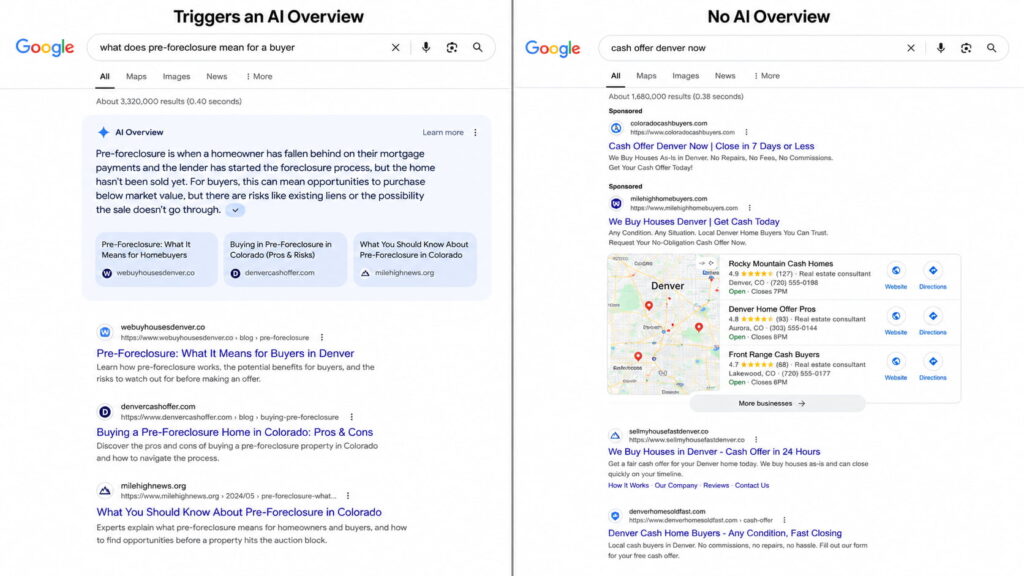
Google doesn’t put an AI Overview on every search. It fires one when three things line up: the intent is informational, a “need to know” question; several trusted sources agree on the answer; and there’s enough structured material for Google to summarize with confidence.
It usually stays away when the intent is purely transactional or commercial, when the intent is messy and mixed, or when the pool of sources is thin and unreliable.
That distinction is your filter. Seller-education queries trigger Overviews: “what does pre-foreclosure mean,” “how do I sell an inherited house,” “what is a fair cash offer.” Bottom-of-funnel searches like “cash offer Tampa now” often stay commercial and skip the Overview entirely. So your AEO effort belongs on the informational seller questions, the ones behind your pre-foreclosure explainer and situation pages, not on the bottom-funnel landing page.
One habit before you optimize anything: run the actual search and look. If no Overview fires for a query today, structuring for it is a lower priority than the queries where one already does.
How Google Chooses Which Sources to Cite
Once an Overview fires, Google picks three to five sources to build it from. Five factors decide whether one of them is you.
| Selection factor | What it means for your site |
|---|---|
| Authority / consensus | Google leans on pages that match what trusted sites agree is the answer. Real local links (chambers, REIAs, local news) build that trust. |
| Structure | Clean question-form headings, concise answers up top, and valid schema make your page easy to read and quote. |
| Specific topical relevance | The most specific page wins. A real page for your city and the seller’s exact situation beats a generic one. |
| Freshness | A recently updated page beats a stale one on the same topic. |
| Cross-combination | The Overview blends three to five domains, so being the clearest voice on one narrow point can earn the cite. |
None of it works if you’re invisible to Google’s index first. About 97% of AI Overview citations come from pages ranking in the top 20 (AirOps). That’s because Google’s AI features run on core Search: they retrieve pages from the normal Search index, then summarize them. There is no separate AI index (Google Search Central). If you’re not ranking, you can’t be retrieved, so you can’t be cited.
Two of those factors, “the most specific page wins” and “authority,” are exactly where a cash buyer gets beaten by a template. A page that swaps the city name into the same paragraph isn’t the most specific answer for anyone. This is the core of what BASEO builds for cash buyers: an original page for each city and each seller situation, proper schema, and real local links, so your page is the specific, trusted answer Google can quote. The next section is how you do it, step by step.
How to Rank in AI Overviews: 8 Steps That Actually Work
To rank in AI Overviews, get into the top 10, answer the query up front, structure content for extraction, build topical authority, prove first-hand experience, add schema correctly, include original data, and keep it fresh. Here’s how each step works for a cash buyer.
1. Get Into the Top 10 First
Ranking still does most of the work. A page in position #1 had about a 53% chance of being cited in an AI Overview; by position #10 that fell to 36.9% (Authoritas via Search Engine Land). Pair that with the ~97% of citations coming from the top 20 and the message is clear: it’s a strong correlation, not a gate, but you want to be in the top 10.
So AEO doesn’t replace SEO fundamentals, it sits on top of them. You still need the fundamentals of real estate SEO: a crawlable site, fast pages, mobile-first, clean technical setup. Google says it plainly, there are no special tricks for AI features, it’s core Search ranking (Google Search Central). BASEO installs that foundation first, tracking and all, before chasing any citation.
2. Answer the Question in the First 2-3 Sentences
The most extractable content is a direct answer sitting right under the heading. Google can lift it cleanly into the Overview.
Use the answer-first pattern, the inverted pyramid: make the heading the question, answer it in 40 to 55 words, then add the detail below. Lead, don’t wind up.
Before: “There are many factors that go into how quickly a home sale can close, and it depends on your situation…” After: “How fast can I sell my house for cash? With a cash buyer you can usually close in 7 to 14 days, because there’s no lender, no appraisal delay, and no financing contingency.” The second version is the one that gets quoted.
3. Structure Content So It’s Easy to Extract
Scannable is citable. If a human can skim your page and find the answer in two seconds, so can Google’s model.
Build for extraction: descriptive question-form headings, short paragraphs, lists, and comparison tables where they fit. One idea per paragraph, plain syntax the model can parse without guessing.
How-to guides, tutorials, and clear comparisons get cited most, because they’re already chunked into retrievable pieces. This section is built that way on purpose.
4. Build Topical Authority With Content Clusters
AI reads topics through entities and their relationships, not exact-match keywords. It wants to see that your site covers a subject in depth, not one lucky page.
The model that works is a pillar plus clusters, tied together with internal links. For a cash buyer, that’s a city pillar linked to seller-situation pages, each linked out to the explainers behind them: a foreclosure buying guide, a pre-foreclosure explainer, and so on. That web of related pages signals real depth on “selling a distressed house for cash in your market.”
City pages and seller-situation pages, original to each market, are the asset BASEO builds for exactly this reason.
5. Prove First-Hand Experience and E-E-A-T
E-E-A-T, experience, expertise, authoritativeness, trust, is a central signal, and Google leans toward first-hand accounts from people who actually do the work.
Show it. Put a real author on the page with a bio and credentials. Use your own deal data, your own screenshots, your own grounded opinions about what actually happens at the closing table. Summarizing what every other blog already said is weak; adding something new is strong, because the models prefer sources with novel information.
This is where a working cash buyer has an unfair edge. You have real numbers and real local deals that a generic marketing blog will never have.
6. Add Schema Markup the Right Way
Valid schema (Article, FAQPage, HowTo, Organization) helps Google understand what your page is and how its parts relate, which can improve clarity and eligibility.
Now the honest part, because there’s a lot of noise here. Google’s own documentation says structured data is not required for its AI features, and there’s no special “AI” schema to add (Google Search Central). So schema helps, but it isn’t a magic switch and it isn’t a guarantee. And you do not need any invented “AI text” file, markdown, or “llms.txt” to appear. Use the standard schema types, validate them with Google’s Rich Results Test, and move on. Foundational schema on your service pages is part of what BASEO sets up.
7. Add Original Data, Quotes, and Fresh Sources
AI Overviews prefer sources that bring something new. Pages with at least three unique data points, your own survey, test, or case numbers, are around 4x more likely to be cited than pages without (AirOps).
You have data most competitors don’t: your average days-to-close, your cash-offer-to-list-price ratio, your local close rate. Put a couple of those numbers on the page. If you don’t have original data for a topic, at least cite recent, recognized studies (Ahrefs, Pew, Seer) inside the article so your page reads as current and sourced.
8. Keep Content Fresh on a 90-Day Cycle
AI Overviews favor content that looks current and maintained. Stale pages quietly fall out of the source pool.
Put your pages on roughly a 90-day refresh cycle: update the numbers, refresh examples, and show a visible “updated” date. In “best of” and how-to lists, a page dated 2026 beats one dated 2024 on trust alone. Just don’t leave old figures sitting on the page, one outdated stat tells the reader, and the model, that nobody’s minding the page.
Myths and Mistakes to Avoid
Most of the “AI Overview hacks” going around are wrong, and Google has said so directly. Clear these out before you waste time:
- You don’t need a special file or markup. No “llms.txt,” no “AI text” file, no invented markup. Google doesn’t use them (Google Search Central).
- Schema is not a magic guarantee. It helps Google read your page. It does not force a citation.
- You can’t pay your way in. There is no ad slot inside the organic AI Overview.
- Blocking the AI bot is a blunt instrument. It can remove you from the citation, but it doesn’t pull you from the index, and it can cost you featured snippets and normal visibility too.
The common execution mistakes are simpler: burying the answer under a paragraph of filler, thin pages with nothing new to say, keyword stuffing, and optimizing a page for a query whose real SERP intent is something else. Fix those before you touch anything advanced.
How to Measure Whether It’s Working
You can’t manage what you don’t watch. Track two things.
First, which of your target keywords actually trigger an AI Overview, and whether your domain is one of the cited sources. Use an AIO or rank tracker with AI-citation coverage, or check the live SERP by hand for your priority queries.
Second, watch Search Console for the tell: impressions climbing while clicks fall on a query usually means an AI Overview is eating the click. Treat that as a diagnostic, not a failure, it tells you exactly where to go earn the citation.
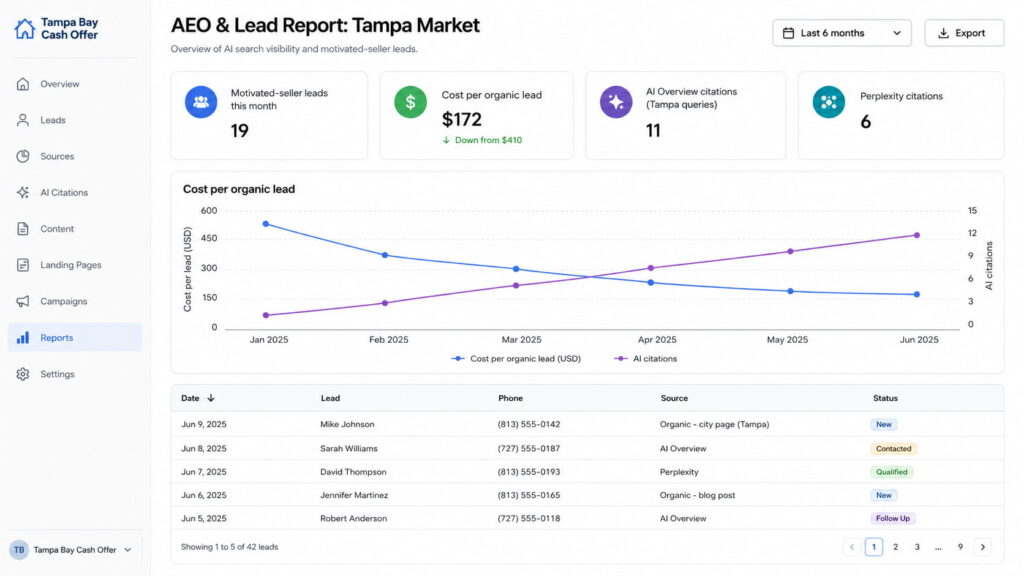
The real KPI isn’t raw position. It’s your share of citations and brand mentions in your markets, and the leads that follow. Remember only about 1% click the cited link, so the payoff is brand visibility plus the ~120% extra clicks per impression that cited pages earn. For a cash buyer, the report that matters counts named citations in your metro and motivated-seller leads with phone numbers, and it recovers the AI-referred visits that GA4 quietly mislabels as “Direct.” That’s how BASEO reports AEO: citations and leads, not impressions.
Want Your Pages Cited in AI Overviews?
That’s the whole playbook, and every piece of it is work, every month: getting into the top 10, structuring pages for extraction, building the cluster, and earning real local links. Some operators run it themselves and do fine. Most would rather spend that time closing deals.
BASEO does SEO and AEO for one kind of business, cash home buyers, so it already knows your seller queries, your city pages, and your seller situations. A Florida client went from 3 to 28 motivated seller leads a month in nine months (BASEO client data). If you’d rather know where your site stands first, start with the free audit, no call required. It’ll show which of your pages can be cited and where the gaps are. You can see real results here.
Final thoughts
The operators winning AI search aren’t smarter than you. They made their pages the clearest, most specific answer to the questions sellers actually ask, and got cited while everyone else was still fighting over the blue link nobody clicks anymore.
Your next move is small and concrete: pick your top three seller-situation queries, run each one in Google, see which fire an AI Overview, and make your page the best answer to those. If you want to know which of your pages can actually be cited today, and which seller searches in your market already trigger an AI Overview, that’s what the audit is for. Free, in writing, delivered in about 2 business days. No call required.
Frequently Asked Questions
Short answers to the questions cash buyers ask most about ranking in AI Overviews.
Not fundamentally. AI Overviews are built on Google’s core ranking systems, so strong SEO, technical health, helpful content, and E-E-A-T, is the foundation. The difference is the goal: instead of only ranking, you optimize your content to be cited as one of the 3-5 sources the AI summarizes.
No. Ranking in the top 10 strongly correlates with citation, and about 97% of citations come from top-20 pages, but only ~38% of cited pages sit in the top 10. AI Overviews pull from a wider source pool, so clear, specific, well-structured pages can be cited without ranking first.
Schema doesn’t guarantee inclusion, but it helps. Pages with valid Article, FAQPage, HowTo, or Organization markup appear in citation chips at higher rates because structured data clarifies context and relationships. Google recommends it, but you don’t need any special “AI” file or markdown; Google doesn’t use those.
There’s no fixed timeline. Once a page ranks in the top 10 and is structured to answer the query directly, it can be cited within days to weeks. Freshness matters, so maintaining a ~90-day update cycle keeps content eligible as AI Overviews favor current, dependable sources.
You can limit it. Using the nosnippet or data-nosnippet directives reduces how your content is used in generated summaries, but this can also remove you from featured snippets and reduce visibility. You cannot selectively opt out of AI Overviews alone while keeping normal Search appearance untouched.