
You can start wholesaling real estate with $0 to $2,000 and, in most states, no license. That’s what makes it the lowest-capital way into real estate investing.
Here’s what the gurus skip: wholesaling is simple to understand and hard to stay consistent at. You don’t buy the house. You get it under contract at a discount, then sell that contract to a cash buyer and keep the difference. Done right, a first deal is realistic in 60 to 90 days.
This is the honest, step-by-step version. What wholesaling actually is, whether it’s legal in your state in 2026, how much money and time it really takes, and the exact seven steps to your first assignment fee.
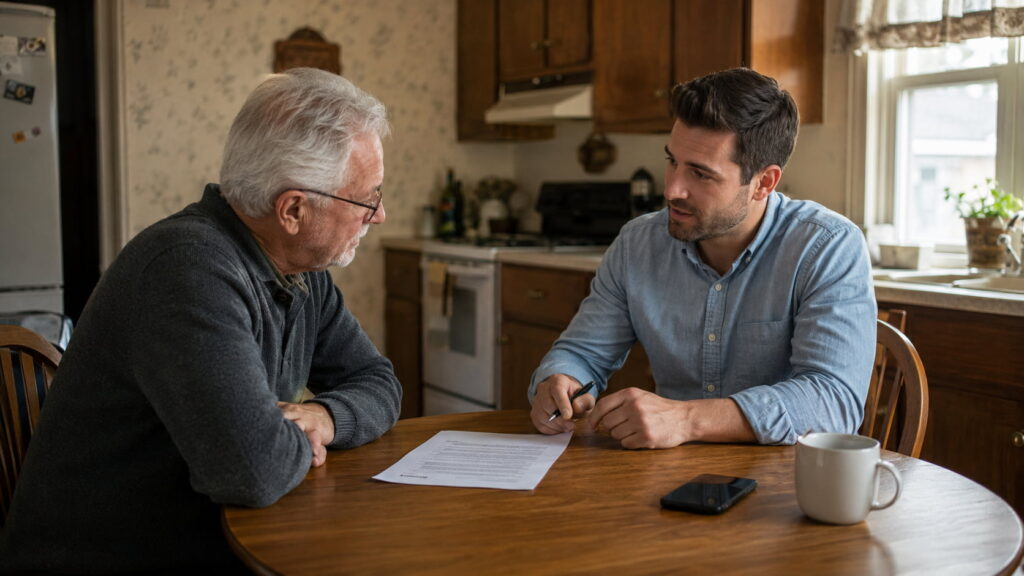
The real job of a wholesaler happens at the kitchen table: a fair contract with a motivated seller. Everything else is paperwork.
What Is Real Estate Wholesaling?
Real estate wholesaling is a middleman business. You find a motivated seller, put their house under contract at a price low enough to leave room for profit, then assign that contract to a cash buyer who closes on it. You collect the difference as a fee.
The part beginners miss: you never own the house. You don’t need the purchase price, a mortgage, or a rehab budget. What you actually control is the contract, and what you sell is the contract, not the property.
The right to buy the house that your signed contract gives you is called equitable interest. Transferring that right to another buyer is called an assignment. Get comfortable with those two words, because they’re the whole business.
Why does this work at all? Because two people both win. Motivated sellers value speed and certainty over top dollar, and cash buyers (flippers and landlords) will pay a finder to bring them discounted houses they don’t have time to hunt for. You sit in the middle and get paid to connect them.
How Wholesaling Actually Makes You Money (The Assignment Fee)
Say you get a house under contract to buy at $150,000. You find a cash buyer willing to take your spot in that contract at $160,000. You assign the contract, the buyer closes with the seller, and the $10,000 difference is your assignment fee.
The only money you usually put at risk is earnest money, often a few hundred to a thousand dollars, to make the contract binding. That’s the appeal. Assignment fees average about $13,000 nationally (Real Estate Bees), and you’re capturing that without a loan or a renovation.
Your fee is simply the spread between what the seller agreed to and what the cash buyer will pay, so the whole game is negotiating a low enough contract price that there’s a healthy gap left for you. Lock the house up too high and there’s no room to assign it.
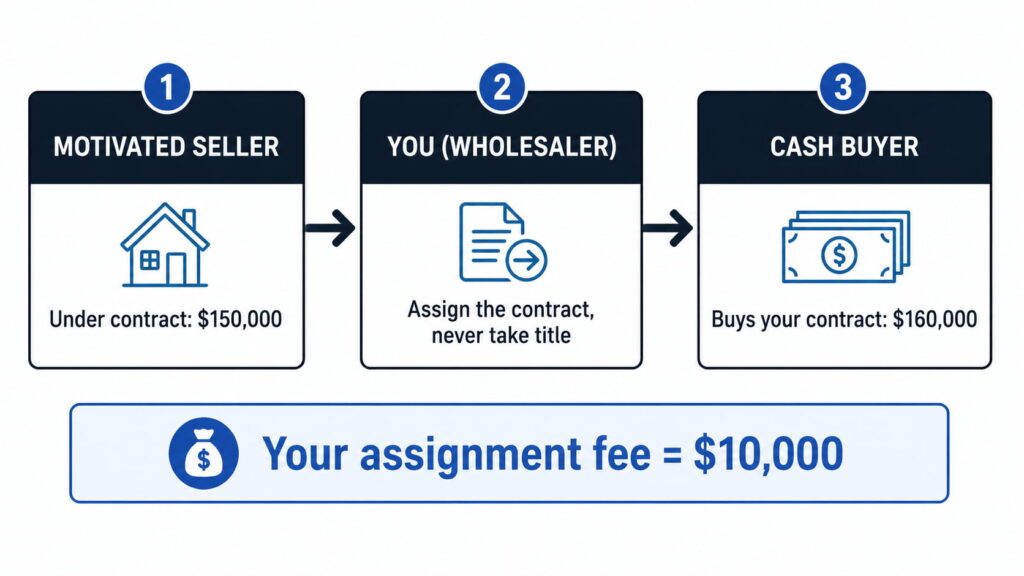
You sell the contract, not the house. The gap between your contract price and the cash buyer’s price is the fee.
Wholesaling vs. Flipping vs. Buy-and-Hold
Wholesaling, flipping, and buy-and-hold are three different games with very different capital needs. Wholesaling is the low-capital entry because you never take title, never renovate, and are out of the deal in weeks.
Flipping means you actually buy the house, renovate it, and resell it. The upside is bigger. The median flip made a gross profit of $65,981 in 2025, but that takes real capital, months of work, and real risk. Buy-and-hold means you buy and rent for years, the highest capital and the longest horizon.
| Strategy | Capital needed | Risk | Speed | Who owns the house |
|---|---|---|---|---|
| Wholesaling | Very low ($0–$2,000) | Low | Days to weeks | Nobody (you sell the contract) |
| Flipping | High (buy + rehab) | High | Months | You, until you resell |
| Buy-and-hold | Highest | Medium | Years | You, long term |
Most successful investors end up doing more than one. Plenty start by wholesaling to build cash and learn how to find deals, then use those skills and that capital to flip or hold later. Wholesaling is the on-ramp, not the ceiling.
Is Wholesaling Real Estate Legal?
Yes. Wholesaling is legal in all 50 states. You’re selling your rights to a purchase contract, not the property itself, which is why it doesn’t automatically require a real estate license. But several states tightened the rules in 2026, so what’s legal depends on how you market the deal and where you operate.
The line that keeps you safe: you can market the contract, meaning your equitable interest in the deal. You generally cannot market the property itself to other buyers without a license, because that looks like brokering real estate you don’t own. Most wholesalers who get in trouble crossed that line.
There’s a common workaround for stricter states called a double close, where you actually buy the house and resell it minutes later in two back-to-back transactions, so you briefly take title instead of assigning a contract. It costs more (you need transactional funding and two sets of closing costs), but it keeps you clearly on the right side of the “you can’t sell what you don’t own” rule.
One caveat, and it matters: this is general information, not legal advice. Laws are changing fast. Verify the current rules with a licensed real estate attorney or your state real estate commission before you do a deal.
Do You Need a Real Estate License to Wholesale?
In most states, no, as long as you stay within the limits and market the contract rather than the property. That’s the default across the country.
The exceptions are growing, though. South Carolina effectively requires a license to wholesale. Pennsylvania now requires wholesalers to register and disclose. Illinois limits unlicensed wholesalers to roughly one deal a year before you’re treated as a broker (Real Estate Bees). If you’re in one of those states, the rules are different from what a national YouTube video will tell you.
A license isn’t automatically a bad idea, either. If you plan to do volume, getting licensed removes the transaction-count worry entirely, gives you MLS access for comps, and lets you legally market properties. Plenty of high-volume wholesalers carry a license for exactly those reasons. For most beginners doing a handful of deals it isn’t required, but know it’s an option, not an obstacle.
States With Strict or New Wholesaling Laws
A handful of states have moved from gray area to written rules. Know these before you market a single deal:
- South Carolina. House Bill 4754 defines wholesaling as brokerage activity, so you need a license. It’s the hardest state to wholesale legally right now.
- Illinois. Deal in real estate contracts, including assignable contracts, on two or more occasions in any 12-month period and the state treats you as a broker. In practice that caps unlicensed wholesalers at about one deal per year.
- Pennsylvania. Act 52 now regulates wholesaling with registration and disclosure requirements.
The trend is broader than those three. Six new wholesaling laws passed in 2025 alone across five states, Connecticut, Maryland, North Dakota, Oklahoma, and Tennessee, mostly adding disclosure and registration rules (Leonine Public Affairs). Roughly a dozen states now regulate wholesaling in some form.
None of this makes the business illegal, but it does mean the rules where you live are the only ones that count. Most of the new laws boil down to the same idea: tell the seller in writing that you’re a wholesaler and that you intend to assign the contract for a profit. That kind of disclosure is good practice everywhere, even where it isn’t required yet. Check your own state, keep everything in writing, and confirm with an attorney before your first deal.
How Much Money Do You Need To Start Wholesaling?
Most beginners start with $0 to $2,000 (Call Porter). Plan for roughly $3,000 spread over the 60 to 90 days it takes to close a first deal, and you’re being realistic rather than optimistic.
Here’s where the money goes:
| Expense | Typical early cost | Can you start nearly free? |
|---|---|---|
| Marketing: driving for dollars | Gas + time | Yes |
| Marketing: direct mail / PPC ads | ~$0.50–$1.50 per mailer; $20+ per ad lead | No, add later |
| Skip tracing (owner contact info) | ~$0.10–$0.30 per lookup | Mostly, free tiers exist |
| Earnest money per contract | A few hundred dollars | Refundable with contingencies |
| Contract templates (attorney review) | One-time $100–$500 | Worth paying for |
The pattern is clear: start with the free channels, put a little money into skip tracing and earnest deposits, and only turn on paid marketing once deals are producing cash. The bigger cost isn’t dollars, it’s time. Expect 20 to 40 hours a week finding sellers, running numbers, and building your buyers list. Wholesaling is cheap to start and expensive to do halfway.
How To Start Wholesaling Real Estate Step by Step
The model is simple. The execution is a repeatable seven-step loop you run over and over. Here’s the exact order, from studying your market to collecting the fee.
Step 1: Study Your Local Market
Before you talk to a single seller, learn your market. What do homes sell for, which neighborhoods have investor activity, and what do typical repairs cost? Those three numbers decide whether a deal is real.
Zillow and Redfin show you sold prices and days on market. Your county property and recorder records show ownership, sales history, and liens for free. An investor-active neighborhood usually shows the signs: recently flipped houses, LLCs on the ownership records, and homes selling below the block’s average because they needed work. Those are the areas where your deals will actually move.
Do one thing today: pull the last ten sold comparable homes in one target zip code and write down the price per square foot. That single number will anchor every offer you make, and it’s the fastest way to sound credible the first time a seller asks what their house is worth.
Step 2: Learn Your State’s Wholesaling Rules
Before you market anything, learn the rules where you operate. Search your state real estate commission, read the disclosure requirements, and note any limit on how many deals you can do unlicensed. Re-read the wholesaling laws section above and match it against your own state.
Get a written assignment disclosure ready, and have a local real estate attorney glance at your approach before your first deal. A one-hour consult is cheaper than a violation, and the attorney you meet now is the same one who can close your deals later. It’s a relationship worth starting before you need it.
Step 3: Find Motivated Sellers
This is the actual job, and it’s where most beginners fail. A motivated seller is an owner with a reason to sell fast and below market: a looming foreclosure, tax or other liens, an inherited house they don’t want, a divorce, or a tired landlord who’s done with tenants. They aren’t chasing top dollar. They’re chasing a fast, certain, as-is exit, and that’s exactly what you offer.
You reach them through a mix of channels, and none of them are magic. The main ones:
- Driving for dollars. Scout target neighborhoods for neglected houses (peeling paint, overgrown yards, code notices, full mailboxes) and log the addresses. Free except for gas and time, and it’s the best on-ramp for a broke beginner.
- Absentee-owner and distressed lists. Pull lists of out-of-state owners, pre-foreclosures, tax delinquents, and probate filings, then work them consistently.
- Direct mail. Postcards and letters to those lists. Costs money per piece but scales once you have cash flow.
- Cold calling and texting. Skip trace the list for phone numbers and reach out. High volume, low cost, thick skin required. Respect the Do-Not-Call Registry and your state’s texting rules.
- PPC and paid ads. Pay to show up when a seller searches. Fast leads, but you’re bidding against everyone. See Google Ads for real estate for how the costs actually work.
Work two or three of these consistently instead of chasing all of them badly. For the full breakdown of channels ranked by cost and speed, see how to get motivated seller leads.
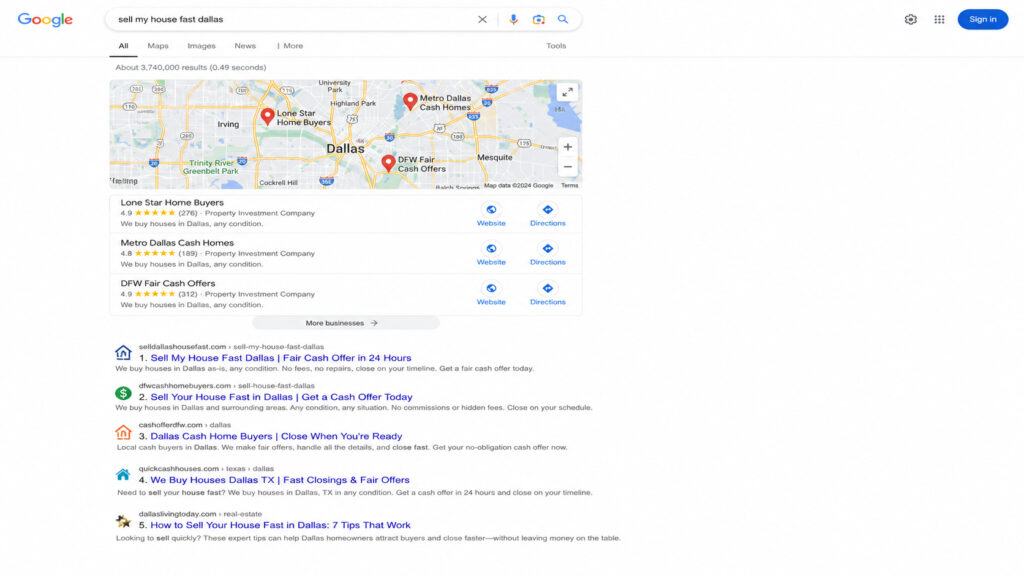
When a motivated seller searches “sell my house fast [city],” the buyers on page one get the call. That’s the channel that keeps producing after you build it.
Every channel above stops the day you stop working it. The one that compounds is being the buyer sellers find when they search “we buy houses [city]” on Google or in ChatGPT. Building that findable, original-per-market presence is what BASEO does for cash home buyers, once you’re established enough to want deal flow coming in instead of chasing it. That’s later. For now, pick two channels and work them daily.
Step 4: Analyze the Deal (ARV & MAO)
A deal only works if the numbers leave room for everyone. Two terms run the math. ARV, or After Repair Value, is what the house will be worth fully fixed, estimated from comparable sold homes nearby. MAO, or Maximum Allowable Offer, is the most you can offer the seller and still leave a profit for your cash buyer and a fee for you.
The standard tool is the 70% rule. The formula:
MAO = (ARV × 0.70) − repair costs − your wholesale fee
Run it on a real house. Say the ARV is $200,000, repairs are $30,000, and you want a $10,000 fee:
MAO = ($200,000 × 0.70) − $30,000 − $10,000 = $100,000
So $100,000 is your ceiling offer. The 30% the rule holds back isn’t padding, it covers your cash buyer’s profit, holding costs, closing costs, and the surprises every rehab hides (Real Estate Skills). Leave that room and your deals actually sell. Skip it and you’ll tie up houses no investor will touch.
Two things trip up beginners here. First, repair estimates: until you can walk a house and cost a rehab yourself, lean on a contractor or an experienced buyer, because a $20,000 miss on repairs can erase your whole fee. Second, the percentage isn’t sacred. In cheaper markets buyers may want 65% of ARV to make the margin work; in hot, high-value markets like coastal California they’ll stretch to 80% or more. Ask the cash buyers you’re building relationships with what number they actually use, then price your offers to it.
Step 5: Get the Property Under Contract
When the seller says yes, you lock it in with a purchase agreement. Two clauses make it a wholesaling contract. An assignment clause lets you transfer the contract to another buyer. An inspection or exit contingency lets you walk without penalty if you can’t place the deal.
Put down earnest money, usually a few hundred dollars, to make it binding. And use a purchase-and-assignment template that a local real estate attorney has reviewed. Do not download a random form off the internet and wing it on your first deal. The contract is the asset you’re about to sell, so it has to hold up.
Be straight with the seller while you’re at it. Tell them plainly that you buy houses to resell, that you may assign the contract to another buyer, and that they’re free to say no. That honesty is now legally required in a growing number of states, and it also protects the deal from falling apart at the closing table when the seller learns something they didn’t expect.
Step 6: Build Your Cash Buyers List
Have your buyers lined up before you sign, or right after, never as an afterthought. A contract you can’t assign is a dead deal and a lost earnest deposit.
Find cash buyers where they already are:
- Investor-friendly agents who work with flippers and landlords.
- Local REIA meetings, where active buyers show up in person.
- County records of recent cash purchases, which name the buyers doing deals in your area.
- Real estate investor Facebook groups and local forums.
Then qualify them. What do they buy, in which areas, at what price, and how fast can they close? A short list of ten real cash buyers who close is worth more than a spreadsheet of a hundred tire-kickers. Your best buyers will take down deal after deal, so once you find a few who perform, feed them first and keep them happy. Repeat buyers are how a wholesaling business goes from stressful to predictable.
Step 7: Assign the Contract and Close
Now you get paid. Sign an assignment agreement that transfers your contract to the cash buyer for your fee. Then take it to a title company or a real estate attorney who handles assignments, so the closing and the fee disbursement are done correctly.
At closing, the buyer funds the purchase, the seller sells, and the title company cuts you your assignment fee. Use DocuSign or a similar tool to move signatures fast. Motivated sellers cool off when paperwork drags, so speed protects the deal. If your state or your buyer prefers it, this is also where a double close happens instead of a straight assignment: same outcome, slightly higher cost, cleaner in strict states.
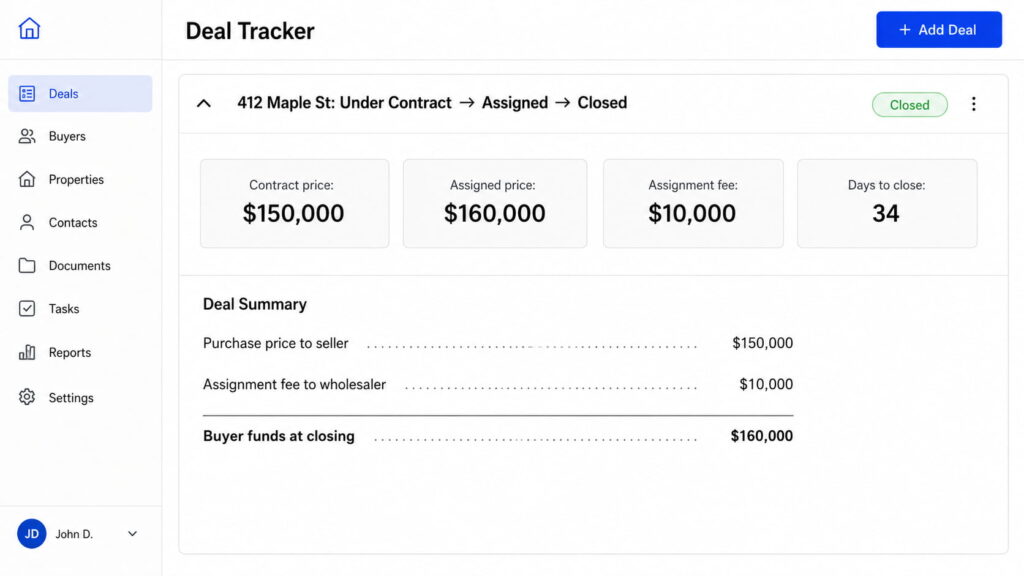
One closed assignment on a deal tracker: contract at $150k, assigned at $160k, a $10k fee, 34 days start to finish.
How Much Can You Make Wholesaling Real Estate?
A typical assignment fee runs $5,000 to $15,000, and the national average is about $13,000 (Real Estate Bees). In most markets, $8,000 to $12,000 is the sweet spot. Hot, high-value markets push $15,000 to $25,000 or more. First-year wholesalers often average $5,000 to $10,000 per deal while they’re still learning.
| Wholesaler stage / market | Typical fee per deal |
|---|---|
| First-year beginner | $5,000–$10,000 |
| Most markets (experienced) | $8,000–$12,000 |
| National average | ~$13,000 |
| Hot / high-value markets | $15,000–$25,000+ |
What moves your fee up that table isn’t luck, it’s the size of the spread you negotiate and the quality of your buyers. A bigger discount from the seller and a buyer who sees strong margin means you can charge more. The rule of thumb many wholesalers use: don’t take more than about half of the buyer’s projected profit, or the deal stops being attractive to them and your reputation takes the hit.
Your first deal is realistic within 60 to 90 days of consistent work. String a few together and a first year can add up to roughly $30,000 to $60,000, which is why so many investors use wholesaling to fund their first flip or rental.
Now the honest part. Most people who start wholesaling never close a deal, because they quit when finding sellers gets boring. The model is simple. The grind of prospecting every day is what separates the people making assignment fees from the people who bought a course and stopped. The money is real, but it pays consistency, not enthusiasm.
Tools and Skills Every Wholesaler Needs
You don’t need much software to start, but a few tools earn their keep fast. A CRM or dialer keeps every seller and follow-up organized. A skip-tracing source turns an address into a phone number. A comps tool speeds up your ARV math, and attorney-reviewed contract templates keep your paperwork clean. If you want a system to manage all of it, here’s how to use a CRM for real estate.
The skills matter more than the stack. Negotiation, honest rapport with stressed sellers, and disciplined follow-up. Most deals are lost to no follow-up, not to no leads, so speed and persistence beat any piece of software. Answer fast, follow up more than once, and log every conversation. And when you’re ready to be found instead of doing all the chasing, learning SEO for a real estate website is what turns your site into a lead source that works while you sleep.
Common Wholesaling Mistakes To Avoid
Most of these quietly cost deals, and every one of them is avoidable:
- Skipping the state-law check. With rules tightening in 2026, this is the fastest way into real trouble.
- Over-estimating ARV. Rosy comps make a deal look great and then it never sells.
- Low-balling your repair estimate. A rehab that costs more than you guessed eats your fee before you ever see it.
- Signing before you have buyers. Line up your list first, or you’re gambling your earnest money.
- Promising the seller things outside the contract. If it’s not in writing, it doesn’t exist, and it can sink the deal at closing.
- Marketing the property instead of the contract. That’s the line that crosses into unlicensed brokering.
- Quitting before 90 days. Most beginners walk away right before the first deal would have landed.
Ready To Start Wholesaling Real Estate?
Wholesaling is the lowest-capital way into real estate, and it rewards consistency far more than cash. Pick one market, learn its rules, run the 70% math on real houses, and start finding sellers this week. Your first deal is closer than it feels, and it usually shows up right after the point where most people quit.
When you grow past the daily grind and want finding motivated sellers to be a channel that runs while you work, a free, written audit shows exactly where an investor site stands: the biggest issues holding it back, the local keywords competitors rank for that you don’t, and the deal-math for your market. No call required, and it’s yours to keep.
Frequently Asked Questions
Yes, it’s legal in all 50 states. You’re selling rights to a purchase contract, not the property. But several states tightened rules in 2026 with written disclosure, registration, or licensing, so verify your state’s laws with an attorney or your real estate commission first.
In most states, no, if you only market the contract, not the property. Exceptions are growing: South Carolina and Pennsylvania now require licensing or registration, and Illinois limits unlicensed wholesalers to about one deal per 12 months. Check your state commission before you start.
As little as $0 to $2,000, mostly for marketing, skip tracing, and earnest money. Many beginners spend around $3,000 over 60 to 90 days to close a first deal, which typically returns a $5,000 to $15,000 assignment fee. The bigger investment is time.
A typical assignment fee runs $5,000 to $15,000, and the national average is about $13,000. In most markets, $8,000 to $12,000 is the sweet spot, while hot, high-value markets reach $15,000 to $25,000 or more. First-year wholesalers often average $5,000 to $10,000 per deal.
Most close within 60 to 90 days of consistent marketing, though some take six months. The main investment is time, not money: expect 20 to 40 hours a week finding sellers, analyzing deals, and building a buyers list before that first fee lands.
ARV, or After Repair Value, is what a property is worth after repairs, estimated from comparable sales. It anchors your Maximum Allowable Offer: MAO = (ARV × 70%) − repair costs − your wholesale fee. Get the ARV wrong and every number after it is wrong too.