
The questions to ask motivated sellers are the difference between a 20-minute call that goes nowhere and one that tells you exactly whether there’s a deal here. The call is where you win or lose the deal, not the offer.
Ask the right things in the right order and you pull motivation, equity, and timeline out of the seller without it feeling like an interrogation. This guide gives you 30+ questions grouped by what they qualify, plus a copy-paste phone script you can read on your next call.

Why the Right Questions Matter More Than the Right Script
A script you read word for word, in a flat voice, off a sheet, loses the seller in the first minute. The words matter less than knowing what each question is actually pulling out of them.
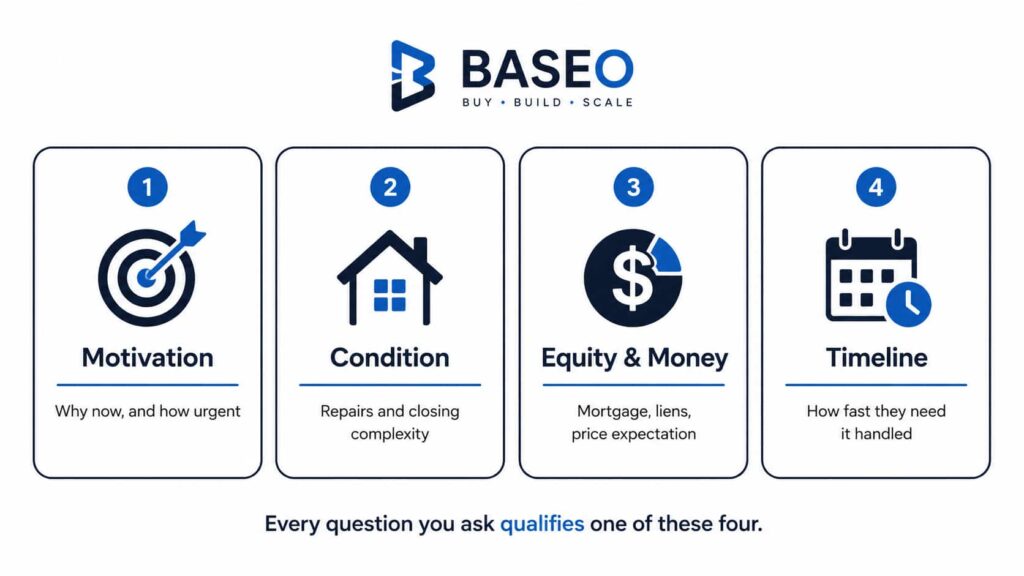
Here’s the frame that makes qualifying motivated sellers simple. Every question you ask is doing one of four jobs: reading their motivation, sizing the condition of the house, mapping the equity and money, and pinning down the timeline. Four axes. That’s the whole call.
The best acquisition people talk less than the seller does. Aim for the seller doing about 70% of the talking and you doing 30%. The six-figure wholesalers Carrot profiles run almost entirely on open-ended questions and then get out of the way (Carrot).
And qualifying is rarely one and done. A real deal is a process across a few touches, not a single perfect call. Your job on the first call isn’t to close. It’s to find out if there’s anything here worth closing.
How to Open the Call: Rapport and Control
The first 60 seconds set the tone for everything after. Lead with something genuine about the house or the neighborhood, keep your voice easy, and sound like a person, not a call center.
Then take control. Not by talking more, but by asking the first soft questions so the seller settles into answering. Don’t open with price, and don’t open with your pitch. You steer the call by asking, not by presenting. The two questions below are how you get the wheel.
Are You the Decision-Maker?
Ask this early, because nothing wastes a call like a great 20-minute conversation with someone who can’t actually sell. A clean way to ask: “Is the house jointly owned, or are you the only one who’d make the decision to sell?”
If there’s a spouse, siblings who inherited together, or a business partner, you want them on a call before you spend real time. It’s not rude to ask. It’s respect for everyone’s time, and motivated sellers appreciate that you’re organized.
How Did You Hear About Us?
Before you get into it, ask how they found you. It breaks the ice, it hands the seller the microphone, and it quietly sets the pattern that they answer and you listen.
There’s a bonus: their answer tells you which of your marketing channels actually produced this lead. Over enough calls, that’s real data on where your deals come from.
Questions That Uncover Motivation
This is the most important block on the call. Without real motivation, there is no reason for a seller to take a cash offer below retail, and no deal for you.
Motivation isn’t curiosity. “I just wanted to see what I could get” is not motivation. Motivation is a reason with urgency behind it. The common ones show up again and again: divorce, pre-foreclosure, an inherited house nobody wants to manage, a job relocation, a property they can’t afford to repair, or a landlord who is simply done.
Why Are You Selling?
This is the central question of the whole call. Ask it open: “What’s got you thinking about selling right now?” Then stop talking.
The first answer is usually the surface answer. The real reason, the one that tells you how motivated they are, tends to land in the second or third sentence, once they keep going. So let the silence sit and let them fill it.
Listen for the specifics. “My brother and I inherited it and we both live out of state” signals high motivation plus carrying-cost pressure they’d love to end. “We’re thinking about upgrading in a year or two” signals a tire-kicker who is early. Same question, completely different deal.
What Happens If the House Doesn’t Sell?
This is the question that separates people who can qualify from people who just collect answers. It’s one of the most underrated questions in the business, and almost nobody asks it.
The way they answer tells you their real motivation. Panic is gold: “I don’t know, I can’t keep making these payments.” That’s a seller with a problem you can solve. Indifference is a flag: “Then I guess I’ll just keep it or rent it out.” That seller has options and no urgency, which means little room on price.
What’s Your Timeline to Sell?
Timeline is urgency in plain numbers. Ask it simply: “Ideally, when would you want this handled?”
“Yesterday” or “before the end of the month” is a motivated seller. “Sometime this year, no rush” is warm at best. And timeline feeds directly into price: the faster they need it handled, the more your speed and certainty are worth, and the more room there usually is to make the math work.
Questions About the Property
These questions estimate your repair number, the rough gap between after-repair value and what the house needs, and they flag closing complexity before you ever walk the property.
What Condition Is the Property In?
Start open and let them describe it in their own words. Then push for specifics: roof, HVAC, plumbing, kitchen and baths, any water damage or foundation issues.
Take the seller’s description as a starting point, not gospel. Sellers almost always underestimate the damage, sometimes badly, and you verify everything in person before it means anything to your offer.
How Long Have You Owned It?
Long ownership usually means more equity, which means more room for a cash offer that still works for both of you. It can also mean deep emotional attachment, which changes how you talk about price.
Either way, the answer helps you gauge how much margin might exist before you’re anywhere near a number.
Is Anyone Living There Now?
A vacant house is the simplest close. Owner-occupied means you’ll help them plan the move. Tenant-occupied means you inherit a lease and a person, so ask about the lease term and whether the tenant is current.
Occupancy shapes both your timeline and your exit. It’s a small question that quietly changes the whole deal.
Questions About the Money
This is where the deal math actually closes or falls apart. Ask these after you’ve built rapport and understood their situation, never at the top of the call. Money questions land fine once the seller trusts you and feel like an ambush when they don’t.
| Question | What a strong (motivated) answer sounds like | What it signals |
|---|---|---|
| Why are you selling? | “We inherited it and live out of state.” | A reason with urgency behind it |
| What happens if it doesn’t sell? | “I can’t keep making the payments.” | Real distress, room on price |
| What’s your timeline? | “As fast as possible.” | High urgency, speed has value |
| What’s the condition? | “It needs a roof and the kitchen’s dated.” | Repair estimate, offer range |
| Any mortgage or liens? | “Almost paid off, no liens.” | Clean title, more equity |
| What price do you have in mind? | “I’m flexible, just want it handled.” | Wide gap to a workable offer |
A qualifying call in one view: the answer tells you the axis, and the axis tells you whether to keep going.
Is There a Mortgage or Any Liens?
This is the base for your equity math. Ask it directly but softly: “Do you still owe anything on it, a mortgage, or any liens or back taxes?”
Liens are debts attached to the house, things like back property taxes, a contractor’s mechanic’s lien, or unpaid HOA dues. They matter because they have to be cleared for clean title, and they come out of the money at closing. A house with $40K in liens is a different deal than one that’s free and clear.
Are the Payments Current?
If they’re behind on the mortgage, that’s one of the strongest urgency signals you’ll hear, and often a sign of pre-foreclosure. Handle it with care.
This is a stressful spot for the seller, so drop any “I found a deal” energy. Talk about how a fast, certain close can stop the bleeding. You’re solving a real problem, and that’s the honest reason they’ll pick you over waiting on a retail sale.
What Price Do You Have in Mind?
Let the seller name a number first. A clean way in: “Have you had it appraised, or do you have a number in mind?” Whoever anchors first gives up information, and you want it to be them.
This is where the idea of a squeal point comes in. The squeal point is the lowest price a seller would realistically accept, and it’s the single most useful number in any motivated seller script. Knowing it tells you exactly how much room you have to write an offer that still leaves margin for your end buyer. You don’t get there by pushing. You get there by letting them name a price, then gently testing how firm it is.
Closing Questions That Set Up the Offer
You’ve read their motivation, sized the house, and mapped the money. These last two questions confirm urgency and set up a clean handoff to your offer.
If We Agreed on a Fair Price, How Fast Could You Close?
This is a hypothetical, which is exactly why it works. It measures how ready the seller really is without committing you to any number yet.
A fast, concrete answer (“this week if it’s fair”) is a seller who is ready to act. A vague one (“I’d have to think about it”) tells you motivation is softer than it sounded. In one question you’ve tied together timeline, motivation, and willingness to move.
What Form of Payment Do You Prefer?
Ask it open and let them talk about their bottom line. Some sellers want the most cash the fastest. Others care more about the total number and would trade speed for more money over time.
That answer can quietly open the door to creative financing, where terms solve a deal that a straight cash number couldn’t.
The Full Motivated Seller Phone Script (Copy/Paste)
Here’s the whole thing in order, ready to read on your next call. Rapport first, then decision-maker, then motivation, then the house, then the money, then the close. Keep your tone easy and let them talk.
- “Hi [Name], this is [You]. Thanks for reaching out about the house on [Street]. Nice street, how long have you been over there?”
- “Before we get into it, how’d you come across us?”
- “Just so I don’t leave anyone out, is the house jointly owned, or are you the only one who’d make the decision to sell?”
- “So what’s got you thinking about selling right now?”
- “Got it. And if the house didn’t end up selling, what would you do?”
- “Ideally, when would you want this whole thing handled?”
- “Tell me about the house itself, what kind of shape is it in?”
- “Anything going on with the big stuff, roof, HVAC, plumbing, any water damage?”
- “How long have you owned it?”
- “Is anyone living there right now, you or a tenant?”
- “Do you still owe anything on it, a mortgage, or any liens or back taxes?”
- “Are the payments current, or have things gotten a little behind?”
- “Have you had it appraised, or do you have a number in mind?”
- “If we agreed on a fair price, how fast could you close?”
- “And what matters more to you, the most cash as fast as possible, or the highest total number?”
- “This is really helpful. Let me run the numbers and I’ll come back to you with something real.”
Want this as a one-page PDF to keep by the phone? Grab the printable script and work it on your next call.
Mistakes That Kill the Call
Most guides stop at the questions. But how you ask matters as much as what you ask, and these are the errors that quietly sink calls that should have turned into deals.
- Talking more than the seller. If you’re doing most of the talking, you’re not qualifying. Aim for 30/70 and let them fill the silences.
- Jumping to price before rapport. Numbers land fine once they trust you and feel like an ambush when they don’t. Earn the number.
- Sounding like a robot reading a sheet. Know what each question reveals so you can ask it like a human, not recite it.
- Showing “I won” excitement. The second you sound thrilled, the seller senses they’re leaving money on the table. Stay flat and calm.
- Not confirming the decision-maker. Find out in the first two minutes who can actually say yes, or risk running the whole call twice.
- Firing closed yes/no questions. “Do you want to sell?” gets you a wall. Open-ended questions get you the story, and the story is where the deal is.
Get More Motivated Seller Leads to Actually Call
Here’s the honest part most of these guides skip. The sharpest script in the world can’t create a deal if the phone isn’t ringing. Great questions only matter when there’s a motivated seller on the line.
And not all leads qualify the same. A seller who typed “sell my house fast” into Google or asked ChatGPT how to sell a house for cash, then called you, is already halfway qualified. They have a problem, they came looking, and they picked you. Compare that to a cold, skip-traced number where you’re interrupting a stranger who never raised a hand. Inbound sellers close warmer, and the data backs it up: in one 2025 case study, visitors arriving from ChatGPT converted at 15.9% versus 1.76% for Google organic search, nearly nine times the rate (Seer Interactive).
That inbound flow is what BASEO builds for cash home buyers. We build the city and seller-situation pages that rank when a motivated seller searches, and we format them to get cited by AI search, so the seller asking ChatGPT or an AI Overview finds you in the answer. That’s the difference between chasing leads and having them call you. If you’d rather build your own, plenty of operators do fine, and this playbook on how to get more motivated seller leads and this one on how to get cited in AI Overviews are a solid start.
If you’d rather just see where your own site is leaking seller calls, that’s what the free audit is for. You’ll get it in writing in about 2 business days. No call required, and it’s yours to keep. Get your free site audit →

Frequently Asked Questions
The three highest-value questions are “Why are you selling?”, “What’s your timeline?”, and “What happens if it doesn’t sell?” Together they reveal true motivation and urgency. From there, cover property condition, existing mortgage or liens, and the seller’s price expectation to qualify the deal fully.
A truly motivated seller has a specific reason and a real deadline: divorce, pre-foreclosure, inherited property, or a job relocation. Listen to how they answer “What happens if the house doesn’t sell?” Panic or urgency signals high motivation. Indifference signals a tire-kicker just testing the market.
Open with rapport, not numbers. Give a genuine compliment about the home, keep your tone relaxed, then confirm you’re speaking with the decision-maker. A soft opener like “How did you hear about us?” breaks the ice and hands the conversation flow to you before you ask qualifying questions.
The squeal point is the lowest price a seller will realistically accept. Knowing it tells you how much room you have to make an offer that still leaves margin for your end buyer. You uncover it by letting the seller name a price first, then gently probing their flexibility.
Aim for 8 to 12 core questions covering motivation, timeline, condition, finances, and decision-makers. The goal isn’t to fire off a checklist. It’s a conversation where the seller talks about 70% of the time. Ask open-ended questions and let their answers guide your follow-ups.