
Most marketing for real estate agents is a listicle of tactics nobody ranks in order. You have roughly 1.5 million licensed competitors, and the market got tighter: first-time buyers fell to a record-low 21% of buyers, the median buyer is now 40, and all-cash buyers hit an all-time high (NAR). Fewer, choosier sellers, more people fighting for each one. This playbook orders the work by what actually makes the phone ring, and it tells you the one hard truth most agent-marketing advice skips: social, ads, and portals rent you attention. Search and AI search build an asset you own.

Marketing is what turns a stranger into the seller who calls you first.
- Why real estate marketing matters more than ever
- Step 1: Define your niche and personal brand
- Step 2: Build a lead-generating website and local SEO foundation
- Step 3: Choose 2–3 social media platforms and go deep
- Step 4: Nurture leads with email and CRM follow-up
- Step 5: Run paid ads to accelerate lead flow
- Step 6: Sharpen your listing presentation
- Step 7: Systematize referrals and past-client marketing
- How to build a 90-day real estate marketing plan
- Real estate marketing tools and budget benchmarks
- FAQ
Why real estate marketing matters more than ever
The market tightened, and that raises the stakes on how you market. First-time buyers dropped to a record-low 21% of buyers, the median buyer age climbed to 40, and all-cash buyers hit an all-time high (NAR Profile of Home Buyers and Sellers). Fewer easy deals, more competition for each one.
The bigger shift is where people look first. Sellers and buyers now research you online before they ever pick up the phone. For a growing share, the internet, not a referral, is where they first find the person they work with (NAR). If a motivated seller in your market can’t find you on Google, you’re not in the running, no matter how many deals you’ve closed.
So marketing is not decoration on top of the job. It is the job of being findable and trusted the moment someone in your market decides to move. Chase listings one at a time and you compete on inventory. Build a marketing engine and you compete on trust, and trust is what gets the call.
Step 1: Define your niche and personal brand
Trying to be everyone’s agent makes you no one’s first call. The operators who get referred are the ones people can describe in a sentence: “she’s the first-time-buyer specialist on the east side,” “he’s the guy who buys houses fast in any condition.”
Pick a lane you can own. A geographic farm (a specific set of neighborhoods or ZIPs you dominate), a client type (first-time buyers, downsizers, investors), or a situation you specialize in (probate, foreclosure, inherited, tired landlords). Choose where you already have traction, because you’ll be talking about it for years.
Then build a brand that matches. A professional headshot, a simple logo, two or three consistent colors, a short tagline, and a one-line positioning statement (“I buy houses fast, as-is, anywhere in Tampa Bay”). Run the same look and message across your yard signs, your Instagram, and your email signature. Consistency is what makes a brand stick.
Run this quick self-audit before you move on:
- Who exactly do I serve, and can I name them in one sentence?
- What do I want to be known for in my market?
- Do my headshot, logo, and colors actually match that positioning?
- If a stranger landed on my profile, could they tell in five seconds?
Step 2: Build a lead-generating website and local SEO foundation
Your website is the hub every other channel points to. Social posts, ads, and emails all send people somewhere, and you want that somewhere to be an asset you own, not a profile on a portal that also advertises three competitors next to your name.
A lead-generating site needs a handful of things done well: IDX listings (a live feed of MLS homes embedded on your site), clear lead-capture forms, local pages for every market you work, real testimonials, and a fast mobile load. Most of your visitors are on a phone, and a slow page loses them before they see a thing.
But here’s the order most people get wrong. Before content can pull leads, you need a foundation that makes leads countable. That means call tracking and form tracking installed, Google Analytics and Search Console set up (often for the first time), schema markup added (labels that tell Google exactly what your pages are), and your Google Business Profile rebuilt. This is the base layer BASEO installs first, because seller-situation pages without tracking is exactly how your last agency hid for eight months. The order matters: tracking first, then content, so every call and form gets counted from day one.
Not sure which of these is missing on your site? A free written audit shows you the three biggest issues in about two business days, no call required, and you keep it either way. For the full technical walkthrough, here’s our guide to SEO for a real estate website.
Local SEO and Google Business Profile
Most buyers and sellers begin on search, and a lot of that search is local: “[city] homes for sale,” “sell my house fast [city],” “cash home buyers near me.” Local SEO is how you show up for those.
Start with your Google Business Profile, the free business listing that appears in Google Maps and the local “map pack” of results. Rebuild it properly: correct category, service area, real photos, and a steady cadence of posts. Keep your NAP consistent, meaning your name, address, and phone number are identical everywhere online, because mismatches make Google trust you less. One client saw a 430% increase in Google Business Profile direction requests after the rebuild (BASEO client data), which is people literally pulling up directions to a business.
Then work reviews relentlessly. Ask every closed client, make it one click, and respond to all of them. Reviews lift your local ranking and the odds a searcher picks you over the operator next to you.
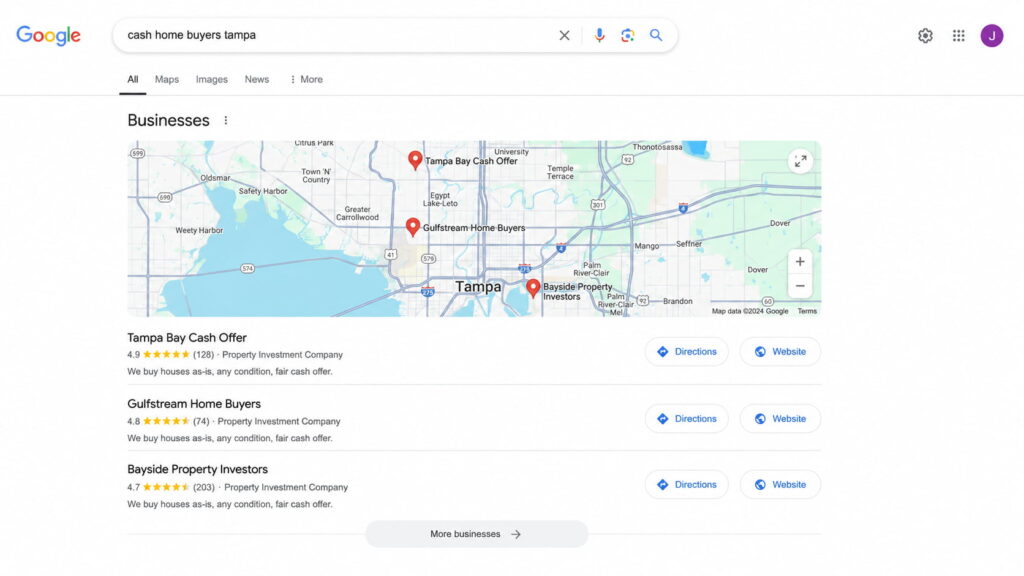
The local map pack is where “near me” searches get decided, and Google Business Profile is how you get into it.
Content and blogging for search visibility
Search-optimized content is a slow asset that pays for years. The pages that actually pull leads on an operator’s site aren’t the homepage. They’re local pages for every market you work, and seller-situation pages that match the searches motivated sellers type under stress: probate, foreclosure, divorce, inherited property, problem tenants.
Two rules make it work. Each page has to be original to its market, not a template with the city name swapped, because Google’s March 2024 update specifically went after duplicate, template content and buried the sites using it. And it has to compound: two to four genuinely useful pieces a month, organized into clusters, is what builds a moat. One client had watched organic traffic collapse from 10,000 sessions to 284 under a previous agency, then reversed that 97% drop within nine months of rebuilding it right (BASEO client data).
The newer wrinkle is AI search. The AI-generated answers now sitting at the top of Google pull from well-structured, genuinely useful pages, so being cited in AI Overviews is becoming its own lead source. Nobody controls whether an AI cites you, and anyone promising page-one rankings on a timeline is guessing. But a year of consistent, local, honest content builds something a competitor can’t buy overnight.
Step 3: Choose 2–3 social media platforms and go deep
The fastest way to burn out on social is to try to be everywhere. Pick two, maybe three, platforms where your ideal clients actually spend time, and go deep instead of wide.
Match the platform to your market. Local community and sphere reach still run through Facebook. Lifestyle and before-and-after deals play well on Instagram. Referral partners and relocation business live on LinkedIn. And keep the frame honest: social builds trust and reach, but it rents attention. The day you stop posting, the reach stops, which is exactly why it works best on top of the compounding search asset, not instead of it. For the deeper version, here’s our take on social media for real estate.
Instagram and Facebook for listings and reach
Instagram and Facebook are where most operators get their first traction, because the formats reward what you already have: properties and a local point of view.
Lean on Reels (short vertical videos), before-and-after deal showcases, quick behind-the-scenes clips, and local spotlights on a business or park in your farm area. On Facebook, staying active in local community groups keeps you top of mind without paying for reach. The goal is to look like the operator who obviously knows this area, because that’s who gets the message when someone’s cousin needs to sell fast.
A sustainable weekly mix might look like:
- Monday: a quick market stat or “just closed” Reel.
- Wednesday: a before-and-after or behind-the-scenes clip.
- Friday: a local spotlight (a business, a neighborhood feature).
- Sunday: a client win or a helpful seller tip.
LinkedIn and video for authority
LinkedIn is underrated for operators. It’s where referral partners, relocation business, and your professional sphere (agents, attorneys, property managers, lenders) actually pay attention. A steady presence turns your network into a referral pipeline.
Video builds authority faster than any other format. YouTube is especially strong because neighborhood tours and “what it’s like to sell in [area]” videos are evergreen: they rank, they keep getting found, and they do the trust-building before you meet anyone. It’s worth putting video and 3D tours on your property pages too. Listings with video and interactive 3D walkthroughs tend to draw more views and more serious inquiries than photos alone, because someone who’s “walked” the home is already qualifying themselves before they call.
Step 4: Nurture leads with email and CRM follow-up
Most of your leads are not ready today, and that’s the whole point. The money is in staying useful for the months between “just looking into it” and “let’s do it.” Operators who win the long game have a system; the ones who don’t lose those leads to whoever followed up.
That system starts with a CRM, a contact database that tracks every lead and automates follow-up so nothing slips. Everyone goes in: web inquiries, form fills, past sellers, your sphere. If you’re setting one up, our step-by-step on how to use a CRM for real estate walks through it. This is your tool to own, not something BASEO sells, but it’s non-negotiable for making the rest of this pay off.
From there, nurture on a few simple tracks: a monthly market-update email, saved-search alerts for active buyers, and drip campaigns (automated email sequences that go out over time) for newer leads. Anniversary and check-in touches keep past sellers warm.
One thing to fix today: speed to lead. When a new inquiry comes in, minutes matter. Responding in a few minutes instead of a few hours sharply improves your odds of connecting while the person is still paying attention. A CRM with instant notifications makes that automatic instead of luck.
Step 5: Run paid ads to accelerate lead flow
Ads buy speed. Organic builds an asset. That difference is the whole game: the day you stop paying, the ads stop, so use paid to accelerate lead flow, not as your entire plan.
Two engines cover most operators. Google Ads captures intent: someone typing “sell my house fast [city]” is already looking, and you pay to sit at the top of that moment. Meta ads (Facebook and Instagram) work the other way, on audience targeting: you reach people by location, demographics, and behavior before they’ve searched. Retargeting sits on top of both, showing ads to people who already visited your site and left.
Here’s the math that matters. Track cost per lead and cost per deal, never clicks or impressions. Paid leads for seller keywords run expensive and get pricier every year, and the moment you stop, they vanish. Organic goes the other way. One client reached $161 per organic lead by month nine, and it kept declining (BASEO client data), while their paid cost per lead stayed flat. The honest play isn’t killing PPC on day one, it’s running it well while organic compounds, then shrinking paid spend as the free channel takes over. BASEO runs both under the same cost-per-deal lens, and most clients cut paid spend meaningfully once organic is doing the heavy lifting.
| Google Ads | Meta Ads (Facebook/Instagram) | |
|---|---|---|
| Best for | Capturing active searchers | Building awareness, seller leads |
| Targeting | Search intent (keywords) | Audience (location, demographics, interests) |
| Typical use | “sell my house fast [city]” campaigns | Home-value offers, brand awareness |
| Watch out for | Rising cost per click on seller terms | Needs strong creative; lower buying intent |
Step 6: Sharpen your listing presentation (photo, video, 3D)
Here’s the part sellers actually judge you on: your last deals. Before a homeowner works with you, they look at how you marketed the properties you already handled. Your listings and case studies are your portfolio, and mediocre photos tell a prospective seller exactly how their home would be treated.
So invest where it shows. Professional photography is the baseline. Video walkthroughs and interactive 3D tours go further, turning browsers into inquiries by letting someone experience the property before they visit. Deals presented this way attract more, and more serious, interest.
Treat every property as an audition for the next one. When a seller down the street sees a well-marketed home with your sign in the yard, you’ve already made your pitch.

Sellers judge your marketing by your last deals. Photo, video, and 3D are the audition.
Step 7: Systematize referrals and past-client marketing
Referrals and repeat business are the highest-return marketing you have, and the channel most operators leave entirely to chance. Past clients and their referrals make up a large share of experienced operators’ business (NAR), yet most go quiet the moment a deal closes.
Systematize it instead of hoping. Build a repeatable cadence of value and asks, so staying in touch isn’t something you “get around to.” A simple past-client engine:
- At close: ask for the review while the good feeling is fresh, and make it one click.
- Quarterly: a genuinely useful email (market update, home-maintenance tip), not a “just checking in.”
- Anniversary: a personal note on the date the deal closed.
- Annually: a client event or a “state of your neighborhood” value piece.
- Always: ask directly. “Who’s the next person you know thinking about a move?”
Those review requests do double duty, feeding the local authority you built in Step 2. Real editorial links and citations from local chambers, REIAs, and local news outlets are the kind of authority that moves rankings, and it’s the sort of thing BASEO builds for the markets you work, with no link farms or paid schemes. The referral you earn today is the deal you close next quarter.
How to build a 90-day real estate marketing plan
Seven steps is a lot to do at once, so don’t. Sequence them. Build the foundation first, then the content and social engine, then paid and referrals on top. Here’s a 90-day rollout you can copy:
- Days 1–15: Install the foundation first: call and form tracking, Analytics and Search Console, and a rebuilt Google Business Profile.
- Days 1–15: Lock your niche and brand basics (headshot, logo, colors, positioning statement).
- Days 15–45: Choose two social platforms and start a weekly cadence you can sustain.
- Days 15–60: Publish your first local page and seller-situation pages (probate, foreclosure, inherited), original to your market.
- Days 30–60: Put every lead into a CRM with instant notifications and an automated follow-up sequence.
- Days 60–90: Launch one small paid campaign on Google or Meta and track cost per lead.
- Days 60–90: Set up your referral and past-client touch cadence and start asking for reviews.
- Days 90+: Review by cost per lead and cost per deal, then double down on the channel that’s working.
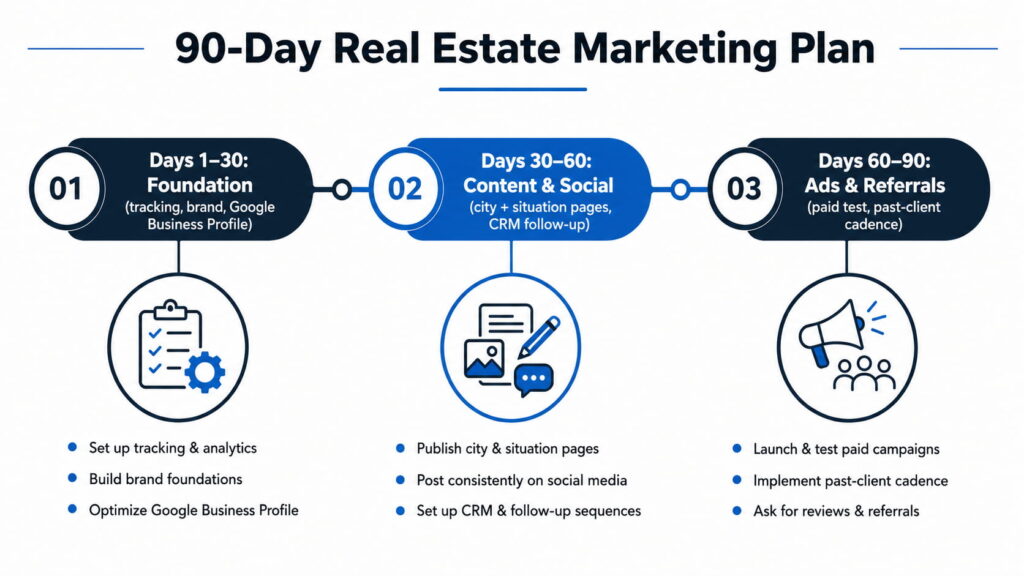
Build in order: foundation first, then the engine, then the accelerators.
Real estate marketing tools and budget benchmarks
You don’t need every tool, and you definitely don’t need the most expensive one. You need one solid pick per category and the discipline to use it. A common rule of thumb is to reinvest roughly 10% of your income into marketing, with newer operators spending more upfront to get visible and established ones spending less as referrals carry more of the load.
Here’s a vendor-neutral starting map:
| Category | Example tools | Rough monthly cost | Note |
|---|---|---|---|
| CRM | Follow Up Boss, HubSpot, REsimpli | $0–$150 | Start lean; upgrade as lead volume grows |
| Social scheduler | Later, Buffer, Metricool | $0–$40 | Batch a week of posts in one sitting |
| Design | Canva | $0–$15 | Templates for deals, stories, flyers |
| Website / IDX | Carrot, AgentFire, WordPress + IDX | $30–$150 | Own the hub; IDX pulls in live listings |
| Email marketing | Mailchimp, MailerLite | $0–$50 | Newsletters and drip campaigns |
Budget bands, monthly: a newer operator can run a credible program on roughly $150–$500 in tools plus sweat equity on content and social. Done-for-you SEO is its own line: across the industry, investor SEO retainers typically run $2,000–$6,000 a month, which is why the cost-per-deal math matters so much. Judge every dollar by cost per lead and cost per deal, not by how busy it makes you feel. One deal usually covers many months of the investment.
Ready to get found by more sellers?
That’s the whole playbook, and every piece of it is work, every month. Some operators run it themselves and do fine. Most would rather spend that time closing deals.
If you want to know which pieces your site is missing before you decide either way, that’s what the audit is for. BASEO works only with cash home buyers, so it already knows your competitors, your keywords, and your seller situations. You send the domain, you get the three biggest issues, your competitor’s keyword gap, and the deal math for your market, in writing, in about two business days. No call required, and you keep it whether we ever speak or not.
Frequently asked questions
A few of the questions operators ask most about marketing themselves.
Most agents invest roughly 10% of their income into marketing, though newer ones often spend more upfront to build visibility. Start with a lean budget focused on a tracked website, one paid channel, and a CRM, then reinvest as leads convert into closed deals. Done-for-you SEO across the industry tends to run $2,000–$6,000 a month, so judge it by cost per deal, not sticker price.
For newer operators, the fastest path is combining a defined niche, a rebuilt Google Business Profile, and consistent posting on two social platforms, all sitting on a tracked website. Pair that with disciplined follow-up in a CRM. Local SEO and referrals compound over time and cost little beyond effort, which is why they beat paid over the long run.
Yes. Sellers and buyers now research you online before they reach out, so a website is the hub that captures leads and builds credibility. It hosts your local pages, testimonials, and seller-situation content, and gives paid ads and social posts a destination you own that converts visitors into inquiries, instead of sending them to a portal.
Operators generate online leads through local SEO, a tracked lead-capture website, social media, paid ads, and email nurture. Search and referrals produce the highest-intent leads, while paid ads accelerate volume. The key is consistent follow-up, since most leads convert weeks or months after first contact.