You found the deal. The numbers work. Then the bank says no, or your cash is already tied up in two other closings.
Creative financing is how that deal still closes. This guide covers what it is, the main methods, the deal math from the buyer’s side, and the risks that actually bite investors.

An operator running the numbers on a deal the bank wouldn’t touch.
- What Is Creative Financing in Real Estate?
- Why Investors Use Creative Financing
- The Main Types of Creative Financing
- Creative Financing Deal Math: A Simple Example
- The Risks Investors Take On
- Is Creative Financing Legal?
- Creative Financing vs. Paying Cash
- When Creative Financing Makes Sense for Your Business
- You Still Need Motivated Sellers
- FAQ
What Is Creative Financing in Real Estate?
Creative financing is any way of buying real estate outside a standard bank mortgage, where the buyer and seller set the terms themselves so the investor can acquire property with little or none of their own cash. Common methods include seller financing, subject-to, lease options, and wraparound mortgages (TurboTenant).
It’s an umbrella term, not one technique. Each method moves a different lever: who lends, who holds title, how much you put down, and when you pay the rest. Some are beginner-friendly. Some are advanced and carry real legal exposure. The rest of this guide walks each one.
Why Investors Use Creative Financing
The core reason is capital efficiency. Put less of your own money into each deal and the same bankroll covers more doors. Ten percent down on a $250,000 house is $25,000. All cash is $250,000. That’s the difference between one deal and ten.
There’s also the bank problem. Conventional lenders care about your credit, your debt-to-income, loan seasoning, and whether the property is livable enough to appraise. Plenty of good deals fail all four. Creative financing routes around the underwriting gauntlet, which is why it pairs so naturally with off-market properties and distressed sellers.
Speed matters too. No appraisal, no 45-day underwriting, no committee. And with one method, subject-to, you can inherit a seller’s below-market interest rate instead of financing at today’s. For operators who also wholesale, it’s another tool for controlling property without a bank in the room.
The Main Types of Creative Financing
There are six methods worth knowing, and they run from beginner-friendly to advanced. Seller financing and lease options are where most operators start. Subject-to and wraparounds carry more legal weight. Hard money is its own animal for short-term deals. Here’s each one, what it is, and where it fits.
Seller Financing (Owner Financing)
The seller becomes the bank. You make a down payment, then pay the balance in installments with interest over an agreed term. Down payments commonly run 10% to 20%, though some sellers want 25% or more; interest often lands around 5% to 10%, and the loan usually ends in a balloon payment after five or ten years (Nav, Forbes Advisor).
The buyer upside is real: no bank underwriting, a faster close, and terms you actually negotiate. The catch is the balloon. If you can’t refinance or sell before it comes due, that clock becomes a problem. It’s the most common creative financing method for a reason, but the exit has to be planned on day one.
Subject-To Financing
In a subject-to deal, you take over the seller’s existing mortgage payments while the loan stays in their name. Title transfers to you. You’re now the owner, making payments on a loan that isn’t legally yours.
The upside is hard to beat: you can acquire a property with almost no cash and inherit the seller’s interest rate, which matters a lot when that rate is well below market. This is common in pre-foreclosure situations where the seller just wants out.
Here’s the risk most guides skip. Nearly every mortgage has a due-on-sale clause: it lets the lender demand the full balance the moment title transfers without their consent (Due-on-sale clause). The lender rarely calls the loan while payments arrive on time, but the right exists, and it’s enforceable federally under the Garn-St Germain Act. Do a subject-to without understanding that exposure and you’re building on someone else’s foundation.
Lease Options (Rent-to-Own)
A lease option lets you control a property now and buy it later at a price you lock in today. You pay an upfront option fee, then rent, often with a slice of each payment credited toward the purchase.
It suits investors who want control with very little down, or who need time before committing capital. The trade-off is that an option is a right, not an obligation on both sides. If the terms are loose or the seller gets cold feet, you can end up in a dispute over money you’ve already put in. Tight paperwork is the whole game here.
Loan Assumption
A loan assumption looks like subject-to with one critical difference: it’s formal. The buyer takes over the seller’s mortgage with the lender’s approval, which releases the seller from liability. No due-on-sale surprise, because the lender signed off.
It mostly applies to assumable loans, typically FHA and VA. When the existing rate sits below the current market, assuming it can be worth more than the equity itself. The downside is that lender approval takes time and you have to qualify, so it’s slower and less flexible than the off-book methods.
Hard Money & Private Lending
Hard money is a short-term, asset-based loan from a private lender or an individual. The deal secures the loan, not your credit, so approval is fast, but you pay for the speed with a higher rate plus points.
This is a flip and bridge tool, not a long-hold strategy. Use it to acquire and rehab, then refinance or sell before the short term runs out. Carry it too long and the cost eats the deal.
Wraparound Mortgages
A wraparound is advanced. The seller keeps their original mortgage and writes you a new, larger loan that “wraps around” it. You pay the seller; the seller keeps paying the underlying note and pockets the spread.
It can work when a seller has a low-rate loan and wants income, but it carries the same due-on-sale exposure as a subject-to, plus more moving parts. This is attorney territory, not a handshake deal.
Creative Financing Deal Math: A Simple Example
Here’s how the capital math actually plays out. Illustrative numbers, not a quote.
Say you buy a $250,000 property with seller financing. You put 10% down, so $25,000 out of pocket. The seller finances the remaining $225,000 at an agreed rate over a set term, with a balloon in year seven. Each month you pay principal and interest to the seller, and that interest is the seller’s return for acting as the bank.
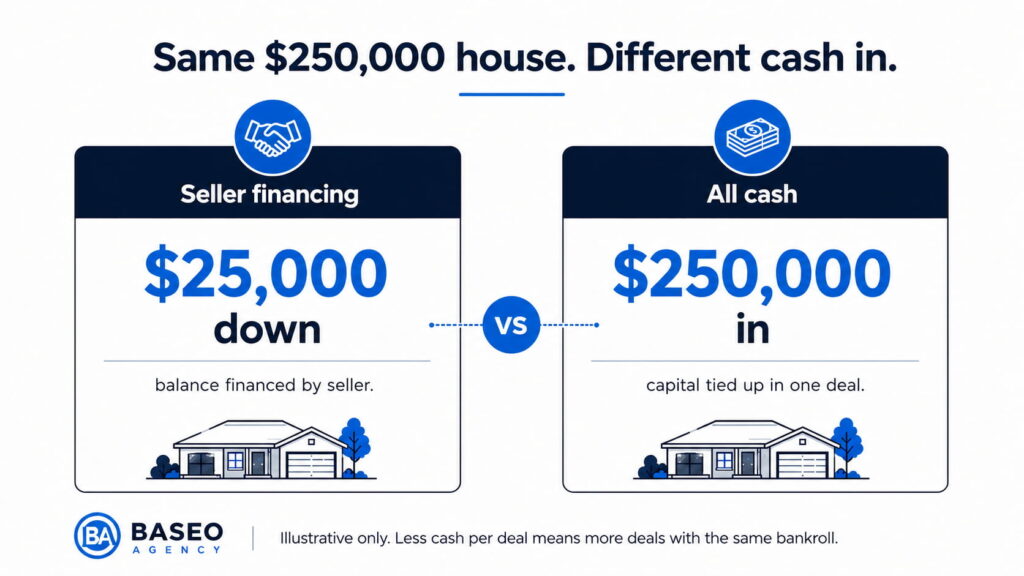
The same asset, two very different capital commitments.
| Term | Illustrative value |
|---|---|
| Purchase price | $250,000 |
| Down payment (10%) | $25,000 |
| Seller-financed balance | $225,000 |
| Interest rate | Negotiated (often ~5–10%) |
| Term | Amortized long, balloon in ~year 7 |
| Cash in the deal | $25,000 vs. $250,000 all-cash |
The point isn’t the exact payment. It’s the $25,000 versus $250,000. Same house, one-tenth the capital exposure. That’s what creative financing buys you, and also the reason the after repair value and your exit plan have to be right, because you’re carrying a balloon.
The Risks Investors Take On
Less of your own money in a deal means more of someone else’s rules around it. The honest list:
- Due-on-sale. In subject-to and wraparound deals, the lender can call the full balance when title transfers. Rare, but real, and federally enforceable.
- Balloon default. If the balloon comes due in a bad market and you can’t refinance or sell, you can lose the property and the money already in it.
- Higher blended cost. When bank rates are favorable, seller financing and hard money can cost more. Run the real number, not the headline.
- Counterparty and paperwork risk. Your outcome depends on the other party and on airtight documents. Sloppy terms lose deals and start lawsuits.
- Volume triggers regulation. Finance enough owner-occupied homes and federal lending rules apply to you, covered next.
None of these kill creative financing as a strategy. They just mean it rewards operators who plan the exit and paper the deal correctly.
Is Creative Financing Legal?
Yes, creative financing is generally legal in the U.S. It’s also regulated, and the rules vary by state and by how you structure the deal.
The line most investors need to know: under Dodd-Frank and the SAFE Act, a seller who finances three or fewer properties in a 12-month period to an owner-occupant, in a one-to-four-unit home, is generally exempt from becoming a licensed mortgage loan originator. Finance more than that and you’re expected to underwrite the buyer’s ability to repay under the federal criteria (NAR). Investor-to-investor and non-owner-occupied deals sit under different rules again.
On top of that, subject-to and wraparound deals carry the due-on-sale exposure, and private deals come with fewer consumer protections than a bank transaction. That’s not a reason to avoid them. It’s a reason to paper them right.
This isn’t legal advice. Before you close any creative deal, use a real estate attorney and a title company. The cost of getting the documents right is a rounding error against the cost of getting them wrong.
Creative Financing vs. Paying Cash
If you’re a cash buyer, the real question is when to deploy cash and when to structure a deal instead. Both are right in different spots.
| Creative financing | Paying cash | |
|---|---|---|
| Capital needed | Low (often 10–20% down) | High (full price) |
| Speed | Fast, no bank | Fastest, no lender at all |
| Risk | Due-on-sale, balloon, counterparty | Lowest; you own it free and clear |
| Best when | You want more doors with less capital | You want simplicity and the strongest offer |
Creative financing conserves capital and can lift your cash-on-cash return by spreading the same money across more deals. Cash is simpler, faster, and makes the strongest offer at the table, but it locks your capital into one property. Most operators blend the two: pay cash when speed wins the deal, structure when capital is the constraint.
When Creative Financing Makes Sense for Your Business
It makes sense when you have steady deal flow but limited capital, when you want to add doors without draining reserves, when there’s a below-market rate worth inheriting, and when you have the patience and legal support to do it right.
It doesn’t make sense when your margins are too thin to absorb the added complexity, when you don’t have an attorney and title relationship, when you can’t stomach the due-on-sale risk, or when you need a clean, fast exit with no strings. If the deal only works because the financing is exotic, that’s usually the deal telling you no.
You Still Need Motivated Sellers
Here’s the part no financing guide mentions. Every method on this page structures a deal you already have. None of them create one.
The constraint for most operators isn’t the structure. It’s sellers finding them in the first place. You can master subject-to and wraps and still have a quiet phone. The financing is the easy half; the motivated seller leads are the hard half, and they’re what actually caps how many deals you close.
That’s the upstream problem worth solving before you optimize acquisitions. Whether you buy leads or build a channel you own, deal flow is the input everything else depends on. BASEO builds that organic channel for cash buyers, so sellers find you on Google and in AI search before a competitor does.
Frequently Asked Questions
Is creative financing a good idea for investors?
It’s a good idea when you have deal flow but limited capital, or a bank won’t work. It stretches your cash across more doors and closes fast. But it adds risk and complexity, so it fits operators who understand the terms and use a real estate attorney.
What is the most common type of creative financing?
Seller financing, also called owner financing. The seller acts as the lender: the buyer puts money down, then repays the balance in installments with interest over an agreed term. It’s the most common form because it’s flexible and skips traditional bank underwriting.
Do you need good credit for creative financing?
Usually not. Terms are set with the seller or a private lender, not a bank, so your credit matters less than the deal and your down payment. The seller sets the qualification bar, which is typically more flexible than a lender’s.
What are the risks of subject-to financing for the buyer?
The mortgage stays in the seller’s name, so you rely on them and their loan servicer staying in order. The lender’s due-on-sale clause can also demand full repayment when title transfers. Get legal and title guidance before you close one.
Is seller financing legal?
Yes, but it’s regulated. Dodd-Frank and the SAFE Act limit how many owner-occupied homes you can seller-finance before licensing and underwriting rules apply, and the terms must be documented properly. Use a real estate attorney and a title company.
Final thoughts
Creative financing is a tool for closing deals with less of your own money, not a shortcut around risk or around finding deals in the first place. The operators who win with it already have deal flow and legal support in place before they get clever with structure.
Get those two right and the financing is the easy part. If you want to know where your motivated-seller pipeline is leaking before you scale acquisitions, that’s what the audit is for. We work only with cash home buyers, so it already knows your market, your competitors, and your seller situations. Free, in writing, no call required, yours to keep.