Every deal you close starts as a lead. The only real question is whether you rent that lead or own the channel it comes from. Buy property leads and the phone rings this week, but the flow stops the day you stop paying. Build your own and it takes longer, but it compounds into a source no competitor can outbid. This guide covers every lead type, what each one costs, and which channel fits your capital, timeline, and experience.

The moment a lead lands is the moment the business feels real. Where that lead came from decides whether it happens again next month.
In this guide:
- What are real estate investor leads?
- Seller leads vs. buyer leads
- Types of motivated seller leads
- Free ways to generate leads
- Paid ways to generate leads
- Buying leads vs. generating your own
- How much do real estate leads cost?
- Choosing lead channels for your situation
- Explore each lead type in depth
- Own your lead channel instead of renting it
- FAQ
What are real estate investor leads?
A real estate investor lead is a property, or the person who owns it: a seller with a reason and the ability to sell off-market, or a cash buyer for your deals. Unlike a retail agent’s listing lead, motivation is the whole variable. A name on a list becomes a lead only when the owner has a reason to sell.
That’s the line that separates investor lead gen from everything an agent does. Agent leads want top-of-market price and a full-service sale that can take months. Your seller wants speed and certainty, an as-is offer, and to be done. A distressed property owned by someone with a deadline is a lead. The same property owned by someone who’s just curious is a data point.
The 2 sides of investor lead gen: seller leads vs. buyer leads
Every investor runs two engines at once. Acquisition finds the deals, and disposition moves them.
Acquisition is the hard one, and it’s where most of this guide lives. It covers seller leads, property leads, wholesale leads, and home leads: all the ways you find an owner willing to sell below retail. Disposition is the other side, the homebuyer and cash buyer leads you need to assign a contract or sell a flip.
Most operators obsess over acquisition and neglect the buyer list until they’re stuck holding a deal. If you’re wholesaling real estate, both engines have to run. The rest of this guide breaks down each type, and the hub near the end links every one in depth.
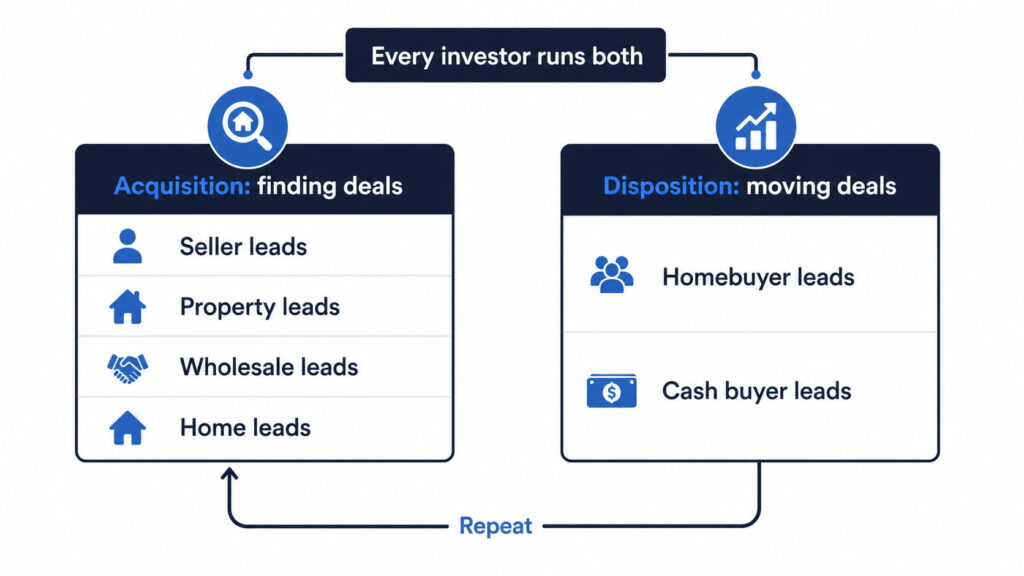
The two engines every investor runs. Neglect either one and deals stall.
Types of motivated seller leads (and how motivated each is)
Motivated seller leads sit on a spectrum, not a switch. Some owners are curious. Some have an auction date. The whole game is spending your time and money where the motivation is real.
The top-converting lists in 2026 don’t just hand you names anymore. They’re AI-scored, ranking owners by equity, ownership length, and mortgage age, then stacking distress signals like tax delinquency, probate, and divorce on top (iSpeedToLead). When a property is vacant and tax-delinquent and owned by an out-of-state landlord, the odds the owner actually wants out climb fast (PropStream). Here’s how the main types stack up by urgency.
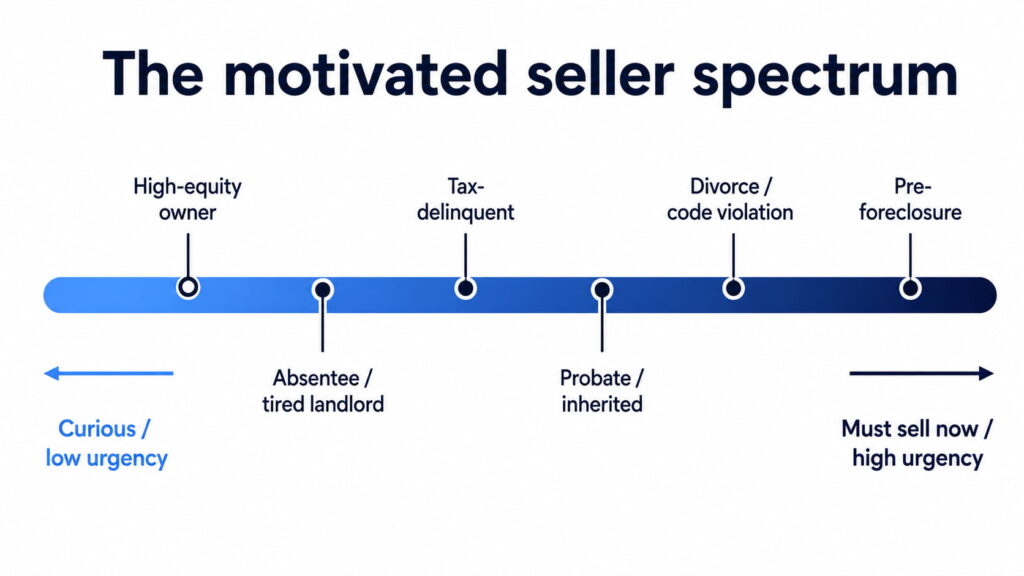
Motivation is a spectrum. Spend your marketing budget toward the right end of this bar.
Pre-foreclosure & foreclosure leads
These are the most urgent leads you’ll find. The owner is racing an auction date, and every week that passes tightens the vise. The records come from county notices of default, which are public. The catch is timing: a perfect list a week too late is worthless, so speed to the owner beats volume every time. If you work this space, learn where to find foreclosure listings and understand the pre-foreclosure timeline cold before you knock.
Probate & inherited property leads
These are heirs who never asked for the house. They’re often out of state, often sitting on high equity because the property was owned free and clear for decades, and rarely emotionally attached to keeping it. The source is probate court filings. The one rule that matters here: someone died, so your outreach has to be patient and respectful, not a hard pitch. Handled with care, these are some of the best deals in the business.
Absentee owner & tired landlord leads
An absentee owner is anyone whose mailing address doesn’t match the property address, and a lot of them are landlords who are done. One bad tenant, a special assessment, or a few years of rising costs turns a buy-and-hold into a headache the owner just wants gone. You pull these from title company data or the county assessor, matching owner address against property address to spot the non-owner-occupied ones.
High-equity & free-and-clear leads
An owner with no mortgage has the most room to negotiate, because there’s no loan balance forcing a floor on the price. That flexibility is real, but equity alone rarely creates urgency. A paid-off house owned by a happy retiree isn’t going anywhere. These leads convert best when high equity is paired with another trigger, like probate or a code violation, so treat equity as an amplifier, not a signal on its own.
Tax-delinquent, divorce & code-violation leads
These are the situational distress signals, and each one maps to a public record you can pull. Tax-delinquent owners show up on county tax rolls and are often ready to walk away from a bill they can’t cover. Divorce filings sit in court dockets, where two people frequently need to sell and split fast. Code violations come from municipal code enforcement, flagging owners staring down repair bills they don’t want. Each is a reason to sell, not just a name on a list.
How to generate real estate leads: free methods
Free doesn’t mean effortless. It means you pay in time and hustle instead of dollars. These are the channels that cost nothing but sweat, ranked roughly from warmest to slowest to pay off (Real Estate Skills):
- Referrals from probate attorneys, agents, contractors, wholesalers, and property managers. The cheapest leads that exist, because a warm intro skips the entire step where a cold seller decides whether you’re legit.
- Driving for dollars: physical signs of distress (overgrown yards, boarded windows, tarped roofs) added to a list you work.
- FSBO and expired listings: owners already trying to sell without an agent, who’ve told you they’re motivated.
- Networking and REI meetups: relationships that quietly feed deals for years.
- Organic social: presence that builds a buyers list and keeps you top of mind.
- SEO and content: the only free method that compounds.
That last one is the difference-maker. Driving for dollars stops the day you stop driving, but a page that ranks for how a stressed owner searches keeps sending motivated seller leads for years after you publish it. It’s also the channel most investors do worst, because a template site doesn’t rank. Building SEO that actually brings deals is exactly what BASEO does for cash buyers, and it’s the one free channel that turns effort today into inbound you own tomorrow. If cold outreach isn’t your thing, there are plenty of ways to get leads without cold calling on this list.
How to generate real estate leads: paid methods
Paid methods buy you the one thing free methods can’t: speed to your first lead. You open the tap, leads come. The tradeoff is that the tap closes the moment you stop paying.
Direct mail is still the workhorse of investor acquisition. You pay per piece, and your list quality decides whether it’s profitable or a money pit. Cold calling and SMS move high volume if you have thick skin and stay on the right side of the compliance rules. Buying lead lists gets you instant volume, but those leads are usually shared and only as good as the underlying data.
Then there’s paid search. Google Ads for real estate puts you at the top of the “sell my house fast” results the instant your campaign goes live. It isn’t cheap: “we buy houses cash” keywords run about $2.50 to $5.00 per click with an investor cost per lead around $28 to $65 (Promodo), and the most contested “sell house fast” terms hit $12 to $63 a click in competitive markets (Webrageous). Local Services Ads sit even higher on the page and charge per lead instead of per click. Facebook ad campaigns offer cheaper clicks but colder intent, which makes them better for building a buyers list and retargeting than for catching a seller mid-crisis.
Buying leads vs. generating your own: the real cost
Here’s the decision that actually matters, and it isn’t which vendor to pick.
Buying leads gives you instant flow. It also hands you a lead that’s shared or rented, priced to rise as more investors bid on the same list, and gone the second your card gets declined. Every lead you buy is a lead a competitor can buy too. You’re renting attention, and the rent goes up every year.
Generating your own is slower to start and worth more at the finish. A page you rank is inbound that can’t be resold to the investor across town. The math backs it up: organic leads cost 83% less than PPC leads and close about twice as profitably, with mature content bringing cost per lead down to $7 to $30 (Visionary Marketing). The shortcut most investors try, a template site, is exactly why they don’t rank: more than 30% of top “we buy houses” sites run near-identical Carrot template content, so Google can’t tell you apart and ranks none of you well (Carrot).
The smart play isn’t either/or. It’s bi-velocity: run PPC and Local Services Ads for leads this week while original city pages and seller-situation content compound into a channel you own. Paid buys speed. Owned buys durability. That’s the model BASEO builds, the organic engine that keeps producing while the paid spend can shrink as it takes over. One Florida cash buyer went from 3 to 28 motivated seller leads a month in nine months on that approach, in the same market, with no extra ad spend (BASEO client data).
| Rented leads (bought) | Owned leads (generated) | |
|---|---|---|
| Speed to first lead | Days | Months |
| Exclusivity | Shared or resold | Yours alone |
| Cost over time | Rises with competition | Falls as content matures |
| When you stop paying | Leads stop | Leads keep coming |
| Who else can buy it | Any competitor | No one |
How much do real estate leads cost?
Prices swing wildly, and the number on the invoice is the least useful one. Motivated seller leads run from about $25 to $40 for shared national leads, up to roughly $80 to $120 for county-level exclusives, and $300 or more for premium exclusive leads in high-value markets (UndervaluedX, US Lead List). Done-for-you services price distressed seller leads from around $66 each (HouseCashin).
The number that actually matters is cost per closed deal, not cost per lead. A $300 exclusive lead that closes beats twenty $25 shared leads that never answer the phone. Cheaper leads come with more competition and more contacts to close; exclusive leads cost more up front and take fewer touches. Here’s the range by source, as of 2026.
| Source | Typical cost per lead | Exclusivity | Note |
|---|---|---|---|
| Shared national list | $25–$40 | Resold widely | High volume, low intent |
| County-level exclusive list | $80–$120 | Limited | Fewer contacts to close |
| Premium exclusive leads | $300+ | Yours alone | Priced by market and motivation |
| Google Ads (PPC) | ~$28–$65 | Yours | Stops when spend stops (Promodo) |
| Agent platforms (Zillow, etc.) | $100–$300 | Shared | Retail intent, not investor (The Close) |
| SEO / organic content | Falls to $7–$30 mature | Yours alone | Compounds, owned (Visionary Marketing) |
For contrast, agent-focused leads price differently: paid social runs $5 to $30, Google buyer leads $20 to $60, and Zillow or realtor.com leads $100 to $300 (Ylopo). Those chase retail buyers and sellers, not the motivated, off-market owner you want.
Choosing lead channels by capital, time & experience
There’s no universal right answer, only the right answer for where you are right now. Match the channel to your capital, your timeline, and how many deals you’ve actually closed.
If you have no capital but time to hustle, start with sweat equity: driving for dollars, working referrals, chasing FSBOs, and laying the SEO groundwork by claiming your Google Business Profile and publishing your first city and situation pages. If you have some capital and need the phone to ring this quarter, PPC, Local Services Ads, and a tight direct mail campaign will get you there faster than anything organic can. If you’re scaling, the move is an owned SEO and AI-search base with a paid blend layered on top, and you measure all of it by cost per deal, not leads generated.
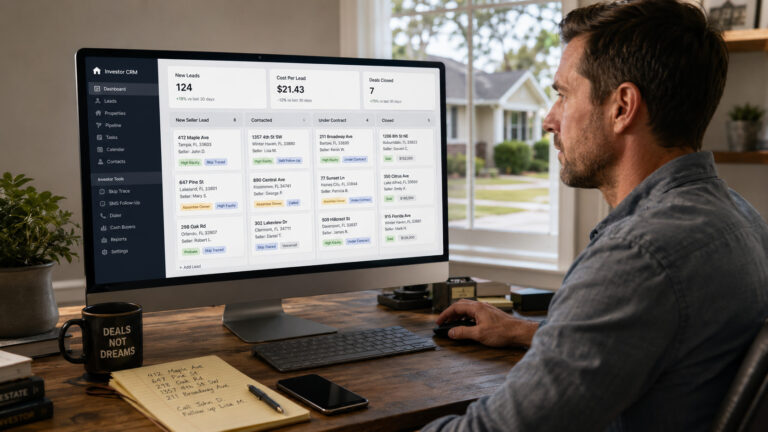
The through-line across all three: whatever you’re spending on today, always be building the owned asset in the background. The point of good lead conversion and a CRM to track everything is to make sure none of these leads, bought or earned, slips through the cracks.
Explore each lead type in depth
Every lead type in this guide deserves its own playbook, so go deeper on the one that fits your niche. Start with seller leads for the full breakdown of finding motivated owners. Dig into property leads to work distressed properties by situation and public record. Study wholesale leads if you’re assigning contracts and need both sides of the deal. Learn home leads for the residential acquisition angle. And build out homebuyer leads so you’ve got a cash buyers list ready the moment a contract needs a home. Each one is a channel you can specialize in and own.
Own your lead channel instead of renting it
Step back and the whole guide points one direction. Every lead you buy is a lead a competitor can also buy. You’re renting attention, and the landlord raises the rent every year.
A page that ranks for “sell my house fast” in your city is different. It sends you exclusive inbound leads around the clock, and no competitor can buy that spot out from under you. The channel is booked when it’s yours. That now includes AI search: one Carrot user pulled 26 of his 45 weekly leads straight from ChatGPT (Carrot), because being the answer an AI cites is the new front page. Getting your pages cited in AI Overviews is a channel most investors haven’t even noticed yet.
That owned channel, original city pages, seller-situation pillars, and AI-search optimization, is what BASEO builds for cash home buyers, with PPC and Local Services Ads keeping the phone ringing while the organic side compounds. You get speed now and durability later, from one team that only works your niche.
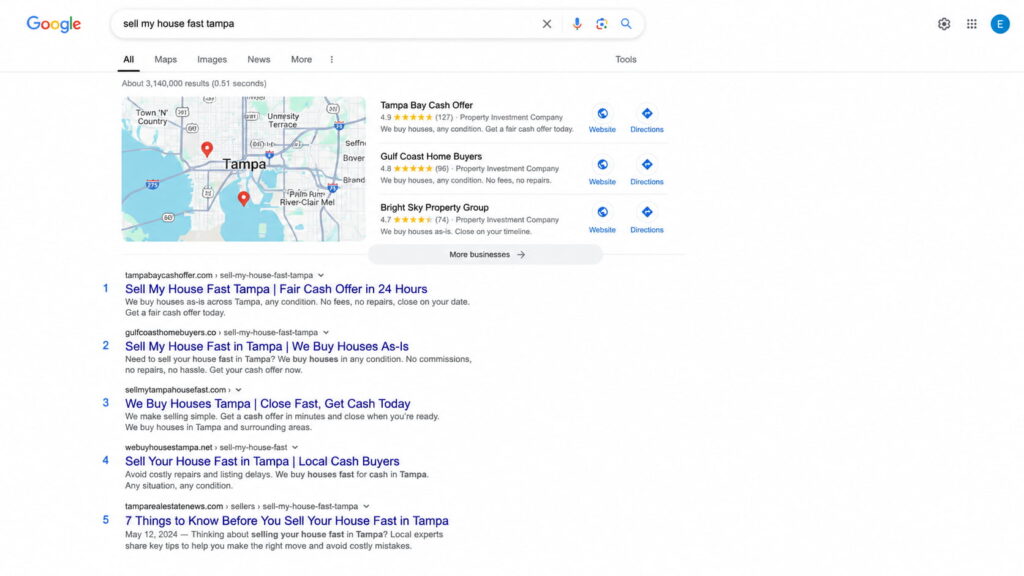
Owning the #1 spot for “sell my house fast [your city]” is a lead a competitor can’t outbid you for.
Frequently asked questions
There’s no single best source, it depends on your capital and timeline. Referrals convert cheapest, direct mail and PPC deliver the fastest volume, and SEO builds the only channel you fully own. Most successful investors run two or three sources at once and measure cost per closed deal, not per lead.
Paid leads deliver speed; free leads deliver ownership. Buying lists gets you talking to sellers this week but the flow stops when spending stops. Free channels like referrals and SEO take longer but compound and can’t be outbid. The strongest strategy combines both.
Motivated seller leads typically run from about $25 for shared national leads to $100+ for county-level and $300+ for exclusive leads, as of 2026. Price rises with exclusivity, motivation, and market competition. Judge leads by cost per closed deal, not the sticker price.
Beginners get their first lead fastest through free, high-effort methods: driving for dollars, contacting FSBO and expired listings, and asking their network for referrals. These need time, not money. Meanwhile, start building an SEO page so inbound leads compound over the following months.
Final thoughts
Leads aren’t a product you buy once and forget. They’re the output of a channel, and the durable move is owning that channel while paid keeps the phone ringing until it compounds. Rent for speed, own for the long run, and judge every dollar by cost per deal instead of the sticker on the lead.
Before you spend another dollar on a lead list, it’s worth knowing which channel your market and budget actually reward. We work only with cash home buyers, so a free audit already knows your competitors, your keywords, and the seller situations in your market. It shows you exactly what’s holding your site back and what your top competitor built instead. Free, in writing, delivered in about 2 business days. No call required, and it’s yours to keep.