
Landscaping leads on Google Local Services Ads run between $20 and $55 in most US markets, which makes landscaping local services ads cost per lead one of the cheapest numbers in home services. That number is also close to useless on its own. Google charges you per lead, not per booked job, and two things changed underneath the number while most landscapers were busy running crews: how bad leads get credited back to you, and where your campaign is about to live. Here is what the leads actually cost by trade, the formula that turns cost per lead into cost per booked job, and what to do about both changes before the season starts.
A landscaping operator’s morning. The cost per lead question gets decided long before anyone opens the ad account.
- What landscaping LSA leads cost right now
- How Google actually charges you for a landscaping lead
- Cost per lead is the wrong number: use cost per booked job
- The lead credit change nobody warned landscapers about
- LSA is moving into Google Ads: what changes for your CPL
- The seven job types that decide your landscaping CPL
- Seasonality: the same lead costs different money in March and August
- How to lower your landscaping LSA cost per lead
- What it takes to get approved as a landscaper
- Is LSA worth it for your landscaping business?
- Frequently asked questions about landscaping LSA cost per lead
What landscaping LSA leads cost right now
Landscaping leads on Google Local Services Ads run between $20 and $55 each in most US markets (Blue Grid Media). That is the low end of every home service trade Google sells LSA to, and it is the number you should carry into a budget conversation.
For context on where that sits: the blended average across all trades is $53 per lead, from SearchLight’s February 2026 benchmark covering 888 contractors, $6.72 million in spend and 126,650 leads (Enrich Labs). Across all home service industries the range runs $25 to $80 (Blue Grid Media).
Landscaping sits under the blended average for two reasons. The average ticket is smaller than a roof or a system replacement. And the work waits. A homeowner with water coming through the ceiling calls the first three numbers he sees. A homeowner who wants the beds redone can call in April, or in May, or he can rent a tiller and do it himself.
Now the part most benchmark pages skip. These are national numbers and they do not predict your market. A landscaping lead in Phoenix or Dallas does not cost what one costs in a rural county with four competitors and no badges. Treat any published range as a sanity check on whether you are wildly off, not as a grade you passed or failed.
Landscaping vs. other home service trades
| Trade | LSA cost per lead |
|---|---|
| Water damage | $80–$180 |
| Roofing | $60–$130 |
| HVAC | $45–$110 |
| Plumbing | $35–$85 |
| Electrician | $30–$70 |
| Landscaping | $20–$55 |
| Pest control | $18–$45 |
| House cleaning | $12–$30 |
Source: Blue Grid Media, 50 Google Local Services Ads Statistics (2026)
The emergency trades pay three to four times what you pay because their work cannot be postponed and their ticket is in the thousands. Nobody comparison shops a burst pipe. The lead is worth $180 because the job behind it is worth $4,000 and the homeowner will hire whoever answers.
Your trade sits at the bottom of that table because your customer has options. He can wait until next month, he can ask his neighbor’s guy, or he can do it himself on a Saturday. That is what makes your lead cheap.
It is also what makes it hard to close. Cheap is not the same as easy. A $20 lead you convert one time in eight is a worse business than a $55 lead you convert one time in two, and the table above tells you nothing about which one you have.
Why your market moves the number more than your ads do
Google is unusually direct about how the price gets set. In its own documentation: “When similar local businesses bid on the same lead, those bids determine how much the lead is worth” (Google Local Services Help).
Which means the number is mostly not yours. How many badged landscapers work your ZIP code explains more about your cost per lead than any setting you will ever touch. The same job type produces two different prices in a metro with eleven Google Guaranteed competitors and a secondary market with two.
The paid search side shows how wide that gets. Lawn care leads on Google Ads average about $87.80 at a cost per click near $3.65, and the same source says a cost per lead running $100 to $120 in August in Phoenix “that’s not a problem” (The Valley Marketing Group). Same trade, same country, forty dollars of swing on the map pin and the month.
So before you compare yourself to anything here, run your own number for 60 days: your cost per lead, your ZIP code, the job types you actually sell. That is the only benchmark that was ever going to be accurate, and there is a reason to get it on paper now rather than in December.
How Google actually charges you for a landscaping lead
Local Services Ads are pay-per-lead, not pay-per-click. Someone can read your reviews, compare you to two other crews and leave, and that costs you nothing. You pay when they call, message or book through the ad.
A chargeable lead is narrower than most operators assume: a live answered call, a text or email, a voicemail with job details, a missed call you return, or a booking request (Enrich Labs). The common thread is someone in your service area asking about a job type you listed.
The list that will not get you a credit is longer, and worth reading before you build a budget around disputes. Google does not credit after-hours valid leads, DIY advice calls, cancelled bookings, price shoppers, leads where you never replied to your own return contact, a subtype you listed but do not do, or a temporary inability to serve an area you generally cover (same source).
If that feels familiar, it should: you paid Angi whether you closed or not either. The difference is the one that matters, and it is not the price. That lead was sold to four other crews the same morning. This one is yours alone, and it arrives as a ringing phone.
BASEO sets up and manages LSA for landscaping crews on the same lens as everything else we run: calls, cost per lead, cost per job. Here is what an LSA unit looks like next to the other channels.
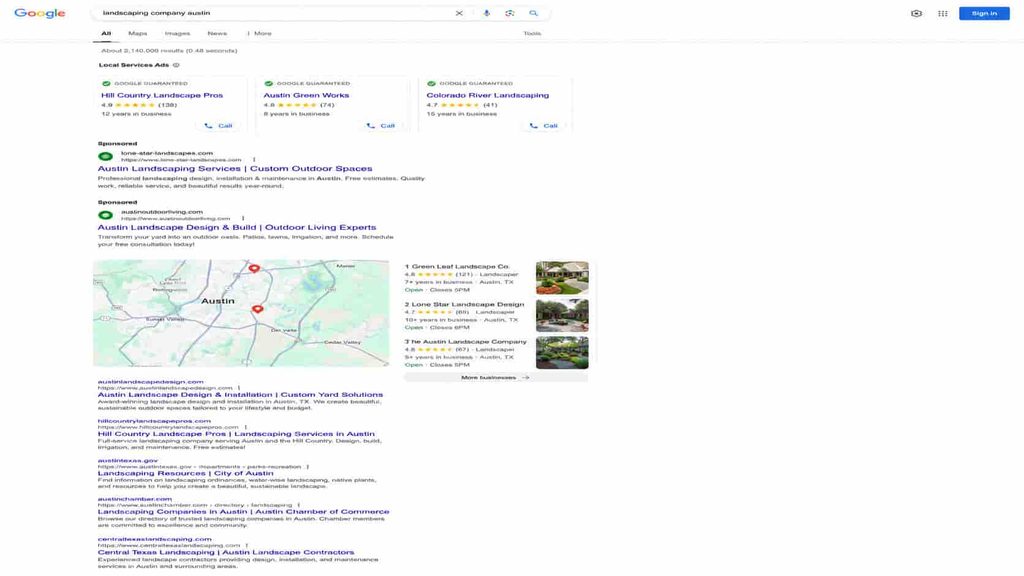
The stack that decides a local landscaping search: pay-per-lead units on top, pay-per-click below them, the map under that.
Bidding modes: Maximize Leads, Target CPL and manual
Google gives you three ways to set what you pay, and the names are less complicated than they sound (Google Local Services Help).
Maximize Leads is the automatic one. Google sets the bid to “get the most leads for your budget,” and it is the recommended setting once you are producing at least about 10 leads a week. Under that volume the system does not have enough to learn from.
Target CPL means you tell Google roughly what you want to pay, either by taking its recommended target or setting your own. Google describes that number as “around the average you’ll pay for leads.” An average, not a ceiling.
Max Per Lead is the manual one, and it is a ceiling: “the most you’d pay for a lead.”
Two things to plan around. Google says “it takes about 2 weeks to see accurate results as the model adjusts and learns about your business,” so judging any of these after five days is judging noise. That two-week clock is why you do not touch bidding in the first week of April: the model is still learning your account during the exact fortnight your season decides itself.
The second is that manual bidding and vertical-level Target CPA are both being deprecated in the migration described below, in favor of a single campaign-level target (Google Ads Help). Do not build your operation on a control scheduled to disappear.
Weekly budget, monthly cap, and what you really spend
LSA budgets are set weekly, and the monthly ceiling is derived, not entered. The formula is your average weekly budget multiplied by 30.4 and divided by 7 (Home Service Direct).
A $750 weekly budget produces roughly a $3,257 monthly maximum. Your spend “can run above that weekly average in a busy week, but over the month it stays inside a monthly max,” which is the behavior you want in a trade where a warm April week looks nothing like a wet one.
Now translate that into your business instead of Google’s. At a $35 lead cost, $750 a week buys about 21 leads a week. The question is not whether you can afford $3,257 a month. It is whether you have the crews to run 21 estimates a week and answer the phone while you do it. If you cannot, raising the budget buys leads that go cold on your voicemail.
One change coming: weekly budgets become daily budgets after the migration. Google takes “your historical average weekly budget” and divides it “by 7 to determine your daily average budget” (Google Ads Help). A $3,500 weekly budget shows up as $500 a day. Same money, different label, worth knowing before you look at the screen and think something broke.
Cost per lead is the wrong number: use cost per booked job
A $25 lead you close 15% of the time is a worse business than a $55 lead you close 45% of the time. Run it: the cheap one costs you $167 per booked job and the expensive one costs you $122.
The formula is one line. Cost per booked job = cost per lead ÷ booking rate.
That is the number that belongs in your P&L. Cost per lead is what Google charges you. Cost per booked job is what the marketing cost, and it is the only one of the two you can set next to an average ticket and get an answer. The operator who tells you his leads are $30 has told you almost nothing until he tells you what he closes.
It is also the lens your reporting has to run on. A report that shows lead volume and lead cost and stops has told you what you spent, not what you bought. BASEO’s reporting counts quote requests and calls with the phone numbers attached and tracks cost per lead against what got booked, because those two decide whether the channel stays on.
The math with a $35 lead and a 31% booking rate
Start with the industry base rate. Landscaping operators book about 31% of the LSA calls they answer, and the top performers convert 40% or more (Blue Grid Media).
Take a $35 lead at that average rate: $35 ÷ 0.31 = about $113 per booked job.
Whether $113 is excellent or terrible depends entirely on what you booked, and that is where landscaping splits from every other trade in the table above. $113 to book a $60 mow is a business that does not work, however cheap the lead was.
$113 to book a design-build job is nothing at all. One landscaping crew we worked with closed a $14,800 patio out of the organic side of the same funnel (BASEO client data). Even across the trade’s ordinary residential spread, jobs “range from $200 cleanup to $6,000 landscape install” (Blue Grid Media). The lead cost is the same across all of it. The denominator is not.
Now run the same $35 lead at a 40% booking rate: $35 ÷ 0.40 = about $88 per booked job.
Nine points of close rate took $25 off every job you book. No bid adjustment, no budget increase and no negotiation with Google does that.
And close rate is mostly a phone problem. Answer inside the hour and you book about 31%. Wait one to four hours and it falls to roughly 27%. Wait a day and it collapses to about 15% (Blue Grid Media). You paid the same $35 for all three.
The phone is the lever, not the campaign.
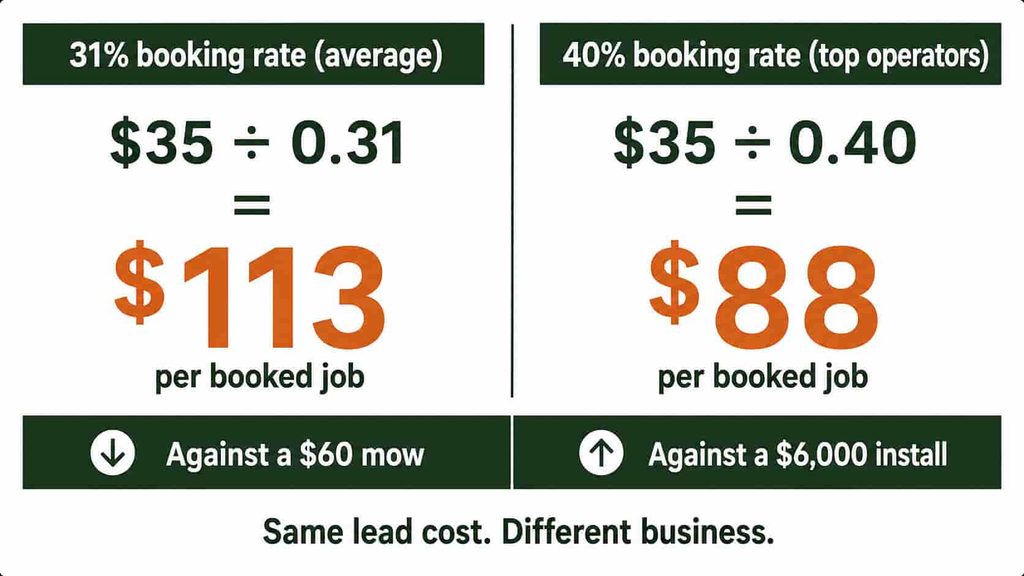
Nine points of close rate is worth more than any bid you could negotiate.
Want your real number instead of the industry’s?
The audit pulls your own cost per booked job out of the account you are already running, before anything gets changed. Free, written, about two business days. No call required, and it is yours to keep either way.
Send Me the Ad Audit →
Where maintenance contracts break the CPL math
Here is the part that appears on none of the benchmark pages ranking for this search, because it is not true for plumbers and not true for roofers.
In landscaping, a lot of leads are not worth a job. They are worth a season.
A mowing lead that turns into a recurring maintenance customer should never be valued against the first cut. Divide $113 of lead cost into a $60 mow and you get a number that says stop advertising. That number is wrong because the denominator is wrong. The right one is what that customer pays you between March and November, or what the contract is worth over three years.
Be careful here, because this is where operators quote each other figures that do not exist. There is no reliable published rate for how often a landscaping one-off becomes a recurring contract. The 30% to 40% conversion rates that circulate come out of house cleaning, and if you use them at all, use them as a rough proxy from another trade and say so.
You do not need somebody else’s rate. You need yours, and it is two numbers you already have:
- Recurring leads ÷ total leads, over one full season.
- Average season value per recurring customer.
Multiply them and you have what an average lead is really worth before you ever look at Google’s price. If one in four mowing leads stays seven months, your effective cost per lead divides into seven months of revenue, not a single $60 cut. Commercial stretches it further: one maintenance contract can run “$1,200 per month” (Blue Grid Media), which changes what the call that started it was worth.
The lead credit change nobody warned landscapers about
In July 2024, Google replaced the manual dispute process with an automated, AI-driven credit system. The “Dispute” button came out of the dashboard entirely and a “Rate this lead” button went in (Blue Grid Media).
Two full seasons have run under that system, and plenty of landscaping operators are still budgeting like they can dispute their way out of a bad month.
Here is how it works now. Charged leads are reviewed automatically “within 72 hours,” and credits “typically appear within 30 days” (BG Collective). Google’s own documentation confirms the timing and adds a detail worth knowing at invoice time: credits “will be applied to your account balance within 30 days. Note that the original lead charge will still appear on your invoice” (Google Local Services Help).
What you lost matters more than what you gained. You cannot appeal the automated decision. And two categories stopped qualifying for credit at all: “job type not serviced” and “geo not serviced” (BG Collective). Those two were the workhorses of the old process for this trade, because they covered the calls a landscaper gets wrong most often.
You still have the “Rate this lead” tool. Marking a lead “Very dissatisfied” is the only rating that can trigger a credit review, it needs a specific reason attached, and it goes in within 30 days of the lead date (BG Collective).
How often that works is worth stating plainly. Under the old manual system, managed dispute services reported approval rates “as high as 97 percent when disputes were filed correctly and promptly.” Today, operators using the self-service tool without a structured process “typically see only about 20 percent of their bad leads result in credits” (Blue Grid Media), and BG Collective puts its own managed accounts at “roughly 15–25%.” All three percentages come from agencies describing accounts they manage. None is a figure Google publishes. Treat them as directional, and treat the direction as the point.
Which changes what your profile is for. Listing your services accurately used to be a best practice. It is now your only lead-quality control. Check the snow removal box without a plow and you will pay for those calls in December and keep paying.
BASEO manages the lead rating and credit side of LSA accounts, but no agency recovers a charge under a category Google stopped crediting. The fix happens in the profile, before the lead comes in.
LSA is moving into Google Ads: what changes for your CPL
Local Services Ads are being folded into Google Ads. The campaigns become a specialized Performance Max campaign type with a pay-per-lead goal, managed from the Google Ads interface instead of the standalone LSA dashboard.
The rollout is phased (Google Ads Help):
- August 2026. The first phase covers select US home and storefront service advertisers, “including plumbing, HVAC, electrical, appliance repair, house cleaning, lawn care, roofing, pest control, and moving.”
- Late 2026. It expands to “service-area businesses without physical storefronts and accounts with custom bidding or booking configurations.” This is where most landscaping operations land.
- 2027. “Non-U.S. accounts, and all remaining business categories that were not migrated in 2026.”
Read phase one again if you run a mixed operation, because lawn care is on that list. A landscaping company running lawn care out of a storefront address can be migrating right now while the service-area crew across town waits until the end of the year. Same trade, different timelines.
| What changes | What does not change |
|---|---|
| “Your historical average weekly budget is automatically divided by 7 to determine your daily average budget” | “You still only pay for valid leads (such as phone calls and messages) rather than ad clicks” |
| Manual bidding and vertical-level Target CPA are deprecated in favor of a unified campaign-level target | Ads “will continue to show exclusively on Google Search and Google Maps” |
| “BBB callouts are no longer supported” | “Your past customer lead history…will automatically transfer to Google Ads” |
| “Your previous campaign-level performance metrics…will not migrate to Google Ads” | “Your campaign remains keywordless” |
| “You will no longer be able to access your original Local Services Ads dashboard” | The Google Guaranteed badge stays |
Source: Google Ads Help. Coverage: Search Engine Journal.
Do this before you migrate
Download your Local Services Ads performance reports now. Expect roughly two weeks of advance notice before your account moves, and up to two weeks of unstable numbers afterward while the model re-learns.
That fourth row on the left is the one that should get you out of your chair. Your lead history comes with you. The record of what you paid per lead, by month, by job type, in your market, does not.
Go back to the top of this article. Every benchmark in it is a national average that does not know your ZIP code. The one number that was ever going to be accurate for your business is sitting in a dashboard scheduled to close. Export it while it exists.
The seven job types that decide your landscaping CPL
Cost per lead is not one number inside your account. It moves by job type, and the list of boxes you check at setup does more to your blended cost per lead than any bid you will ever set.
Google’s landscaping categories group into seven families (Blue Grid Media):
- Maintenance: lawn care and mowing, fertilization and weed control, edging and dethatching.
- Design and planting: landscaping design, planting.
- Hardscaping: retaining walls, patio and hardscape installation.
- Irrigation: system installation, repair and maintenance.
- Trees and shrubs: tree trimming and pruning, shrub trimming.
- Soil and seasonal: mulching and top dressing, sod installation, seeding and overseeding, leaf removal, spring and fall cleanup, snow removal.
- Commercial: commercial property maintenance, HOA and common area maintenance.
The decision rule gets simple once you see the two shapes. Project categories (hardscaping, design, irrigation) bring more expensive leads against much larger tickets. Maintenance categories bring cheap leads that can turn into a route. Neither is right in general. They are different businesses and they want different budgets.
What is not optional: do not check every box. Since the credit change, a job type you listed and do not perform is a charge you cannot recover. Every box is a promise to answer that call.
The residential and commercial split needs its own patience. Residential leads are “ready to book within a day or two,” running “from $200 cleanup to $6,000 landscape install.” Commercial is “lower volume,” closes slower, and is worth “significantly higher,” with a single maintenance contract at “$1,200 per month” (Blue Grid Media). Judge a commercial lead on a residential timeline and you will shut off the more valuable of the two in week three.
Seasonality: the same lead costs different money in March and August
“Lead costs in landscaping are not flat throughout the year” (Blue Grid Media), and neither is your capacity to serve them. In this trade the calendar is a budget document.
| Window | What the market does | What to do with budget |
|---|---|---|
| Jan–Feb | Pre-season. Competition thin, homeowners planning | Moderate spend aimed at high-value projects and at filling the season’s contracts |
| Mar–Jun | Peak. Demand at its highest | Raise budget 40–60%. This is where the year’s volume gets captured |
| Jul–Aug | Steady. Project demand cools | Hold. Push maintenance contracts over one-off work |
| Sep–Oct | Second peak. Fall cleanup | Push hard, this window is short |
| Nov–Dec | Low. Snow markets shift | Cut back without shutting off. Capture snow removal where it applies |
Here is the calibration that stops the calendar from being obvious: more demand does not automatically mean a more expensive lead. On the paid search side of the same industry, cost per lead “drops to $40–$50” in late April and May when demand explodes, then “levels out to $80–$95” from June through August (The Valley Marketing Group). The cheapest leads of the year land in the busiest month, because volume grows faster than competition. That pattern repeats across more than LSA, which is why the season’s cost per lead by channel is worth having on one page.
One warning that costs real money: do not switch the campaign off entirely in the off-season. Google says the model takes about two weeks to learn your business, and a full stop restarts that clock, so you pay for the re-learning at the exact moment the spring rush starts. Reduce it, do not kill it.
And plan backwards. If you want to be competitive in April, the budget conversation happens in January, not in the second week of March when every other crew in town has had the same idea.
How to lower your landscaping LSA cost per lead
Your bid is the last lever, not the first. By the time you are adjusting it you have usually skipped the three things that move the number more: your reviews, how fast you answer, and whether your profile says what you actually do. All three are free, and Google weighs all three.
Reviews are the lever, not the bid
Review count is the strongest ranking input LSA has, and the thresholds are specific enough to plan against (Blue Grid Media).
A 4.0-star rating is “required to maintain an active LSA listing.” Below 3.0, “Google automatically pauses your LSA listing” for you. Profiles with “50+ reviews get significantly more impressions than those with fewer than 10.” In competitive markets, “4.7 stars or higher” is the entry price for the top three, and “4.8-star rating or higher strongly correlates with consistent top-3 rankings.”
Velocity matters more than a static count. A profile that added twelve reviews this quarter outranks one sitting on forty since 2023, and answering a bad review within 24 hours limits what it costs you.
So make it a system instead of a resolution. Ask on the day of the final visit, from the crew lead’s phone, with the link already open. Those three specifics are the difference between a review program and an intention.
Your trade has an advantage here that nobody in it uses. Your customer is standing on the finished patio the same afternoon your crew packs up. An HVAC customer cannot see the ductwork. A plumber’s customer never sees the work at all.
You get the best moment to ask in all of home services, and most crews drive away without using it. That is what BASEO’s review work is: a request system built around the finished job, so the ask lands on the day the work is still in front of the customer.
[SCREENSHOT: A Google map pack for a landscaping search where the review counts tell the story: the top result has a large review count and the third result has almost none, at nearly the same star rating.]
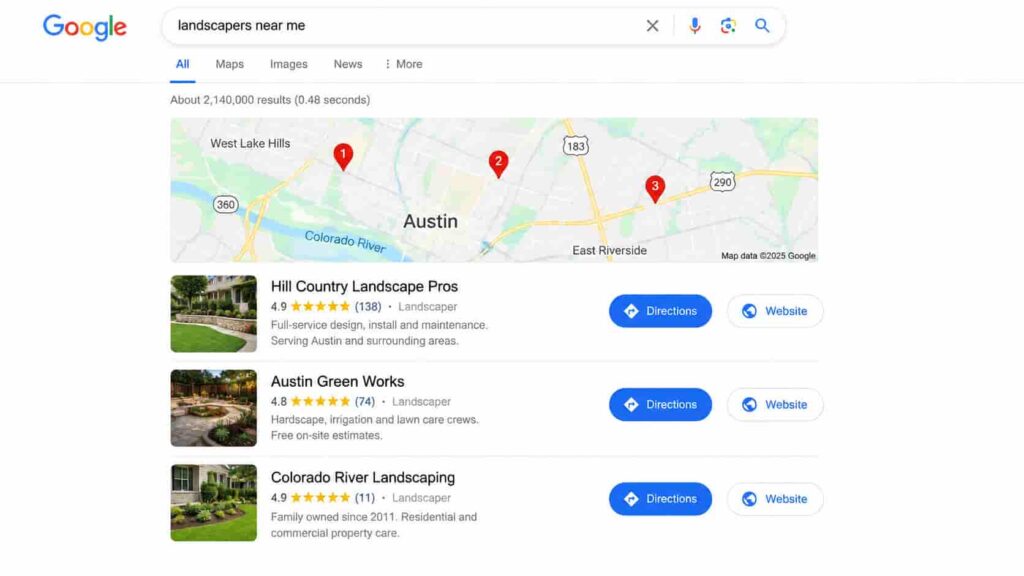
Same rating, twelve times the reviews. That gap is the ranking difference, and it compounds.
Answer speed, decline discipline and profile accuracy
Three rules, and none of them costs anything.
Answer during the hours you told Google you are open. Those response-time numbers from the math section are not a curiosity, they are your close rate: 31% inside the hour, 27% at one to four hours, 15% after a day. If your declared hours say you answer until 6pm, answer until 6pm or change the hours.
Reply to the jobs you turn down. Enrich Labs puts it in four words: “Reply to messages you will decline. Silence hurts rank.” The same source notes that “serious or repeated negative feedback can lower rank or stop the ad from showing” (Enrich Labs). Declining a job you cannot take is a normal business answer. Ignoring it is a ranking cost.
List your categories honestly, and pause when you are full. Paying for leads you cannot serve costs you twice: once at the invoice, once at the ranking, because unanswered and badly-handled leads feed back into position. And since the credit change, your profile is the only lead-quality control you still own.
Those three are the only things on this page you can change before Friday.
Running LSA and Google Ads together without double-paying
The question underneath this one is usually “am I paying Google twice for the same customer.” You are not, and the reason is placement. LSA units sit above the search ads and catch a different moment: the homeowner who wants a call made now. Search ads catch the one who is still reading.
The cost difference is real. LSA “can run 30–40% cheaper per lead than non-branded search in the same market,” according to The Valley Marketing Group. On the search side, Get X Media’s landscaping benchmarks put standard-tier Google Ads cost per lead at $137 to $343, against a home services category figure of $125. LocaliQ’s measured average for landscaping search comes in lower, at $117.92, which tells you how much the answer moves with the sample. Read either as a shape rather than a price.
One uncomfortable number from those benchmarks, included because leaving it out would be selling you something: landscaping’s category click-through rate is about 4.69%, “among the lowest in home services,” on traffic with high commercial intent. People search for you and scroll past you. That is a landing page and ad copy problem, worth knowing before you blame the channel.
The split that works: LSA first for maintenance and the fast-response job types, where winning means being the call that gets answered. Paid search for project terms and the longer research queries, where the homeowner compares three portfolios before he dials.
But the structure is worth more than the split. One landscaping operator we run ads for cut cost per lead from $84 to $43 in six months on the same budget (BASEO client data), and none of that came from moving money between channels. It came from what each campaign was allowed to bid on. And since this is an article about paying Google: ad spend goes straight to Google, never marked up.
Ads book jobs now. Organic makes every job after that cheaper. The two paid surfaces catch different intent, which is why running both is not double paying. What Google Ads costs per booked job has its own math, and its own piece.
What it takes to get approved as a landscaper
Approval is paperwork, and it is not instant.
Google requires proof of general liability insurance from every landscaper. Some states also require a landscaping license or a pesticide applicator license. Background checks are required for owners and field employees, and “in some markets they take more than a week” (Blue Grid Media).
The planning consequence writes itself. If you want to be running when the spring calls start, the paperwork goes in during January. Not February, and not the week the phone starts ringing, because a background check queue does not care about your season.
What you get is the Google Guaranteed badge and Google’s backing behind the work: if a customer is not satisfied with a job booked through Local Services Ads, Google may reimburse them up to a coverage limit that varies by market (Google Local Services Help). That badge does real work. A homeowner choosing between three crews he has never heard of takes the one Google vouched for.
BASEO handles profile setup, verification and screening for the crews we run LSA for, because the thing that sinks a spring launch is not the paperwork itself. It is finding out in March that a field employee’s background check has been sitting in a queue since February. The insurance and the licenses have to be yours.
Is LSA worth it for your landscaping business?
It is worth it if four things are true: you answer the phone inside the first hour, you have the reviews to compete, your profile lists only what you do, and you measure cost per booked job instead of cost per lead.
If three of those four are missing, LSA does not fail quietly and tell you. It keeps selling you leads you never close, at a price that looks reasonable on the invoice.
BASEO runs Local Services Ads, SEO and paid media for landscaping companies, and the team on your account works only with this trade. If you want your real cost per booked job, we pull it from the account you already run, with your job types ranked by what each costs to book. Free, written, about two business days, no call, and you keep it.
Frequently asked questions about landscaping LSA cost per lead
Landscaping leads on Google Local Services Ads typically cost between $20 and $55 in most U.S. markets, among the lowest of any home service trade. Large metros trend higher and rural markets lower. Your actual cost is set by what competing local businesses bid on the same lead.
Usually yes. Local Services Ads can run 30–40% cheaper per lead than non-branded search in the same market, because you pay per lead rather than per click. Standard Google Ads leads for landscaping have been reported between $137 and $343, against $20–$55 on LSA.
Not the way you used to. Google replaced manual disputes with an automated review that checks charged leads within about 72 hours and credits invalid ones on its own. You can still flag a lead through “Rate this lead,” but “job type not serviced” and “geo not serviced” no longer qualify.
Any CPL that keeps your cost per booked job well below your average ticket. At a 31% booking rate, a $35 lead means roughly $113 per booked job. A $25 lead you never close is more expensive than a $55 lead you do. Measure booked jobs, not leads.
Google requires proof of general liability insurance for all landscapers, and some states additionally require a landscaping or pesticide applicator license. Background checks are required for owners and field employees and can take more than a week in some markets, so start before your busy season.
Your monthly maximum is your average weekly budget multiplied by 30.4 and divided by 7. A $750 weekly budget caps near $3,257 a month. Set the budget from crew capacity, not ambition: at a $35 lead cost, $750 a week means roughly 21 estimates to run.