You put a thousand dollars into Google Ads last spring. Inside a week you had calls: somebody asking if you were hiring, somebody pricing mulch by the yard, and a homeowner forty miles out who wanted a retaining wall quote you were never going to drive to. Nobody booked. You shut it off and decided Google Ads does not work for landscaping.
It works. It just does not work by default, and almost nothing written about it is written for your trade.
Here is the number that decides everything and the one nearly nobody in this business tracks: not what a click costs, not what a lead costs, but what a booked job costs. Landscaping search ads average $117.92 per quote request. At a 30% close rate, that is about $393 to put one job on the schedule. Whether $393 is cheap or ruinous depends entirely on which service that job is, and that is the whole argument for how the account gets built.
- Do Google Ads work for landscaping?
- What Google Ads costs a landscaping business
- The number that tells you whether to keep spending
- Build the account around margin, not search volume
- Where landscaping ad budgets actually die: the page the click lands on
- Local Services Ads, and the change Google made in August
- What to spend, and when in the season to spend it
- Ads book this month. Organic makes every month after it cheaper.
- What to do next: see where your ad budget is leaking
- Google Ads for landscaping FAQs
Do Google Ads work for landscaping?
Yes, but only three kinds of search are worth your money. The ones where you need to say something the map pack cannot say for you. The ones attached to a job big enough to justify a $393 cost per booked job, which in this trade means hardscape, irrigation or turf. And the ones where Local Services Ads simply are not offered in your market, so paid search is the only seat above the fold.
Outside those three, ads still run. They just run badly by default, which is a different problem from not working.
The default account bids broadly on the word “landscaping,” fences a lazy radius around your zip code, collects no negatives, and sends every click to a homepage. It spends a thousand dollars and produces exactly what yours produced: a job seeker, a price shopper, and a guy forty miles away.
So the honest read is not that the channel failed you. The account did. That matters because the fix is cheap and the channel is not replaceable. If you need work on the schedule three weeks from now, paid is the only lever that moves that fast.
This trade does start from worse numbers than the rest of home services, though. Running green industry ad accounts is a service BASEO sells, and the first thing we put in front of anyone is that baseline, because a budget set against the wrong number is exactly how the last thousand dollars disappeared.
What Google Ads costs a landscaping business
Here is what landscaping search ads actually cost, measured rather than estimated.
| Metric | Landscaping | Home & home improvement | What it means for you |
|---|---|---|---|
| Click-through rate | 4.69% | 6.47% | Fewer people click your ad for the same spot |
| Cost per click | $8.76 | $8.33 | Each of those clicks costs you a little more |
| Clicks that become a quote request | 6.42% | 8.05% | Fewer of them turn into somebody asking for a price |
| Cost per quote request | $117.92 | $90.92 | Every lead runs about 30% above the category |
Landscaping figures: LocaliQ home services search ad benchmarks, 3,211 US search campaigns, April 2024 to March 2025, updated July 15, 2026. Comparison column: LocaliQ 2026 search advertising benchmarks, Home & Home Improvement, updated June 1, 2026.
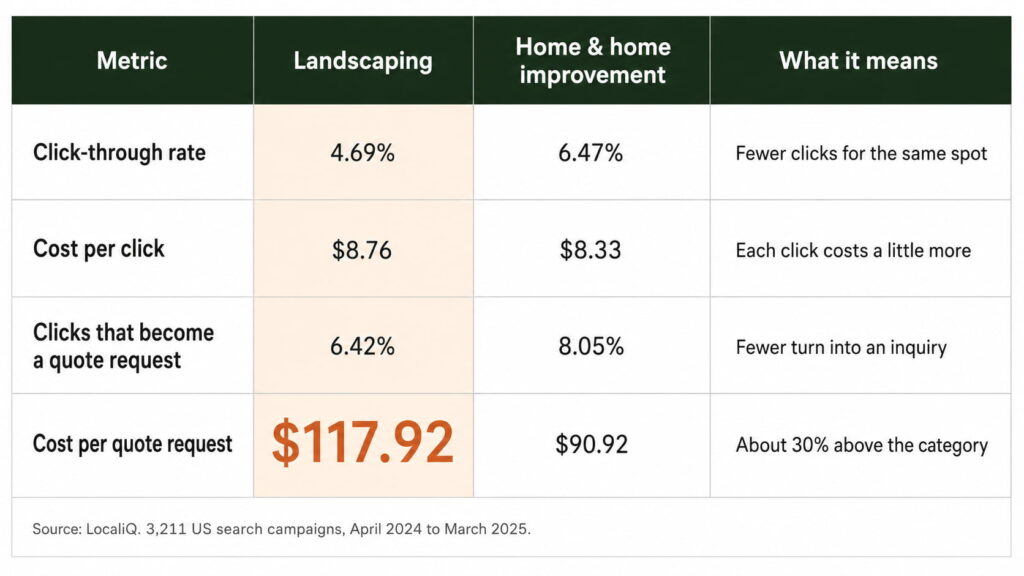
The four numbers most landscaping ad guides do not publish, side by side with the category they are usually compared to.
Read that as a starting line, not a forecast. Yours lands above or below it depending on which service you advertise, how tight your service area is, and how well the account is built. What it does tell you: if somebody quotes you a $40 lead on landscaping search ads, one of you is wrong about what a lead is.
Cost per click, cost per lead, cost per booked job
Three numbers, and they are a chain. A click is somebody landing on your page: $8.76. A quote request is somebody asking you for a price: $117.92, because only 6.42% of clicks ask. A booked job is the one that pays you, and the only one of the three that decides anything.
Almost nobody in this trade measures the third. Run it: at $117.92 a quote request and a 30% close rate, a booked job costs about $393 in ad spend.
Now watch that $393 land in two different businesses. Against a $14,800 patio it disappears; the job covers it thirty-seven times over. Against a $150 a month maintenance account it takes roughly three months of that contract to break even.
Same channel, same number, opposite verdicts. That is why those two services cannot share a campaign, and why the monthly report has to count quote requests and booked jobs with phone numbers beside them instead of impressions.
Why landscaping’s numbers are worse than the rest of home services
Look back at that 4.69% click-through rate, because it is the number that explains the other three. Of the home services categories LocaliQ measured, landscaping has the lowest one of any of them.
That is not a failure of your ads. It is a description of how people buy landscaping.
Nobody searches for a landscaper with water coming through the ceiling. There is no burst pipe version of a paver patio. Your customer opens six tabs, looks at photos, asks the neighbor who did theirs, and comes back three weeks later.
So the consequence is practical, not sad: here the ad copy and the page it lands on carry more weight than they do in plumbing, not less. The plumber survives a bad landing page because urgency does his closing. Nothing is doing yours.
The number that tells you whether to keep spending
Your ceiling is not a percentage of revenue. It comes out of gross margin, and the formula fits on one line:
Job value × gross margin × the share of that margin you will spend to win it = your ceiling per booked job.
Run it separately for your two lines of business, because they are two different businesses wearing the same truck.
Install and hardscape. A $6,000 install at a 22% to 28% gross margin is $1,320 to $1,680 of gross profit. A booked job costing $393 eats roughly a quarter of it. Expensive, and the job still pays. Move up to a $14,800 patio and the same $393 stops being a line item you can feel.
Maintenance. A $150 a month contract is $1,800 in the first year. That $393 takes about three months of it, which only works if you are looking at the three-year number instead of the first invoice. Buy maintenance customers at hardscape prices and you will be busy and broke by August.
Before you argue about ad budget with anyone, get three numbers per service line:
- Average job value for that service, not blended across everything you sell
- Gross margin on it, after materials and crew hours, not after overhead
- Your close rate on quote requests, counted from last season rather than guessed
Without your cost per booked job, every conversation about ad budget is an opinion. With it, “ads are expensive” stops being a sentence you can say. Ads are expensive for one of your service lines and cheap for the other, and the account has to know the difference.
Build the account around margin, not search volume
The keyword with the most volume is almost always the worst one in this trade.
“Landscapers near me” gets about 107,000 US searches a month at roughly $2.00 a click. “Retaining wall contractor” gets 2,200 at $4.00 (Ahrefs, US, 2026). One search in forty-nine, at double the click price, and it is the one that turns into a job you want.
Hold those two next to the $8.76 you are actually paying. Neither keyword costs that. The $8.76 is the blended price of an account bidding on both, which is another way of saying most landscaping budgets are split between a term that never closes and a term nobody set a budget for.
Split campaigns by service, not by “landscaping”
One campaign per service you sell. The high-margin lines get their own budget, separate from maintenance: patios, retaining walls, irrigation, turf.
Mixing them breaks for a boring mechanical reason. The algorithm spends where the volume is, and the volume is at the cheap end. It is not sabotaging you; it is doing what a shared budget asked, which is buy the most clicks available. Maintenance searches are what cheap clicks are made of, so maintenance quietly eats the patio budget and you never see the trade happen.
That is what BASEO’s ad management is built around: campaigns split by trade and by service, the geo fence drawn to the real service area, negatives managed instead of collected once, copy that repeats the search back to the searcher, and call tracking on every number so a booked job traces to the term that bought it. Reported in quote requests and cost per job, the same lens as organic. And since this reader always asks: ad spend goes straight to Google, never marked up.
Draw the geo fence at your real drive time
The radius is not a circle you draw on a map. It is your crew’s actual drive time, and it is a margin decision before it is an advertising one.
A job forty-five minutes out with two men on the truck loses money before anybody unloads a mower. You paid for the click, you paid for the windshield time both ways, and you priced it like it was twenty minutes out. Fence the campaign to the towns you would say yes to on a Tuesday in June, not the ones you would take in February.
One Google setting quietly undoes this. By default your ads reach people merely interested in your area, not only people in it. Set it to presence, meaning people actually located in your service area, and watch what leaves.
The negative keyword list every landscaping account needs
Negative keywords are the terms you tell Google never to show you for. Every landscaping account needs these seven groups on day one:
- Hiring: jobs, hiring, salary, careers, “landscaping jobs near me”
- DIY and tutorial: how to, DIY, yourself
- Free and cheap: free, cheap, low cost
- Training: course, school, license, certification
- Equipment for sale: mower, equipment, for sale, rental
- Suppliers and wholesale: wholesale, supplier, bulk
- Homeowners pricing materials: mulch price, sod per pallet, paver cost per square foot
Every one of those is a click you paid almost $9 for and could never have closed.
Here is the part almost nobody does: open the search terms report every month and read what people actually typed. That list is a starting point, not a finished job. Your market invents its own garbage and the report is the only place it shows up. An account nobody reads is still paying for “landscaping jobs near me” in month nine.
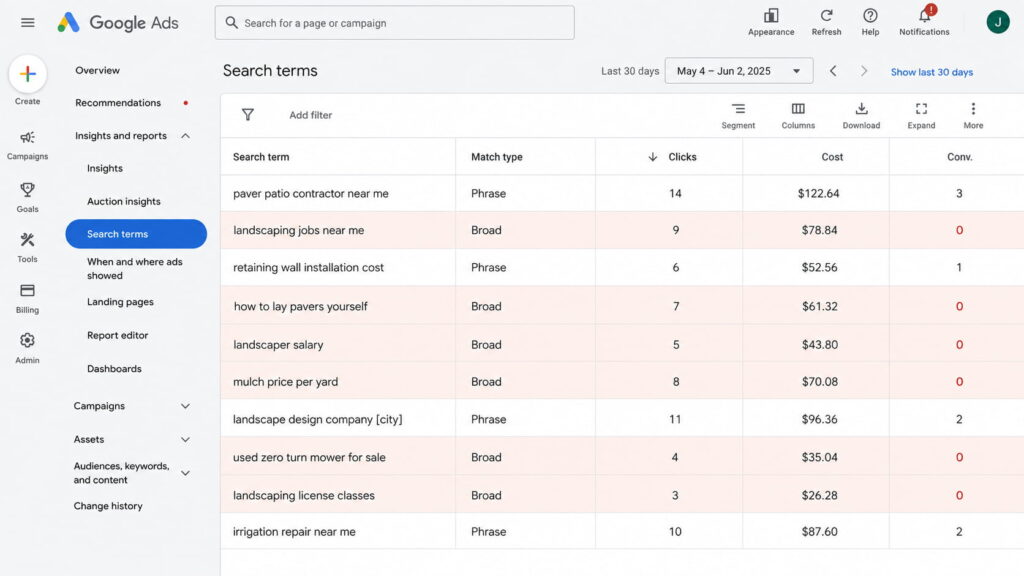
One month of search terms in a landscaping account with no negatives. The highlighted rows are the ones that were never going to book.
Where landscaping ad budgets actually die: the page the click lands on
Your ad says “paver patio.” The click lands on a homepage that says “full-service landscaping serving the greater metro area,” with a photo carousel and a contact form three scrolls down.
You just paid $8.76 to hand somebody a menu when they asked for one thing.
The rule is simple. Every service you advertise needs its own page saying back what the ad promised, with the quote form at the top and a tappable phone number on mobile, because the person reading it is standing in his own yard looking at the spot where the patio goes.
Another landscaping operator BASEO runs ads for went from $84 to $43 per lead in six months, and from 18 leads a month to 54, on the same ad budget (BASEO client data). Nobody added a dollar. What changed was the account structure and the pages the clicks landed on: campaigns split by service, negatives cleaned out, and a real page behind each ad instead of the homepage behind all of them.
That is what happened in that account. It is not a forecast for yours, and anyone showing you that chart as a promise is selling you something. What transfers is the mechanism, not the number.
The page side is its own discipline: a page per service you sell, fast on a phone, a form that reaches a human, and call tracking from day one so you know which page produced the job. Not a redesign for its own sake, just the pages the ads are already paying to fill.
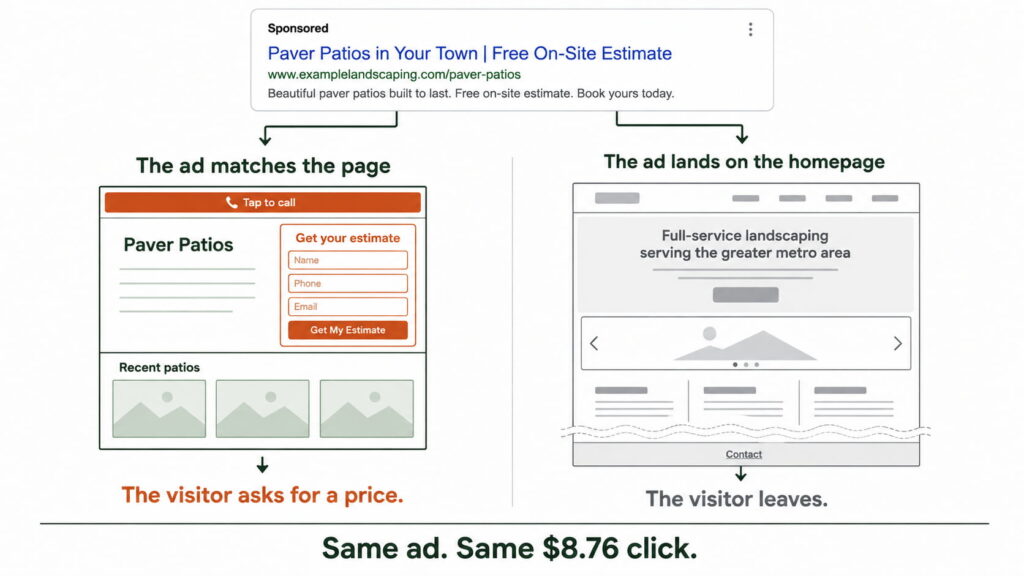
The same click, the same cost, two different destinations. This is where most landscaping ad budgets go.
If you want to know which of those is broken in your own account before you spend another month on it, that is exactly what the ad audit covers. Send Me the Ad Audit →
Local Services Ads, and the change Google made in August
Local Services Ads are the other paid option, and for a trade with the worst click-through rate in home services the difference is the whole point: you pay per lead, not per click. The homeowner who opens your gallery of finished patios, thinks about it, and comes back three weeks later costs you nothing on the way through. They sit above everything else in local results with the Google Guaranteed badge, which you only get after Google verifies your license and insurance. And the lead arrives as a phone call, not a form sitting in an inbox.
On price, be careful what you believe. Searchlight Digital measured 126,650 leads from 888 home services contractors on $6.72M of Local Services Ads spend in February 2026 and found a blended average of $53 per lead, ranging from $39 to $71 by trade. That dataset is HVAC, plumbing, electrical, drain work and water heaters, so read it as the shape of the channel rather than as your number. What it does tell you is worth having: the whole measured range sits well under the $117.92 a landscaping search quote request costs today, and the trades at the cheap end of it are the ones without an emergency driving the call. That is your end.
Now the news, which is recent enough that none of the guides currently ranking for this topic mention it.
On July 20, 2026, Google announced that Local Services Ads are moving inside Google Ads, managed as a Performance Max campaign type with a pay-per-lead goal (Search Engine Land; Google Ads Help). The rollout began in early August 2026 with a small group of US advertisers, home services included, and continues in phases through 2027.
As of August 2026: the separate Local Services Ads dashboard goes away and you manage leads and calls inside Google Ads, next to the patio and irrigation campaigns you are already running. Pay-per-lead billing does not change, so you still pay only for a call that came in, not for a homeowner who browsed your photos and left. Budgets, settings and creative assets transfer automatically, and the job photos you add to your Google Business Profile now push into the campaign on their own.
One thing does not transfer, and it is the part worth acting on this month: your historical reporting data does not migrate. Download it before your account moves, or you lose the only evidence you have of what a lead used to cost you.
Local Services Ads have not disappeared and are not going to. They are becoming a campaign type. BASEO sets them up and manages them under the same cost-per-job lens as everything else. If you run them yourself, the export is this week’s job.
What to spend, and when in the season to spend it
This is about pacing ad spend across a season. What the business should spend on marketing overall is a different question, and you budget it out of gross margin, not out of what is left over.
Start with the question everyone asks. Is $10 a day enough?
At $8.76 a click, $10 a day buys roughly one click. At a 6.42% rate of clicks turning into quote requests (LocaliQ), that is one quote request every two to three weeks. Not a budget, a coin flip repeated slowly. The first month of any account is mostly buying data about which terms turn into work, and at one click a day you will not have enough to decide anything before the season ends.
So set the floor by learning speed rather than by a dollar figure somebody made up: enough budget that each service campaign produces quote requests weekly, not monthly. If it cannot, run one service instead of three.
Then there is the calendar this trade lives and dies by. Snow belt operators need the spend live before spring breaks; Sun Belt markets peak between January and March. Either way you count backwards from the month the schedule has to be full instead of reacting to the month it empties.
You raise budget when the schedule opens up, not when it is already full. By the time you feel slow, the searches you needed happened three weeks ago. For a second channel in the shoulder months, what Facebook ads cost per lead is separate math.
Ads book this month. Organic makes every month after it cheaper.
Ads turn on this week. For an operator staring at a half-empty May that is not a small thing. What ads do not do is get cheaper: you pay the same $8.76 in year three that you paid in month one, plus whatever the auction has done since.
Organic does get cheaper. One San Antonio crew had been buying Angi leads at $78 apiece, each one sold to three other operators the same morning, and paying whether the job came in or went to one of them. That is what makes the comparison unfair: $8.76 buys a click you can improve, and $78 buys a coin flip you cannot. Six months into building pages he owns, his leads were arriving at about $11, and his organic quote requests went from 28 a month to 77 (BASEO client data).
None of that is an argument for shutting the aggregator off this week. But it is the one argument for running ads that has nothing to do with ads: a search campaign is the only replacement that turns on fast enough to cover the hole in the same month you stop buying shared leads. Organic cannot do that in month one. That is the order. Ads take the pressure off, organic takes the cost out.
The two channels run on different clocks, and anyone blurring them is lying to you. Ads can put calls on the phone in the first two to three weeks once campaigns and tracking are live. Organic quote requests typically start between month three and month five, with real volume between month six and month nine. Anyone promising organic leads in 30 days is describing ads, or making it up.
So run both on purpose. Paid fills the schedule while the pages you own lower the cost of every job after it, and work you can book in seven days covers the gap in between.
Three things stay true across both: your leads are exclusive to you and never shared with another crew, your ad spend goes straight to Google with no markup, and no BASEO client has ever been put on a 12-month contract.
What to do next: see where your ad budget is leaking
The problem is almost never the channel. It is what you are paying for and where it lands.
Checked on your actual account, the ad audit shows three things: where the budget is going, which search terms you are buying without meaning to, and the cost-per-booked-job math for your market and your service lines.
You get back the same three numbers this article kept using, run on your own account: what a click costs you, what a quote request costs you, and what a booked job costs you, by service line.
Free. No call. Written, in about two business days. Yours to keep, even if we never speak again. The audit comes before the invoice.
Google Ads for landscaping FAQs
Yes, when the account is built around one service at a time. A small crew with one campaign for its highest-margin service, a tight geo fence and a page that matches the ad will outperform a bigger budget spread across “landscaping.” The constraint is structure, not budget size.
Not for most landscaping accounts. Landscaping search ads average $8.76 per click (LocaliQ, 3,211 US campaigns), so $10 a day buys roughly one click. At a 6.42% rate of clicks turning into quote requests, that is one every two to three weeks, too slow to learn anything from.
The measured average is $117.92 per lead for landscaping, against $90.92 across home and home improvement (LocaliQ). Whether that is good depends on your close rate and job value: at 30% close on a $6,000 install it is cheap, and on a $150 monthly mow it is not.
Local Services Ads charge per lead instead of per click and sit above everything else, so most landscapers start there. Search ads earn their place when you need to control the message or sell a high-ticket service. As of August 2026, Google is moving Local Services Ads inside Google Ads.
Ads can put calls on the phone in the first two to three weeks once campaigns and tracking are live. That is the honest range for the channel, not a guarantee. The first month is mostly buying data on which search terms turn into quote requests.
Ads stop the day you stop paying, and they do not get cheaper over time. Organic does. Running both is the point: paid fills the schedule this month while the pages you own lower the cost of every job after that.