You paid to boost the post. The ad ran for nine days. Nobody called.
Most landscaping ads examples are descriptions: run a Facebook ad, try a door hanger, get a truck wrap. This page writes the ads out instead. All 15, word for word, ready to paste and swap your city into, including the offline landscaping advertisement examples that still work here. At the end, a table of what a lead costs on each.
- What separates an ad that books jobs
- Google Search ad examples
- Local Services Ads examples
- Facebook and Instagram ad examples
- Google Business Profile post examples
- Print and offline examples
- Ads that stop working after one season
- The swipe formula behind all 15
- What each of these ads costs per lead
- Which ad to run first
- Get your ads audited
- Landscaping advertising FAQs
What separates a landscaping ad that books jobs from one that just gets seen
Three things, and none of them is design.
- It names one service. Not “landscaping services.” A paver patio. A spring cleanup. A weekly route.
- It names the area. The town, the suburb, sometimes the street.
- It asks for one thing, and that thing is easy. A quote request, not a consultation.
Here is the ad almost everybody runs instead:
Quality Landscaping
Free Estimates. Call Today.
It names no service, so it matches no search anybody is typing. And it asks a man standing in his kitchen at 9pm to make a phone call, when what he wants is a number.
Hold onto that, because it sits under all 15 examples below. An ad rarely fails on the creative. It fails on the offer, and on the page it lands on.
Google Search ad examples for landscapers
Search is demand that already exists. The ad does not have to create the want. It only has to win the click against four others saying the same four words.
It is also the priciest click here. Across Home & Home Improvement accounts the average click runs $8.33 and the average lead $90.92 (LocaliQ, 2026 benchmarks). Most of that leaks through search terms nobody meant to buy, which is a question of how the account is built, not of copy. BASEO splits green industry campaigns by service rather than running one that covers six of them, because bidding “landscaping” against “paver patio” out of the same budget is how the money goes.
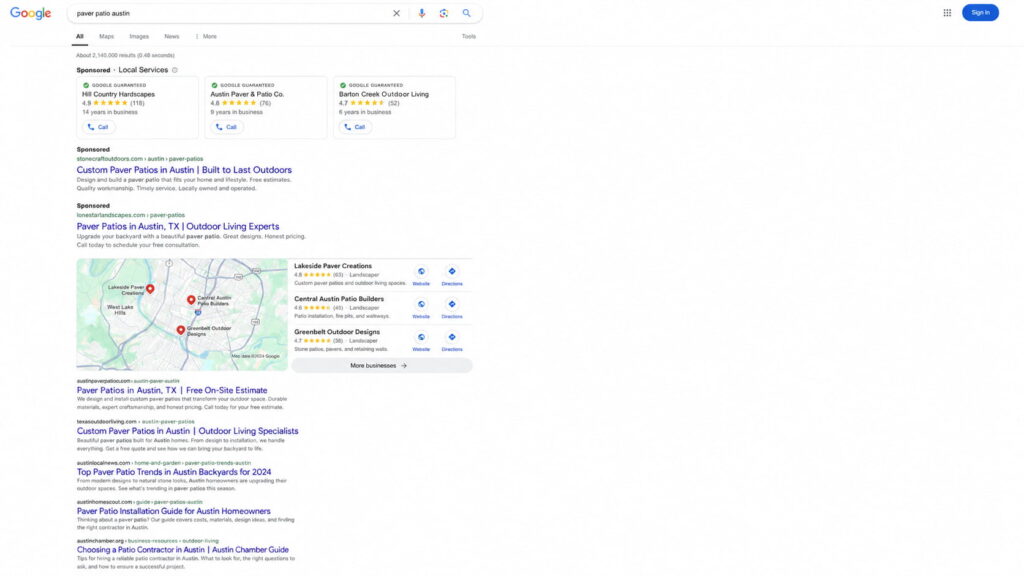
The whole vertical in one screen: pay-per-lead units, then paid clicks, then the map, then the pages you own.
Example 1: The design-build ad (high ticket, long consideration)
Headline 1: Paver Patio Installation in Naperville
Headline 2: 200+ Patios Built Since 2011
Headline 3: See the Portfolio Before You Call
Description: Design, base prep and install by one crew, not three subs. Photos of every job we have built in DuPage County. Written quote in 24 hours.
Display path: yoursite.com/patios/naperville
Why it works
- Service in the first headline, so the ad matches what he typed.
- The action is “see the portfolio.” Nobody books a five-figure job off a headline.
Swap this: headline 1 takes service and city together. Headline 2 takes whatever proof your photos can back.
Example 2: The cleanup ad (fast money, low ticket)
Headline 1: Spring Cleanup in Naperville From $285
Headline 2: Beds, Edging, Haul-Away
Headline 3: Crews Booking Through April 12
Description: One crew, one day, everything hauled off site. Book a date online and we confirm the same afternoon.
Display path: yoursite.com/spring-cleanup
Why it works
- The entry price filters tire-kickers before they cost you a click.
- The urgency is a real date off your calendar, not “act now.”
Swap this: the date. If it is not a date you would give a customer, do not print it.
Cleanups bring one-time customers. Their value is that they put your crew on the property, where the contract conversation happens.
Example 3: The maintenance contract ad (recurring revenue)
Headline 1: Weekly Lawn Maintenance in Naperville
Headline 2: Same Day, Same Crew, One Monthly Price
Headline 3: $150/mo, No Contract Lock-In
Description: Serviced the same day every week by the same two guys, on a fixed route. Monthly billing, cancel with 30 days.
Display path: yoursite.com/maintenance
Why it works
- It sells the route, not the cut. Reliability is what a repeat customer buys.
- Crew consistency is the one promise most competitors cannot make.
Swap this: the monthly figure, and only to a number your route density supports.
Run that $150 out three seasons and the customer is worth $5,400, which is why a $60 lead on this ad and a $60 lead on the cleanup ad are not the same purchase at all. If your book leans on recurring maintenance work, that gap is the business.
Local Services Ads examples: what you actually control
In Local Services Ads you do not write an ad. Google builds the unit from your profile, and there is no headline field to be clever in.
What you control is the profile and the behavior behind it: services selected, area served, review count and rating, how fast you answer, and the Google Guaranteed badge.
That matters more than copy would, because of the pricing. Local Services Ads charge per lead rather than per click, and a lead outside your area or your service list can be disputed (Google Local Services Help). It is also a phone call, not a form. BASEO sets these up and runs them on the same lens as everything else: cost per lead, cost per job, bad leads disputed rather than absorbed.
Example 4: The Google Guaranteed profile that gets picked
No copy to show, so here is the unit broken out field by field.
| Field | The profile that gets picked | The one that gets scrolled past |
|---|---|---|
| Business name | Hill Country Hardscapes | Hill Country Hardscapes LLC Landscaping & More |
| Categories selected | Patio, retaining wall, landscape design | All 14 available |
| Rating and reviews | 4.9, 118 reviews | 4.8, 9 reviews |
| Years in business | 14 | Blank |
| Google Guaranteed | Yes | Not yet verified |
| Typical response | Under 5 minutes | Next business day |
The last row decides more of this than the first five. Answer inside five minutes or that homeowner has already spoken to the crew listed under you, and you paid for the lead either way.
Facebook and Instagram ad examples for landscaping
Nobody on Facebook is looking for a landscaper, which is the whole difference. On Search you are catching a homeowner who already decided he wants a patio. Here you are catching him three weeks earlier, staring at the same tired backyard he has stared at every summer, and the photo has to be the thing that makes him look at it differently.
Which is why before and after is the native format of this trade. Targeting and what Facebook ads cost is a separate question. This is the creative.
Example 5: The before-and-after that sells the transformation
Primary text:
This backyard in Wheaton was 400 square feet of dead sod and a drainage problem.Six days of work: regrade, base prep, 400 sq ft of pavers, and a seat wall along the north side. The homeowner asked for a fire pit on day four. That is in the second photo.
Booking hardscape installs for June and July now.
Headline: Paver Patios in DuPage County
Button: Get Quote
Why it works
- The first line survives the “see more” cut and still says where and what.
- Six days. 400 square feet. Job numbers, not adjectives.
Swap this: the town, the square footage and the material.
The photo spec matters as much as the copy: same angle on that same backyard, same time of day, no filter. A before shot at noon paired with an after at golden hour is a lighting change, and a homeowner who has priced two patios can tell. And the photo has to be from your own job, with the customer’s permission before it runs.
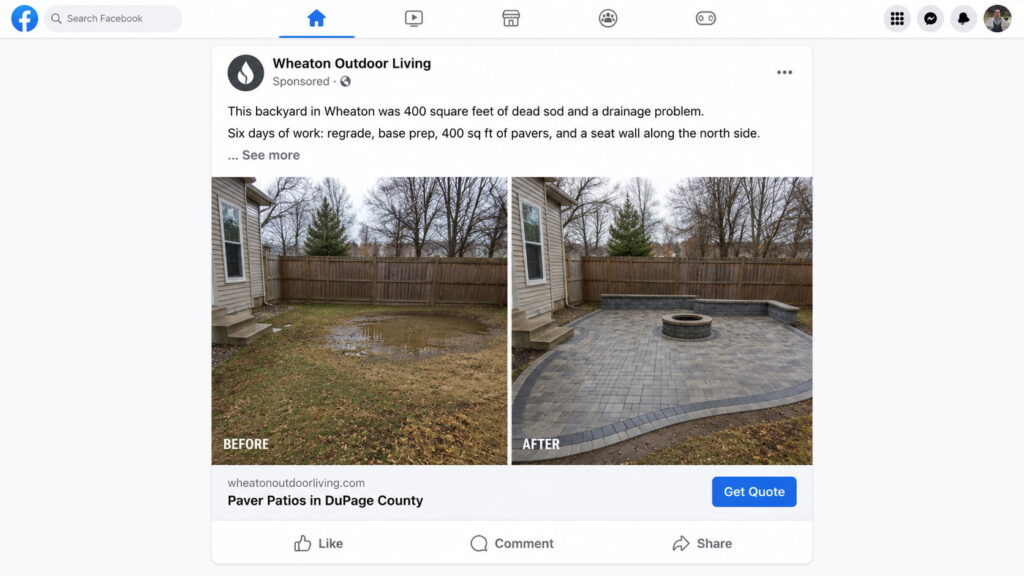
Same angle, same light, no filter. The before shot does more work than the after shot.
Example 6: The neighborhood ad (radius targeting around a job you just finished)
Primary text:
We just rebuilt a patio on Ridgewood Ave, two streets over.Same crew is in the neighborhood through the 22nd. If you have been putting off a patio, a walkway or a wall, we can walk it while we are already here.
Quotes in 24 hours. No sales visit.
Headline: Hardscape Crew Working Two Streets Over
Button: Get Quote
Why it works
- It names a street. Nothing else here buys that much credibility for that little.
- The constraint is true: the crew leaves on the 22nd.
Swap this: the street and the end date, every time you finish a job.
The mechanic is a 1 to 2 mile radius around the job you just finished, a small budget, 7 to 10 days, then off. Why it beats a cold lead has nothing to do with targeting theory and everything to do with your truck: the drive time is already paid for. Two jobs on Ridgewood in one week is a different margin than two jobs forty minutes apart.
Example 7: The off-season offer that keeps the crew paid in January
Primary text:
Book your spring hardscape install now, pay 20% down, and we start the first week the ground allows.January deposits get first dates on the calendar. By March we are quoting June.
Also running leaf cleanup and winter pruning through the 15th.
Headline: Spring Patio Installs, Booked in January
Button: Get Quote
Why it works
- The offer is a calendar position, not a discount. That costs you nothing.
- It gives a January reason to act on a June job.
Swap this: the deposit percentage and the cutoff date.
Do the January arithmetic before you decide a discount hurts. Ten percent off a $12,000 spring install is $1,200. A two-man crew standing in the shop for that same week costs more than that in wages alone, and it does not book a June date. The click is cheaper too, since fewer competitors bid in the dead months.
Google Business Profile post examples (the free ad most landscapers skip)
The Google Business Profile post is the only free ad on this list, and it shows up where the decision is already being made: the map.
The profile underneath it does the heavy lifting. Google states plainly that “businesses with complete and accurate info are more likely to show up in local search results” (Google Business Profile Help). BrightLocal’s 2019 study of 45,000 profiles put the average at 59 customer actions a month, split roughly between website clicks, calls and direction requests (BrightLocal). Most landscapers never reach that floor, because half the profile is empty.
Which is why BASEO puts the profile back together before it writes a single page for a new client: a post can only work as well as the profile carrying it. If the categories and the service list do not match what the post is about, the post has nowhere to surface, and posting weekly will not fix that. The rest of the map pack playbook comes after that.
Example 8: The job-of-the-week post
Finished a 320 sq ft paver patio in Glen Ellyn this week, with a seat wall and a step down to the yard. Three days, one crew.
We build patios, walkways and retaining walls across DuPage County. Planning one this season? Send the dimensions and we will send back a written number.
Button: Request a quote
Why it works
- Service, neighborhood and size named in two sentences.
- It ends in a request that takes 30 seconds.
Swap this: all of it, once a week, from a job you already finished. If the crew took a photo, you have a post.
Example 9: The seasonal offer post
Fall cleanup crews are booking now. Beds cut back, leaves hauled, gutters cleared, mulch refreshed.
$50 off cleanups booked before October 31. After that we are into the November backlog and dates get tight.
Button: Request a quote
Why it works
- Real expiry date, real reason behind it.
- The scarcity is your calendar, which is honest and also true.
Swap this: the date, and then honor it. A “20% off” banner that has sat on your profile since March is not an offer. It is your price, and you trained everyone in town to wait for it.
Print and offline landscaping advertisement examples
Print is dead almost everywhere and it is not dead here, for two reasons specific to this trade. Your work is visible from the street, so the ad is standing in the yard whether you paid for it or not. And your market is a short radius, so paper can cover it.
The trap is measurement. A door hanger carrying your main number and your homepage produces calls you cannot attribute, and what you cannot measure you repeat badly for three seasons. Every offline piece gets its own trackable number and its own URL, or it does not get printed.
Example 10: The door hanger for the street you’re already on
FRONT
WE’RE WORKING AT #142 ON YOUR STREET THIS WEEK
Patios, walkways and retaining wallsBACK
While our crew is on Ridgewood Ave through Friday, we are quoting neighbors at no charge and no obligation. Written quote in 24 hours, no sales appointment.
Call or text (630) 555-0148 · yoursite.com/ridgewood
Why it works
- The hook exists only in this channel. No digital ad can say “we are on your street right now.”
- The URL is street-specific, so every lead is attributable.
Swap this: the house number, the street and the URL slug.
They go out the same day the crew is there, not the week after. EDDM postage runs $0.26 a piece through USPS with printing on top (USPS), and hand-delivering the street you are parked on skips the postage entirely. The response rate will look terrible on paper, and on a $3,000 ticket that is not the number that decides it: 200 pieces that produce one patio was a good week.
Example 11: The yard sign that names the job
PATIO & RETAINING WALL
BY WHEATON OUTDOOR LIVING
(630) 555-0148 · yoursite.com/patios
Why it works
- It names the job the neighbor is currently staring at.
- The URL goes to the patio page, not the homepage.
Swap this: the service line, per job.
“Landscaping by Wheaton Outdoor Living” converts worse, and the reason is obvious once you see it. The neighbor is not thinking about landscaping. He is looking at a patio. Ask before you plant the sign, and agree on a removal date.
Example 12: The direct mail postcard for a $10K+ patio
FRONT
One full-bleed photo of a finished patio. Overlaid text: A patio like this in Hinsdale takes about six days.BACK
We build paver patios, seat walls and outdoor kitchens across Hinsdale, Clarendon Hills and Western Springs. 200+ built since 2011, every one by our own crew.
Send us your dimensions and we will send back a written number in 24 hours. No sales visit.
yoursite.com/hinsdale · (630) 555-0148
Why it works
- One photo and one sentence on the front. That is all the attention a postcard gets.
- The back carries proof and a low-friction ask, in that order.
Swap this: the towns and the photo, which should be a job you did in one of them.
Now the arithmetic that decides whether you mail at all. Postage is $0.26 a piece before printing (USPS), so a 2,000-piece drop runs a few hundred in postage and a few hundred more in print. Against a $14,000 patio one job covers that several times over. Against a $180 mow it never does. Postcards for hardscape, never for mowing: the ticket decides it, not the creative.
Example 13: The truck wrap as a rolling ad
PATIO & HARDSCAPE INSTALLS
NAPERVILLE + DUPAGE COUNTY
(630) 555-0148 · yoursite.com
Why it works
- Four lines, all readable from the next lane.
- It names one thing you want to be known for, not everything you do.
Swap this: nothing, for three years. That is the point.
What kills a wrap is the list: nine services in small type, four social icons and a tagline nobody reads at 45 miles an hour. A wrap costs thousands and amortizes across every season the truck is on the road, so it gets designed once and left alone.
Ad examples that stop working after one season
The next two are not ads. No budget line, no auction, no targeting screen.
They belong here because they compete for the same dollar and win almost every time. Both talk to somebody who already knows your name, which is a shorter conversation than any ad has ever had.
Example 14: The referral ask, written down
Hi [Name], the patio is finished and the crew is off your property.
One ask: if a neighbor mentions they are thinking about something similar, would you pass along my number? I pay $150 for any referral that turns into a job, and it comes as a check, not a discount on future work.
Either way, thanks for having us out. Text me if anything settles or shifts this winter.
Why it works
- Sent the day the job ends, when the customer is looking at brand new work.
- It names the amount, which converts far better than “we appreciate referrals.”
Swap this: the amount, by job type.
Pay more for the neighbor two doors down than for a referral across town, and pay it without flinching: that job carries no drive time and no marketing cost at all. There is more on what to pay for a referral.
Example 15: The reactivation text to last year’s customers
Hi [Name], it’s Dan at Wheaton Outdoor Living. We did your fall cleanup last October.
We are scheduling spring cleanups for the week of March 24. Want me to put you on the list? Reply yes or no.
Why it works
- 40 words, one question, and the answer is one syllable.
- A real date makes it a scheduling message rather than a sales message.
Swap this: the date and the service. Send it every February.
You need consent to text a customer and every list needs a working opt-out. It is still the cheapest lead in the trade and it is not close: the customer is already in your phone and the price conversation happened last year.
Landscaping ad copy: the swipe formula behind all 15
Read the 15 back to back and the same shape sits under every one:
[Specific service] + [Area you serve] + [One piece of proof] + [One thing to do next]
There is no fifth element. What follows is the block to copy.
Headlines you can swap your service into
- [Service] in [City]: [Proof point]
- Booked Through [Month]? Get on the [Service] List
- [City] [Service] Crews Book Out by [Month]
- Written [Service] Quote in 24 Hours, [City]
- [N] [Service] Jobs Built in [City] Since [Year]
- [Service] Starting at $[X] in [City]
- Your Neighbor on [Street] Just Booked a [Service]
- [Service] Installs for [City], No Sales Visit
- Planning a [Service] for [Season]? Here Is the Wait
Notice what is not on that list. No slogans, because a slogan is not a headline. A headline makes a specific promise to somebody searching for a specific thing right now. “Where Quality Grows” makes no promise, matches no search and has never once produced a quote request. If your headline would work equally well on a coffee mug, it is a slogan.
Offers that don’t shred your margin
Four types, ranked from least damaging to most:
- Bundle. Patio plus walkway, cleanup plus mulch. You raise the ticket instead of cutting the price, and the second service usually carries better margin than the first.
- Entry price on the first service. First month of maintenance, or a first cleanup at a fixed rate. You are buying the relationship, not the job.
- Free add-on with a big job. Throw in the fire pit on a $20,000 install. It costs materials and an afternoon, and it closes at full price.
- Percentage off. Last, and by a distance.
Here is why the percentage is worst, on a $3,000 patio. Ten percent off is $300 straight out of margin, not revenue, so at 25% margin you gave away more than a tenth of the profit and nothing changed about what he bought. The same $300 spent on a free fire pit costs you $180 in materials and leaves the invoice intact.
The CTA mistake that kills good landscaping ads
“Call for a free consultation” is on half the landscaping ads running today, and it is the most expensive line in this article.
It fails twice. It asks for a phone call from a man who does not want to talk to a salesperson, and it offers a meeting when what he wants is a number.
Replace it with one of these:
- Get your quote
- See what a patio costs in [City]
- Written quote in 24 hours
Then make sure the click lands somewhere that can deliver it. Four fields: name, address, service, photo upload. Not twelve, and not a quote form that works in theory but emails an inbox nobody has opened since spring.
Two of these three are usually wrong on an account that is not booking, and it is rarely the one the owner suspects. A free written audit will tell you which two, on your own account, before you rewrite a single headline. Send Me the Ad Audit →
What each of these ads costs per lead
| Channel | Cost per lead | First lead lands | Ticket it closes against |
|---|---|---|---|
| Shared lead marketplaces | No published benchmark. One landscaping crew was paying $78 a lead, and you pay whether you close it or not (BASEO client data) | Days | Any, but you are bidding against the four crews who bought the same phone number |
| Google Search | ~$91 average, Home & Home Improvement (LocaliQ, 2026) | Days | Design-build and hardscape, $3K up |
| Local Services Ads | Per lead, varies by market and service. No published green industry benchmark | Days | Maintenance, cleanups, mid-ticket installs |
| Facebook / Instagram | No published green industry benchmark. Judge on cost per booked job | 1 to 2 weeks | Visual, high-ticket work |
| Google Business Profile posts | $0 in money. About 15 minutes a week | Weeks | Whatever you already rank for |
| Door hangers | $0.26 postage per piece via EDDM, printing on top (USPS). Free if hand-delivered | Same week | $3K up, street-level |
| Direct mail postcards | Same per-piece math at a larger drop | 2 to 4 weeks | $10K up. Patios and walls only |
| Yard signs | One-time cost, amortized across seasons | Months | Whatever the sign names |
| Referrals and reactivation | Whatever you choose to pay per referral | Same week | Any ticket, and it closes highest |
Every benchmark above carries its source and its date, and none of them is a projection for your market. Two rows are not benchmarks at all: the first and the last are what specific companies paid, which is a different kind of number and is labelled as such.
That first row is the one to look at hardest, because it is the only channel on the list where the lead is not yours. One San Antonio landscaping crew was paying $78 for a shared lead and, six months into building pages it owns, was getting leads at about $11 (BASEO client data). Those two numbers are not the same purchase at two prices. The $78 buys a phone number four other crews are dialing this morning. The $11 buys one nobody else has.
Now a second landscaping company, a different account and a paid one. Its cost per lead was $43 in month six, down from $84, with the ad budget untouched (BASEO client data). Forty-three dollars is not the interesting part. Divide it by your close rate.
At a one-in-four close, that is roughly $172 of ad spend behind every booked job: under 6% of a $3,000 install, and invisible against a $14,000 patio. That is one account, not an average, and the number you care about is the one that comes out when you put your own close rate in.
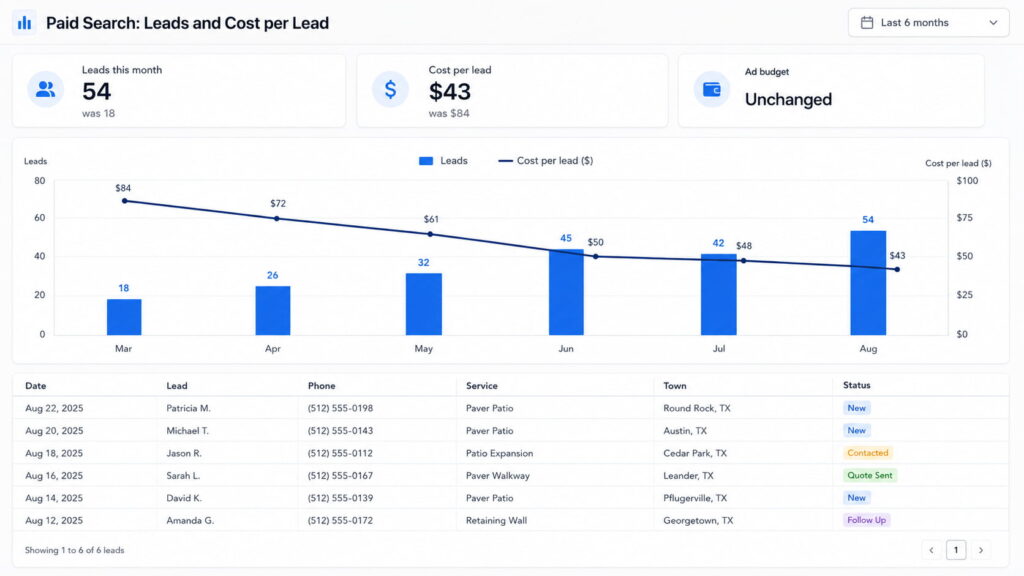
Same budget, six months apart. The number that matters is not on this screen: it is what a booked job cost.
Cost per lead is the number every platform hands you. Cost per booked job is the number that decides whether you keep spending, and no platform will calculate it for you.
How to know which ad to run first
There is no universal order. There is an order for the situation you are in this week, and the first question is how fast you need to book work in seven days rather than in ninety.
Crew idle and next week is half empty. Local Services Ads and Google Business Profile posts. Both produce phone calls in days, and neither needs a landing page built first.
Schedule full but the tickets are small. Search ads on design-build and hardscape terms, plus a postcard drop into the two towns your best jobs came from. You are buying ticket size, not volume.
Off-season, nothing on the calendar. The off-season offer, then the reactivation text. One fills spring dates, the other costs nothing.
Budget below what search needs. Google Business Profile posts, referrals and door hangers first. Ads after.
That last one deserves a number instead of an opinion. At $8.33 a click, a hundred dollars buys twelve clicks, and twelve clicks is not a test, it is a coin flip you paid for. Work backwards from the click cost in your market: enough clicks for a handful of leads, times enough months to see whether they close. If that number is more than you can commit, run the free channels until it is not. Where it sits against everything else you spend is a question of budget and channel order.
Get your ads audited before you spend another dollar
The ad is almost never what failed. The offer was wrong, or the page behind it could not take a quote request.
So the ad audit reads the offer and the destination, not just the spend. Five things: what the ad promises, whether the page it points at can deliver that promise, whether your profile is filled out well enough to get picked in the first place, what a lead is costing you today, and how many minutes pass before somebody answers one. It comes back as a document in about two business days. No call, nothing to cancel, no 12-month contract behind it.
Landscaping advertising FAQs
A landscaping ad should name one specific service, the city or neighborhood you serve, one piece of proof, and one action. “Patio installation in Naperville. 200+ built since 2011. Get your quote in 24 hours” outperforms “Quality landscaping, free estimates” because it tells the reader what you do and what happens next.
There is no single best channel. It depends on how fast you need work. Local Services Ads and Google Business Profile posts bring calls within days. Google Search ads work for high-ticket design-build. Facebook before-and-afters and neighborhood targeting build demand. Referrals stay the cheapest lead you will ever get.
Most landscaping companies spend between 5% and 10% of revenue on marketing, weighted higher when growing or entering a new market. What matters more than the percentage is your cost per booked job: if a $3,000 job costs $300 in ads to win, the spend is working regardless of the budget line.
Yes, but not as lead-generation ads on their own. Facebook works for landscaping when the creative is a real before-and-after from your own job and the targeting is a tight radius around work you just finished. Boosting a generic post to your whole county is the version that wastes money.
For street-level work, yes. Door hangers convert best when they are dropped the same day your crew is on that street and the copy says so. Response rates are low by design, so they only pay off when the job ticket is high enough and the phone number on the piece is trackable.
Get specific where competitors are vague. Name the exact service instead of “landscaping services,” name the neighborhood instead of the metro, show one real project photo instead of stock imagery, and replace “call for a free consultation” with a quote request that takes under a minute.