
Most “real estate keyword” lists were built to rank a blog, not to run an ad. So they lean on high-volume, informational terms that read great in a traffic report and quietly drain a paid budget. This list of real estate keywords for ads does the opposite. It’s grouped by intent, ready to paste into a campaign, and it works whether you’re a realtor chasing listings or a cash home buyer chasing motivated sellers. You’ll get 150+ keywords sorted by buyer, seller, and investor intent, plus how to actually use them: match types, negative keywords, ad-group structure, and 2026 CPC benchmarks. No theory. Pick your groups and build.
- What makes a keyword good for ads (and different from SEO)
- Start with intent: the 3 buckets that decide your ROI
- 150+ real estate keywords for ads, grouped by intent
- Match types: telling Google exactly what to buy
- Negative keywords: the list that protects your budget
- How to group these keywords into ad groups
- 2026 CPC and cost-per-lead benchmarks by keyword type
- Free tools to expand your keyword list
- Mistakes that quietly burn your ad spend
- Turn keywords into leads without paying per click
- Frequently asked questions
What makes a keyword good for ads (and different from SEO)
In SEO, a big informational keyword can be a win. It pulls traffic, builds authority, and costs you nothing per visit. In paid search, that same keyword is a bill. You pay for every click whether the searcher was ready to act or just reading.
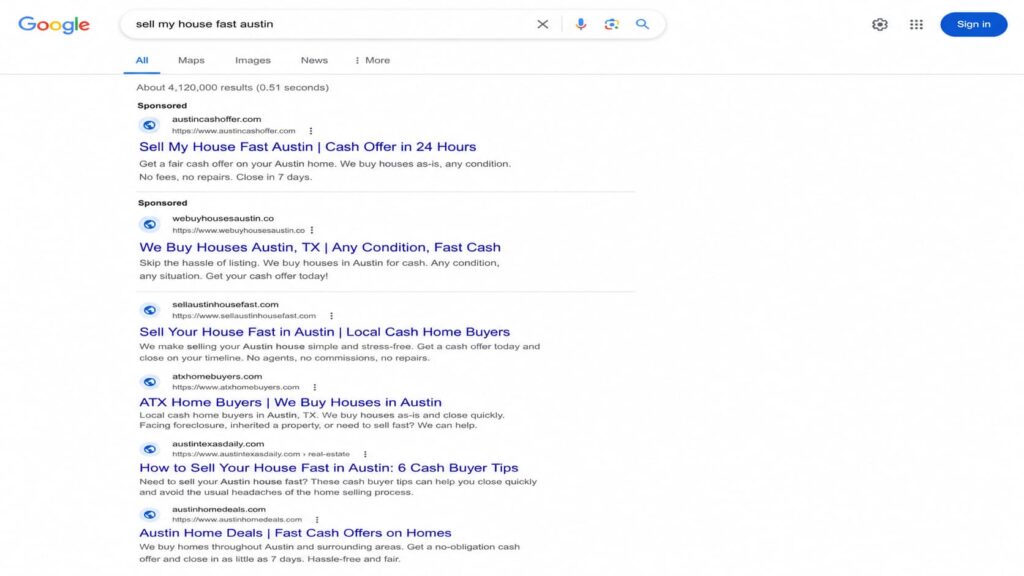
So a good ad keyword is transactional and specific, not high-volume and vague. “Real estate market trends” is a fine blog target and a terrible ad target. Nobody typing it wants to buy or sell today. “Sell my house fast Dallas” is the opposite: it names an action, a place, and an urgency. That’s someone you want in front of, even though high-intent seller terms like “sell my house fast” can run anywhere from $25 to $120 a click depending on the market.
Three things separate a keyword worth bidding on from one that just burns money:
- Conversion intent: the words imply an action (buy, sell, cash offer), not research.
- Specificity: long-tail phrases with a location or situation beat one-word terms.
- Cost control: the more precise the term, the fewer wasted clicks you pay for.
Intent is the thread through all three. If you want the same terms broken down for organic instead, we keep a separate SEO keyword list for that. This page is for the ones you pay to show up on.
Start with intent: the 3 buckets that decide your ROI
Every keyword below fits one of three intent buckets: buyer, seller, or investor. Location sits on top of all three as a layer you add to almost any term.
Grouping this way isn’t organizational tidiness. It’s what lets you write one ad and one landing page that match one search. Google rewards that match with a higher Quality Score (its rating of how relevant your ad is to the search), and a higher Quality Score means a lower cost per click for the same position. Relevance is the cheapest lever you have (GrowMyAds).
Here’s the part most guides skip: you probably don’t need all three buckets. A retail agent lives in buyer and seller intent. A cash home buyer usually wants only seller and investor intent and should treat most buyer terms as noise. Pick your buckets before you copy a single keyword.
One more preview. Inside every bucket, the long-tail and hyperlocal versions convert better and cost less than the short, generic ones. Keep that in mind as you read, then weight your budget toward them.
150+ real estate keywords for ads, grouped by intent
Copy the groups that apply to your business. Ignore the rest. These keywords for real estate ads are written in base format, so swap in your own [city], [neighborhood], or [zip code] before you launch. The intent lives in the H3 groups below.
Buyer-intent keywords
These are people actively hunting for a property. They’re comparing listings, neighborhoods, and agents, and they respond to specificity. Append a [city], [neighborhood], or [price] and both your conversion rate goes up and your cost per click comes down, because you’ve narrowed to searchers who mean it.
- homes for sale [city]
- buy house [neighborhood]
- condos for sale near me
- first time home buyer [city]
- real estate agent [city]
- homes for sale under [price]
- 3 bedroom house for sale [area]
- new construction homes [city]
- houses for sale near me
- townhomes for sale [city]
- move in ready homes [city]
- open houses [city] this weekend
- homes with pool for sale [city]
- [city] real estate listings
- buy a home in [neighborhood]
- foreclosed homes for sale [city]
- homes for sale with land [area]
- single family homes for sale [city]
- best neighborhoods to buy in [city]
- realtor near me
- [zip code] homes for sale
- 4 bedroom homes for sale [city]
- starter homes [city]
- homes for sale [school district]
- buy investment property [city]
- new listings [city]
- houses for sale [city] under [price]
- real estate agent near me
Seller-intent keywords
Sellers search less often than buyers, but each search is worth far more. Someone typing “what is my house worth” or “best realtor to sell my home” is close to a listing, and the terms price accordingly. That single keyword can spike to $10 to $65 a click. It’s still worth it when a listing means a full commission. Note the difference from the investor bucket below: these are retail sellers who want top dollar on the open market, not distressed sellers who want out fast.
- sell my house [city]
- list my home for sale
- home valuation [city]
- what is my house worth
- best realtor to sell my home
- sell house fast [city]
- how to sell my home without an agent
- home value estimate [city]
- sell my home fast
- realtor to sell my house [city]
- list my house for sale
- how much is my home worth [city]
- sell house by owner [city]
- top listing agent [city]
- sell my property [city]
- get a home appraisal [city]
- sell my house this month
- home selling agent near me
- what’s my home worth [zip]
- sell my house without a realtor
- free home valuation [city]
- sell my condo [city]
- quick home sale [city]
- sell my house online
Investor & cash-home-buyer keywords
This is the group the generic, SEO-flavored lists leave out, and it’s the one that prints deals for wholesalers, flippers, and cash buyers. The searcher here is a motivated seller with a problem: a foreclosure, an inherited house, a divorce, a property that needs more repairs than they can stomach. They don’t want a listing. They want a cash offer.
The catch is competition. You’re bidding against national budgets like HomeVestors and iBuyers on the broad terms. That’s why the long-tail and hyperlocal versions are your weapon. A cash term like “we buy houses cash” runs around $2.50 to $5.00 a click (Promodo), and with wholesale assignment fees averaging $10,000 to $13,000 nationally, a $5 click that lands one deal is one of the cheapest leads in your business. Worth knowing before you build the ad group: this same seller traffic can be captured organically too, not just rented by the click, which is where the math eventually turns. More on that at the end. If paid isn’t your only channel, here’s how the free, paid, and referral routes to get motivated seller leads stack up.
- sell my house fast for cash
- cash home buyers [city]
- we buy houses [city]
- sell house as is
- sell inherited house
- avoid foreclosure [city]
- sell house before foreclosure
- cash offer for my home
- sell my house fast [city]
- we buy houses cash [city]
- sell distressed property [city]
- sell house as-is for cash
- stop foreclosure [city]
- sell house after divorce [city]
- sell rental property with tenants
- sell fire damaged house
- sell house that needs repairs
- cash for houses [city]
- sell probate house [city]
- quick cash home sale
- sell my house no repairs
- sell house fast as is [city]
- we buy ugly houses [city]
- get a cash offer [city]
- sell house without agent for cash
Luxury & niche keywords
Niche terms trade volume for value. Fewer people search “waterfront homes [area]” or “golf course homes for sale,” but the ones who do are high-value leads with less competition on the keyword. Because volume is thin, run these on phrase and exact match so you’re not paying for loosely related clicks.
- luxury homes for sale [city]
- waterfront homes [area]
- gated community homes
- luxury condos [neighborhood]
- golf course homes for sale
- luxury real estate agent [city]
- million dollar homes [city]
- estate homes for sale [area]
- penthouses for sale [city]
- beachfront homes [area]
- equestrian property [city]
- new luxury developments [city]
- high end homes [neighborhood]
- luxury townhomes [city]
- lakefront homes for sale [area]
Rental & property management keywords
Only bid on these if renting or property management is a service you actually offer. If it isn’t, this group is a preview of your negative keyword list. Renters searching “houses for rent near me” will happily click a “we buy houses” ad and cost you money, so most cash buyers and sales agents exclude the whole set.
- apartments for rent [city]
- houses for rent near me
- property management [city]
- pet friendly rentals [area]
- homes for rent [city]
- condos for rent [neighborhood]
- rental property management [city]
- townhomes for rent [city]
- section 8 rentals [city]
- short term rentals [area]
- apartment for rent [zip]
- property manager near me
- rent to own homes [city]
- cheap apartments for rent [city]
- furnished rentals [city]
Hyperlocal keywords (the highest-converting group)
If you take one thing from this list, take this: hyperlocal keywords convert better than anything else, and they usually cost less. A phrase like “realtor in [neighborhood]” or “homes for sale [subdivision]” carries lower keyword difficulty and a lower cost per click, and it converts at a higher rate, because the searcher has already decided where they want to act (Sierra Interactive, Ylopo).
Broad city terms put you in a bidding war. Neighborhood, subdivision, and zip-level terms put you in front of a smaller, readier audience that the big budgets often ignore. The move is to build one ad group per zone: a set of keywords, an ad, and a landing page for each neighborhood or zip you work.
- realtor in [neighborhood]
- homes for sale [subdivision]
- best real estate agent [zip code]
- we buy houses [neighborhood]
- sell my house fast [subdivision]
- cash home buyers [zip code]
- houses for sale near [landmark]
- real estate agent [suburb]
- homes for sale [downtown district]
- [neighborhood] homes for sale
- sell house fast [zip code]
- condos for sale [district]
- realtor near [landmark]
- homes for sale [named community]
- property for sale [neighborhood]
- cash buyers near [zip]
- sell my home [suburb]
- new homes [master-planned community]
Match types: telling Google exactly what to buy
A keyword is only half the instruction. The match type tells Google how loosely it can interpret it, and that setting decides how much of your budget goes to searches you never meant to buy (Google Ads Help).
Broad match is the widest and the loosest. Broad sell my house fast can trigger on “how to sell your house” or even “fast house cleaning.” Maximum reach, maximum waste unless you’re managing it carefully.
Phrase match (the words in order, close variations allowed) is the middle ground. “sell my house fast” will show for “sell my house fast in Dallas” but not for unrelated searches that happen to share a word.
Exact match (the term and very close variants only) is the tightest. [sell my house fast] shows for that search and near-identical ones, and little else.
The practical play for anyone watching their spend: start with phrase and exact. You’ll reach fewer people, but almost everyone you reach means it, and your cost per click stays sane. Only open up to broad match once you’re running Smart Bidding and you’ve built a real negative keyword list to catch the junk. Tighter match types also feed a better Quality Score, which pulls your cost per click down further.
| Match type | How you write it | Example that triggers it | Best use |
|---|---|---|---|
| Broad | sell my house fast | “quickest way to sell a house,” “house cleaning fast” | Only with Smart Bidding + strong negatives |
| Phrase | “sell my house fast” | “sell my house fast in Dallas” | Safe default for controlled reach |
| Exact | [sell my house fast] | “sell my house fast,” “sell my home fast” | Highest intent, tightest spend control |
Negative keywords: the list that protects your budget
Negative keywords are the terms you exclude so your ad never shows for them. They’re the single most underused setting in real estate PPC, and skipping them is how good keywords still lose money.
Without a negative list, a “we buy houses” campaign pays for renters, job hunters, students, and DIY researchers, none of whom will ever become a lead. Here’s a startable list to paste in before you launch:
- free
- cheap
- for sale by owner
- fsbo
- jobs
- salary
- license
- classes
- course
- for rent (if you don’t do rentals)
- zillow
- realtor.com
- trulia
- redfin
- how to become
- real estate school
- games
- definition
- internship
Two things trip people up. First, geography. There are more than 20 U.S. towns named Dover, so a national or sloppy geo setup can pay for clicks from states you’ll never buy in. Add the metros and states you don’t work as location or keyword negatives. Second, negative keywords don’t behave like positive ones. They don’t match close variants, so “for rent” won’t automatically block “rentals” (Google Ads Help). You have to add the plurals and synonyms yourself. Build the list once, then keep pruning it from your Search Terms report every week.
How to group these keywords into ad groups
The structure rule is simple and it’s where most accounts fall apart. Put 10 to 20 tightly related keywords in each ad group. Google itself suggests that range when you build a new ad group, and going tighter, 5 to 15, is fine; going past 30 usually means the group is trying to do two jobs (GrowMyAds).
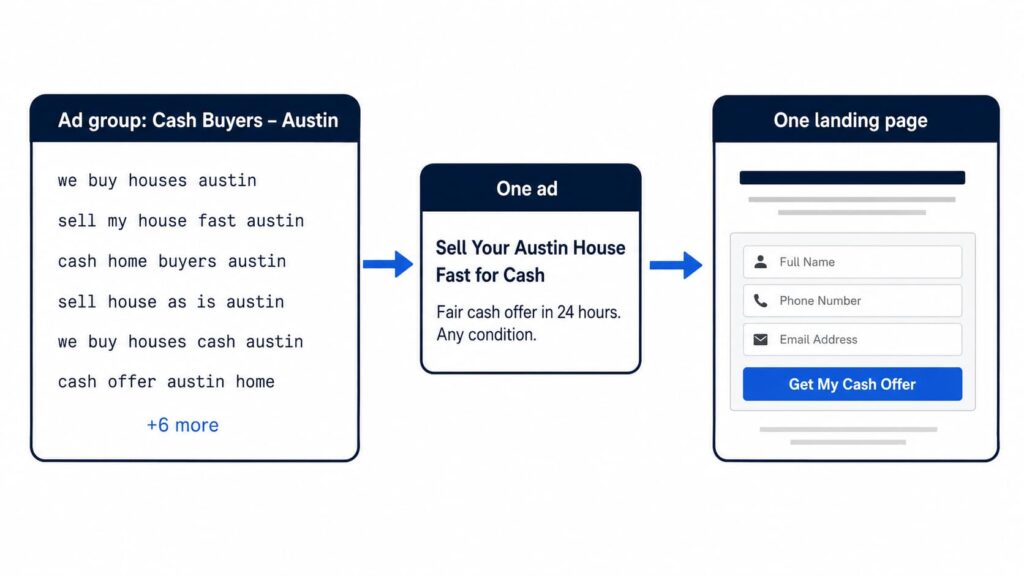
The principle underneath the number: one ad group per intent and location, each with its own ad and its own landing page. When the keyword, the ad, and the page all say the same thing, Google reads that as relevance, your Quality Score rises, and your cost per click drops. Send every click to the homepage instead and you throw that relevance away.
Concretely, a cash buyer working Austin might build an ad group called “Cash Buyers – Austin” holding a dozen cash keywords (“we buy houses austin,” “sell my house fast austin,” “cash home buyers austin,” and so on), pointed at a single cash-offer landing page written for Austin sellers. Not the homepage. A page about that exact promise, in that exact city. Then do it again for the next zone. Once those ads produce calls and form fills, what you do next decides the deal, so have a plan to follow up on the leads fast.
2026 CPC and cost-per-lead benchmarks by keyword type
Numbers to set your budget by, with the standing caveat that they swing hard by market. Across real estate search in 2026, expect a blended cost per click around $2 to $6, conversion rates near 3% to 3.5%, and a cost per lead of roughly $65 to $170 depending on your market tier and whether you’re chasing buyers or sellers (Expert PPC Services, ROA Marketing).
That $2 to $6 is a blended average, and it hides a wide spread. The highest-intent seller terms sit at the top: “sell my house fast” can run $25 to $120 a click in competitive metros. Investor cash terms are gentler, around $2.50 to $5.00. Broad buyer terms are cheap per click and expensive per lead, because so few of the clicks convert. Read the table as a spectrum, not a promise.
| Keyword type | Typical CPC | Conversion rate | Est. cost per lead | Notes |
|---|---|---|---|---|
| Broad buyer (“real estate”) | $1–$3 | Low (1–2%) | High | Cheap clicks, poor intent, avoid |
| Buyer-intent ([city] homes for sale) | $2–$5 | ~3% | $65–$150 | Volume play |
| Seller-intent (“what is my home worth”) | $10–$65 | ~3–3.5% | $120–$170+ | Costly, but a listing is worth it |
| Investor / cash | $2.50–$5 | ~3% | $80–$150 | Deal value dwarfs the click cost |
| Hyperlocal / long-tail | Lowest | Highest | Lowest | Where your budget works hardest |
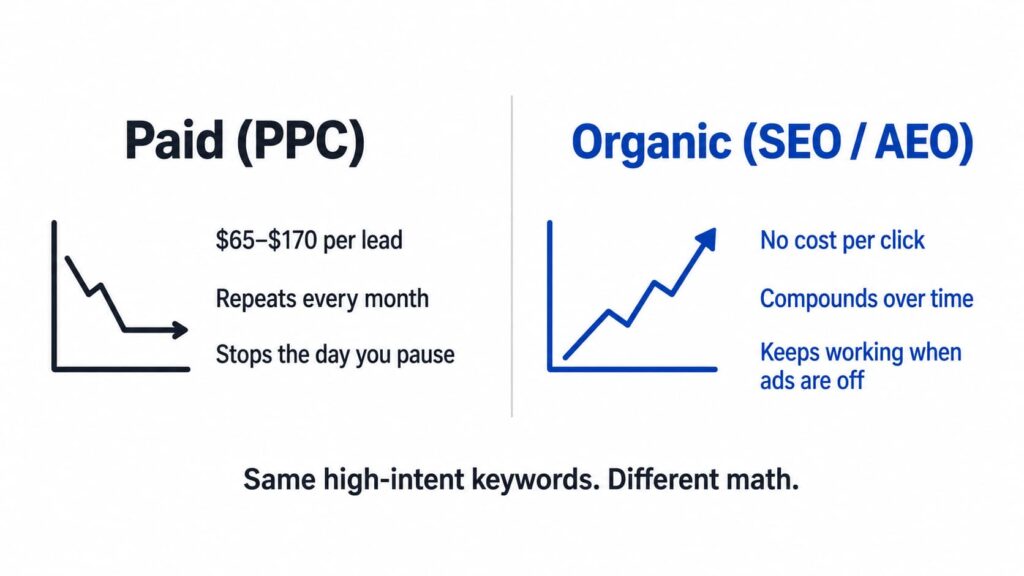
The seller and investor keywords cost more per click but earn more per deal, so judge them on cost per deal, not the sticker price of a click. One thing the table can’t show: that cost per lead repeats every single month, and it stops the day you pause the campaign.
Free tools to expand your keyword list
The lists above are a starting set. To find the terms specific to your market, these free tools do the job without a subscription:
- Google Keyword Planner: volumes and keyword ideas straight from Google, built into every Ads account.
- Google Trends: seasonality and rising terms, filterable by metro so you can see what’s climbing in your city.
- Ubersuggest: fast free keyword ideas with a rough difficulty score.
- Google Ads Search Terms report: the goldmine. It shows the actual searches that triggered your ads, which is where you find both new keywords to add and junk terms to negative out.
- Google’s own search box: type a seed term and mine the autocomplete suggestions and the “searches related to” block at the bottom of the results page.
Start with the Search Terms report once you’re live. No tool guesses your market as accurately as your own real search data.
Mistakes that quietly burn your ad spend
Most wasted budget traces to the same handful of errors. Each one has a one-line fix:
- Bidding on broad one-word terms like “real estate” → switch to specific, intent-led phrases on phrase or exact match.
- Running with no negative keyword list → build one before launch and prune the Search Terms report weekly.
- Sending every click to the homepage → build one landing page per intent, like a cash-offer page for cash keywords.
- Mixing buyer and seller keywords in one ad group → split them so the ad matches the exact search.
- Ignoring hyperlocal terms → add neighborhood and zip ad groups where clicks cost less and convert more.
- Never opening the Search Terms report → it’s where wasted spend and your next best keywords both hide.
Turn keywords into leads without paying per click
Here’s the part the other ad guides won’t tell you. The same high-intent terms you just budgeted for, especially the seller, investor, and hyperlocal ones, can be won organically instead of rented by the click. Rank for “sell my house fast [city]” or “cash home buyers [neighborhood]” on Google, or get cited when someone asks an AI assistant how to sell fast for cash, and that traffic carries no cost per click. It also doesn’t switch off the moment you pause a campaign.
That’s the work BASEO does for cash home buyers and real estate operators: building the pages that rank for these terms organically and getting them cited in AI answers, while running motivated-seller PPC under the same cost-per-deal lens so paid keeps the phone ringing until organic takes over. One Florida cash buyer went from 3 to 28 organic motivated-seller leads a month in nine months, no extra ad spend (BASEO client data).
If you want to see which of these terms you could rank for instead of bidding on, that’s what the free audit is for. Written, no call required, yours to keep. Get your free site audit →
Frequently asked questions
Quick answers to the questions that come up most when building a real estate ad keyword list.
The best real estate keywords for ads are transactional, long-tail, and hyperlocal: terms like “sell my house fast [city],” “homes for sale [neighborhood],” and “cash home buyers near me.” They signal high buying or selling intent, cost less per click than broad terms, and convert far better than generic phrases like “real estate.”
Use 10 to 20 tightly related keywords per ad group as a starting point, and no more than about 30. Keeping ad groups tightly themed, one intent, one location, one landing page, raises your Quality Score, lowers your cost per click, and makes your ads more relevant to each searcher.
SEO keywords target informational searches to earn free rankings over time. Ad (PPC) keywords target transactional searches you pay for per click. Ad keywords should be more specific and conversion-focused, “sell my house fast” beats “real estate market trends,” because every click costs money and you want buyers or sellers, not researchers.
In 2026, real estate Google Ads keywords run roughly $2 to $6 per click, with conversion rates near 3% to 3.5% and a cost per lead of about $65 to $170. Seller and investor keywords usually cost more per click but are worth it given the higher value of each closed deal. Costs vary by market.
Negative keywords are terms you exclude so your ads don’t show for irrelevant searches. In real estate, common negatives include “free,” “cheap,” “jobs,” “salary,” “FSBO,” “classes,” and “for rent” (if you don’t do rentals). A strong negative list stops you from paying for clicks that will never become leads.
The bottom line
The keywords that convert in real estate ads aren’t the popular ones. They’re the specific, intent-led, hyperlocal ones, and bidding on the wrong list is a paid mistake you make every single day the campaign runs. Pick your buckets, group them tight, write a negative list before you launch, and point each ad group at its own landing page.
Then do the math the click cost hides. A cost per lead of $65 to $170 that resets every month is a very different business than ranking for the same terms once and keeping the leads. If you want to know which of your highest-intent keywords you could win organically instead of renting, that’s exactly what the audit tells you. Free, in writing, no call required, yours to keep. Get your free site audit →