
Most “top real estate keywords” lists are an alphabetical volume dump. This one is organized by what the searcher actually wants, with real monthly volumes and a usage note on every row. It works whether you’re building SEO pages or buying PPC clicks, and it flags the terms worth chasing versus the ones that will only feed Zillow.

- How to Use This List (Read This First)
- The 4 Types of Real Estate Search Intent
- Top Buyer Keywords (Transactional)
- Top Seller Keywords
- Top Rental Keywords
- Real Estate Agent & Broker Keywords
- Property-Type Keywords
- Local & Geo-Modified Keywords (Highest ROI)
- Long-Tail & Question Keywords for AI Search (AEO)
- Real Estate PPC Keywords (Highest CPC = Highest Intent)
- Emerging Real Estate Keywords to Watch in 2026
- How to Find More Keywords for Your Market
- Turn These Keywords Into Rankings
- Frequently Asked Questions
How to Use This List (Read This First)
Every table below gives you three things: the keyword, an approximate US monthly search volume, and a one-line note on intent. Read the note, not just the number. Volumes are third-party estimates, so treat them as directional, not gospel.
Here is the trap to avoid. High volume means high competition. The broad term “real estate” pulls roughly 450,000 searches a month, and it is locked down by Zillow, Realtor.com, and Redfin (wpresidence). You will not rank for it, and half the people typing it aren’t buyers anyway.
So filter by relevance to your market. Aim for terms with volume of at least 30 and a keyword difficulty around 30 to 70 percent, and skip the head terms you can’t win. The two sections that pay for this whole article are the local keywords and the AI-search questions. If you’re building pages, start with our step-by-step SEO playbook for a real estate website and pull your targets from here.
The 4 Types of Real Estate Search Intent
Before the lists, sort every keyword by what the searcher wants. Four buckets cover it, and the bucket tells you whether the term is worth a page.
- Informational: the searcher is researching. Examples: “how to buy a house,” “what is escrow.” Answer these with guides and blog posts. They build authority and feed AI answers, but they rarely convert on their own.
- Navigational: the searcher wants a specific brand. Examples: “zillow login,” “realtor.com.” You can’t win these, and you don’t need to.
- Commercial: the searcher is comparing options and close to acting. Examples: “best real estate agent in Miami,” “cash home buyers reviews.” High value.
- Transactional: the searcher is ready to move. Examples: “homes for sale in Dallas,” “sell my house fast.” This is where the qualified leads are.
Prioritize commercial and transactional terms for lead generation. Use informational content to earn trust and get cited by AI engines, then let it funnel readers toward the pages that convert.
Top Buyer Keywords (Transactional)
These are the highest-demand terms in real estate. They’re also the most competitive, because you’re fighting the national portals for every one. The play is to attack the geo-modified and long-tail versions, which we cover below.
| Buyer keyword | Approx. US monthly volume | Intent note |
|---|---|---|
| homes for sale near me | ~368,000 | Very high competition, portal-dominated, strong local intent |
| houses for sale | ~301,000 | Very high, broad buyer |
| houses for sale near me | High | Local buyer, ready to browse |
| condos for sale | ~110,000 | Property-type buyer |
| for sale by owner | ~110,000 | Buyer avoiding agents |
| homes for sale by owner | Medium | FSBO-focused buyer |
| 3 bedroom homes for sale | Medium | More specific, better qualified |
| open houses near me | Medium | High intent, ready to visit |
| new listings near me | Medium | Active, monitoring the market |
| cheap homes for sale | Medium | Budget buyer |
| luxury homes for sale | Medium | High-value buyer |
| waterfront homes for sale | Low to medium | Niche, high value |
| foreclosed homes for sale | Medium | Deal-seeking buyer or investor |
| townhomes for sale | ~40,500 | Property-type buyer |
| fixer upper homes for sale | Low to medium | Flip or value buyer |
| move in ready homes | Low to medium | Convenience buyer |
| Head-term volumes from wpresidence; qualitative levels reflect relative competition, not exact counts. |
Top Seller Keywords
This is where cash buyers and wholesalers live. “Sell my house fast” and “we buy houses” aren’t just seller keywords. They’re your keywords, the exact phrases a motivated seller types before they call someone like you. Searches for “we buy houses [city]” surged past 12,000 a month as more sellers went looking for cash offers (Carrot).
| Seller keyword | Approx. US monthly volume | Intent note |
|---|---|---|
| how much is my house worth | Very high | Seller researching value, early stage |
| sell my house fast | High, motivated | Urgent, motivated seller, prime cash-buyer term |
| we buy houses | High (12,000+ with city) | Motivated seller seeking a cash buyer |
| home value estimator | High | Pre-listing seller |
| cash home buyers | Medium to high | Seller wanting a cash offer |
| sell house without realtor | Medium | Cost-conscious or FSBO seller |
| sell my house for cash | Medium | Motivated, ready to act |
| cash offer for my house | Medium | Motivated, decision-stage |
| how to sell my house | Medium | Seller in research mode |
| sell inherited house | Low to medium | Situation seller (probate) |
| sell house in foreclosure | Low to medium | Distressed, urgent seller |
| best time to sell a house | Medium | Seller planning ahead |
| The seller terms with cash and speed language are the highest-intent motivated-seller keywords. For the full channel breakdown, see how to get motivated seller leads. |
Top Rental Keywords
Rental terms carry very strong local intent and high turnover, which makes them a steady traffic source for buy-and-hold operators and property managers. The searcher almost always has a city in mind, even when they don’t type it.
| Rental keyword | Approx. US monthly volume | Intent note |
|---|---|---|
| apartments for rent near me | Very high | Local renter, ready |
| houses for rent | Very high | Broad renter |
| houses for rent near me | Very high | Local renter, ready |
| pet friendly apartments | High | Filtered, specific need |
| cheap apartments near me | High | Budget renter |
| studio apartments for rent | Medium | Segment-specific |
| 3 bedroom house for rent | Medium | Family renter |
| 1 bedroom apartments for rent | Medium | Segment-specific |
| rooms for rent near me | Medium | Budget, short-term |
| apartments for rent under [price] | Medium | Budget-qualified |
| luxury apartments for rent | Low to medium | High-value renter |
Real Estate Agent & Broker Keywords
These are commercial terms with high lead value, which is why they’re some of the priciest in paid search. The generic version is brutally competitive. Add a location and you get a term you can actually own.
| Agent keyword | Approx. US monthly volume | Intent note |
|---|---|---|
| real estate agent near me | ~90,500 | Very high competition, high commercial value |
| realtor near me | High | Same intent, high value |
| real estate agents near me | High | Comparison stage |
| best real estate agent in [city] | Medium | Commercial, geo-modified, winnable |
| real estate broker near me | Medium | Commercial |
| listing agent | Medium | Seller-side intent |
| buyers agent | Medium | Buyer-side intent |
| top real estate agents [city] | Low to medium | Comparison, geo |
| real estate agent reviews | Low to medium | Commercial, trust stage |
| “Real estate agent near me” volume from wpresidence. Chase the geo version, not the generic term. |
Property-Type Keywords
Property-type terms are the ones you combine with a city or neighborhood to turn a head term into something rankable. “Luxury homes” is a fight. “Luxury homes in Scottsdale” is a page.
| Property-type keyword | Approx. US monthly volume | Intent note |
|---|---|---|
| single family homes for sale | High | Core buyer, combine with geo |
| land for sale | High | Buyer or investor |
| commercial real estate | ~110,000 | Commercial buyer or tenant |
| new construction homes | High | Buyer, combine with geo |
| luxury homes | High | High-value, combine with geo |
| foreclosure homes | ~74,000 | Deal-seeker or investor |
| townhomes for sale | ~40,500 | Property-type buyer |
| waterfront homes | Medium | Niche, high value |
| investment property | ~18,100 | Investor intent |
| multifamily homes for sale | Medium | Investor intent |
| mobile homes for sale | Medium | Budget or niche buyer |
| Volumes from wpresidence. For the foreclosure angle, see where to find foreclosure listings. |
Local & Geo-Modified Keywords (Highest ROI)
If you only act on one section, make it this one. Geo-modified keywords are the only realistic way to compete with national portals, and they convert better than any head term on this page.
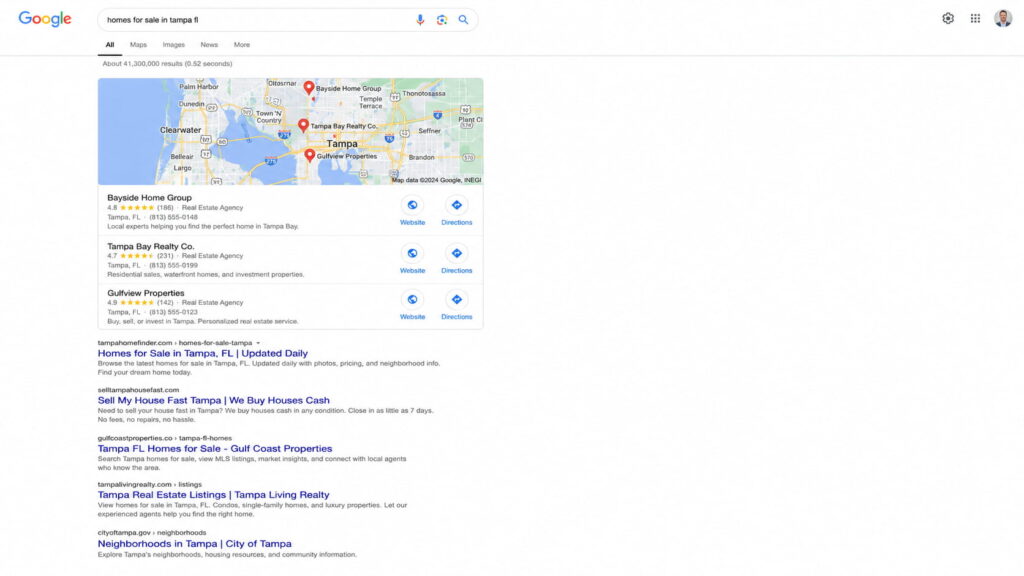
Here’s why. Zillow can’t write an authentic page about the best neighborhoods in Austin for young families, or condos near a specific landmark in Tampa. They scale on volume, not local knowledge. That’s the gap you fill. A searcher typing “homes for sale in Tampa FL” or “real estate agent 90210” has already told you their market and their intent. That’s a long-tail term with less competition, a higher click-through rate, and a more qualified lead at the end of it.
Adding a location to any generic keyword does two things at once. It drops the competition, and it raises the conversion rate, because you’re matching the exact search instead of a broad one. “Condos for sale” is a portal fight. “Waterfront condos for sale in Clearwater” is a lead.
There’s a catch, and it’s the reason most investor sites fail here. You need a unique page for every market you work, not one template with the city name swapped out. Google’s Scaled Content Abuse policy, tightened in the March 2024 update, specifically targets those near-duplicate location pages. Building an original page per city, with local proof and market-specific content, is exactly what programmatic city pages are, and it’s the core of what BASEO builds for cash home buyers.
The Location-Modifier Formula
You don’t need to guess at these. Use one formula: [intent keyword] + [city / neighborhood / ZIP / county / school district]. Each level of specificity trades a little volume for a lot less competition.
| Modifier level | Example | Why it works |
|---|---|---|
| City | homes for sale in Tampa FL | Rankable, clear local intent |
| Neighborhood | condos for sale in Seminole Heights | Lower competition, hyper-local |
| ZIP code | real estate agent 90210 | Precise, low competition |
| County | houses for sale in Travis County | Broader-than-city coverage |
| School district | homes in Round Rock ISD | High-intent family buyers |
Apply the formula to any term in the tables above, and you’ve turned a portal fight into a page you can win.
Long-Tail & Question Keywords for AI Search (AEO)
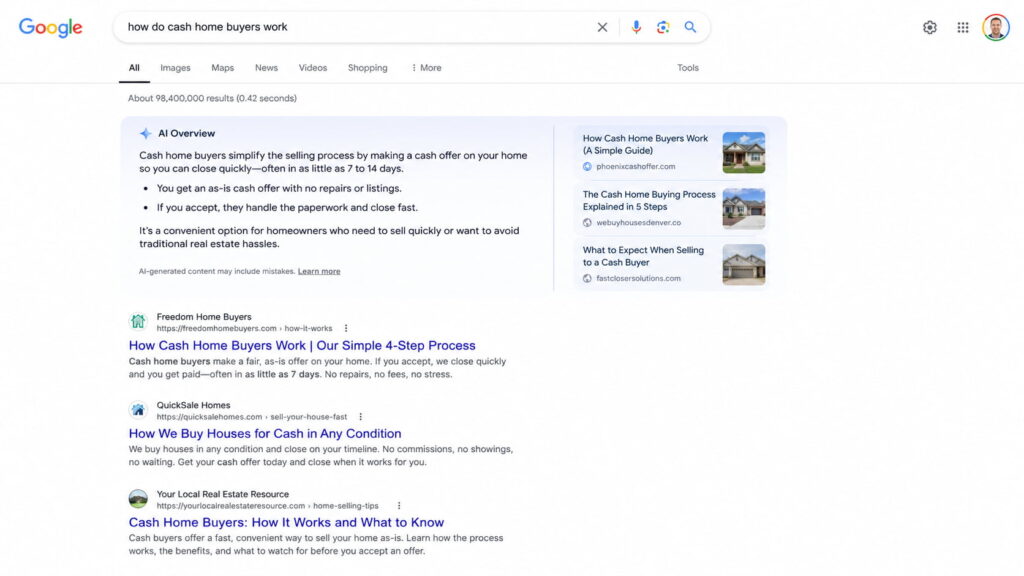
This is the section almost nobody in the top results covers, which is exactly why it’s the opportunity. In 2026, people don’t just type fragments into Google. They ask full questions, out loud and in chat, and those questions feed AI Overviews, ChatGPT, and Perplexity.
The numbers are hard to ignore. AI Overviews now appear on roughly 48% of Google searches, and informational queries trigger them about 39% of the time (The Stacc). Zero-click searches, where the answer is read right on the results page, hit about 68% in early 2026 (Search Engine Land). If you’re not the source the AI quotes, you’re invisible in half the results.
These are the question keywords worth targeting:
- how much do cash home buyers pay
- is it a good time to buy a house
- what credit score do I need to buy a house
- how to sell a house by owner
- how does a cash offer on a house work
- what are closing costs for a seller
- how long does it take to sell a house
- is it better to rent or buy in 2026
- how much down payment do I need for a house
- what is a good credit score to buy a house
- do I pay taxes when I sell my house
- how do I sell a house that needs repairs
Here’s the format rule that wins the citation: answer each question directly in about 40 to 55 words, right under a heading that matches the question. That tight, self-contained answer is what a snippet grabs and what an AI engine quotes. Formatting content that way, with question-and-answer structure and citation-friendly schema, is the AEO work BASEO does and tracks for its clients. If you want the mechanics, read our guide on how to get cited in AI Overviews. The window where few competitors are formatting for AI won’t stay open forever.
Real Estate PPC Keywords (Highest CPC = Highest Intent)
Cost per click is a confession. When advertisers pay a premium for a term, they’re telling you it converts. That makes the PPC price list a shortcut to the highest-intent keywords in the niche, and those same terms are worth targeting organically, where the click is free.
The real estate category averaged about $3.22 per click in 2026, up more than 27% year over year, the biggest jump of any industry (WordStream). Seller terms run far above the average, because a motivated seller is worth more than a browser.
| PPC keyword | Rough CPC | Intent signal |
|---|---|---|
| real estate (category average) | ~$3.22 | Rising fast, high commercial value |
| best keywords for real estate | ~$2.50 | Near category average |
| homes for sale in [city] | $0.50 to $5 | Broad buyer, longer sales cycle |
| sell my house fast | $5 to $65 | Motivated seller, high lead value |
| cash offer on house | High (seller range) | Ready-to-transact seller |
| real estate agent near me | High (lead cost near $100) | Premium commercial term |
| CPC ranges from WordStream and real estate PPC benchmarks. Seller campaigns commonly run a cost per lead near $100, and past $150 in competitive markets. |
The takeaway isn’t “spend more on ads.” It’s that these are the terms sellers and buyers use when they’re ready. If you want the full paid-search breakdown, see our guide to Google Ads for real estate. Judge every one of them by cost per deal, not clicks.
Emerging Real Estate Keywords to Watch in 2026
Search behavior moves, and the terms with the least competition are the ones just starting to climb. A few years ago nobody searched “AI real estate tools.” Now these pull thousands of searches a month, and most local sites haven’t written a word about them.
Keywords gaining ground right now:
- virtual home tours
- AI real estate tools / AI home valuation
- sustainable and energy-efficient homes
- remote-work-friendly neighborhoods
- 55+ communities
- ADU (accessory dwelling unit) regulations
- homes with EV charging
- walkable neighborhoods
The math here is simple. If you’re the first operator in your market publishing a real page on ADU rules or energy-efficient homes, you rank before anyone else shows up. These terms are small today and larger every quarter. Get the page indexed early and the position is yours to lose.
How to Find More Keywords for Your Market
This list is a starting point, not the finish line. Your market has its own terms, and the tools to find them are mostly free.
Start here: Google Autocomplete (type a seed term and read the suggestions), People Also Ask (every question is a page idea), Google Keyword Planner (basic volume and competition), Google Trends (seasonality and rising terms), and Google Search Console (the keywords you already show up for). For keyword difficulty and competitor gaps, the paid tools Ahrefs and Semrush are worth it once you’re serious.
The method:
- Take a seed term (“cash home buyers,” “homes for sale”) and add your city.
- Filter for volume of at least 30 and a keyword difficulty around 30 to 70 percent.
- Mine People Also Ask and Autocomplete for long-tail and question variations.
- Check the actual search results to see who ranks and whether you can realistically beat them.
Practitioners like lowfruits and Sierra Interactive run the same play: seed, filter, and mine the questions Google hands you for free.
Turn These Keywords Into Rankings
A keyword list doesn’t rank itself. Turning these terms into leads takes optimized pages, technical SEO that Google can read, and enough authority to compete. That’s the gap between “I have the list” and “the phone rings.”
That’s the whole job we do for real estate cash home buyers: unique city pages, seller-situation content, and AI-search formatting, built around the terms that actually convert. One Florida cash buyer went from 3 motivated seller leads a month to 28 in nine months, same market, no extra ad spend (BASEO client data). Some operators run the playbook themselves and do fine. If you’d rather see the gap before you decide, that’s what the audit is for.
Send your domain and we’ll send back a free, written audit: your top competitor’s keyword gaps, the geo terms you should own, and the deal-math for your market. No call required, yours to keep. Get your free site audit →
Frequently Asked Questions
A few quick answers to the questions operators ask most about real estate keywords.
The best real estate keywords combine high commercial or transactional intent with local modifiers, for example “homes for sale in [city],” “real estate agent near me,” and “sell my house fast.” Local, geo-modified long-tail keywords convert best because they attract buyers and sellers ready to transact in a specific area.
There’s no fixed number, but most real estate sites target one primary keyword per page plus several related long-tails. Focus on relevance and intent over quantity. A handful of well-chosen local keywords per neighborhood or service page outperforms hundreds of generic terms you can’t realistically rank for.
Localized, transactional keywords convert highest, think “homes for sale in [neighborhood]” or “sell my house fast [city].” These searchers have clear intent and are close to acting. Generic high-volume terms like “real estate” bring traffic but rarely convert without a location or action attached.
Usually, yes. Long-tail real estate keywords are more specific, less competitive, and convert at higher rates because they match decision-stage intent. Adding a location to any keyword automatically makes it long-tail, for example “condos for sale” becomes “waterfront condos for sale in Tampa.”
Enter a seed term plus your city (like “homes for sale in Austin”) into a tool like Ahrefs, Semrush, or Google Keyword Planner. Filter by search volume of at least 30 and keyword difficulty of 30 to 70 percent, then mine Google Autocomplete and People Also Ask for local long-tail variations.