
You pay a portal for leads that were searching in your own city, on a website you will never own. Meanwhile your site sits on page four, invisible to the same buyers and sellers. SEO for realtors closes that gap. This is a hyper-local playbook any agent can follow to rank your real estate website and get found before the portal does.

A lead that comes from your own ranking page keeps coming. A portal lead stops the day you stop paying.
In this guide:
- What Is SEO for Realtors (and Why It’s Different)
- Does SEO Actually Work for Real Estate Agents?
- Local SEO: The Foundation of Realtor SEO
- Keyword Research for Realtors
- On-Page SEO for Real Estate Websites
- Content Marketing: Hyperlocal Authority
- Technical SEO Essentials
- SEO and AI Search (AEO) for Realtors
- How Long Does Realtor SEO Take to Work?
- How Much Does SEO for Realtors Cost?
- DIY vs. Hiring a Real Estate SEO Agency
- Get Found by More Buyers and Sellers
- Frequently Asked Questions
What Is SEO for Realtors (and Why It’s Different)
SEO for realtors is the work of optimizing your website and profiles to rank for the local, buyer- and seller-intent searches your market actually types, phrases like “homes for sale in [city]” and “best realtor [city].” Done right, it puts you in front of motivated buyers and sellers on Google instead of handing them to a portal.
Here is what makes it different from generic SEO. It is hyper-local. You are not fighting for a keyword across the whole country. You are fighting to own a set of specific markets, ZIP codes, and neighborhoods. The SERP for “condos in [neighborhood]” looks nothing like the national one, and that is the opening. A solo agent can win a neighborhood. No agent wins “real estate” as a word.
That local focus changes everything downstream: the pages you build, the keywords you chase, and the buyer-intent versus seller-intent split that decides which page answers which search.
Does SEO Actually Work for Real Estate Agents?
Short answer: yes, and the numbers are not close. In 2025, 96% of buyers used online tools to search for properties (NAR). Your next client is already searching. The only question is whose name shows up.
Real estate also posts the highest return on SEO of any industry First Page Sage measures: an average of 1,389% ROI, with the investment typically paying for itself in about ten months (First Page Sage). That number holds up because a real estate transaction is worth a lot and the intent behind a local search is high.
The deeper reason to care is ownership. A ranking page is an asset you own. It keeps producing leads next month whether you spend or not. A portal lead is rented. The moment the card stops, the leads stop. This is the same logic behind SEO for real estate investors: one Florida cash buyer went from 3 organic leads a month to 28 in nine months, in the same market, with no extra ad spend (BASEO client data). The reports counted leads, not impressions, because leads are the only number that pays a mortgage.
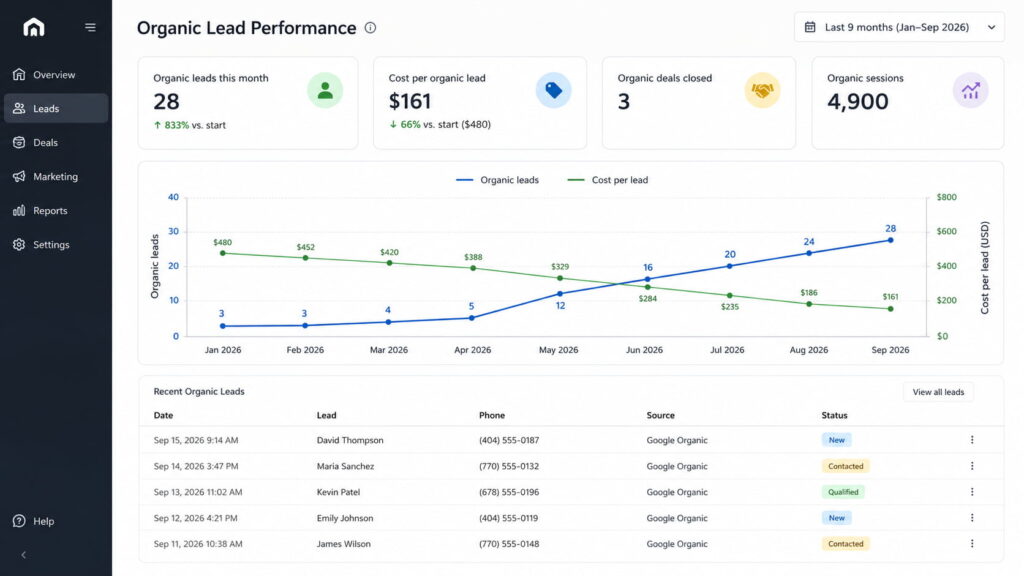
Organic leads climbing from 3 to 28 over nine months, with cost per lead falling the whole way. Leads with phone numbers, not impressions.
Local SEO: The Foundation of Realtor SEO
If you only fix one thing, fix local. For a real estate business, local SEO is the single biggest lever you have, because almost every search that matters has a city, a neighborhood, or a “near me” attached to it.
Three moves make up the local trifecta, and the rest of your SEO leans on them: your Google Business Profile, your city and neighborhood landing pages, and your reviews. Get these three right and you are already ahead of most agents in your market.
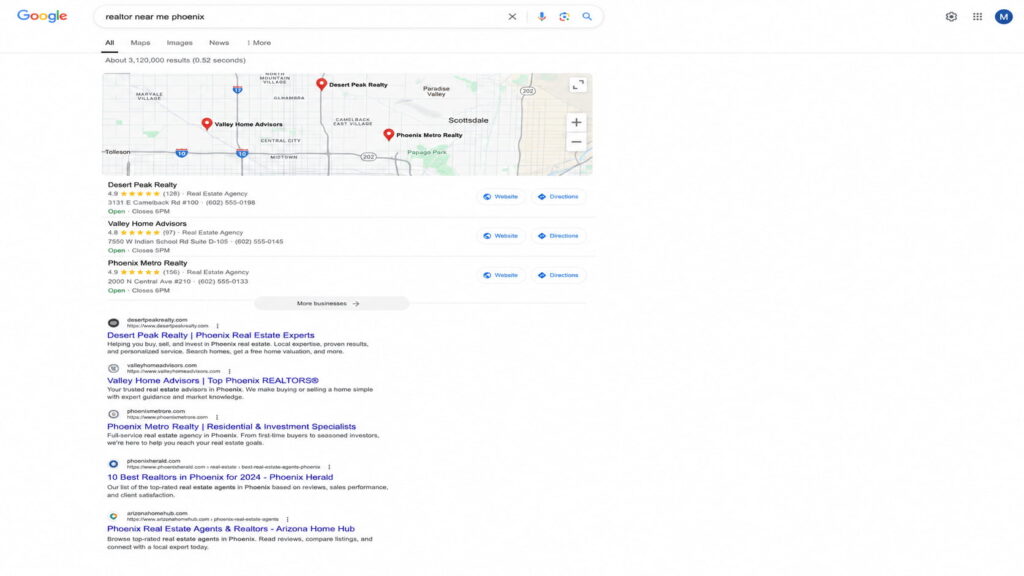
The local Map Pack is prime real estate. Three spots, and they go to the profiles Google trusts most.
Optimize Your Google Business Profile
Your Google Business Profile (the listing that shows your business in the local pack and on Maps) is the highest-leverage free asset you have. Work the checklist until it is genuinely complete:
- Claim and verify the profile, then fill every field: primary and secondary categories, service areas, hours, phone, and website.
- Add real photos and keep adding them: your headshot, closings, and neighborhoods you work.
- Write the business description in plain language with your city worked in naturally, not stuffed.
- List your services and use the Q&A and Posts features regularly, the way you would a small social feed.
- Respond to every review, good or bad, quickly and like a human.
There is a second reason to keep it airtight. Your profile is now a top data source that AI tools read when someone asks an assistant to recommend a local agent. A thin profile is invisible in both places. This foundation layer, tracking installed and the profile rebuilt from scratch, is exactly what BASEO sets up first for the operators it works with, and it moves real numbers: one client saw a 430% increase in Google Business Profile direction requests (BASEO client data).
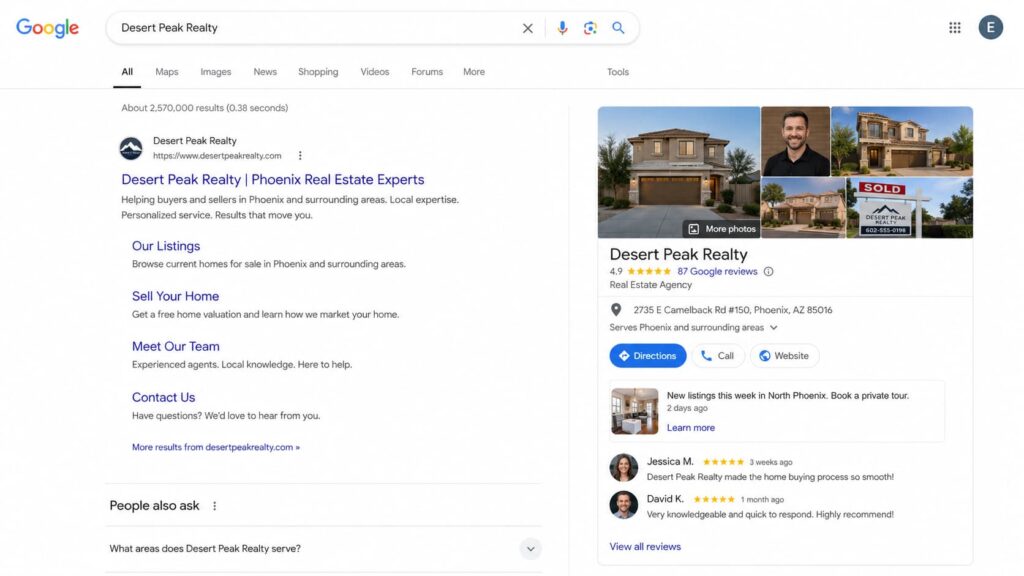
A complete profile, categories, service area, photos, posts, and answered reviews, is what earns a Map Pack spot and an AI mention.
Build City & Neighborhood Landing Pages
This is the highest-ROI content asset in real estate SEO: a dedicated page for each city and neighborhood you work, packed with genuine local detail. Not a thin page with the city name swapped in. A real page a local would recognize.
A strong neighborhood page usually covers:
- Schools, walkability, and commute reality.
- Cost of living and current market trends, with recent numbers.
- The streets, parks, restaurants, and landmarks locals actually name.
- Who the area suits (first-time buyers, downsizers, investors) and why.
- Active or recent listings and a clear next step.
One warning that costs agents dearly: do not mass-produce near-identical pages. Google’s March 2024 core update, paired with the new Scaled Content Abuse policy, wiped out a huge amount of low-quality, templated content, roughly 45% of low-quality results by Google’s own estimate (Google Search Central). Fifty pages that only differ by the city name now hurt more than they help. Each page has to earn its place. Building original pages per market, instead of templates, is the core of what BASEO does for its clients, precisely because the swap-the-city shortcut stopped working.
Get and Manage Reviews
Reviews do two jobs at once: they lift your local ranking and they close the visitor once they land. Google’s local ranking factors explicitly weigh reviews by quantity, recency, and how well you respond, and reviews remain one of the strongest local trust signals consumers act on (BrightLocal). A profile with 90 recent, answered reviews beats one with 12 stale ones, every time.
The fix is a system, not hope. After every closing:
- Ask in person while the good feeling is fresh.
- Send the direct Google review link the same day by text.
- Send one polite reminder a few days later if needed.
- Respond to the review when it lands, by name.
Do that on every deal and reviews compound quietly in the background, the same way rankings do.
Not sure which of these three you are missing? A free site audit will tell you exactly where your local SEO breaks, no call required.
Keyword Research for Realtors
Real estate keyword research starts from two things: a location and an intent. Nearly every valuable query is a place plus a job the searcher is trying to do. Get the pairing right and each keyword points cleanly at the page that should answer it. Our full top real estate keywords list is a good place to mine ideas.
Buyer-Intent vs. Seller-Intent Keywords
The fastest way to organize a keyword list is by who is searching and what they want next:
- Buyer-intent: “homes for sale in [city]”, “[neighborhood] condos”, “3 bedroom houses [city]”.
- Seller-intent: “sell my house fast [city]”, “home value [city]”, “how much is my house worth”.
- Agent-intent: “best realtor [city]”, “top real estate agent [neighborhood]”.
There is also the investor lane, phrases like “we buy houses [city]”, which is where cash buyers compete and where keywords for real estate investors live. Seller-intent terms are where the seller leads for real estate investors get captured, and they convert hardest. The rule across all of them: match the page type to the intent. A buyer keyword should land on a listings or neighborhood page, a seller keyword on a valuation or “sell your home” page, an agent keyword on an about or service page. Send a seller-intent search to a listings page and you lose them.
Why Long-Tail Keywords Win
Specific phrases are where solo agents actually win. Long-tail searches make up roughly 70% of all search traffic (SEOmoz via HubSpot), and Backlinko’s analysis of 306 million keywords found 91.8% of all queries are long-tail (Backlinko). They carry lower competition and higher intent, which is the combination that lets your site outrank a portal.
You will never outrank Zillow for “homes for sale.” You can absolutely outrank it for:
- “pet-friendly condos in [neighborhood] under 400k”
- “best school districts in [suburb] for families”
- “sell an inherited house fast in [city]”
- “new construction homes near [landmark]”
Fewer people search each phrase. The ones who do are ready to act.
On-Page SEO for Real Estate Websites
On-page SEO is everything you control on the page itself. None of it is complicated, and skipping it is why a lot of good content never ranks. Work this checklist on every important page:
- Title tag: primary keyword near the front, under about 60 characters.
- One clear H1 that matches search intent, with H2s and H3s that use natural variations.
- A meta description that reads like a promise, 140 to 160 characters.
- Internal links from strong pages to the page you want to rank.
- Descriptive image alt text (what the photo actually shows and where).
- Keywords placed naturally in the first 100 words and the headings, never stuffed.
If you want the full sequence in order of impact, our step-by-step guide on how to do SEO for a real estate website walks through it.
Listing Pages and Schema Markup
Individual listing pages are your highest-intent pages, and most agents leave them half-optimized. Give each one a unique title, real description copy, and complete details, then add schema markup (structured data, the labels that tell Google exactly what the page is). RealEstateListing or Product schema makes a listing eligible for rich results, the enhanced listings with price and photos that stand out in the SERP.
The tricky part is what happens when a listing sells or expires. Do not just delete the page and leave a dead link. Two clean options: redirect the sold listing to the matching neighborhood page so the ranking value carries over, or keep it live and clearly marked “sold” to feed local proof and internal links. Either beats a 404. Getting schema and sold-page handling right is part of the technical foundation BASEO installs before scaling content.
Content Marketing: Hyperlocal Authority
A blog that publishes real local content is how an agent becomes the name the neighborhood trusts, and how you earn the local backlinks that lift every other page. Generic “5 tips for buyers” posts do nothing. Hyperlocal content that only someone working the area could write is what ranks, earns links, and now feeds AI answers when an assistant summarizes a neighborhood.
Ideas worth publishing:
- Quarterly market reports for your city or ZIP, with real numbers.
- Neighborhood spotlights: schools, commute, price trends, the local feel.
- Buyer and seller guides tuned to your market’s quirks.
- “Cost of living in [suburb]” and “is [neighborhood] a good place to buy” explainers.
- Local event and development roundups that locals and local sites link to.
- Situation guides for sellers under pressure (probate, divorce, inherited property, or buying a foreclosure with cash), the searches motivated seller leads come from.
Pair the content with distribution: real estate social media marketing amplifies the local pages that already rank and feeds the signals that help them rank further. The links these pages earn from chambers of commerce, local news, and community sites are the kind of real editorial authority that moves rankings, not link farms or PBNs. That is the type of local authority BASEO builds for the markets its clients operate in.
Technical SEO Essentials
Think of technical SEO as the plumbing. Nobody praises it, but if it leaks, nothing else works. You do not need to become an engineer. You need the basics solid so your content has a clean path to rank:
- Site speed: pages that load fast, especially on phones.
- Mobile-friendliness: most real estate searches happen on mobile.
- A clean, logical site structure Google can crawl.
- HTTPS on every page.
- Indexability: no important page accidentally blocked from Google.
- Core Web Vitals: LCP under 2.5 seconds, INP under 200 milliseconds, and CLS under 0.1 (INP replaced FID as a Core Web Vital in March 2024, per Google).
These are table stakes. Fixing them will not win a competitive keyword by itself, but ignoring them will quietly cap everything you build on top. Installing this base layer is where BASEO starts every engagement, so the content that follows has something solid to stand on.
SEO and AI Search (AEO) for Realtors
Here is the piece most real estate SEO guides skip. Ranking no longer means only ranking in the ten blue links. It now means being the source that AI Overviews, ChatGPT, and Perplexity cite when a buyer or seller asks an assistant for help in your city. This is answer engine optimization, or AEO, and it is where the next few years of local advantage will be won.
The mechanics reward the same things good local SEO already does. A complete Google Business Profile, structured hyperlocal content, and clear question-based headings with concise answers are exactly what an AI needs to lift and cite your page. Write the way people ask (“what is the average home price in [neighborhood]?”), answer in the first two lines, and add schema so the machine can read it cleanly. Our guide on how to get cited in AI Overviews goes deeper.
The reason to move now is conversion. Visitors who arrive from ChatGPT convert at 15.9%, against 1.76% for Google organic (Seer Interactive). Nine times the close rate on the same person, because the assistant already qualified them before they clicked. BASEO builds this into its clients’ accounts: Q&A formatting, weekly tracking of who gets cited across the major AI engines, and recovering the AI-referred visits that show up mislabeled as “Direct” in Google Analytics. The agents who structure for citations while their competitors ignore it get a head start that is hard to close later.
How Long Does Realtor SEO Take to Work?
Expect first movement in 4 to 8 weeks, local-pack gains around 8 to 16 weeks, top-3 rankings on competitive city keywords in 6 to 12 months, and 12 to 24 months in ultra-competitive metros like Manhattan or Beverly Hills. SEO compounds, so results accelerate the longer you stay consistent.
| Milestone | Typical timing |
|---|---|
| First ranking movement, early long-tail wins | 4–8 weeks |
| Local Map Pack improvement | 8–16 weeks |
| Top-3 on competitive city keywords | 6–12 months |
| Ultra-competitive metros (NYC, LA, Miami) | 12–24 months |
In lead terms, most real estate operators see their first organic leads around month 3 to 5 and meaningful volume by month 6 to 9. Anyone promising ranked-and-flooded in 30 days is describing paid ads or selling you something.
How Much Does SEO for Realtors Cost?
Real estate SEO usually runs from about $500 to $5,000 per month, with the range driven by how competitive your market is and how much work the scope includes. Here is the lay of the land:
| Approach | Typical monthly range | Best for |
|---|---|---|
| DIY / solo, light effort | ~$500–$600 (tools + time) | One agent, one small market |
| Most agencies | $500–$5,000 | Agents and teams wanting done-for-you |
| Competitive metros | $4,000–$7,000 | Dense, high-value markets |
The number that matters more than the invoice is cost per deal. One closed transaction usually covers many months of the investment, so the real question is whether the work produces leads, not what the retainer says. That Florida operator paying a $4,500 monthly invoice closed 3 organic deals worth $54,000 in combined profit in month 9 alone, at $161 per organic lead and falling (BASEO client data). Priced against a single commission, mature organic is the cheapest lead channel most agents will ever run.
DIY vs. Hiring a Real Estate SEO Agency
You can do a real amount of this yourself, and you should know which parts. Here is an honest split:
| You can realistically DIY | Where an agency earns its fee |
|---|---|
| Claiming and completing your Google Business Profile | Technical SEO, schema, Core Web Vitals |
| A steady review-collection habit | Building original city and neighborhood pages at scale |
| Writing neighborhood and market content | Earning real editorial backlinks |
| Basic on-page fixes | AI-search (AEO) setup and citation tracking |
The catch with DIY is not capability. It is time. Every hour on schema and link outreach is an hour not spent listing, showing, and closing, and most agents value that hour highly. A fair thing to demand from any agency, by the way, is no long lock-in. BASEO, for example, has never placed a client on a 12-month contract. If you are weighing build-versus-buy, the same local playbook drives results for cash home buyers and traditional agents alike; the difference is who spends the hours.
Get Found by More Buyers and Sellers
Hyper-local SEO plus AEO is not a quick hit. It is an asset that compounds: the profile, the pages, the reviews, and the citations all keep working while you close deals. The agents winning organic in your market are not smarter. They started building these pages and profiles earlier, and every month of compounding widened the gap.
You do not have to build all of it at once. Start with the Google Business Profile and one real neighborhood page, add reviews on every closing, and let the wins stack. In lead terms, that is the difference between renting a portal’s traffic and owning a channel that still produces next year.
If you want to know exactly what is broken on your site and what your top competitor did instead, that is what the audit is for. Send your domain and get a free, written audit: the 3 biggest issues holding your site back, the local keywords your top competitor ranks for that you do not, and a deal-math projection for your market. No call required, yours to keep.
Frequently Asked Questions
A few of the questions agents ask most about realtor SEO.
Yes. For most agents SEO is one of the highest-ROI marketing channels, with real estate companies averaging roughly 1,389% ROI (First Page Sage). Instead of renting leads from portals, you build an owned asset that compounds, drawing buyer- and seller-intent traffic to your own site month after month.
Expect first movement in 4 to 8 weeks, local-pack gains around 8 to 16 weeks, and top-3 rankings on competitive city keywords in 6 to 12 months. Ultra-competitive metros like Manhattan or Beverly Hills can take 12 to 24 months. SEO compounds, so results accelerate the longer you stay consistent.
Costs vary by market and scope. Solo agents doing light work can budget around $500 to $600 per month, while most agencies charge $500 to $5,000 monthly. In highly competitive metros like New York or Los Angeles, expect $4,000 to $7,000 per month for the effort needed to compete.
Go hyper-local. Fully optimize your Google Business Profile, build unique city and neighborhood landing pages, publish local market content that earns backlinks, and collect steady reviews. Because real estate search is location-driven, local SEO plus long-tail, buyer-intent keywords beats chasing broad national terms.
Yes, agents can handle the basics: claiming and optimizing your Google Business Profile, gathering reviews, and writing neighborhood content. Technical SEO, link building, schema, and AI-search optimization are harder to scale solo, so many agents DIY the fundamentals and hire help for the rest.
[FAQ SCHEMA: Mark up the five Q&A pairs above with FAQPage / Question / Answer JSON-LD structured data on publish.]