
The investor’s actual scoreboard: a lead notification, with a phone number attached.
Every agency ranking for “real estate SEO services” is selling you traffic.
Traffic isn’t what you’re short of. Deals are.
So there are two questions worth asking about any real estate SEO service: what does a lead cost, and what does it close for? Most agency pages answer neither. This one does, including the parts that don’t flatter us.
- Why Real Estate SEO Is Different From Generic SEO
- What Our Real Estate SEO Services Include
- Who We Work With: Investors and Cash Buyers
- The Deal Flow Bridge: PPC for Speed, SEO for Compounding Growth
- How Much Do Real Estate SEO Services Cost?
- How Long Until Real Estate SEO Pays for Itself?
- Results: What One Extra Deal per Month Is Worth
- Get a Real Estate SEO Plan for Your Market
- Real Estate SEO Services: FAQs
Why Real Estate SEO Is Different From Generic SEO
The failure mode is always the same. An agency signs you, then runs the playbook it runs for a dentist. Blog posts on a content calendar. A monthly report full of impressions. Nothing that touches the pages a motivated seller lands on.
Three things make this niche a different product.
The searcher is in distress, not browsing. A man handling his mother’s estate isn’t comparison shopping, he’s solving a problem tonight. The intent is geo-bound: a seller in Tampa doesn’t want a national brand.
And the competitive set is largely identical. More than 30% of the top Google rankings for motivated-seller terms are Carrot template sites (Carrot): dozens of your competitors running near-identical copy with the city name swapped.
That stopped being cosmetic in 2024. Google’s scaled content abuse policy targets “large amounts of unoriginal content” generated “for the primary purpose of manipulating Search rankings,” and it applies “no matter how it’s created” (Google Search Central).
In operator language: your site looks like everyone else’s, so Google ranks none of you.
The damage isn’t theoretical. One client came to us after his previous agency ran his organic traffic from roughly 10,000 sessions down to 284, a 97% drop, while invoicing him every month (BASEO client data).
That’s why BASEO works only with cash home buyers. One niche, one page architecture. For the execution-level version, we published how to do SEO for a real estate website.
What Our Real Estate SEO Services Include
Read this as a vetting checklist, not a pitch. It’s what you should be getting for the money, from us or from anyone else.
- Keyword and market research built on two axes: city and seller motivation
- Local SEO and a Google Business Profile rebuilt from scratch
- Content that ranks and converts: original city pages and seller-situation pages
- Technical foundation: tracking first, then schema, then programmatic pages
- Local authority: real editorial links, no farms
- AEO/GEO: being the company AI search names when a seller asks
The order isn’t decorative. Tracking goes in before content, or you end up back where you started: a report full of impressions and no way to prove a lead came from any of it.
Keyword and Market Research by City and Motivation
Two axes. City, and motivation.
Most agencies hand a cash buyer a keyword list built for a Realtor: “homes for sale in Tampa,” “best neighborhoods in Tampa.” Nobody typing that is selling you a house.
The motivation axis is where your deals live: probate, foreclosure and pre-foreclosure, divorce, inherited property, problem tenants. That’s how the search gets typed at 11pm.
The paid market tells you which terms are contested. “Sell house fast” runs roughly $12 to $63 per click (Webrageous); broader investor terms like “we buy houses cash” run closer to $2.50 to $5.00 (Promodo). Read those as a valuation, not a cost: what a keyword costs on the paid side is the clearest signal of what it’s worth organically.
BASEO maps that grid before you’re a client, and the competitor keyword gap is part of the free audit. The raw list: keywords for real estate investors, and a broader set sorted by search intent.
Local SEO and Google Business Profile
When a seller searches “we buy houses near me,” the answer resolves in the Map Pack. Three results. That’s the entire competition for that search.
Your Google Business Profile is the cheapest asset you own and the one almost nobody has rebuilt: categories right, services listed, real photos, posts on a cadence instead of never.
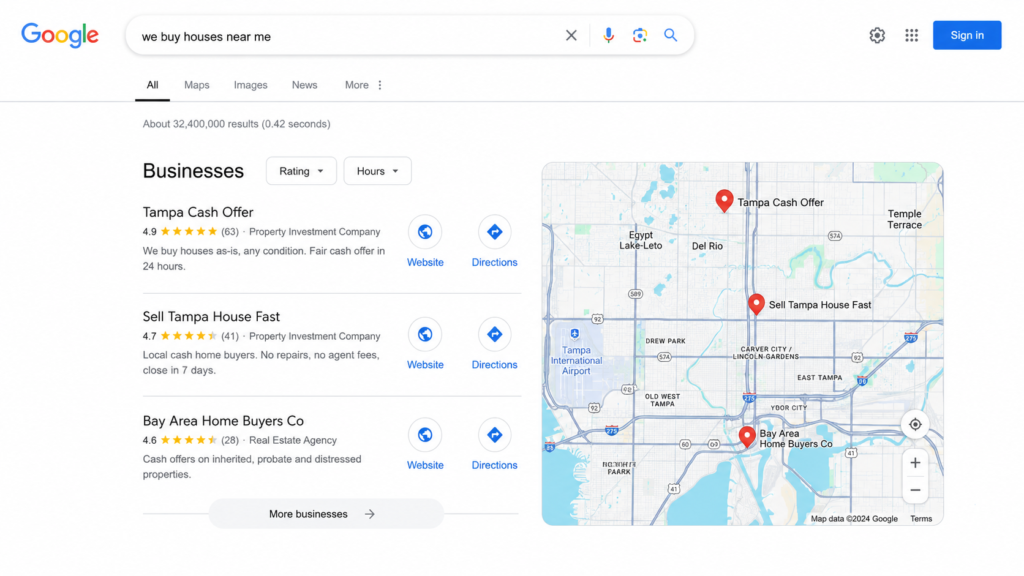
Three results. That’s the entire competition for “we buy houses near me” in your city.
It moves real numbers: one client’s profile went from ignored to a 430% increase in direction requests (BASEO client data).
One honest limit. A rebuilt profile wins the near-me search. It does not win “sell my house fast [your city].” That one needs a page.
Content That Ranks and Converts Sellers and Buyers
Your homepage is not your most important page. On investor sites that actually pull leads, 60% or more of organic traffic lands on city pages. The homepage is where a seller checks that you’re real, after a city page already caught him.
City landing pages: one for every market you actually buy in, original to that market. Local copy, local proof, market-specific detail. Not a template with the city name swapped, which is the exact behavior Google’s policy was written to catch.
Seller-situation pages: probate, foreclosure and pre-foreclosure, divorce, inherited property, problem tenants. These convert above average for a reason that has nothing to do with SEO. The situation is urgent, so the searcher isn’t shopping, he’s solving. They also feed internal links back to your city pages.
That architecture is the core of what BASEO builds. We broke down what seller leads cost per deal separately.
Technical SEO and Programmatic Pages
Most cash buyers don’t have a technical problem in the abstract. They have a tracking problem.
So the foundation goes in first: call tracking and form tracking installed, so a lead becomes something you can count. GA4 and Search Console configured, often for the first time. Schema markup on the service pages (labels that tell Google exactly what a page is). The inherited template copy replaced.
The order matters more than any item on that list. Situation pages without tracking is how your last agency hid for eight months.
Then programmatic pages, done the way that survives: original per market, or you’re inside the definition of scaled content abuse and the pages are a liability.
Link Building That Moves Local Rankings
What moves a local ranking is local authority. Chambers of commerce. REIAs. Local news outlets. Sites that exist in your market and have a reason to mention a company that buys houses in it.
No link farms. No PBNs. No paid schemes. If an agency won’t tell you where a link came from, you already have your answer.
A link from the county REIA does more for “we buy houses [city]” than a generic high-authority placement with no connection to the market. That’s the authority BASEO builds, in the markets you operate in.
AEO / GEO: Getting Recommended by ChatGPT, Perplexity and AI Overviews
A seller opens ChatGPT and types the question he used to type into Google. “How do I sell my house fast for cash in Phoenix.”
He gets an answer. The answer names two or three companies.
That list is the new Map Pack, and it’s shorter.
AI Overviews now appear on nearly half of all searches, and Google rolled out AI Mode to every US searcher in May 2025 (Carrot). The number that travels in REI circles came from Carrot’s own customer base: one investor received 26 of his 45 leads in a seven-day stretch from ChatGPT.
Those leads behave differently, because the seller arrives having already had the conversation. In one published case study, ChatGPT traffic converted at 15.9% against 1.76% for Google organic (Seer Interactive). That study tracked a single B2B software client, so treat it as direction, not a benchmark for your market. The mechanism is what carries over: the AI qualified the seller before he clicked.
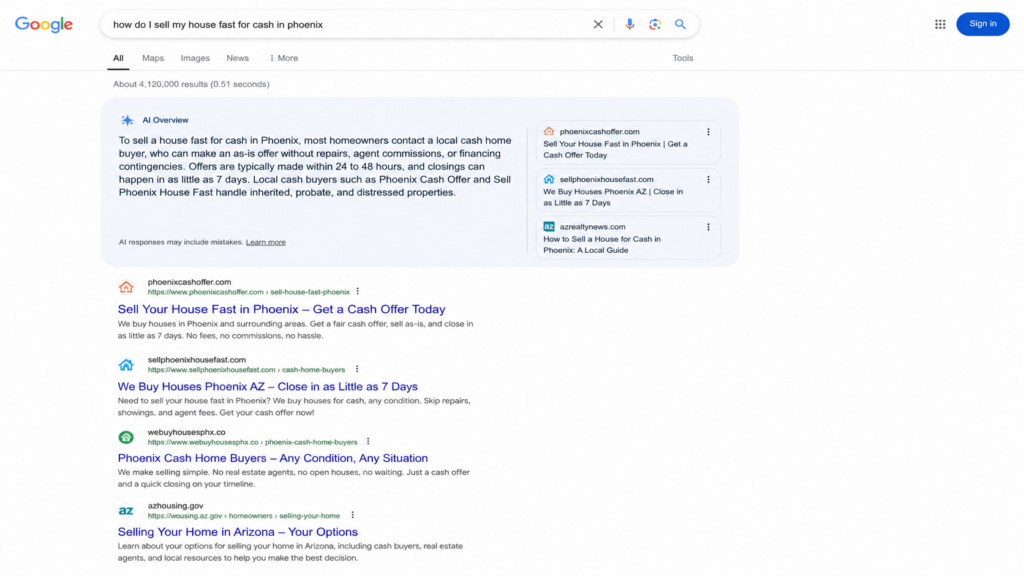
The AI Overview names two companies. In that search, those are the only two that exist.
There’s a measurement trap here. Most AI-referred visits land in Google Analytics as “Direct,” so the channel looks like it doesn’t exist. It isn’t absent, the attribution is broken. And the window is open right now, because the cited list in most markets is still short.
What BASEO does about it: Q&A structure and citation-friendly schema these systems lift from, weekly citation tracking across ChatGPT, Perplexity, Claude and AI Overviews for every market you operate in, and AI referral attribution that pulls those “Direct” sessions back into the report.
What BASEO does not do is promise a citation. Nobody controls whether an AI cites a page. We optimize the inputs, track the outputs, and show you when a competitor gets named instead of you. The mechanics are in how to get cited in AI Overviews.
Who We Work With: Investors and Cash Buyers
BASEO works with cash home buyers. Wholesalers, flippers, buy-and-hold operators, HomeVestors franchisees. That’s the list.
The narrow list isn’t exclusivity for its own sake. It means we walk into your market already knowing your competitors, your keywords, and your seller situations.
If you’re an agent or a listing team, retail SEO is a different product with different pages and a different buyer at the end of it. We won’t pretend otherwise to win the engagement. Start with our marketing playbook for agents instead.
Structurally, here’s the engagement:
- Month-to-month. Thirty days’ written notice. We have placed 0 clients on a 12-month contract, ever (BASEO client data).
- A written scope of work every month. If we miss a deliverable on it, that month is refunded.
- Market exclusivity. One client per core metro, so we’re never optimizing two sites against each other.
- You own everything. The content, the links, the data, the reports. If you leave, it leaves with you.
The Deal Flow Bridge: PPC for Speed, SEO for Compounding Growth
Don’t kill your ads.
BASEO manages PPC for cash buyers, which is exactly why that advice isn’t self-serving. Paid rents attention. It’s the fastest way to a lead, and the only channel that stops the day your card stops.
| Google Ads (paid) | Mature organic | |
|---|---|---|
| First lead | Days | Typically months 3 to 5 |
| Cost per lead | $28 to $65 on investor campaigns | Falls over time, toward $7 to $30 |
| When you stop paying | Leads stop that day | Leads keep coming |
| Over time | Cost per click rises with competition | Cost per lead falls as the asset compounds |
| What you own at the end | Nothing | The pages, the rankings, the traffic |
Sources: investor PPC cost per lead of $28–$65 (Promodo); mature content cost per lead of $7–$30 (Visionary Marketing).
Now the number that decides the argument. In real estate, organic leads cost 83% less than paid leads, the largest gap of any industry in the comparison, and Carrot’s Investor Performance Study found organic leads close 2x more profitably (Visionary Marketing). Our Florida client landed at $161 per organic lead by month 9 (BASEO client data).
$161 per organic lead. And falling every month.
So the bridge is a sequence, not a war. Paid keeps the phone ringing through months 1 to 5 while the organic asset gets built. Then the spend comes down because it can: most clients cut PPC 30% to 50% by months 6 to 9.
For the paid-side detail: real CPC and cost-per-lead numbers, and a ranking of channels that actually bring in deals.
How Much Do Real Estate SEO Services Cost?
Straight answer first. Across the industry, the most common agency retainer sits between $1,500 and $5,000 a month, where roughly half of all agencies operate. The Ahrefs survey of 439 SEO professionals put the average at $3,209 a month (GoodFirms).
Here’s what those tiers buy.
| Monthly range | What it typically buys | Who it fits | The risk at this tier |
|---|---|---|---|
| Under $1,000 | A few blog posts. Maybe a directory listing. No tracking, no page production. | Nobody serious about deal flow. | You pay for activity and never find out whether it produced a lead. |
| $1,000 to $2,000 | Basic local SEO and profile upkeep. Little original page production. | A single-market operator testing the water. | Not enough production to outrank an established competitor. |
| $2,000 to $5,000 | The common tier: technical foundation, original city and situation pages, local authority, real reporting. | Most cash buyers in one to three markets. | The tier is usually right. The agency is where it goes wrong. Ask what gets built and what gets counted. |
| $5,000+ | Multi-market builds, aggressive content and authority programs. | Operators buying across many metros. | Paying enterprise rates to an agency that doesn’t know the niche. |
The monthly number is the wrong question anyway. The right one is cost per deal. A $2,000 retainer that produces nothing is infinitely expensive. A $4,000 retainer that produces one extra assignment a month is the cheapest thing in your business.
So the number to fear isn’t a high one. It’s a wasted one. That Florida client spent 14 months at $4,500 a month with his previous agency, and not one report contained a lead count (BASEO client data). He didn’t have a pricing problem. He had an accountability problem.
BASEO’s number is custom to your market, and it’s in the audit, in writing, before anyone asks you to decide anything. Get your free site audit →
How Long Until Real Estate SEO Pays for Itself?
Anyone telling you leads in 30 days is describing PPC, or lying.
The honest arc: first organic leads typically show up in months 3 to 5, and real lead volume tends to land between months 6 and 9. That’s an expectation based on what we’ve seen, not a promise. Nobody can guarantee a ranking, and Google says so itself.
| Phase | When | What happens | What you should see |
|---|---|---|---|
| Audit | Week 1, free | Written audit: the 3 biggest issues, the competitor keyword gap, the deal math for your market. | A document you keep, whether or not you hire anyone. |
| Foundation | Months 1 to 2 | Call and form tracking installed. GA4 and Search Console configured. Schema added. Template copy replaced. Google Business Profile rebuilt. | Leads become countable. Usually for the first time. |
| Content engine | Months 2 to 6 | Original city pages and seller-situation pages published. | First organic leads, typically months 3 to 5. |
| AI layer | Months 3 to 9 | Q&A structure, citation-friendly schema, local editorial links. | AI citations typically become visible months 6 to 9. |
| Compounding | Month 9+ | The asset keeps working without new spend behind it. | Lead volume that changes how the business feels. |
The curve bends late, and that’s the trade. Paid is a flat line: you pay, you get leads, you stop, they stop. Organic is slow, then it isn’t, because content compounds while the cost per lead moves the other way, from around $80 to $100 down to $7 to $30 once the pages have authority (Visionary Marketing). For the Florida client, month 5 was the turn: 12 organic leads, and the first 3 organic deals closed (BASEO client data).
Which leaves the only payback question that matters: what is one extra deal a month worth to you?
Results: What One Extra Deal per Month Is Worth
Start with the before, because it’s the part most people recognize. A Florida cash buyer, 14 months into an agency relationship. Organic traffic down from roughly 10,000 sessions to 284. Three motivated seller leads a month.
What happened over the next nine months, same market, same invoice, no extra ad spend (all figures BASEO client data):
- 3 to 28 motivated seller leads a month, in 9 months.
- The 97% traffic collapse reversed within those same 9 months.
- $161 per organic lead, declining every month.
- Month 9: 3 organic deals closed, $54K in combined profit, against a $4,500 monthly invoice.
Across other accounts, organic sessions rose 102%, 438%, and 121% (BASEO client data).
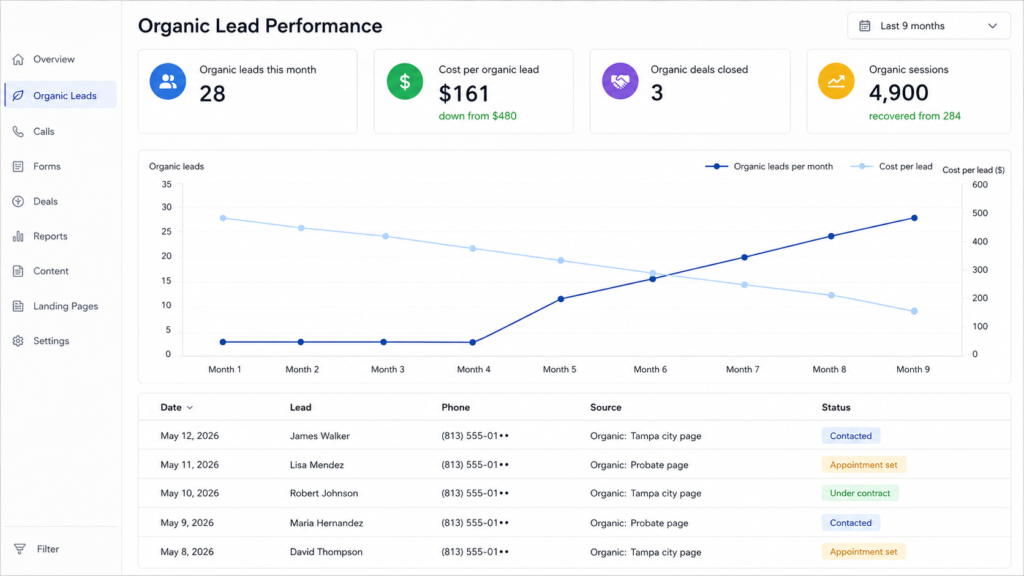
What the report is supposed to show: leads with phone numbers, and a cost per lead that goes down.
That’s what the monthly report is built around: leads with phone numbers, the cost-per-lead trend, pages published, AI citations, and next month’s plan in plain English. If your current report leads with impressions, you already know what it’s hiding. The month-by-month version is in the full case study.
Now run your own number, because your market isn’t Florida. The national average wholesale assignment fee is about $13,000, ranging from roughly $3,000 to $25,000 by market (Real Estate Bees). On the flip side, ATTOM’s Q3 2025 data shows the median flipped home bought at $260,000 and sold at $320,000: $60,000 in gross profit, at a 23.1% return, the lowest since 2008 (ATTOM).
So one extra assignment a month is $13,000 against a marketing invoice that’s a fraction of it. One extra flip is roughly five times that. And that margin compression is precisely why the cost of a lead matters more this year than last. When the spread on the deal narrows, the cost of finding the deal is what’s left to fix.
Get a Real Estate SEO Plan for Your Market
Send us your domain. That’s the whole ask.
In about two business days you get a written audit back: the three biggest issues holding your site back, the keywords your top local competitor ranks for that you don’t, the deal math for your market, and what the work would cost in your situation.
No card. No contract. No call required. If you never speak to us again, the document is still yours, and you can hand it to whichever agency you do hire.
And if your market doesn’t support the math, the audit will say so. We’ve turned down operators whose markets weren’t worth the spend. You’d rather hear that in a free document than discover it in month seven.
One practical note: one client per core metro. If yours is spoken for, better to know now.
Real Estate SEO Services: FAQs
Most agencies charge between $1,500 and $5,000 a month, where roughly half the market sits, and the industry survey average is about $3,200 (GoodFirms). For real estate, the monthly figure matters far less than the cost per deal it produces. BASEO prices per market, and your number comes back in the free audit.
It depends on your market and your math, and any agency answering with an unqualified yes is selling. In real estate, organic leads cost 83% less than paid leads and close 2x more profitably, per Carrot’s Investor Performance Study (Visionary Marketing). In thin markets, the numbers don’t get there. We’ve told operators not to buy.
First organic leads typically appear in months 3 to 5. Meaningful volume usually lands between months 6 and 9, once the city pages and seller-situation pages have authority behind them. Anyone promising leads in 30 days is describing pay-per-click advertising, or lying. That timeline is an expectation, not a guarantee.
A real package covers six things: keyword and market research by city and seller motivation, local SEO and a rebuilt Google Business Profile, original city and seller-situation pages, a technical foundation with lead tracking installed first, local editorial links, and AI search optimization. “Package” means whatever an agency wants it to mean, so get the deliverables in a written scope with a date on each one.
Ads stop producing the day you stop paying, and purchased leads are usually sold to your competitors too. Organic keeps working after the invoice ends, and in real estate organic leads run about 83% cheaper than paid (Visionary Marketing).
This isn’t an argument to quit ads. Investor campaigns produce leads at $28 to $65 (Promodo), which is real. Run both, then shrink the paid side as organic takes over. Here are the keywords worth bidding on.
GEO (generative engine optimization), also called AEO, is the work of getting your pages cited by ChatGPT, Perplexity, Claude and Google’s AI Overviews when a seller asks how to sell a house fast for cash in your city. It’s a citation game, not a ranking game: the AI names two or three companies, and you’re either on that list or invisible.
It matters now because the list is short. One Carrot customer got 26 of his 45 leads in a single week from ChatGPT (Carrot).
Final thoughts
The investors winning organic search in your city aren’t smarter than you. They started earlier and built the pages you haven’t built yet.
That’s the whole playbook above, and every piece of it is work, every month. Some operators run it themselves and do fine. Most would rather spend those hours at a kitchen table with a seller, which is where the money gets made.
If you want to know which pieces your site is missing before you decide either way, that’s what the audit is for. We work only with cash home buyers, so it already knows your competitors, your keywords, and your seller situations. Free, in writing, about two business days. No call required, and yours to keep.