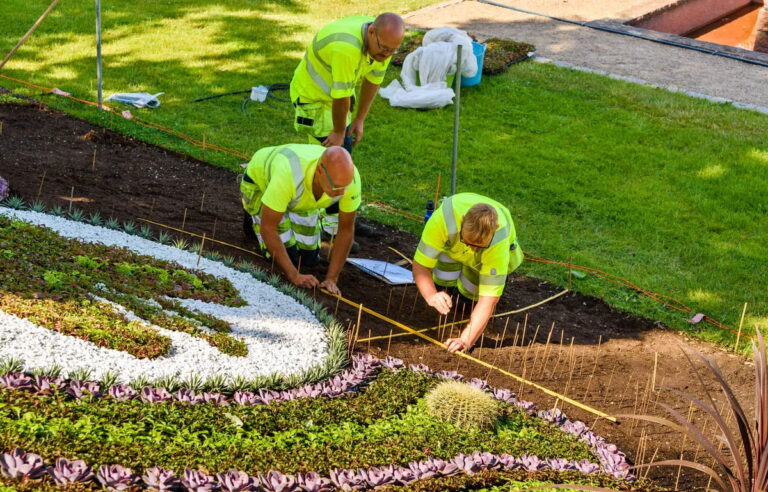
You already paid somebody to build your website. A web guy, an agency, or a plan that bills every month, and today you cannot name one job it brought in. Now you have to pick again, and every list you open ranks ten companies without telling you how to decide.
This page does not rank anyone. It sorts the companies that build landscaping websites into the five kinds that exist, because almost every “best of” list on this search was published by one of the companies on it. By the end you will know which kind you are talking to, and the seven questions that prove it.
The person who has to live with whatever site you buy.
- Why this list has no #1
- The five kinds of company that will pitch you a landscaping website
- The companies landscapers actually run into
- What a landscaping website costs, by who builds it
- Seven questions that tell you which kind you’re talking to
- How to check a landscaping web design portfolio in ten minutes
- The prettiest site in town can still book nothing
- Which landscaping website company fits the size of your operation
- Where we fit, and where we don’t
- Get a written read on the site you already have
- Frequently asked questions
Why this list has no #1
Look at who publishes them. A “best landscaping web design companies” roundup is almost always written by a company that builds landscaping websites, and that company sits somewhere in its own top three. Rarely disclosed. The format is the conflict of interest.
So here is ours, up front. BASEO is a marketing agency for landscapers, and building websites is one of the things we do. A ranking from us would be worth what the ones you already read were worth. You are not getting one.
What you are getting is five categories and the criteria to sort anybody into them, us included.
Three questions did the sorting: who owns the domain when it ends, whether the build covers every town the crew drives to, and who picks up when the quote form breaks in July. Every difference here that costs money traces back to one of those three.
The team on your account here works only with landscapers, which is why we have opinions about this and also a reason to discount them.
The five kinds of company that will pitch you a landscaping website
- Green industry specialists. They build only for landscaping, lawn care, tree and hardscape crews.
- Home services agencies at scale. They serve every trade, and landscaping is one vertical.
- General web design shops. Real designers who have never heard of a service area.
- Template subscriptions and DIY builders. A monthly plan, or you build it yourself.
- The local freelancer. One person, cheap and close, until they stop answering.
Most specialized to least. Price runs roughly the other way. Ownership tracks neither, which is what surprises people.
Green industry specialists
These firms work only inside the green industry: landscaping, lawn care, tree service, hardscape. You do not spend the first call explaining what a service area is, or why the patio page beats the mowing page.
Verified names here: Green Frog Web Design, which builds for lawn and landscape companies and nothing else; Landscape Leadership, green industry only since 2008; and Ramblin Jackson, a green industry agency working with landscapers, lawn care operators, arborists and snow crews.
What you give up is choice. There are not many, the waitlist is real, and some sell one industry template over and over. That is how five landscapers in one state end up with sites that read the same.
So ask the uncomfortable question: how many landscaping sites came out of this template, and where is the nearest one?
Home services agencies at scale
These are contractor agencies. Roofing, HVAC, plumbing, garage doors, and landscaping as one vertical on a long list. Verified names: Blue Corona, now operating under RYNO; Builder Funnel, which works with builders, remodelers and lawn care; Hibu; KickCharge Creative; and Scorpion.
What you get is infrastructure. Tracking that exists, reporting that arrives, somebody who picks up on a Tuesday, and ads run next to the site instead of by a second vendor. If you run three crews and you are tired of chasing four people, that is not a small thing.
What the model brings with it is term length and the ownership question. Multi-year agreements are normal here, and the site can stay behind when you leave.
That is not a knock on anyone named. It is how the model is built, and why questions one through three exist. Plenty of operators here are happy.
General web design shops
These build good sites for anyone. Verified names: FreshySites, Thrive Internet Marketing Agency and WebFX.
What you get is design. Real designers, a real process, and sometimes a better price than a specialist quotes.
What gets shipped is a five-page site with one Services page listing eleven services, and no town pages. Not because they are careless. Because nobody told them the site’s job is to show up in the towns your truck already drives through.
So hire one with your eyes open: you bring the page map. Write down every service you sell and every town you cover, and pay them to design it well. The page map to hand them is already written out step by step.
Template subscriptions and DIY builders
Two different things share this category.
The first is the industry monthly plan. 180 Sites publishes landscaping and lawn care sites from $195 a month, and Footbridge Media publishes a contractor program at $249 a month with no contract. The second is you, on a Sunday night, with Wix or Squarespace or Webflow.
Going in cheap and fast is a legitimate answer. For an operator still building the book it is usually the right one, and nobody should talk down about that.
Check ownership before you sign. On many subscription plans the site is not yours: stop paying and it goes dark, because you were renting it. Ask which one this is.
Then judge it on time, not features. Whoever maintains this has to change a phone number from a truck between jobs. If that takes a support ticket, it never gets changed.
The local freelancer
The web guy. Your nephew, the guy from the gym, the designer in town who did the sign shop’s site.
What you get is cheap, close, and a person who picks up. Some do genuinely good work.
What you are exposed to is the most expensive failure in this trade, and it is structural, not moral. One person, no backup, the domain in their name.
They take a full-time job in March. They stop answering in May. In July the site with your phone number goes down and there is nobody to call.
Nobody is accusing anyone of running a scam. It is a business with one point of failure, so that is where it fails. How you avoid it is three sections down.
The companies landscapers actually run into
The company that calls you next month is probably not in this table. Most landscapers hire local, or hire whoever another operator vouched for at a trade show. That is why the category matters more than the name.
Every company below was opened on its own website in August 2026 and confirmed operating. Grouped by category, alphabetical inside each group. No numbers, no “best for,” no order of quality.
| Company | Category | Why you run into them |
|---|---|---|
| Green Frog Web Design | Green industry specialist | Lawn and landscape only |
| Landscape Leadership | Green industry specialist | Green industry only, since 2008 |
| Ramblin Jackson | Green industry specialist | Landscaping, lawn care, arborists, snow |
| Blue Corona (RYNO) | Home services at scale | Home services, landscaping practice |
| Builder Funnel | Home services at scale | Builders, remodelers, lawn care |
| Hibu | Home services at scale | All-in-one plan for local businesses |
| KickCharge Creative | Home services at scale | Branding and sites for home service trades |
| Scorpion | Home services at scale | Home services platform, landscaping practice |
| FreshySites | General web design shop | Comes up when you search web design, not landscaping |
| Thrive Internet Marketing Agency | General web design shop | Runs ads on contractor keywords in most markets |
| WebFX | General web design shop | Ranks for web design in nearly every metro |
| 180 Sites | Template subscription | Landscaping sites on a monthly plan |
| Footbridge Media | Template subscription | Contractor program on a monthly plan |
No row for the fifth category. The local freelancer has no brand, and that is the point.
One pattern shows up top to bottom: as specialization goes up the number of shops goes down and price climbs with it. Ownership follows neither line, which is why you ask.
What a landscaping website costs, by who builds it
These are market ranges, not ours. We have written up what a landscaper site costs in more detail.
| Who builds it | Typical range | What that buys |
|---|---|---|
| DIY builder or template | $500–$2,500 | Three to five pages, minimal search work |
| Industry monthly plan | $195–$250 a month | A maintained site, usually on their platform |
| Freelancer | $2,500–$7,500 | Custom design, mobile, a working quote form |
| Agency with tracking and town pages | $7,500–$20,000+ | Quote forms, call tracking, service area pages |
| Full high-end rebuild | $15,000–$25,000 | A complete project, not a subscription |
Build ranges from BuiltRight Digital (August 2026) and Landscape Leadership. Monthly figures published by 180 Sites and Footbridge Media.
Two things the table leaves out. Hosting and security run $10 to $50 a month, and maintenance $50 to $300 a month, on top of the build (BuiltRight Digital). Nobody quotes those on the first call.
Now the part no page on this search does. Translate the price into jobs.
One landscaping crew closed a $14,800 patio off a page they own, with a maintenance contract underneath it that kept renewing (BASEO client data). Against that, a $7,500 build is paid for by half of one job. Run it the other way: the same build spread over a year has to produce one extra patio, or a handful of maintenance contracts that renew, to have been free. A much lower bar than the invoice makes it feel.
Which flips the question. It was never what the site costs. It is how many jobs it has to bring in to pay for itself, and how fast.
A $500 site that never appears in a town you drive to costs more than a $12,000 site that does. One produces nothing, the other produces work.
If you want our number: it depends on your market, and it comes in the free audit with the job math for your area.
Seven questions that tell you which kind you’re talking to
- Whose name is the domain registered in?
- If I leave, does the site come with me?
- Is there a term contract, and how long is it?
- Does the build include a page per service and a page per town?
- Who can edit the site without calling you? If the answer is “we do,” every change is a ticket.
- In month three, will you show me visits or quote requests? A report with no phone numbers is not a report.
- Can I see two sites you built and Google them myself?
Rather not ask all seven cold? Send us the site you have and we will answer them in writing.
Who owns the domain, the site, and the Google Business Profile
Three lines, and that is the whole rule.
The registrar account is in the business’s name. The owner email is a business email, not whoever built the site. The login is in your hands, even if you never touch it.
Same rule for the hosting, and for the Google Business Profile, the listing that puts you on the map and is often worth more than the site.
Here is the failure, without the sermon. The day it ends, whoever holds the login wins.
Your phone number lives on that domain. Your reviews live on that profile. If somebody else controls them, you are negotiating for your own business.
Checking takes two minutes. Log into the registrar with your business email and see whether the domain is listed. If it is not there, it is not yours, whoever paid the invoice.
For what it is worth, BASEO clients own everything: site, content, links, data. It is a clause in the agreement, not a feature.
What happens on day 366
The first 365 days look about the same everywhere. Day 366 is where they separate, and the contract decides whether you bought an asset or rented one.
Four questions, and get the answers in writing. How long is the term. What happens the day I cancel. Is there a rebuild fee or an exit fee. Does the site stay up.
There is a model where you pay monthly, the site looks good, the provider maintains all of it, and the day the payments stop the site goes dark. It is not a trap and it is usually published. The mistake is not reading it. You find out in February, with nothing booked for spring and the phone number on a site somebody else can switch off.
For the record, no BASEO client has ever been put on a 12-month contract (BASEO client data). Month to month, 30 days’ notice. Not generosity: it is the version where the work has to keep earning the invoice.
Does the build include a page per service and a page per town
This is the difference between a brochure and a dispatcher. A brochure tells a homeowner who you are. A dispatcher shows up when somebody two towns over searches for the thing you do.
What that takes is boring and specific. A real page for every service you sell, ordered by what the job pays rather than how often it gets searched. And an original page per town your crew drives to.
Original is the load-bearing word. If your town pages are one page with the name swapped, they look like everybody else’s, so Google ranks none of you. One “Areas We Serve” page with forty cities is the common version.
Ranking for a paver patio is not harder than ranking for a mow. It just pays what the last section said it pays.
We build a page per service and per town that way. The full map lives in its own guide, so whoever you hire, make sure they use one.
How to check a landscaping web design portfolio in ten minutes
A portfolio is a gallery of screenshots until you check it. Ten minutes, from your phone.
- Ask for two sites they built for landscapers in markets like yours. If they cannot produce two, you already know their category.
- Google that client’s service plus their town. If the site does not come up, this provider does design, not search. Not disqualifying. It changes what you ask them for.
- Open it on your phone and count the taps to a quote request. More than three and the site is arguing with the visitor. Check the phone number dials with one tap.
- Look for real town pages. Individual pages per town, or one “Areas We Serve” page with forty cities. That is the difference between a site that dispatches and one that lists.
- Check the date on the newest thing on the site. If nothing has moved in two years, that is the maintenance the plan includes.
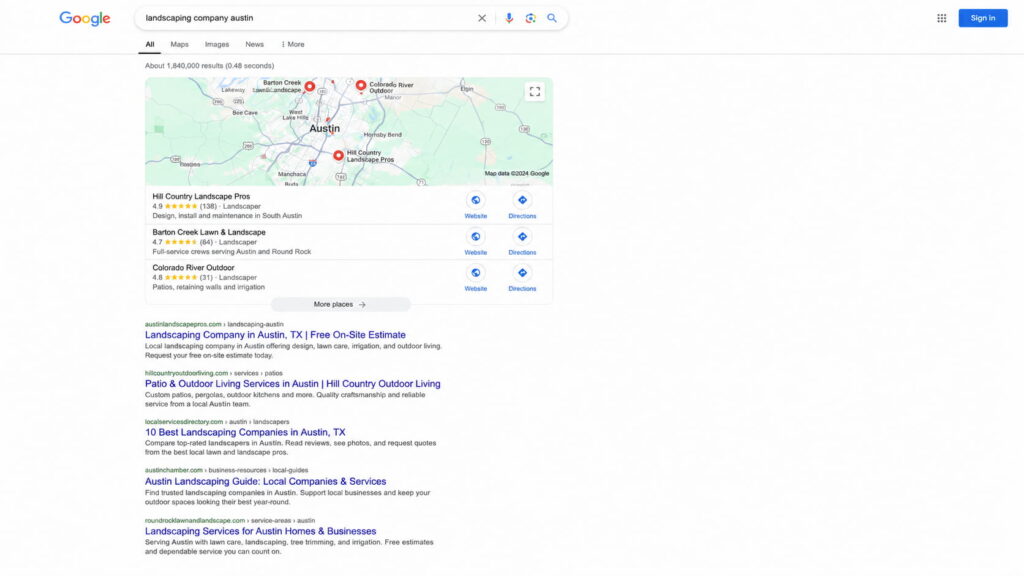
Step two, on a real query. If their client is nowhere on this page, you know what you are buying.
Two of five failing does not make them a bad company. It tells you what you will have to supply yourself, which is useful before you sign, not after.
The prettiest site in town can still book nothing
Your site has three jobs, in this order.
Show up where the crew already drives. Make the work look real to a stranger. Get a quote request into your phone before he opens the next tab.
Design serves the third. It does not replace the first two. A beautiful site that never appears in the next town over is an expensive brochure. What to write on each page is its own subject.
Here is where design earns its money. 97% of consumers read reviews for local businesses, and 54% then check the business’s website (BrightLocal, Local Consumer Review Survey 2026).
Reviews walk the homeowner to your door. The site has to close. If it does not name the town, show work you actually did, and carry a form somebody answers, that review got spent for nothing.
A San Antonio landscaper’s site was rebuilt around those three jobs. Six months later it was taking 77 organic quote requests a month instead of 28 (BASEO client data). What changed was the build, not the look: pages for the services, pages for the towns.
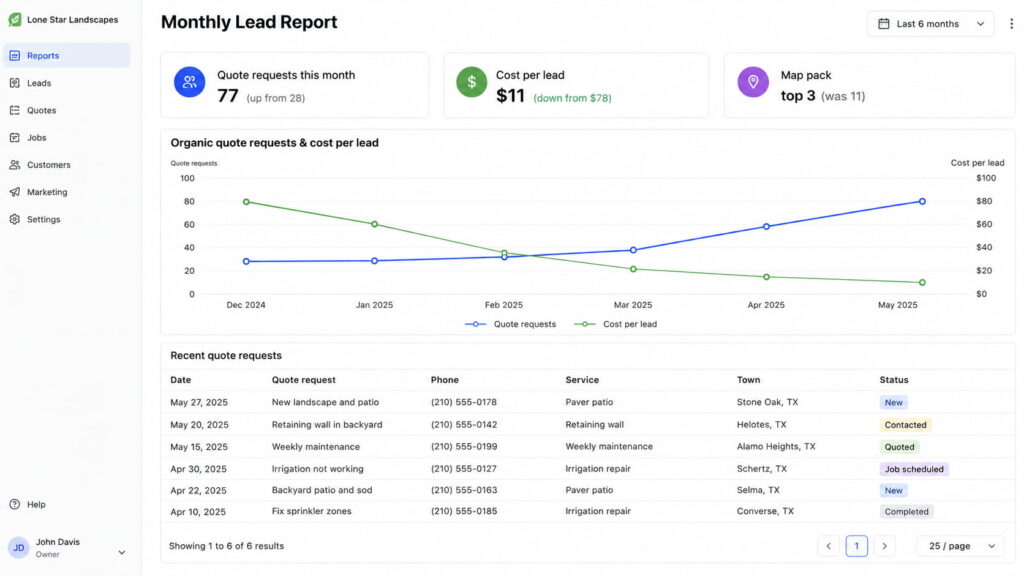
The report you should be getting in month three: quote requests with phone numbers, not visits.
If a provider only wants to talk about design, the site will look good. Ask them about the other two jobs.
Which landscaping website company fits the size of your operation
These brackets are sorted by the problem you have, not by what you bill.
One truck, one or two guys, mostly one town. (Under about $250K, if you think in revenue.) A builder or a monthly plan is the honest answer. Not because you deserve less. At that size the site is not the bottleneck: word of mouth and your Google Business Profile bring most of the work, and $12,000 on a website is money sitting still.
Two or three crews, several services, five or six towns. ($250K to $1M.) Here the site stops being a brochure. You need a page for each service and each town, and a specialist starts paying for itself. It is where pages ordered by margin matter more than page count.
Multiple crews across more than one market. ($1M and up.) You need one team running the site, the ads and the reporting together, because at that size the three start stepping on each other.
If you are paying Angi right now, you already have the budget. It is just rented. Angi is not a lead source, it is a lead rental: you pay the same whether you close the job or lose it, and the day you stop paying it all stops. One crew went from $78 a shared lead to about $11 for a lead off pages they own (BASEO client data), and four other crews bought that same $78 lead.
That does not mean cancel it Monday. That channel feeds your crew this week. Build the one you own while the other keeps running.
Where we fit, and where we don’t
We said at the top that we build landscaping websites. Here is the specific version, including the part that costs us work.
What the team does: landscaping website design built around a page per service and a page per town, with SEO and Google Ads and Local Services Ads in the same house instead of three vendors. You own everything: site, content, links, data. Leads are 100% exclusive and never shared. No 12-month contract, ever. Month to month, 30 days’ notice. Most sites go live in a few weeks, not months.
What we are not: the cheapest option on this page, and not trying to be. If you are still building the book, the right answer is a builder for now. Go do that instead.
We also do not touch the software you run the work on. Jobber, Aspire, ServiceTitan: those are yours and stay yours. The site and the lead channel are ours.
Plenty of operators handle this themselves in the off-season and get a real site out of it. The rest would rather be out measuring jobs.
Get a written read on the site you already have
The question was never which company is best. It was which kind you are talking to, and what walks out the door with them if it ends.
If you want to know what the site you have is missing, and how many jobs a year your market has on the other side of it, that is what the audit is for. Free. No call. Written, in about two business days. Yours to keep, even if we never speak again. If your market does not support the math, the audit will say so.
Frequently asked questions
There is no single best one. The companies landscapers hire fall into five groups: green industry specialists, home services agencies, general web design shops, template subscriptions, and local freelancers. The right pick depends on who ends up owning the site, what the build includes, and how big your operation is.
Roughly $500 to $2,500 for a template build, $2,500 to $7,500 from a freelancer, and $7,500 to $20,000 or more from an agency that includes tracking and service area pages. Industry monthly plans publish rates from about $195 to $250, with hosting and upkeep billed separately.
Not automatically. Ask three things before signing: whose name the domain is in, whether the site and its town pages come with you if you leave, and whether there is a rebuild fee. On subscription plans the site often stays with the provider and goes dark mid-season when payments stop.
For a new operation, yes. A builder gets you a real site fast and cheap, and you can edit it from a phone between jobs. It falls short once you need a page for every service you sell and every town you drive to.
A template build takes days. A freelancer build usually takes two to six weeks. An agency build with service pages, town pages and tracking runs four to twelve weeks, and most of that wait is photos and copy from you. Get the timeline in writing before you pay a deposit.
A specialist already knows the trade math and builds a page per service and per town without being asked. A general shop may design better and charge less, but usually ships a five-page brochure. If you hire one, hand them the page map yourself.