
Most landscapers think a marketing plan is the list of what they’re going to do this year. It isn’t.
It’s January. The notebook is open. Twelve ideas down the page, and not one of them has a price next to it. That’s a wish list.
A plan starts with one number: the most you can pay to book a job. Everything else hangs off it.

The plan gets written in the off-season, at the desk, by the person who signs the checks.
- What a landscaping marketing plan actually is
- Step 1: Size the plan from your margin
- Step 2: Decide what the plan is supposed to sell
- Step 3: Set the landscaping marketing budget
- Step 4: Put the channels in order
- Step 5: Put the plan on a calendar
- Step 6: The three numbers
- The one-page template
- Where plans quietly fall apart
- Final thoughts
- FAQs
What a landscaping marketing plan actually is
A landscaping marketing plan is six written decisions, not a list of tactics: how many jobs you need and of what type, the most you can pay to book one, what you spend each month, the order your channels run in, the month each one starts, and the three numbers you check.
- Name the jobs you need, and which service line they come from.
- Set the most you can pay to book one, from your gross margin.
- Work the monthly budget backwards from that ceiling.
- Order the channels by what each dollar buys, and when.
- Put a start month next to every channel.
- Pick the three numbers you check, and the day you check them.
That’s the whole document. It fits on one page because six decisions fit on one page.
Strategy and plan are not the same word. Strategy is what you do. The plan is how much and when. Most of what ranks for this search is strategy wearing a plan’s clothes: thirty good ideas, no prices, no dates.
Step 1: Size the plan from your margin, not from a revenue percentage
You’ll find the same figure everywhere you look: spend seven or eight percent of revenue on marketing.
A percentage of revenue doesn’t know what you sell.
Two crews can bill the same number in the same month, one on maintenance and one on installs, and walk away with very different amounts left over. Your ceiling doesn’t come off the top line. It comes off what’s left after the crew, the truck and the material.
What your gross margin lets you pay to book a job
Gross margin is the money available to pay for everything that isn’t the job, and getting the job is part of everything. Here are the benchmarks by service line, from Level’s landscape company benchmark index:
| Service line | Typical gross margin | Where the number comes from | Ticket example | Ceiling at a quarter of margin |
|---|---|---|---|---|
| Maintenance | ~50% (bottom quartile under 35%, top over 58%) | Wilson360 / Lawn & Landscape composite, ~53% | $150/month contract | ~$225 on year one alone |
| Install, heavy-material new construction | 22–28% | Level’s own operator observation | $14,800 patio | ~$925 |
| Install, lighter-material enhancement | 45–65% | published design-build benchmarks | n/a | n/a |
| Irrigation | 45–55% | Level’s own operator observation | n/a | n/a |
| Snow | 20–28% | Level’s own operator observation | n/a | n/a |
Read the third column: the rows aren’t the same kind of number. Maintenance is a composite across many companies. The rest is the publisher’s own read from the operators they work with.
Install appears twice on purpose, and that spread is the argument. If your own install margin can sit anywhere between 22 and 65 percent depending on what you sell, a percentage of revenue has no way of knowing which one you are.
Now the arithmetic, with a real job. One landscaping crew closed a $14,800 patio from organic search (BASEO client data). At 25 percent, that leaves about $3,700 of gross margin. Give up a quarter of it to win the job and your ceiling is about $925 per booked job. The same crew’s $18,600 retaining wall carries a bigger one, because the ceiling scales with the ticket.
The quarter isn’t an industry rule, it’s your call. Give up an eighth and your ceiling halves.
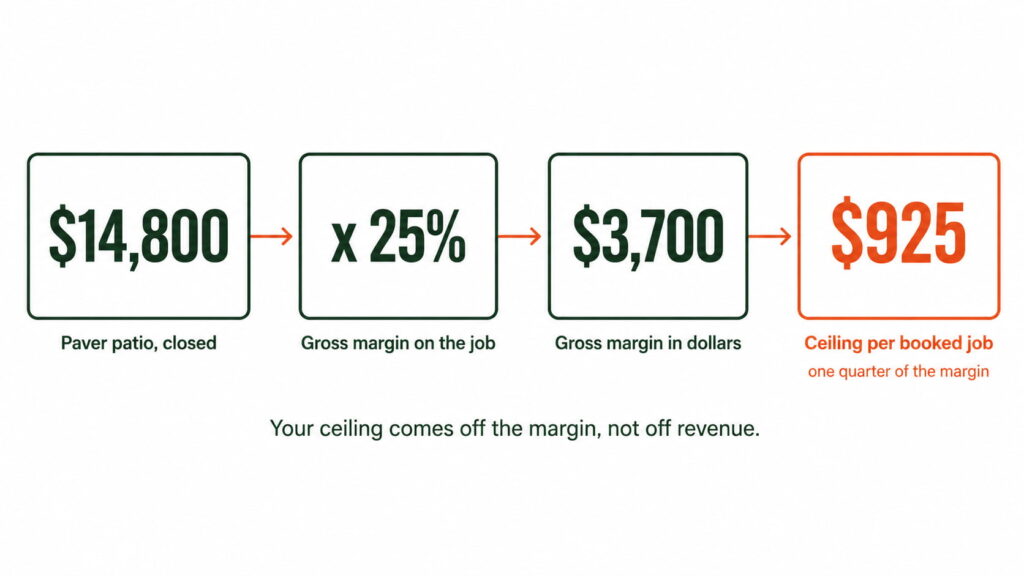
The ceiling is the number the rest of the plan hangs off. Everything downstream is division.
Cost per booked job: the number the whole plan runs on
Three ways to price a channel, and only the third compares to your ceiling. Cost per click is what Google charges to send someone to the page. Cost per lead is what it costs to make the phone ring. Cost per booked job is what it cost to put money on the schedule: channel spend divided by the jobs you closed from that channel.
Almost nobody can run it, for a boring reason. The denominator only exists if your intake asks how the customer found you. You still watch the money leave, you just can’t see which channel spent it, and adding that field is a fifteen-minute job you keep not doing.
Origin changes the price of the same closed job. That crew was paying $78 for an Angi lead and ended up at about $11 for an organic lead (BASEO client data). Not a promise about your market, a demonstration that the number moves.
Landscaping runs $117.92 per lead in paid search, across 3,211 US home services campaigns (LocaliQ). Close one in four and the booked job cost about $470. Against a $925 ceiling on a patio, that clears with room. Against the ceiling on a maintenance contract, it doesn’t come close. Same channel, same month, same invoice from Google: it works for one service line and not the other.
That’s the job the ceiling does. It doesn’t tell you which channel is good, it tells you which one works for you, for the work you’re trying to sell. The full breakdown of cost per lead by channel is a different piece.
Step 2: Decide what the plan is supposed to sell
A plan that says “more customers” isn’t a plan. It’s the same wish you started with, typed neatly.
The plan has to name the work. Which service line, and which towns. Both change what you can afford, which channel gets the money, and what month it starts.
Maintenance contracts and install work are two different plans
Maintenance is low ticket, high margin, recurring. You sell it once and bill it twelve times, and most of it renews. The plan chases it with route density.
Install and hardscape is high ticket, thinner margin, and much more variable. It doesn’t renew, so the plan chases it with service pages and ads pointed at the right window of the year.
Run the arithmetic on the maintenance side and watch it change shape. A $150 a month contract bills $1,800 in year one, and at roughly 50 percent margin that’s about $900 of gross margin, so a quarter of it puts your ceiling near $225 per contract booked. Count that contract for three years instead of one and the ceiling moves again.
So those two lines don’t share a ceiling, don’t share a channel, and don’t share a start month. A plan that averages them into one figure can’t decide anything, because the average describes a business nobody runs.
What that customer is worth over three years is its own conversation. For this document, just pick the number of years and write it down.
Draw the map before you set the budget
The plan names towns. Not “the metro area.” “The metro area” isn’t a decision, it’s a way of not making one.
Every extra town is a page to build and keep current, and an ad radius to fund. Twelve towns with budget for three is the most common way to spend real money and show up in none of them.
A page per town beats one page listing eleven, because the homeowner puts his town in the query and Google won’t rank one page for eleven suburbs. Start where you already have finished jobs and photos: you have something real to put on the page, and the drive is already paid for.
Step 3: Set the landscaping marketing budget
The landscaping marketing budget is one multiplication and one division. Jobs you still need, times your ceiling per booked job, equals the year. Divided by twelve, that’s the month.
Backwards from the ceiling. Never as a slice of revenue.
| Jobs still needed this year | Ceiling per booked job | Annual budget | Monthly budget |
|---|---|---|---|
| 12 install jobs | $925 | $11,100 | $925 |
| 24 install jobs | $925 | $22,200 | $1,850 |
| 40 maintenance contracts (year one only) | $225 | $9,000 | $750 |
Those rows are arithmetic, not results. Look at the third against the first two: nearly three and a half times the accounts, and a smaller budget. Forty maintenance contracts and twelve patios are different businesses to market inside the same company, and a percentage of revenue would have handed both the same envelope.
Now the uncomfortable part, which is what makes the document worth writing. Sometimes the multiplication gives you a number bigger than the money you have.
The plan then is not “spend it anyway and hope.” It’s to lower the job target or raise the ticket. Both are decisions a plan is allowed to make. What it can’t do is leave the gap unwritten and find out in June.
The build order also shifts with the size of the company, which is a longer conversation than this page has room for.
If you want this arithmetic run before you commit a dollar, BASEO’s free written audit is your market’s version of this page: the ceiling your service mix supports, the towns where a page would pay for itself, and the gap between your map position and the crew above you. About two business days, no call, and you keep it either way.
Step 4: Put the channels in the order the plan can afford
The order isn’t a ranking of which channel is best. It’s a question of what each dollar buys, and when it arrives.
Ads buy this month’s calendar. Pages buy next year’s jobs. Your Google profile buys both and costs time instead of money.
So each channel below gets a budget line and a date, not a tutorial.
Own the map first: Google Business Profile and reviews
This goes first because it’s the only line on the budget that costs hours instead of dollars. A plan that leaves it for later is paying for traffic while giving away the position that was free.
What the plan writes here is specific. The correct primary category. The full service list. Photos of real jobs, yours, not stock. And a review cadence with a number beside it, decided by you and written down. “More reviews” is not a line in a plan.
Reviews aren’t a vanity number. They’re an input into who Google shows in the top three, and into who an AI assistant names when a homeowner asks. The crew at the top usually has a visible review lead over the crew at eleven, and the gap widens on its own.
One landscaping crew went from position 11 to the top three of the map pack in under six months on their main money keyword (BASEO client data). The cheapest line in their plan is the one that moved the position.
BASEO rebuilds that layer first, before a dollar of ad budget moves, because it’s the only line that can gain position without a media spend behind it. Doing it yourself, the map pack playbook and rank in the map pack cover the rest.
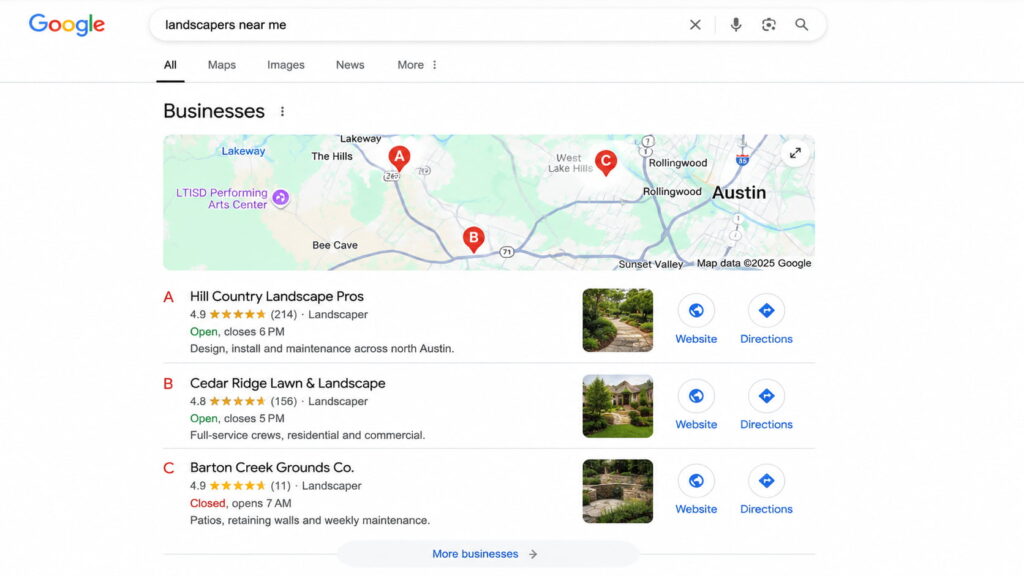
Same star rating, very different review counts. The plan’s job is to put a monthly number next to the third row.
The pages that decide which margin walks in
Rank for the patio, not the mow.
Winning either search costs you about the same. One ends in a weekly cut, the other in a $14,800 patio, and only one clears the ceiling you wrote in Step 1. Which is why BASEO orders service pages by margin rather than by search volume, and why the highest-volume keyword in your market is often the one to chase last.
There’s a loop in that. The pages that rank decide which margin comes in the door. That margin sets your ceiling. The ceiling sets next year’s budget. Step 4 feeds Step 1.
What the plan writes here is four columns: how many pages, for which services, for which towns, and the month each one exists.
That ordering is what a San Antonio landscaper’s pages were rebuilt around, and the quote requests went from 28 a month to 77 in six months (BASEO client data). The interesting part isn’t the 77. It’s that the 77 arrived in the service lines he chose, which is the difference between more leads and a bigger ceiling next year.
Building them yourself, what to write on a service page and how long landscaping SEO takes are worth reading first.
Paid: Google Ads and Local Services Ads
Ads are the only line in the plan that buys this month’s calendar. That’s a real job in a business where April is either booked or it isn’t, and it’s why paid gets switched on and off with the season on purpose.
Landscaping runs about $8.76 a click in paid search, at the $117.92 a lead from earlier (LocaliQ). Neither number means anything alone. Both mean everything against the ceiling from Step 1: fine for the patio, not for the contract.
Local Services Ads get their own budget line. Pay-per-lead placements above the map pack with the Google Guaranteed badge, and they deliver a phone call, not a form.
Ads run badly are what burns budget: one campaign covering six services, no negative keywords, a radius that includes towns you don’t drive to, clicks landing on a page that never names the town. One landscaping operator went from $84 to $43 cost per lead in six months on the same ad budget, and from 18 to 54 leads a month on that budget (BASEO client data). Nothing was added. The account was rebuilt.
BASEO runs Google Ads and Local Services Ads against the same measuring stick as the organic work, because a channel you can’t price per booked job can’t be compared to your ceiling. Ad spend goes straight to Google, never marked up.
What the plan does about the Angi bill
In the plan, the aggregator isn’t a debate. It’s a budget line with a review date.
Three things get written next to it. What you’re still paying. What you measure it against, which is cost per booked job and not cost per lead, because a shared lead was sold to four other crews and the lead price was never the real price. And the month you decide whether to cut it.
Not today. Whoever is telling you to cancel it on Monday is not the person making your payroll on Friday. The plan doesn’t switch it off out of principle. It switches it off when another channel is already carrying the number, and that’s a date, not an opinion.
Write the date after the month your slowest channel is supposed to start producing. Then the decision gets made with a number in front of you instead of a feeling in June.
Step 5: Put the landscaping marketing plan on a calendar
Count backwards from the first busy week of your season. Not from January, not from the fiscal year. From the week the phone has to be ringing.
Everything else falls out of that. Pages take months to move, so they start furthest from the rush. Ads move in weeks, so they start late, and late is correct rather than disorganized.
| Month | What starts | Why that month | When you see it |
|---|---|---|---|
| Off-season, first thing | Google Business Profile rebuild and review cadence | costs time, not money, and it moves the map | weeks to a few months |
| Off-season | service pages ordered by margin, plus a page per town | slowest to rank, so they start furthest from the rush | first quote requests typically month 3 to 5 |
| A few weeks before the rush | Google Ads and Local Services Ads switched on | buys this month’s calendar | first booked jobs typically inside 2 to 3 weeks |
| The rush | nothing new starts | the plan is running, not being built | n/a |
| After the season | read the three numbers, reset the ceiling | the margin that came in sets next year’s ceiling | next year’s plan |
Use your season, not a month name. A snow belt crew and a Sun Belt crew don’t share a calendar.
The mistake worth naming, without a lecture attached: the spring campaign that starts in April arrives late to its own spring. It happens to people who did the work, just counting forwards instead of backwards. Ads can still rescue that April. Pages can’t, because pages started in April are for next April, and they’re worth starting anyway for that reason.
Step 6: The three numbers that prove the plan is working
Three. Not ten, and not a dashboard you have to learn.
- Quote requests per month, by source. Not the total. By source, or number two doesn’t exist.
- Cost per booked job, by channel. Channel spend divided by jobs closed from that channel.
- The share of next month’s schedule that’s already sold. The only one of the three that tells you about the future instead of the past.
What isn’t a number in the plan: rankings, impressions, followers, traffic. None of them divides by jobs. A position moved is interesting. A patio on the calendar is the business.
The first two depend on that source field. Whoever answers the phone asks how they found you, and it goes in the same place every time. Then twenty minutes a month with the plan next to you.
BASEO’s monthly report is built to answer those three and not much else: quote requests and calls listed with the phone numbers, so number one is countable by source; cost per lead by channel, so number two divides; and what got published, so you can see which line of the plan ran. If a report can’t produce your three numbers, it isn’t reporting on your plan.
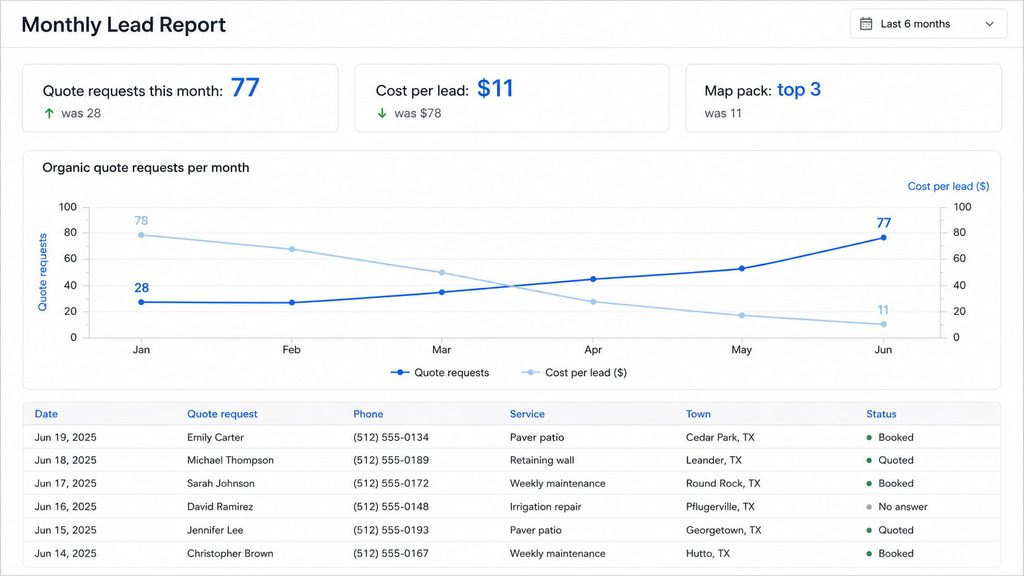
A report built around jobs. The phone numbers are the point: you can call them back.
If you can’t produce all three today, the audit names which one is missing and what it takes to get it. In writing, no call. Send Me the Marketing Audit →
The one-page landscaping marketing plan template
Here’s the whole thing. Six lines, one page, each produced by a Step you just read.
THE ONE-PAGE LANDSCAPING MARKETING PLAN

1. The jobs I need this year, and which service line they come from ....... (Step 2)
   ______________________________________________________________________

2. The most I can pay to book one ......................................... (Step 1)
   ______________________________________________________________________

3. What I spend per month, twelve months .................................. (Step 3)
   ______________________________________________________________________

4. The order my channels run in ........................................... (Step 4)
   ______________________________________________________________________

5. The month each one starts .............................................. (Step 5)
   ______________________________________________________________________

6. My three numbers, and the day of the month I read them ................. (Step 6)
   ______________________________________________________________________
Say a made-up three-truck crew fills it in. A hypothetical, not a client, running the arithmetic from earlier: 18 install jobs at a $925 ceiling is $16,650 for the year, about $1,390 a month. Profile and reviews first, then service pages for four towns, then paid six weeks before the rush, then the aggregator line under review the month after the pages are supposed to produce. Three numbers read on the first Monday.
Six decisions somebody has to make anyway, written where they can be checked instead of remembered.
Print it. Put it wherever you do the invoicing, because that’s the one place you’ll look at it once a month without meaning to.
Where landscaping marketing plans quietly fall apart
Four ways, and none of them is laziness. They happen to the people who did the work.
The plan exists, but nobody wrote the ceiling. Every channel gets judged on feel. A $118 lead is either fine or terrible, and without the ceiling you can’t say which.
Five channels started the same month. Something works, and there’s no month in the data where you can see which one. Stagger the start dates, which is the reason Step 5 exists.
No source field on the intake. Number two never gets calculated, so the plan runs on one and three, and the budget conversation goes back to being an argument.
The plan covers 90 days and the season covers twelve months. It gets judged in the wrong quarter and switched off a month before the slow channel would have started paying. Expensive, and the most common of the four.
If you’ve paid an agency before and it went nowhere, one question would have caught most of this on the first call: what’s my ceiling per booked job, and which report shows it to me? If nobody can answer that in a sentence, there isn’t a plan. There’s a retainer.
Final thoughts
The plan fits on one page because it’s six decisions, not fifty tactics, and the first one is the only one the other five need.
Write the ceiling first. Then the budget is division, the channel order is a question of what each dollar buys, the calendar is counted backwards from your busiest week, and the scoreboard is three numbers you can read in twenty minutes.
Some owners fill in all six lines themselves over the off-season and do fine. Most get as far as line two, the ceiling, and stall there, because it’s the one line you can’t guess at. That line is what the audit hands you: your ceiling per booked job for your market and your service mix, plus the gap between your map position and the crew sitting above you. Written, about two business days, no call. Print your page either way.
Landscaping marketing plan FAQs
Six things: how many jobs you need and of what type, the most you can pay to book one, a monthly budget, the order your channels run in, the month each starts, and the three numbers you check. Anything past that is a tactic list.
Work backwards, not off a percentage. Take the jobs you still need to fill the season, multiply by the most your margin lets you pay to book one, divide by twelve. A maintenance-heavy book and an install-heavy book land on very different numbers at the same revenue.
Product, price, place, promotion and people. For a landscaping crew: which services you push, what you charge, the towns you cover, the channels you run, and who answers the phone. Useful as a checklist, useless as a budget.
A business plan is for the bank and covers the whole company: equipment, crews, revenue projections. A marketing plan is for you and covers one question. What it costs to get the next job booked, and where that money goes each month.
Spend the time before the money. A complete Google Business Profile, real job photos, and a steady review cadence cost nothing but hours and are what the map pack reads. Add paid only once you know what a booked job is worth to you.
Paid channels can produce calls in the same week you turn them on. Pages and map-pack position move over months. That gap is the reason the plan has a calendar: the slow line starts in the off-season, the fast one near the rush.
Referrals are a channel with a ceiling, not a plan. Write it down anyway: the referral rate you actually get, what a slow spring costs you, and one owned channel building underneath. The written version tells you when the ceiling arrives.