You opened Search Console and the line was up. Then you looked at what it was up for. “How much does artificial grass cost.” Half those people live in a state your trailer has never been to. Meanwhile the installer two towns over owns “artificial turf installation near me” in the suburb where you did four jobs last year.
That gap is not a quality problem. You are ranking on the wrong half of the buying journey. The turf buyer researches for weeks, then hires locally in one afternoon, and those two halves are won by two different sets of pages.
SEO for turf contractors: the short answer
SEO for turf contractors is the work that gets an artificial turf installer in front of buyers in their own service area. It runs in a fixed order: fix the Google Business Profile and the map pack first, then build service and city pages, then the objection pages buyers read before they call.
The whole turf installation SEO guide, in five steps:
- Fix the Google Business Profile and the map pack, the three-business block above every local result. Weeks, not months.
- Build a page for every turf service you sell, ordered by margin.
- Build a page for every town your crew actually drives to.
- Publish the objection pages: heat, pets, drainage, warranty.
- Measure quote requests, cost per lead, and map position. Nothing else.
The profile is the only piece that moves inside a season, so it goes first. The pages take months and then keep paying. For the full-service-crew version, we wrote the full landscaping SEO guide separately.
Why turf SEO is not landscaping SEO with the word “turf” swapped in
Search for synthetic turf SEO and you get nine agency pages telling you to do local SEO. They treat turf as landscaping painted green. Two facts say otherwise.
One install is worth a whole season of mows. Artificial grass installation averages $5,784, and most homeowners pay between $1,300 and $15,000, according to Angi. An 800 square foot backyard at those numbers is a five-figure job. The install search and the mowing search cost about the same to win, and only one of them books five figures.
He researches for weeks, then hires locally in a day. For three or four weeks he is not searching for you. He is searching for answers. Does it get hot. Is it safe for the dog. What happens when it rains. None of those has a town name in it.
Then it compresses: he searches local and asks two or three installers for estimates the same afternoon. Local pages win the afternoon, objection pages win the three weeks before it, and winning only one is why a turf site gets more traffic every quarter and the same quote requests.
You are also not competing only with other installers. National manufacturers hold those results, and so do the cost-guide sites, which publish that page to sell the reader to you. In Angi’s own words to contractors, “you pay a nominal fee for each lead you match to” (Angi Leads), due whether you win the job or one of the others matched to it does.
A shared lead is not a lead source. It is a rental. Not an argument for shutting it off on Monday, because it is feeding your crew this week. An argument about year two.
Turf SEO keywords that book installs, and the ones that burn budget
Twenty searches a month for “artificial turf installation” in your best suburb, with $5,784 behind each one, beats two thousand searches for a national price question. And each service niche is a page, not a bullet in a services list, which is the most common structural mistake in SEO for turf care companies.
| Keyword pattern | Who is searching | What it books | Priority |
|---|---|---|---|
artificial turf installation [city] | A homeowner in your service area, ready for quotes | Install jobs. The highest intent search there is | First |
artificial grass installers near me | The same buyer, phone in hand, standing in the yard | Install jobs, often inside a week | First |
pet turf [city] · putting green installation [city] | A buyer who already picked the specialty | An install with a specific objection attached | Second |
artificial turf cost in [city] | A local buyer three weeks out | Nothing today. Everything in a month | Third |
artificial grass cost (national) | Someone who may live 1,800 miles away | Traffic. Not quote requests | Skip |
how to install artificial turf | Someone who already decided not to hire anyone | Nothing | Skip |
“Artificial grass cost” is a fight you lose to the cost guides. “Artificial turf cost in [your city]”, with real numbers from your market, is winnable and is what AI Overviews pull from. If a page cannot carry a number from your own market, do not publish it.
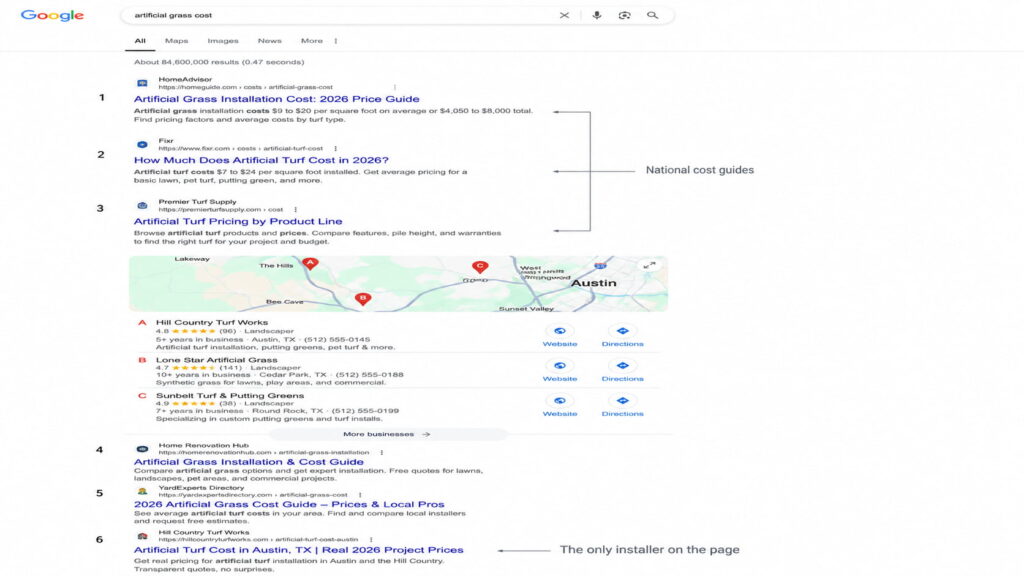
The national cost query is spoken for. The one local installer got there by writing the local version.
Fix the map pack first: the turf SEO that moves in weeks
The installer holding the top of your map does not lay better turf than you do. He finished a profile you claimed once and never opened again. A May 2026 WebFX study ran 500 searches across 100 home services keywords and the map appeared in 488 of them, roughly 98 percent (WebFX), which is how often it shows up rather than how many clicks it takes. It matters more in turf than that suggests, because “near me” is the one search where nobody types a city name. No page wins it. Only a profile, and its mechanics are in the map pack playbook.
Your Google Business Profile categories are probably wrong
Open your profile and look at the primary category. If it says “Landscaper,” you are competing against every mowing crew in your city for searches that have nothing to do with what you sell.
Two more things are load bearing: the services list, where pet turf, putting greens and pool surrounds should each appear by name instead of hiding under “artificial grass,” and the service area, which should match the towns your crew drives to rather than an 80 mile radius nobody has serviced. Photos count too, because turf is bought with the eyes.
BASEO rebuilds the profile and puts call and form tracking on every number before anything else goes live. Pages without tracking is how an agency bills you for eight months and never has to show you a booked job.
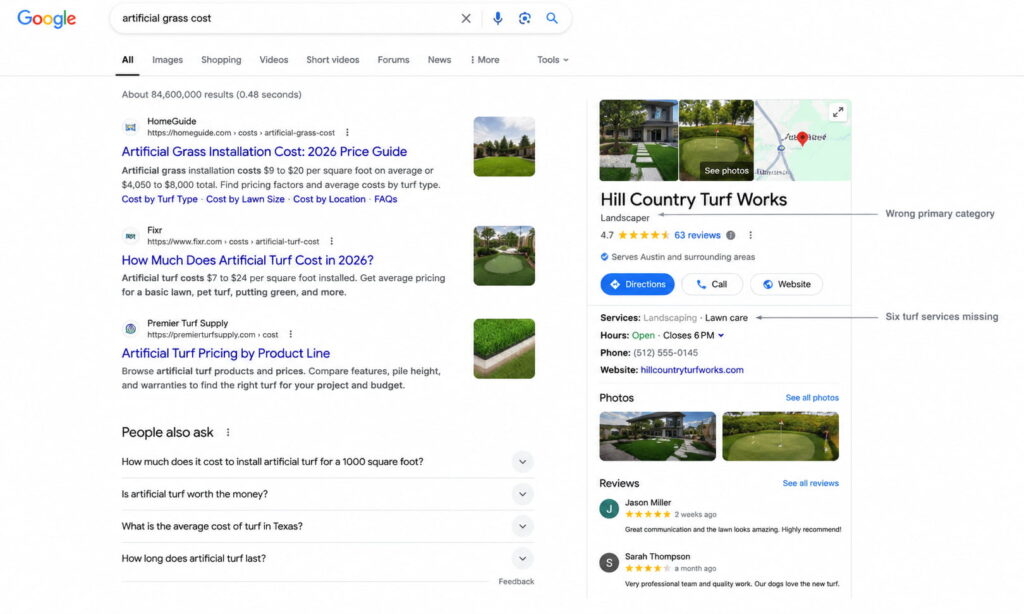
Filed as a generic landscaper, a turf specialist shows up for none of the searches he wants.
Reviews are the gate, not the garnish
Reviews do three jobs and only one is reputation. They rank the map, they decide the call between three unfamiliar profiles, and they are what an AI assistant checks before it names anyone. In BrightLocal’s 2026 survey of 1,002 US consumers, 97 percent of AI users said they at least sometimes check real reviews against an assistant’s answer (BrightLocal).
So ask for more than five stars. Ask the customer to name the town and the job, because “pet turf in Chandler” does work that “great crew” never will. In a trade where the buyer already suspects the product of being fake, a bought review is the one thing you cannot afford.
The pages that actually rank for turf installs
Original pages per market, not templates with the city name swapped. If you have hired an agency before, you may already have sixty of those on your domain doing nothing.
A page for every turf service you sell
Order the build by margin, not search volume: pet turf, putting greens, playground turf, pool surrounds, rooftop and balcony, commercial. Each page needs four things and most have none. The work described the way you describe it on a walkthrough. A price range for that service in your market. Your own photos of that job type, not the supplier’s stock library. And the objection that service drags behind it, because the page that answers drainage on pet turf gets the call. Then a quote form above the fold (what to write on a service page has the section-by-section version).
A page for every town your crew actually drives to
One page per town the crew really drives to, not one per zip code, and what makes it worth publishing is what only you have: real jobs finished there with photos, plus the water restrictions or rebates that across California, Arizona and Nevada are why the homeowner started looking. Sixty identical pages with the town name swapped is more risk than benefit.
The project portfolio page almost nobody builds correctly
Every turf installer has a portfolio and almost none rank, because a portfolio is one page with a grid of photos and no text. To Google and to an AI assistant that is a blank page. Build it the other way: one URL per project, each carrying the town, the type of turf, the square footage, the problem it solved, and photos with real alt text. Two hundred words and six photos is enough. Do that with your last twenty jobs and the portfolio becomes twenty legitimate local pages. Not one of the agency pages ranking for turf SEO mentions it.
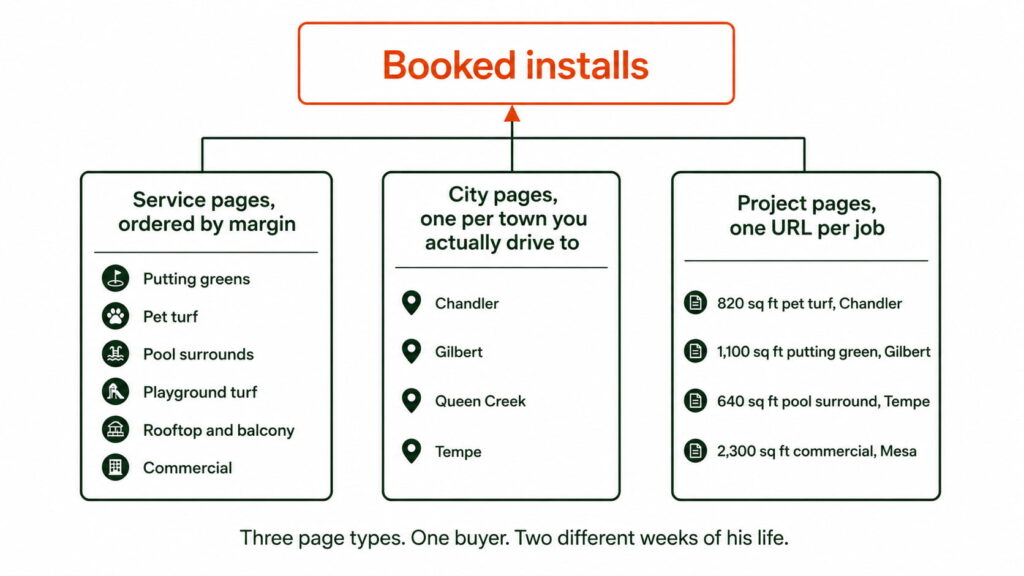
Three page types, one buyer. Most turf sites have only the first, half-built.
If you want to know which of these pages already exist in your market and who owns them, that is what the audit is for. Free. No call. Written, in about two business days.
The objection pages that get you cited by AI
Four questions decide whether a turf job happens: does it get hot, is it safe for the dog, where does the water go, and what happens if it fails. Right now they are answered on a manufacturer’s site or in a Reddit thread, and whoever answers them is who the assistant cites two weeks later.
One page per objection, then, not one long FAQ under the contact form. Write each as a question with a direct answer underneath, then the context. That is what assistants pull from, for the reason it wins featured snippets: the answer is retrievable without reading the page. One caution: we are a marketing team, not your product engineer. Write the answers you already give and cite the manufacturer for any number.
Why an AI assistant checks your reviews before it names you
Asked for a turf installer in their town, an assistant does not return ten blue links. It names two or three businesses. To narrow it down it reads what everyone else reads: your categories, your review count and what those reviews say, and whether any page answers a question specifically enough to quote. That last one is the gap, because the answers a buyer wants sit on somebody else’s domain.
In that same survey, 42 percent said they always check reviews before acting on an assistant’s answer. The assistant gets you on the list. The reviews decide whether you survive it. Most operators think none of this is happening because of a measurement problem: assistant traffic used to land in GA4 as “Direct,” until Google added an “AI Assistant” channel in May 2026 (Search Engine Journal). That is the layer BASEO builds from month three. Nobody controls whether an assistant says your name. You control every input it reads.
What turf SEO costs, and where paid fits
We do not publish ours, because it depends on how many towns you serve and what your competitors already built. The public range: Landscape Leadership puts green industry SEO retainers “somewhere between $500 – $1,500 (or higher) each month” (Landscape Leadership). Nobody can promise you a position or a date, and anyone who does is guessing with your money.
| Phase | What gets built | When you notice |
|---|---|---|
| Week 1 | The written audit: your biggest holes, the competitor gap, your job math | Immediately. You keep it either way |
| Months 1–2 | Tracking on every call and form, and the profile rebuilt | Map visibility usually moves first, in weeks |
| Months 2–6 | Service pages by margin, city pages, project pages | First organic quote requests typically month 3 to 5 |
| Month 3+ | Objection pages, Q&A formatting, reviews and citations | AI citations show in the report |
What we put in writing is the work: a scope every month, refunded if we miss a deliverable. At an average install of $5,784, one booked job covers several months of a program at that rate.
Paid fills next month while those pages compound, and Local Services Ads hand you a ringing phone instead of a form. One landscaping operator we work on came to us paying $84 per lead; six months later, on the same budget, that was $43 and monthly leads had gone from 18 to 54 (BASEO client data). That crew was a landscaping business rather than a turf specialist, and the fix transfers directly, because a wasted click on “artificial turf installation” wastes money the way one on “paver patio” does. BASEO runs Google Ads for landscapers against the same scoreboard as the pages, and your ad spend goes straight to Google, never marked up.
The three numbers that tell you your turf SEO is working
A report full of rankings and impressions does not tell you whether work came in. If your last marketing company’s report never used the words “quote requests,” you know what to look for.
- Quote requests and calls, with the phone numbers attached. Not a total. A log you can check against your calendar.
- Cost per lead, by channel, month over month.
- Map position for the install keyword in the town you actually want.
Run those three against a real account. A San Antonio landscaping crew was buying aggregator leads at $78 apiece. Six months after the pages went up, the same crew was taking quote requests off its own site at about $11, organic quote requests had gone from 28 a month to 77, and its money keyword had moved from position 11 to the top three on the map (BASEO client data). Against a $5,784 install, the gap between a $78 lead and an $11 lead is the margin on the job.
That crew’s high-ticket work was hardscape rather than turf. The mechanism transfers cleanly, because both jobs behave the same way: weeks of research, a local hire in a day, and one job big enough to pay for months of the program.
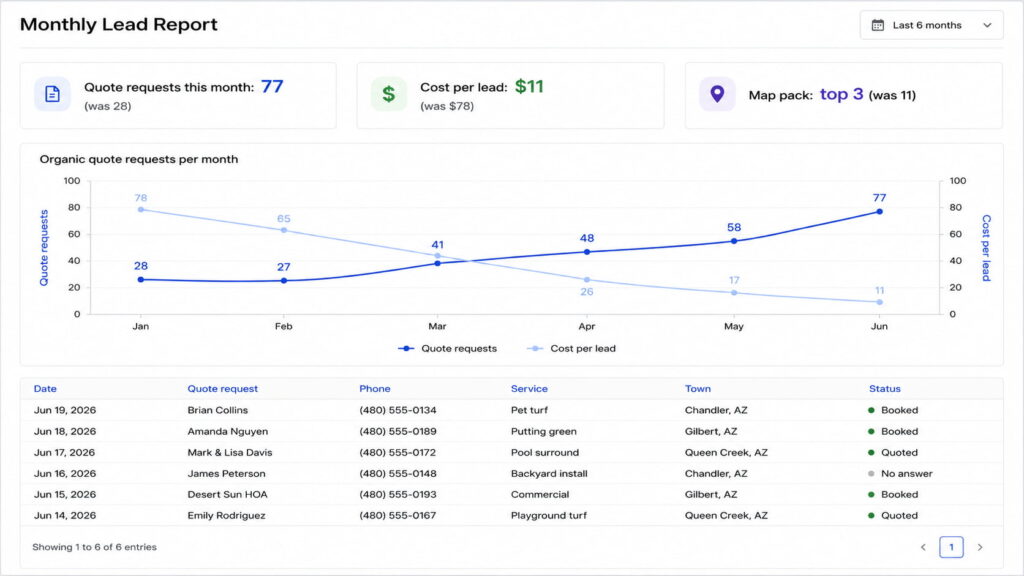
Traffic is not on this report. The three numbers that show up on the calendar are.
Final thoughts
Turf contractors do not lose for lack of traffic. They lose because their traffic is from the wrong half of the buying journey, and that half was never going to hire anybody.
Fix the profile so you show up in the afternoon when somebody is picking between three installers. Build the pages that answer the three weeks before it. Then count quote requests instead of sessions.
Plenty of installers run this themselves between seasons and do fine. If you would rather spend those weeks on estimates, the audit will tell you which turf services already have a page in your market, which towns nobody has claimed, and what the installer above you built. Free. No call. Written, in about two business days. Yours to keep, even if we never speak again.