

A cash buyer checks a fresh Facebook lead between property visits. The channel works, but only if you run it inside the rules.
Most guides on real estate Facebook ads were written for agents chasing listings. They skip the one rule that gets cash buyers banned: your “we buy houses” ads are housing ads, and Facebook treats them differently from everything else. Get that wrong and the leads never come. Get it right and you have a real motivated-seller channel. Here’s the operator’s version, with real numbers and none of the fluff.
Why Facebook Ads Still Work for Real Estate in 2026
Facebook reaches a seller before they ever type a word into Google. You find the tired landlord or the guy behind on payments while he’s scrolling, not while he’s searching. That’s the whole value: interruption. Search catches sellers who already know they want out. Facebook catches them earlier.
The tradeoff is honest and worth saying up front. That earlier seller is a lower-intent seller, and the moment you stop paying, the leads stop. Facebook is attention you rent, not an asset you own.
It’s also getting pricier. Metro-market ad costs (CPMs, the price to show your ad 1,000 times) rose 20–35%, and real estate cost per lead climbed roughly 5–10% from 2025 to 2026 (Sotros). It still works. It just rewards operators who run it tight. If you’re weighing it against the free and referral channels, our breakdown of how to get motivated seller leads puts the paid option in context.
The Special Ad Category That Changed Real Estate Facebook Ads
Here’s the rule almost every agent guide buries. Because your ads are about housing, Facebook forces them into the Housing Special Ad Category, a restricted classification that strips out most of the targeting you’d normally use (Meta Business Help).
This isn’t optional and it isn’t a glitch. It came out of a 2022 settlement between Meta and the U.S. Department of Housing and Urban Development over ad targeting that could discriminate in housing (Meta Newsroom). Fair-housing law now shapes how every “we buy houses” ad can be aimed.
It hits a cash buyer harder than it hits an agent. Your whole pitch is geographic and situational. The Special Ad Category constrains both, so you have to win a different way.
What You Can No Longer Target
Inside the Housing category, the levers you’d reach for first are gone or capped (Meta Business Help):
- No ZIP code targeting. You can target by city, county, or region, but not by postal code.
- A 15-mile minimum radius. Drop a pin and Facebook automatically widens it to at least 15 miles in every direction (Meta Newsroom).
- No location exclusions. You can’t carve out neighborhoods.
- No age or gender targeting. Both are off the table.
- Lookalike audiences and many interests are limited or unavailable. The precision tools most advertisers lean on are capped.
What Still Works (and How to Win With It)
You still pick the metro. You still let Facebook’s algorithm optimize toward the people most likely to act. And you still have the one lever the Special Ad Category can’t touch: your creative. When you can’t aim by demographics, you aim by message. More on that below, because it’s the whole game now.
How Much Do Real Estate Facebook Ads Cost?
In 2026, real estate Facebook ads cost about $35 per lead on average, though motivated-seller and home-valuation leads often run $15–$35, and smaller markets can fall to $8–$20. Expect a realistic starting budget of $500–$1,500 a month to gather enough data to know what a lead actually costs you (SuperAds).
Now translate that into deal math, because cost per lead means nothing until it becomes cost per deal. Say your leads run $30 and you close 1 in 40 Facebook leads (paid social is lower-intent, so a low close rate is normal). That’s $1,200 in ad spend per deal, before you count the assignment fee or the flip. Tighter targeting-by-creative pushes that down. Sloppy ads push it up fast.
| Lead type / market | Typical cost per lead (2026) |
|---|---|
| Home-valuation / seller leads | $15–$35 |
| Buyer-form leads | $35–$65 |
| Smaller (Tier-3) markets | $8–$20 |
| Luxury | $80–$200+ |
| Lead-form ad (avg) | ~$34 |
| Video ad (avg) | ~$46 |
Real estate Facebook cost per lead, 2026. Motivated-seller and valuation offers sit at the cheap end; forms beat video on raw cost. Source: SuperAds.
How to Set Up a Real Estate Facebook Ad Campaign (Step by Step)
You don’t need an agency to launch. You need the steps in the right order and the discipline to declare the Special Ad Category before you do anything else. Here’s the sequence.
- Create your Facebook Business Page and ad account.
- Declare the Housing Special Ad Category.
- Choose your campaign objective.
- Build your audience within the rules.
- Pick the right ad format.
Step 1: Create Your Facebook Business Page
Everything runs through a business Page, not your personal profile. Set up the Page, open Meta Business Suite, and create an ad account under it. Add your payment method and confirm your business details so you’re not scrambling when an ad is ready to launch.
Step 2: Declare the Housing Special Ad Category
At the campaign level, Facebook asks whether your ad falls into a special category. For “we buy houses” ads, the answer is Housing, every time (Meta Business Help). Declaring it is mandatory. Skipping it to keep the better targeting is one of the fastest ways to get an ad rejected or an account flagged. Declare it and move on.
Step 3: Choose Your Campaign Objective
Your objective tells Facebook what to optimize for. Two fit motivated sellers: Leads (an instant form that opens inside Facebook) and Sales/Conversions (sending people to a landing page on your site). Lead forms are lower-friction and cheaper. Landing pages ask more of the seller and tend to bring higher intent. Pick based on how fast your team can follow up, which we’ll get to.
Step 4: Build Your Audience Within the Rules
Set your location to the metro you buy in, knowing the radius will snap to 15 miles minimum. Skip the demographic filters you can’t use anyway. If lookalikes are available in your account, keep them broad. Then let the algorithm do what it’s good at: finding the people in that area most likely to respond to your specific ad.
Step 5: Pick the Right Ad Format
Keep it simple. A single clear image or a short video outperforms busy carousels for this audience. Choose between a lead form and a link to your site based on your follow-up speed. On cost, lead-form ads average around $34 per lead versus roughly $46 for video, so forms win on price, but video often brings a warmer, more educated seller (SuperAds).
The 3-Layer Facebook Ad Structure That Generates Leads
A single ad blasted at a whole city wastes money. The structure that works is the same funnel you already run in acquisitions: reach a lot of people cold, warm up the ones who react, and close the ones who are ready.
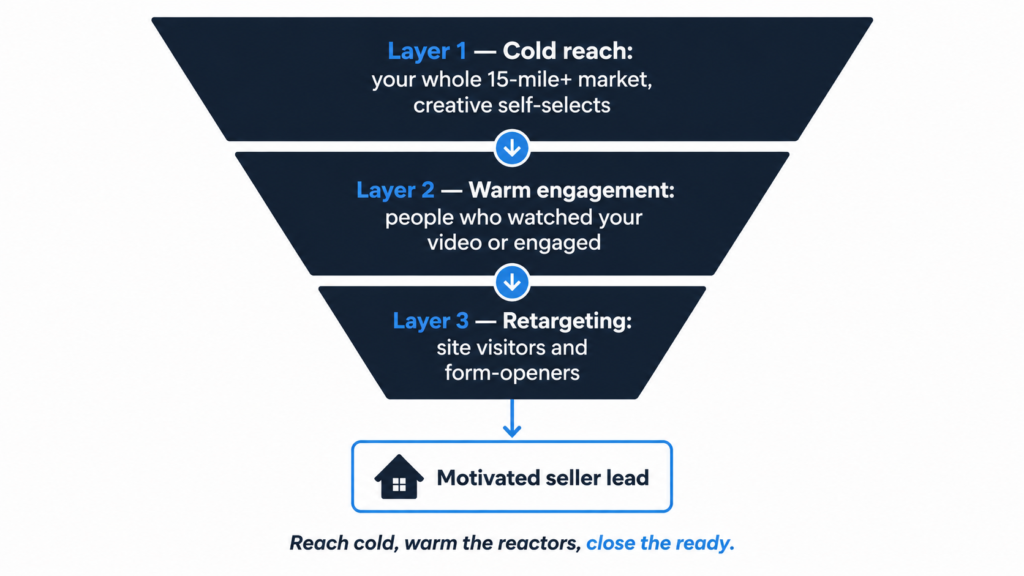
The three layers: cold reach (often called TOF, top of funnel), warm engagement (MOF), and retargeting the ready seller (BOF). Each layer gets its own ad and its own budget.
Layer 1 is cold prospecting: broad reach across your market, where the creative does the qualifying. Layer 2 re-engages the people who reacted, like video-viewers, with a stronger offer. Layer 3 is retargeting, the cheapest lead you’ll buy, covered in its own section below. Fund all three. Skipping the middle is why most single-ad accounts stall.
Facebook Ad Creative: Where the Real Targeting Happens
Since the Special Ad Category took your demographic targeting, your creative has to do that job instead. The headline and the image are your targeting now. Write for the situation, and only the sellers in that situation raise a hand.
Speak to the moment, not the market. “Behind on payments and running out of time?” self-selects a pre-foreclosure seller. “Inherited a house you don’t want to keep?” pulls the probate seller. “Done being a landlord?” reaches the tired landlord with a problem tenant. Each ad filters the audience by relevance, which is exactly what you lost at the targeting layer.
Keep it honest and plain. A phone photo of a real house beats a glossy studio render for this audience, because it reads as a real local buyer, not a national brand. If you want the fuller picture of how paid and organic social fit together, our guide to social media for cash buyers walks through the mix.
7 Real Estate Facebook Ad Examples That Convert
Every one of these is built to self-select a motivated seller, and every one is worded to stay inside Facebook’s rules (no “are YOU facing foreclosure” personal-attribute phrasing, which trips policy). Use them as starting angles.
- “Facing foreclosure? See your options before the auction date.” Pulls pre-foreclosure sellers who still think they have none.
- “Inherited a house you don’t want? We’ll buy it as-is.” Speaks to probate and out-of-state heirs.
- “Tired of being a landlord? Sell with the tenant still in place.” Reaches the burned-out buy-and-hold owner.
- “We buy houses as-is. No repairs, no agent fees, no showings.” For sellers who can’t or won’t fix up.
- “Need to sell fast before a move or divorce settlement?” Timeline-driven sellers who value speed over top dollar.
- Short video: “Here’s exactly how a cash offer works, in 60 seconds.” Educates the skeptical seller and warms Layer 2.
- “Get a fair cash offer in 24 hours.” The classic speed hook, still the highest-volume angle.
Facebook Lead Ads vs. Landing Pages: Which Converts Better?
Neither wins outright. They trade cost for quality, and the right pick depends on how fast your team calls a fresh lead.
| Factor | Facebook lead ads | Landing pages |
|---|---|---|
| Cost per lead | Lower (~$34 avg) | Higher |
| Friction for the seller | Low (form pre-fills) | Higher (they leave Facebook) |
| Lead intent | Lower | Higher |
| Follow-up urgency | Extreme (minutes) | High |
| Do you own the asset? | No | Yes |
| Can it earn organic traffic? | No | Yes |
Lead ads are cheaper because they’re easy: the form pre-fills the seller’s info and they never leave the app. That ease is also the catch. Low friction means lower intent, and 78% of sellers work with the first buyer who responds (iHomefinder). If you can’t call within minutes, cheap leads go cold.
Here’s the part the ad guides miss. A landing page is an asset you own, and a good one can also rank in Google for the exact searches sellers type when they’re ready. That’s the difference between renting attention and building something that pays you for years. It’s the channel we build for cash buyers, and it’s why a page worth advertising to is also a page worth ranking. If you want the mechanics, start with SEO for a real estate website and the keywords sellers search.
Retargeting: How to Turn One Click Into a Client
Most sellers won’t call the first time they see your ad. Retargeting is how you stay in front of the ones who showed interest, and it’s the cheapest lead you’ll ever buy because these people already know your name.
The mechanics are simple. The Meta Pixel, a small tracking snippet on your website, remembers who visited. You then run ads only to those visitors and to people who watched most of your video. Warm audiences convert at a fraction of cold-audience cost.
None of it matters without follow-up. About 80% of online leads need more than five follow-up attempts, yet the average operator follows up just 1.3 times (iHomefinder). Retargeting keeps you visible; a real cadence closes the deal. If your follow-up lives in your head instead of a system, a CRM to follow up is the fix.
Common Mistakes That Get Real Estate Ad Accounts Banned
A banned account costs you days and sometimes the whole ad account. Almost every ban traces to one of these:
- Not declaring the Housing Special Ad Category. The single most common trigger. Declare it, always.
- Personal-attribute language. Ads that imply you know something about the person (“Are you struggling with debt?”) violate Meta’s rules (Meta Transparency Center). Speak to the situation, not the person.
- Fighting the 15-mile radius. Trying to sneak in ZIP-level targeting gets ads disapproved.
- Landing-page mismatch. If the ad promises a cash offer and the page pitches something else, Facebook flags it.
- Overreaching claims. “Guaranteed top dollar, today” reads as a policy violation and as a scam to sellers. Drop it.
Ready to Scale Your Real Estate Lead Gen?
Scaling lead gen is not the same as scaling ad spend. Every dollar you put into Facebook stops working the second you stop paying. Turn the ads off and the phone goes quiet the same week.
The channel that compounds is the seller already looking for you: the one typing “sell my house fast” into Google, or asking ChatGPT who buys houses for cash in his city, at the exact moment he’s ready to deal. That intent is where the cheapest, highest-close leads live, and it’s the channel we build for cash home buyers. Original city pages for every market you buy in, tracking so every call and form is counted, and content formatted so AI search cites you. Not Facebook management, the organic engine underneath it.
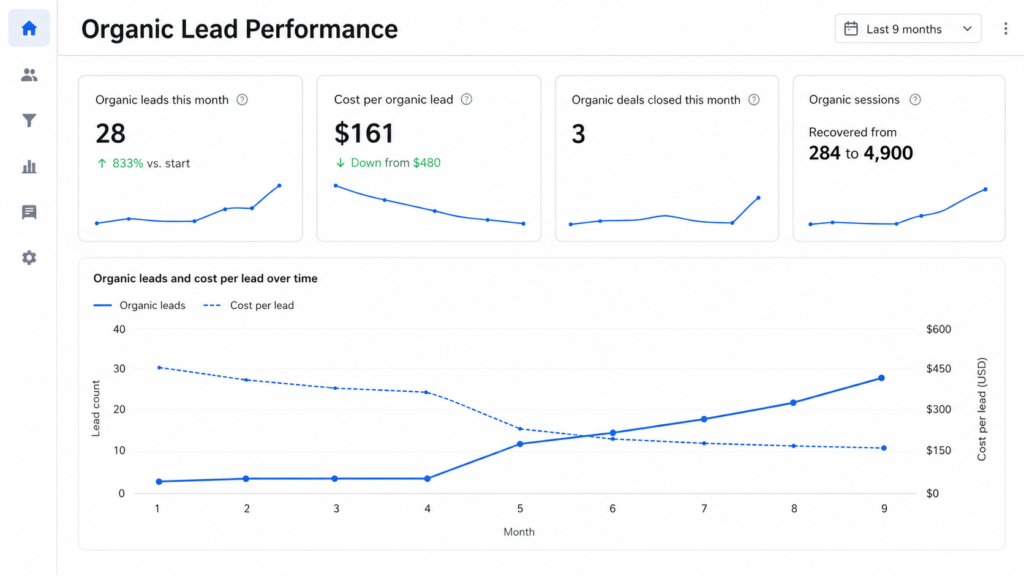
One Florida cash buyer went from 3 organic leads a month to 28 in nine months, same market, no extra ad spend, with organic cost per lead around $161 and falling (BASEO client data).
That’s the case for running both. Use Facebook to fill the pipeline now, and build the organic and AI Overviews presence that lowers your cost per deal over time. We work only with cash home buyers, so SEO built for cash home buyers already knows your keywords, your competitors, and your seller situations.
Frequently Asked Questions
In 2026, expect about $35 per lead on average, with motivated-seller and home-valuation leads often at $15–$35 and smaller markets as low as $8–$20 (SuperAds). Plan on a $500–$1,500 monthly budget to gather enough data to know your true cost per lead, then judge it on cost per deal.
No. Because “we buy houses” ads fall under the Housing Special Ad Category, Facebook blocks postal-code targeting and enforces a minimum 15-mile radius around any location you pick (Meta Newsroom). You can target by city, county, or region, but not tighter than that.
It’s Meta’s required classification for any housing-related ad, including cash-buyer ads. It removes age, gender, ZIP, and lookalike targeting to prevent housing discrimination, following Meta’s 2022 settlement with HUD (Meta Business Help). You must declare it, and it changes how you have to win: with creative, not demographics.
Yes, for volume. Lead ads are cheaper and lower-friction, which also makes them lower-intent, so they live or die on follow-up speed. With 78% of sellers going to the first buyer who responds, lead ads only pay off if you can call within minutes.
Start at $500–$1,500 a month. That’s enough to collect real data without betting the business on an unproven ad. Watch cost per lead first, then cost per deal, and scale only the ads that prove out.
The bottom line
Real estate Facebook ads are a real motivated-seller channel in 2026, but only if you respect the Housing Special Ad Category, aim with your creative instead of your targeting, and treat paid social as attention you rent. It fills the pipeline. It does not build equity.
The leads that get cheaper every month come from the seller already searching for you, not the one you interrupt. Before you pour more into ad spend, it’s worth knowing what’s already working, and what’s broken, on the organic side of your lead gen. That’s what the audit is for. Free, in writing, no call required, yours to keep.