
Seller leads for real estate investors are the whole game. No motivated sellers, no contracts, no assignment fees, no flips. The problem in 2026 is that the leads most buyers rent get more expensive every quarter and get shared with three competitors the same day. This guide covers where motivated seller leads actually come from, free and paid, what they cost per deal instead of per lead, and how to stop renting a channel and start owning one.

A steady deal pipeline starts with steady seller leads. The question is whether you rent them or own them.
- What Makes a Seller Lead “Motivated”
- Types of Motivated Seller Leads Investors Target
- How to Get Motivated Seller Leads: Free Strategies
- Where to Buy Motivated Seller Leads: Platforms Compared
- How Much Do Motivated Seller Leads Cost in 2026?
- The Problem With Renting Leads (and the Fix)
- How to Convert Seller Leads Into Signed Contracts
- Get More Seller Leads Without Renting Them
What Makes a Seller Lead “Motivated” (and Why It Matters)
A motivated seller lead is a homeowner with a reason to sell fast. Foreclosure, probate, divorce, a burned-out landlord, a job relocation. Something in their life made the house a problem, and they will trade top dollar for speed and certainty.
That reason is the only thing that separates a deal from a tire-kicker. A cold owner list is just names and addresses. A motivated lead is a person who already decided to move.
For a cash buyer, that difference is the business. A motivated lead converts to a signed contract far more reliably than a cold list, and a signed contract is either a flip margin or an assignment fee. Assignment fees nationally average around $10,000 to $13,000 per deal, so a single motivated seller who signs is worth more than a month of most marketing budgets.
So the goal isn’t more leads. It’s more motivated ones.
Types of Motivated Seller Leads Investors Target
Motivated seller leads aren’t all the same temperature. Some sellers are ready today; some need a few months of follow-up. Below are the types with the highest intent and the lowest competition from other buyers, ordered roughly from hottest to warmest.
Expired Listings
An expired listing is a seller who already tried to sell and couldn’t. The listing ran, the showings happened, and nothing closed. That owner is frustrated, and frustrated owners are open to a different path: a cash, as-is offer with no showings and no repairs.
The pool is enormous and growing. Expired listings are the top-performing lead type in 2026, with more than 78,000 listings falling off the MLS every week, up 83% in two years, and over 64,000 active expired leads available weekly (REDX).
You find them on the MLS through an agent partner, or through an expired-lead service. Move fast. Every buyer in your market is working the same list.
FSBO and FRBO Leads
A FSBO (for sale by owner) has already decided to skip the agent commission and sell solo. Then they discover how hard that is: the calls, the lowballs, the paperwork. A clean cash offer that skips the showings and the repairs lands well with a FSBO three weeks into the grind.
FRBO (for rent by owner) means a landlord advertising a rental themselves. Read that as a tired landlord, worn down by tenants and maintenance, which is a classic cash-buyer target.
You find both on Zillow’s FSBO filter, on Craigslist and FSBO sites, and through services that aggregate fresh FSBO and FRBO listings daily. A tight, respectful script matters more here than anywhere else.
Pre-Foreclosure and Distressed Sellers
Pre-foreclosure owners are running out of time, and time changes what they want. They prioritize speed and certainty over squeezing out the last dollar, which is exactly the offer a cash buyer makes.
Direct mail is still one of the most effective ways to reach them, along with foreclosure and inherited-property lists. Lead with help, not pressure. These are people in a hard spot, and the buyers who win the deal are the ones who solve a problem instead of circling it. If you’re newer to this niche, start with the basics of buying pre-foreclosure homes before you mail the list.
Inherited, Absentee, and Tired-Landlord Leads
Inherited and probate properties, out-of-state absentee owners, and burned-out landlords share a profile: high motivation, low competition. Most buyers never work these lists, so the phone isn’t ringing off the hook when you call.
You build these lists by stacking public records (probate filings, tax delinquency, out-of-state mailing addresses) and by driving for dollars past neglected properties. PropStream and similar tools let you pull and stack motivated-seller lists from public data.
They convert because the circumstance is doing the selling for you. An heir who lives three states away doesn’t want to manage a house. He wants it gone.
How to Get Motivated Seller Leads: Free Strategies
The cheapest leads are the ones you generate yourself. These channels cost time instead of a per-lead fee, and they’re where most new buyers should start.
- Sphere and word of mouth. Tell everyone you buy houses. The plumber, the closing attorney, the wholesaler two markets over. Warm referrals close fastest.
- Cold calling and texting. Pull a list, dial it, text it. High volume, fast feedback, one of the best returns on time in the business.
- Door-knocking distressed streets. Slow but personal. A conversation on the porch beats a postcard every time.
- Direct mail. Postcards and letters to targeted lists (pre-foreclosure, probate, absentee). Consistency is the whole trick.
- Driving for dollars. Log the ugly houses, skip-trace the owners, reach out. The neglect is your signal.
- Referral alliances. Build a bench: wholesalers, agents who pass on ugly houses, probate attorneys, property managers, contractors. Each one sees motivated sellers you don’t.
- Your own website. A site that captures “sell my house fast [city]” searches is the one free channel that keeps working after you stop touching it. More on that below.
One rule cuts across all of it: answer fast. Respond within five minutes and you convert around 5% of leads, against roughly 0.5% once you wait past thirty minutes, which makes a five-minute buyer about 21 times more likely to convert than a slow one (iHomefinder). And 78% of sellers work with the first buyer who calls back (AgentZap). A motivated seller is dialing several buyers at once. The one who picks up wins.
For the full breakdown of free, paid, and referral channels, see the full motivated-seller-lead playbook.
Where to Buy Motivated Seller Leads: Platforms Compared
When time is shorter than budget, you buy leads. The investor stack breaks into a few categories, and the right one depends on whether you want raw data you work yourself or finished leads that ring your phone.
| Platform / type | What it’s for | Exclusive or shared | Best for |
|---|---|---|---|
| PropStream, ListSource | Pull and stack motivated-seller lists from public records | You own the data | DIY list builders on a budget |
| BatchLeads, DealMachine | List building, driving for dollars, skip tracing | You own the data | Scaling teams running outreach |
| Pay-per-lead marketplaces (MotivatedSellers.com, MotivatedLeads.com, Real Estate Bees, iSpeedToLead) | Done-for-you inbound seller leads | Exclusive or shared, by plan | Buyers who want volume now |
| Carrot + PPC | Inbound leads from paid search on your own site | Exclusive | Buyers ready to run ads |
Marketplace leads typically run about $29 to $325 each and arrive pre-scored, so you’re paying for someone else’s cold calling, ads, and verification (iSpeedToLead).
Match the tool to where you are. New or tight on budget, pull your own lists and buy the occasional marketplace lead to keep deals moving. Scaling, layer PPC and list stacking so volume climbs. Established with real budget, that’s when building your own channel starts to beat buying, for reasons the next two sections make plain.
How Much Do Motivated Seller Leads Cost in 2026?
Bought motivated seller leads cost roughly $30 to $325 each on marketplaces, while exclusive PPC-sourced leads run $150 to $400 or more. But the number that matters is cost per contract, not cost per lead: a $300 lead that closes at about 6% works out to nearly $5,000 per deal (iSpeedToLead).
That per-deal math is the part most buyers skip. By channel, marketplace leads land at $29 to $325 depending on whether they’re exclusive or shared. Running your own Google Ads, investor keywords like “we buy houses cash” and “sell my house as-is” run about $2.50 to $5.00 per click, while broad seller terms like “sell my home fast” can hit $65 per click in competitive markets (Promodo).
Stack the misses on top and paid channels land somewhere around $2,500 to $7,500 per closed deal. Mature organic search runs $500 to $2,000 per deal, and organic leads have been shown to close about twice as profitably as PPC leads (Investor Nitro). Same seller, same keyword, very different math.
If you want to know which of those seller searches your own market can rank for, and what that would cost against what you pay now, that’s exactly what a free written audit shows you. No call required. See what your market can rank for →
The Problem With Renting Leads (and the Fix)
Here’s the part the lead sellers won’t put on their pricing page. Buying leads is renting. You pay every month, the lead is often shared with competing buyers, and the price only climbs.
Look at what happened to portal leads. They now average around $181 each, national conversion has bottomed out near 0.4% (you buy 250 to close one), and the price is up more than 1,000% since 2015 (REDX). That’s the trajectory of every rented channel: more expensive, more crowded, never yours.
And the day you stop paying, the phone stops. A rented channel never becomes an asset. It’s a meter running against your margin.
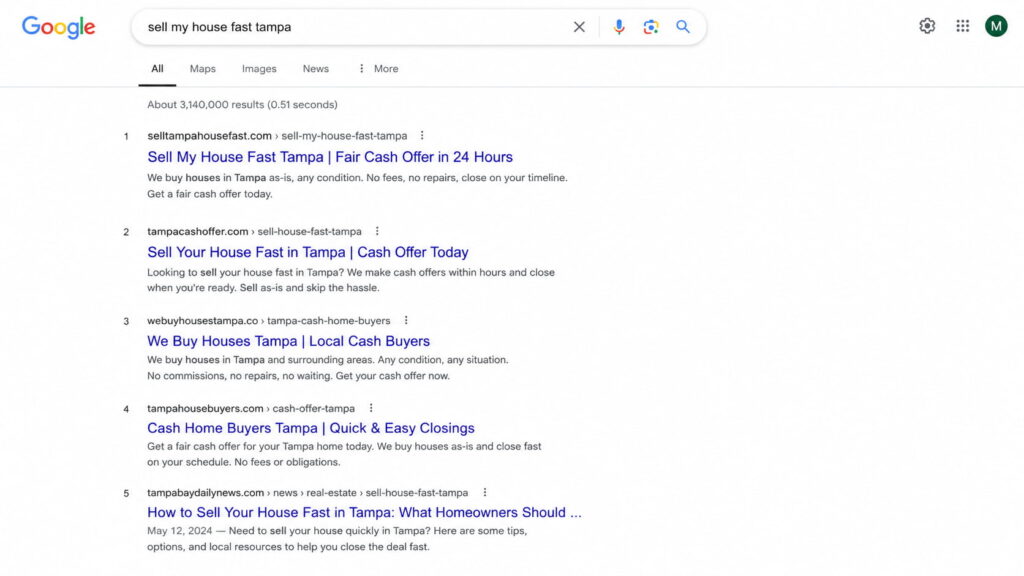
The owned-channel payoff: your site ranking #1 for the exact search a motivated seller types at 11pm.
The fix is simple to say and slower to build: own the channel.
Build a Seller-Lead Engine With SEO and AEO
Owning the channel means ranking your own site for the searches motivated sellers already type. Two kinds of pages do the work.
Local pages that rank for “sell my house fast [city]” and “we buy houses [city]” in every market you buy in, plus the other seller-intent keywords your sellers actually type. And seller-situation pages for the searches people type under stress: probate, foreclosure, divorce, inherited property, problem tenants. Each page has to be original to its market. Google’s Scaled Content Abuse policy killed the swap-the-city-name template pages that most investor sites still run, so a page that actually ranks is one written for that city, not copied across fifty. If you want the mechanics, here’s how to do SEO for a real estate website.
Then there’s the AEO layer. AEO (answer engine optimization) is formatting your pages so AI tools cite them. A growing share of sellers now start in ChatGPT or a Google AI Overview, typing “how do I sell my house fast for cash,” and the AI answers with a short list of companies. AEO is how you become one of the names on that list instead of watching a competitor get cited. That window is still open in most markets, and it won’t stay open. Here’s how to rank in AI Overviews.
That’s what BASEO builds for cash buyers: original city pages, seller-situation pages, and AI-search optimization, installed on top of proper lead tracking so every call and form gets counted. One Florida cash buyer went from 3 to 28 motivated seller leads a month in nine months, in the same market, with no extra ad spend, at $161 per organic lead and falling. In month 9 that was 3 organic deals and $54K in profit against a $4,500 invoice (BASEO client data).
The difference is ownership. Rented leads stop when the payment stops. Organic leads compound: exclusive, cheaper every month as the pages age, working while you sleep.
How to Convert Seller Leads Into Signed Contracts
Getting the lead is half the job. Turning it into a contract is the other half, and it’s where most buyers leak money.
Start with speed. Under five minutes or the deal goes to the buyer who called back first. Then have a script ready for the type of lead: for an expired, you tried the retail path and it didn’t work, here’s a cash offer with no showings; for a FSBO, skip the commission and the open houses; for a pre-foreclosure, speed and certainty before the clock runs out.
Then follow up like the deal depends on it, because it does. About 80% of deals close between the 5th and 12th contact, yet 44% of people quit after a single follow-up (Spring Forest Media). A simple multi-touch cadence keeps you in the deals everyone else abandoned:
- Minute 0: call the second the lead comes in.
- Same day: text if no answer.
- Day 2: second call, leave a specific voicemail.
- Day 4: email or DM with your offer range.
- Day 7: check-in call.
- Day 14 and beyond: monthly touch until they sell or tell you to stop.
Run that out of a CRM so nothing slips. If you don’t have one dialed in, start with how to use a CRM to follow up. Remember that your real cost per deal includes all this follow-up time, so a nurturing system is what turns an expensive lead into a profitable one.
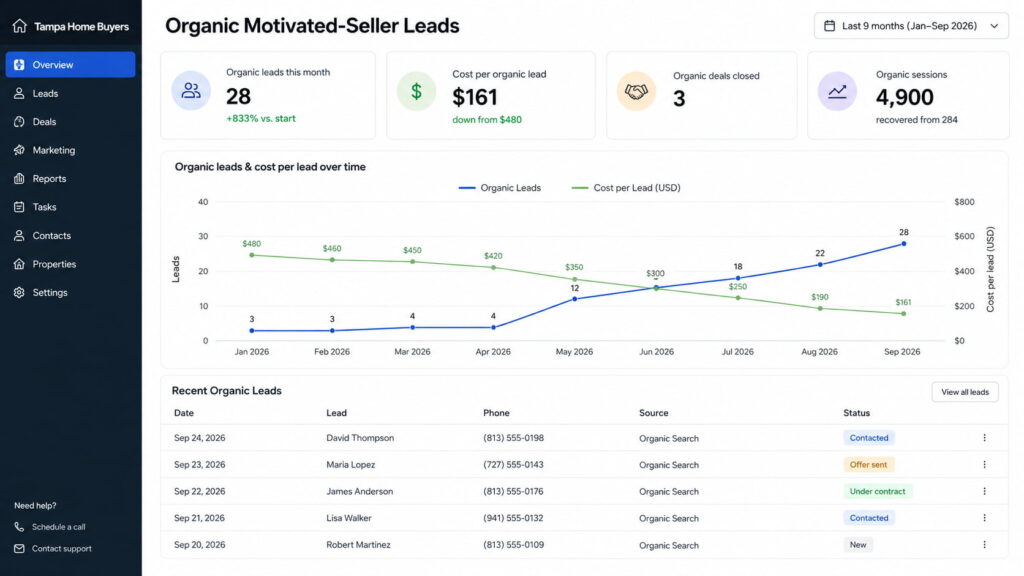
Nine months of an owned channel: leads climbing from 3 to 28, cost per lead falling to $161.
Get More Seller Leads Without Renting Them
Free sources work but scale slowly. Paid leads scale but get pricier and shared with every other buyer in your market. An organic SEO and AEO engine gives you exclusive leads that compound, at a cost per deal that falls instead of climbs.
Some operators build that channel themselves and do fine. Most would rather spend that time closing deals. Either way, the first step is knowing which seller searches your market can actually rank for, and what your top competitor already built that you haven’t. That’s what the audit is for. BASEO does SEO built for cash home buyers and nothing else, so it already knows your keywords, your competitors, and your seller situations. Free, in writing, delivered in about 2 business days, no call required, yours to keep.
Frequently Asked Questions
A few of the questions cash buyers ask most about seller leads.
Motivated seller leads are homeowners likely to sell soon with a reason to move fast, such as expired listings, FSBOs, pre-foreclosures, and inherited or absentee owners. For cash buyers they convert to signed contracts at higher rates than cold lists because the seller already needs to move.
Investors get them through free methods (sphere, cold calling, driving for dollars, direct mail, referral alliances) and paid sources (PropStream or BatchLeads lists, pay-per-lead marketplaces, and PPC). Increasingly, investors build their own pipeline with local SEO and seller-situation pages that produce exclusive leads.
Bought leads run about $30 to $325 each on marketplaces, while exclusive PPC-sourced leads run $150 to $400 or more. The truer number is cost per contract, often near $5,000 on paid channels, versus $500 to $2,000 for mature organic once you count follow-up time.
Expired listings, pre-foreclosures, and inherited or probate leads carry the highest intent and the lowest competition from other buyers. The best source depends on your budget and whether you want rented, shared leads or exclusive ones you own through your own channel.
They’re worth it if you answer within five minutes and follow up consistently. Paid leads scale quickly but get pricier and shared over time. Building your own SEO and AEO pipeline delivers exclusive leads at a lower long-term cost per deal, which is what compounds.