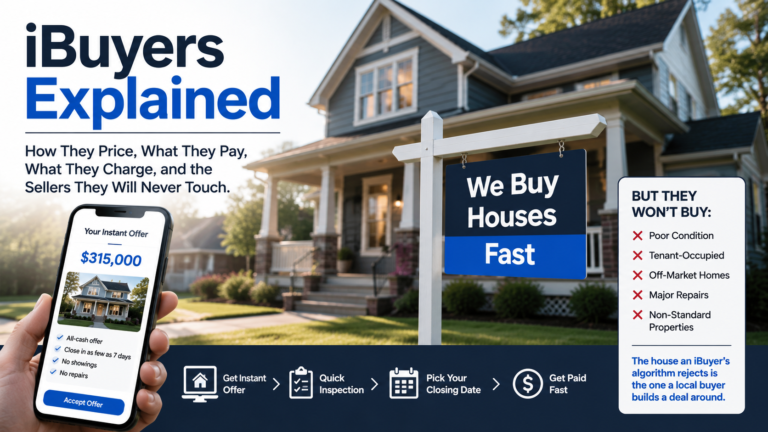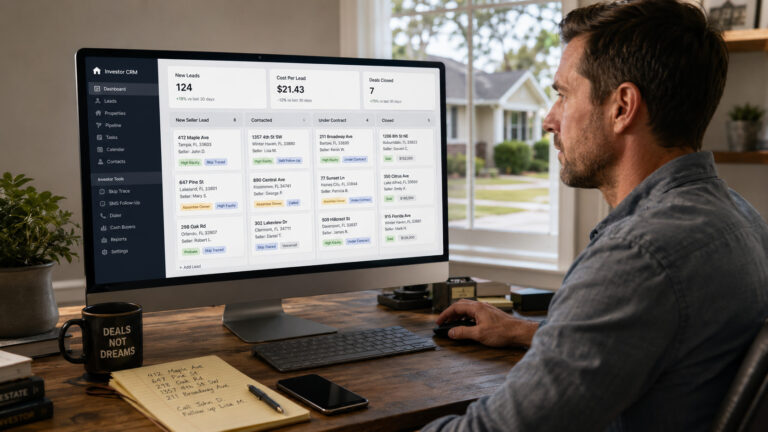

The website is the salesperson that never sleeps. When it ranks, sellers find it on their own.
The right real estate investor website turns Google searches into motivated-seller and cash-buyer leads around the clock, without you touching an ad account. This guide compares the 8 best platforms on price, lead capture, and the thing every other list skips: how well they actually rank. A full comparison table and a custom-vs-templated breakdown are below.
In this guide:
- What Is a Real Estate Investor Website?
- What to Look For in an Investor Website
- The 8 Best Real Estate Investor Websites
- Comparison Table: Pricing & Features at a Glance
- Templated vs. Custom: The Hidden SEO Cost Nobody Mentions
- How Much Does a Real Estate Investor Website Cost?
- How to Choose the Right One for Your Business
- Get a Website Built to Rank, Not Just to Exist
- Frequently Asked Questions
What Is a Real Estate Investor Website?
A real estate investor website is a lead-generation site built to capture motivated-seller and cash-buyer information through simple forms, so an investor or wholesaler gets inbound deals instead of chasing them. It is not a Realtor’s site.
An agent’s MLS or IDX site lists homes for retail buyers to browse. An investor site does the opposite job: it gets a stressed seller to raise their hand and request a cash offer, then drops that lead into your pipeline.
The core job is blunt. Rank on Google for the searches sellers actually type, then convert those visitors into motivated seller leads while you sleep. Everything else, the design, the copy, the CRM, serves that one outcome. Which is exactly why the platform you pick matters more than most investors think, and why comparing real estate website builders on looks alone is a mistake.
What to Look For in an Investor Website
Before the rankings, here is the checklist to score each platform against. Six factors decide whether a site rings the phone or just sits there.
- Lead capture that converts. Look for two-step forms that ask for the property address first and contact details second. Sellers finish those more often than a single wall of fields.
- SEO and AEO foundation. Page speed, mobile layout, clean structure, and schema markup (labels that tell Google what the page is) decide whether you rank, and whether AI answers cite you. This is where most template sites are thin. One Carrot user reported getting 26 of 45 weekly leads from ChatGPT (Carrot), so AI search belongs on the checklist now, not next year.
- CRM and integrations. Does it connect to Podio, Zapier, and your email or SMS tools, so a lead gets worked instead of dying in an inbox? A good CRM for real estate investors is half the battle.
- Customization vs. cookie-cutter templates. Can you look different from the competitors running the same template, or is your site a clone with a different logo?
- Pricing and contract flexibility. Month-to-month beats locked-in. Watch for setup fees.
- Support. When a form breaks on the morning a lead comes in, you want real help, not a ticket queue.
That is the rubric. Every platform below is scored against it, and the ranking runs from best all-around value down to the specialty picks. If you want to go deeper on the ranking side, here is how to do SEO for a real estate website.
The 8 Best Real Estate Investor Websites
The list is ordered by overall value for a typical investor. “Best” still depends on your budget and goals, which is why the checklist above matters. No filler, straight to the picks.
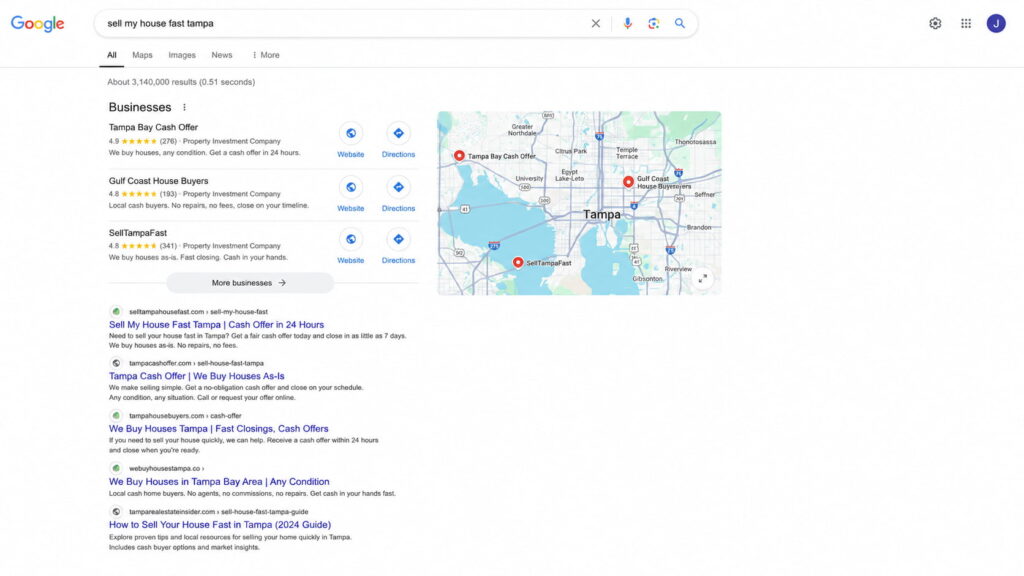
What an investor site is fighting for: the first page for “sell my house fast [city].”
1. Carrot (Best Overall for SEO)
Carrot is the category leader for investors who care about ranking. It has been purpose-built for cash buyers and wholesalers since 2013, and the platform’s whole pitch is conversion data plus built-in SEO tooling: automated location pages, keyword tools, rank tracking, and call tracking baked in.
It integrates with the tools investors actually run, including Forefront/InvestorBase, Podio, Zoho, REIPro, and smrtPhone, and it has one of the largest user bases in the niche.
Pricing starts around $84/month billed annually (about $1,009 a year) for the Starter plan, or roughly $119/month month-to-month. There is no setup fee and a 30-day money-back guarantee (Carrot). An AI Suite add-on runs $99/month if you want the automation features.
The strengths: proven conversion templates, the best built-in SEO tools in the category, and a deep template library. The catch is that same template library. Those layouts are shared across thousands of investor sites, so a seller can land on your page and then see the exact same design on a competitor’s site (RealEstateBees). Carrot itself reports that 30%+ of top-ranking “we buy houses” sites use near-identical template content (Carrot). That is the trade-off, and it sets up the custom-vs-templated question later.
2. LeadPropeller (Best Budget Option)
LeadPropeller is the affordable, investor-built option. It was made by wholesalers, and it shows: two-step lead forms, quick setup, buyer and seller site types, and a base of 1,000+ investors.
Pricing starts at $49/month for the Starter plan, with Professional at $79/month and a Franchisor tier at $299/month (RealEstateBees).
The wins are price, simplicity, and a fast launch. The trade-offs: templates are more generic, the CRM is lighter (it connects to basic email tools like Mailchimp and AWeber rather than a full investor stack), and both integrations and support are thinner than Carrot’s. The ideal user is a new wholesaler on a tight budget who needs a lead site live this week.
3. REI/kit (Best All-in-One for Wholesalers)
REI/kit bundles the website with a full marketing suite: CRM, email, SMS, direct mail, and deal analysis in one login. Site setup is close to two clicks, with pre-built templates and content plus motivated-seller lead tools.
There is a free tier, and paid plans run $57.60/month (Marketing Starter), $93.60/month (Success), and $183.60/month (Scale) (RealEstateBees).
For a wholesaler who wants tools bundled instead of stitched together, it is a strong pick, especially if you are still learning how to start wholesaling real estate. The downside is the flip side of “all-in-one”: the broad feature set can be more than a pure lead site needs, and you pay for tools you may not use.
4. REI BlackBook (Best for CRM + Automation)
REI BlackBook is for the investor who leads with operations. If your priority is a CRM, follow-up automation, and marketing workflows, with the website attached rather than the star, this fits. You get phone and SMS tools, pipeline management, and a website builder in one place.
Pricing runs $97/month for Solo ($81 billed annually), $197/month for Team, and $297/month for Executive, with a 14-day free trial (REI BlackBook).
The strength is deep automation and all-in-one operations for a growing team. The trade-offs: a steeper learning curve, and a website that is clearly secondary to the CRM. If your bottleneck is follow-up rather than traffic, that order is fine. If you want to get the follow-up side right, here is how to use a CRM for real estate.
5. DealMachine + InvestorFuse (Best for Deal Pipeline)
These two get named in a lot of “investor website” lists, so it is worth being precise: neither is actually a website builder. DealMachine is a driving-for-dollars and list-building app for outbound sourcing (DealMachine). InvestorFuse is an investor CRM, or “lead conversion system,” that was acquired by Carrot in 2022 and now runs as CarrotCRM (InvestorFuse).
They earn a spot here because deal flow is not only inbound. If your model runs on driving for dollars and list stacking, these tools manage the pipeline that your website leads flow into. You just pair them with a real lead-capture site from the list above.
If you want one login that bundles an SEO website with the deal pipeline, look at an all-in-one like REsimpli, which packages a lead-capture site, CRM, and driving-for-dollars in a single platform (RealEstateBees). The point of this category is integration: inbound web leads and outbound sourcing working from the same pipeline.
6. WordPress + Investor Theme (Best DIY)
The self-hosted route is WordPress plus a real-estate-investor theme (Winning Agent Pro is a common one) on cheap hosting. Hosting runs roughly $3 to $15/month, the theme is a one-time or annual cost, so practical all-in is about $10 to $30/month.
The upside is real: full control, low monthly cost, no shared template, and you own the asset and its SEO equity outright. Nobody can raise your rent or retire your layout.
The downside is that you build and maintain it. There is no investor-specific lead logic out of the box, and it is slower to launch than a two-click builder. The ideal user is a tech-comfortable investor who wants a unique, ownable footprint and does not mind doing the work to get it.
7. Wix / Squarespace (Best for Simple Brand Sites)
Wix and Squarespace are general website builders. For an investor who mainly wants a clean brand presence with a basic contact form, they are easy, cheap, and genuinely good-looking. Business plans run roughly $16 to $36/month depending on tier.
What they are not is a lead-generation machine. There are no investor-specific conversion features, and SEO control is weaker for the competitive keywords that matter, like “we buy houses [city].” Treat these as fine for credibility, a place to look real, not as the tool that will rank you against dedicated cash-buyer platforms.
8. Custom-Built SEO Site (Best for Long-Term Organic Growth)
A custom, agency-built site is the pick when a template stops being enough. That happens when you are competing hard for local organic and AI-answer rankings, when you need a layout no competitor shares, and when you want the site engineered around keyword architecture and schema from day one instead of bolted on later.
The strengths are the ones no template can match: a unique design with no duplicate-template trust problem, full control over SEO and AEO, content that scales as you add markets, and an asset you own. The costs are honest too: a higher upfront investment and the need for a capable partner.
This is the lane BASEO works in. We build custom, SEO- and AEO-engineered sites for cash home buyers, with a unique page for every market you buy in rather than a swap-the-city-name template, because duplicated pages are exactly what Google penalizes. If you are weighing this route, it is worth understanding what real SEO services for real estate investors include and how to pick the best SEO company for real estate before you commit.
Comparison Table: Pricing & Features at a Glance
| Platform | Best For | Starting Price | Lead Capture | SEO Control | CRM / Integrations |
|---|---|---|---|---|---|
| Carrot | SEO overall | ~$84/mo (annual) | Strong, 2-step | Strong, built-in tools | Deep (Podio, Zoho, REIPro, smrtPhone) |
| LeadPropeller | Budget | $49/mo | Good, 2-step | Basic | Light (email only) |
| REI/kit | All-in-one wholesalers | Free / $57.60/mo | Good | Moderate | Full suite (email, SMS, mail) |
| REI BlackBook | CRM + automation | $97/mo | Good | Moderate | Deep CRM + phone/SMS |
| DealMachine + InvestorFuse | Deal pipeline | Varies (pair with a site) | Via paired site | N/A (pipeline tools) | CRM + D4D sourcing |
| WordPress + theme | DIY control | ~$10–$30/mo | DIY (plugin) | Full, you control it | Any (via plugins) |
| Wix / Squarespace | Simple brand site | ~$16–$36/mo | Basic | Limited | Basic |
| Custom-built SEO site | Long-term organic | Custom build / retainer | Custom | Full, engineered | Custom |
Prices were accurate at publish. SaaS pricing shifts often, so confirm the current number with each provider before you buy.
Templated vs. Custom: The Hidden SEO Cost Nobody Mentions
Here is the part the other lists leave out. When hundreds of investors run the same template, their sites share near-identical structure and copy. A seller comparing two “we buy houses” sites in the same city sees the same layout twice. That quietly erodes both trust and differentiation, and in a competitive market it can cap how well any of you ranks.
This is not a fringe worry. Carrot reports that more than 30% of top-ranking “we buy houses” sites use near-identical template content (Carrot).
More than 30% of top-ranking “we buy houses” sites run near-identical template content. Google has to pick one of you, and it often picks none of you.
The risk got sharper in 2024. Google’s March 2024 core update introduced the Scaled Content Abuse policy, which targets large amounts of unoriginal content “no matter how it’s created” (Google Search Central). Swap-the-city-name pages are the textbook example. When your pages do not differentiate, Google has no reason to prefer yours, and that shows up as flat rankings and weak E-E-A-T signals.
AI search raises the stakes again. AI Overviews now appear on nearly half of all searches, and Google rolled AI Mode out to US searchers in 2025 (Carrot). Answer engines cite distinctive, well-structured pages. Near-identical templates give them nothing to prefer, so you stay out of the citation. If you want to be the site that gets pulled into those answers, here is how to get cited in AI Overviews.
A custom site solves this by being built around your keywords for real estate investors, your markets, and clean schema, with unique content on every page. That is what BASEO builds for cash buyers: a distinct page for each market you operate in, engineered to rank and to get cited, not a clone of the site down the street.
To be fair to templates: they are the right call when speed and budget matter most, and plenty of investors do well on them. Custom wins when you are serious about local SEO and AEO and want a footprint no competitor can copy.
Not sure whether your template is costing you rankings in your market? That is exactly what a free audit answers: it shows you where you stand against your top local competitor and what is holding the site back. Get your free site audit →
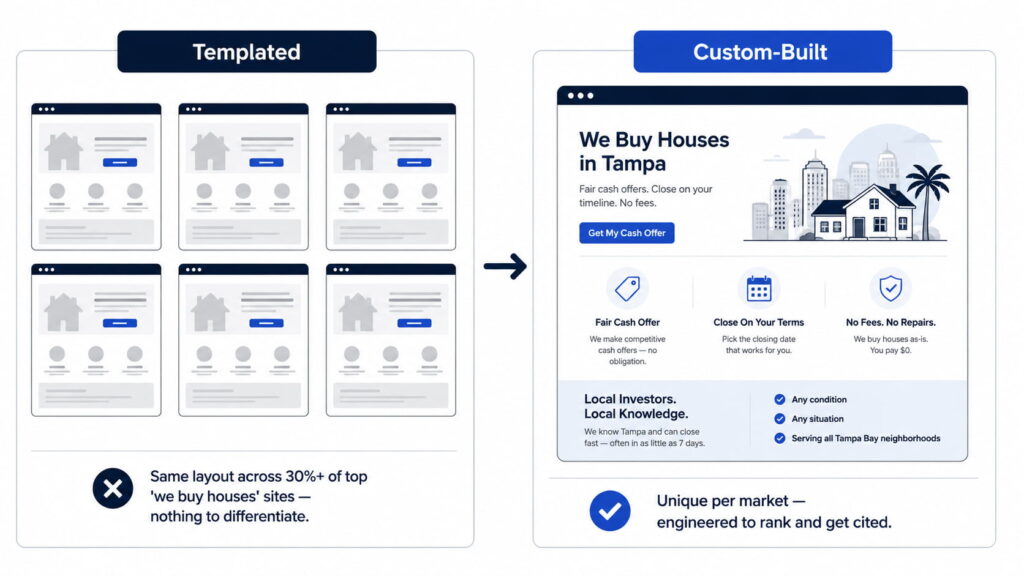
Templated sites blur together. A custom build is the only one Google and AI answers can tell apart.
How Much Does a Real Estate Investor Website Cost?
A real estate investor website costs about $40 to $100/month on a template builder like Carrot or LeadPropeller, and roughly $10 to $30/month for a DIY WordPress site (hosting plus a theme). A custom, SEO-built site is a larger upfront or monthly retainer investment, and full done-for-you marketing that pairs SEO with ads commonly starts around $2,500/month.
That done-for-you number is a market range, not a quote from any one agency. Industry SEO retainers most commonly run $1,500 to $5,000/month across providers (GoodFirms).
Now the math that matters. The national average wholesale assignment fee is about $13,000 (Real Estate Bees). One closed deal covers years of any subscription on this list, or several months of a serious custom build. Framed that way, the question is not “what does the site cost,” it is “how many extra deals does it need to bring me,” and for most investors that answer is one. If you also run paid, the cost picture for Google Ads for real estate is worth reading alongside this.
How to Choose the Right One for Your Business
Match the tool to your situation, not to whichever platform gets called “best” the loudest.
- New or on a tight budget: LeadPropeller or a WordPress DIY build.
- Want more leads and built-in SEO tools fast: Carrot.
- Want a website plus a full marketing stack in one login: REI/kit or REI BlackBook.
- Running a heavy sourcing pipeline: pair DealMachine or InvestorFuse (or an all-in-one like REsimpli) with a real lead-capture site.
- Competing hard for local organic and AI-answer rankings: a custom-built SEO site.
The winning move is honest about where you are. A brand-new wholesaler and a veteran fighting for the top of a competitive metro do not need the same site, and forcing either into the other’s tool wastes money.
Get a Website Built to Rank, Not Just to Exist
Most investor websites exist. Far fewer rank. A pretty page that never shows up on Google is just a business card that costs a monthly fee.
BASEO builds custom, SEO- and AEO-engineered sites for cash home buyers, designed to bring motivated sellers and cash buyers to you organically. The approach is bi-velocity: quick wins from paid search and your Google Business Profile while the organic asset compounds underneath, so you are not waiting in silence for months.
We work only with cash home buyers, so a free audit already knows your competitors, your keywords, and the seller situations in your market. Some operators run all of this themselves and do fine. If you would rather spend that time closing deals, that is where we come in.
Want to see exactly what is holding your site back? The audit is free, written, delivered in about two business days, and yours to keep. No call required. Get your free site audit →
Frequently Asked Questions
The following answers are formatted for FAQ snippets. Add FAQPage schema on publish.
Yes. A website lets motivated sellers and cash buyers find you on Google 24/7 and submit their info through lead-capture forms, giving you inbound leads that don’t depend on paid ads. It also builds credibility and becomes an owned asset that compounds in value as it ranks.
Template builders like Carrot or LeadPropeller run roughly $40-$100 per month. A DIY WordPress site costs about $10-$30 per month in hosting. Custom, SEO-built sites require a larger upfront or retainer investment, while full done-for-you marketing (SEO plus ads) typically starts around $2,500 per month.
For most investors, yes. At under $1,000 per year you get conversion-optimized templates and strong SEO tools, and a single closed deal can cover years of the subscription. The main drawback is shared templates. Other investors may use the same layout, which can weaken trust and differentiation.
Carrot is the best overall for investors who want conversions plus built-in SEO tools. LeadPropeller wins on budget, REI/kit is strongest as an all-in-one for wholesalers, and a custom-built site is best when you’re competing hard for local organic and AI-answer rankings.
They rank in Google for searches like “sell my house fast [city],” then convert visitors with two-step lead-capture forms and clear calls to action. Submitted leads flow into a CRM for follow-up. The stronger the site’s SEO and conversion design, the more qualified leads it produces.