
Keywords for real estate investors aren’t one list, they’re five: motivated sellers, cash buyers, wholesaling, flips, and rentals. This page maps 100+ of them to buyer intent and rough difficulty, so you chase the terms that bring deals instead of feeding Zillow. Strategy notes follow every category, because a keyword you can’t rank for is just a word.

The keyword list only matters once you know which terms your market can actually rank for.
- How to use this keyword list (read this first)
- Why keyword strategy is different for investors
- How to read search volume and keyword difficulty
- Motivated seller keywords (highest intent)
- Cash home buyer & “we buy houses” keywords
- Wholesaling keywords
- Fix & flip / rehab keywords
- Rental & buy-and-hold keywords
- Real estate investing education keywords
- Local + geo-modified keywords
- Long-tail & question keywords for AEO
- How to prioritize: building your keyword map
- Common keyword mistakes investors make
- Turn this list into ranked pages
- Frequently asked questions
How to use this keyword list (read this first)
Every keyword below is grouped by intent, not alphabet. Seller-facing money terms sit apart from education terms, and each group carries a rough difficulty note so you know what you’re walking into.
Don’t try to use all of them. Pick 5 to 15 to start, based on your model. A wholesaler or flipper lives in the motivated-seller and cash-buyer lists. A landlord leans on the rental terms. The rest is reference.
One rule governs everything on this page: one keyword equals one page. A single page trying to rank for five different keywords ranks for none, because Google can’t tell what it’s about. If you want the fuller picture across buyer and rental terms too, we keep a broader real estate keyword list as well. The two sections that pay for this whole article are the geo keywords and the AI-search questions. Start there.
Why keyword strategy is different for investors than for agents
Here’s the trap most keyword lists walk investors straight into: they hand you agent keywords.
An agent chases the buyer side. “Homes for sale in Dallas,” “best real estate agent near me,” “condos for sale.” Those terms pull a buyer browsing listings. You don’t want a buyer. You want a distressed seller ready to deal below retail this week.
That means your money is on the seller side, with urgency baked in. “Sell my house fast.” “Cash for houses.” “We buy houses.” Investor SEO targets motivated, distressed sellers, not the “homes for sale” crowd (Adwords Nerds). Same industry, opposite keyword.
The generic head terms are a dead end anyway. Zillow, Realtor.com, and Redfin own “real estate” and “houses for sale,” and you will not outrank three portals with a domain they’ve never heard of. Half that traffic isn’t even a seller.
So investors win two places instead: long-tail and local. And you build a dedicated page for each seller niche, distressed, probate, pre-foreclosure, rather than cramming them onto your homepage.
[TABLE: Investor keywords vs. agent keywords]
| Search goal | Agent keyword | Investor keyword |
|---|---|---|
| Reach the other party | homes for sale in [city] | sell my house fast [city] |
| Signal urgency | new listings [city] | we buy houses any condition |
| Capture a situation | [neighborhood] condos | sell inherited house [city] |
| Local intent | best realtor in [city] | cash home buyers [city] |
| Commercial intent | home valuation | cash offer for my house |
Same market, opposite side of the deal. Agent keywords are a trap for a cash buyer.
How to read search volume and keyword difficulty
Two numbers decide whether a keyword is worth a page. Learn them once and the tables below make sense.
Search volume is how many people type the term each month. Keyword difficulty, or KD, is a 0 to 100 score for how hard the first page of Google is to crack. Higher KD, tougher fight.
The filter the pros use: aim for KD roughly 20 to 50 with meaningful volume. But don’t skip the low-volume long-tail. A term at KD under 10 with only 40 searches a month can out-earn a head term, because the person typing it is ready to sell, not researching.
Now the part that trips people up: traffic potential versus raw volume. Take this very page. “Keywords for real estate investors” shows a KD around 4 and only a few hundred exact monthly searches (Ahrefs estimate). Weak, on paper. But the traffic potential is roughly 4,400, because a page that ranks for it also pulls the whole cluster of related terms around it. You’re not chasing one keyword’s volume. You’re chasing everything one page can rank for.
Motivated seller keywords (highest intent)
This is the category that pays your bills, so it goes near the top.
A motivated seller tells you they’re motivated by how they search. Two ingredients do it: an urgency trigger word (fast, quick, cash, now, as-is) and a selling situation. Put them together and you’ve got someone ready to move below retail. That modifier is the whole signal (Motivated Leads).
These terms are high-intent, lower-volume, and geo-friendly. Pair any of them with a city and competition drops off a cliff. One more thing before the list: every phrase here is voiced like a seller, but you’re not writing to the seller. These are the searches you want your page to rank for. If you also want the channel side of this, we cover how to get motivated seller leads separately.
The core motivated-seller keywords to target:
- sell my house fast
- we buy houses
- sell my house for cash
- need to sell my house fast
- cash for my house
- sell house as-is
- sell my house without a realtor
- who buys houses for cash
- sell my house quickly
- cash offer for my house
- we buy houses any condition
- sell my house before foreclosure
- i need to sell my house now
- companies that buy houses for cash
- sell my house fast [city]
- sell my house for cash [city]
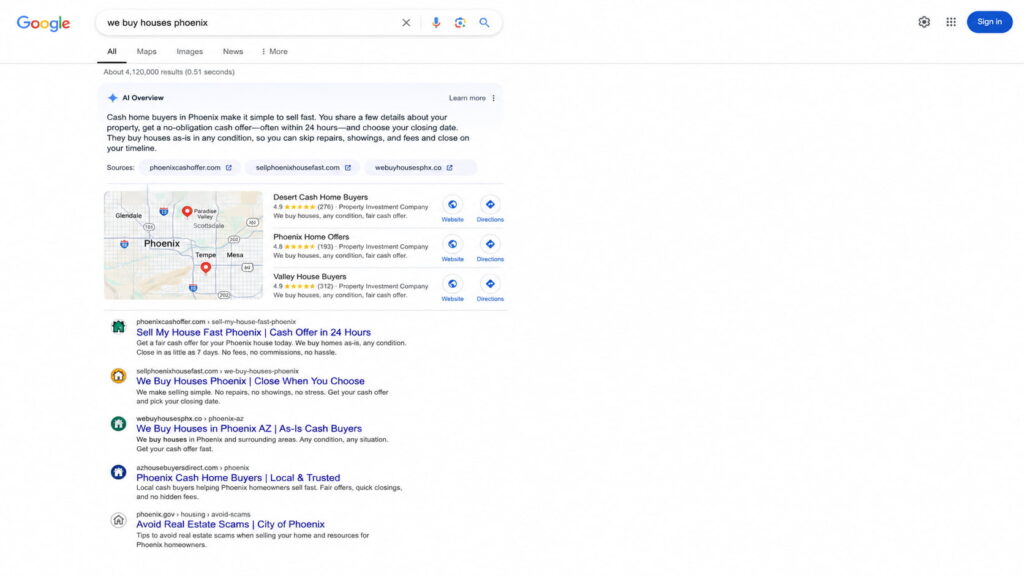
A single high-intent seller query in 2026: AI Overview on top, Map Pack below, then organic. Three ways to show up, one page to build.
“Sell fast” and cash-urgency keywords
The fastest way to spot a motivated seller is the word fast. Someone in no hurry doesn’t type it. These urgency phrases are the sharpest end of the category:
- sell my house fast
- quick house sale
- sell house for cash now
- sell my house in 7 days
- fast cash for my house
- need to sell my house now
- sell my house immediately
- quick cash home sale
Standing alone, “sell my house fast” is a national bloodbath. Add a city and it isn’t. “Sell my house fast Tampa” is a different, winnable term with the same intent. Pair every urgency phrase with your market and you’re near zero competition.
Distressed & situational keywords (probate, foreclosure, inherited)
Situational sellers don’t lead with urgency, they lead with a problem, whether that’s probate, divorce, or buying foreclosures with cash from an owner who’s out of time. Each problem is its own search:
- sell inherited house
- probate property buyers
- stop foreclosure
- sell house in foreclosure
- sell fire-damaged house
- sell rental with tenants
- divorce house sale
- sell house with code violations
Here’s the rule that separates a site that converts from one that doesn’t: each situation deserves its own landing page. A pre-foreclosure seller and a probate seller are searching different things and living different problems. One page can’t speak to both without going vague, and vague doesn’t rank or convert.
Building a separate page per situation, probate, foreclosure, divorce, inherited, problem tenants, is exactly the seller-situation content that works, because the searcher’s problem is specific and urgent. That’s a chunk of what BASEO builds for cash buyers.
Cash home buyer & “we buy houses” keywords
This is the core commercial category for a cash buyer. The searcher isn’t researching, they’re shopping for someone to buy their house:
- cash home buyers
- we buy houses [city]
- sell my house for cash
- cash offer for my house
- companies that buy houses for cash
- as-is home buyers
- sell house for cash [city]
- cash house buyers near me
Because the intent is commercial, these terms cost money in both channels. Cash-buyer keywords run a cost per click of roughly $1.80 and up (Ahrefs estimate), so they matter for SEO and for PPC. The difference is what happens when you stop paying. A paid click for “cash home buyers Dallas” disappears the moment your budget does. An organic ranking for it keeps producing leads after the spend stops. That’s the whole case for building the page instead of only renting the click.
[TABLE: Cash home buyer keyword targets]
| Keyword | Intent | Note |
|---|---|---|
| cash home buyers | Commercial | Add a city; national term is portal-heavy |
| we buy houses [city] | Commercial / local | Highest-value cash-buyer term per market |
| sell my house for cash | Transactional | Seller ready to deal |
| cash offer for my house | Transactional | Bottom of funnel |
| companies that buy houses for cash | Commercial | Comparison shopper |
| as-is home buyers | Transactional | Distressed property signal |
The cash-buyer terms carry commercial intent, which is why they cost the most per click and convert the best organically.
Wholesaling keywords
Wholesaling keywords split two ways, and confusing them wastes money.
- real estate wholesaling
- wholesale real estate contract
- how to wholesale a house
- cash buyers list
- off-market properties
- assign a contract
Some of these are seller-lead or deal-flow terms (“off-market properties,” “cash buyers list”). Most are educational (“how to wholesale a house,” “real estate wholesaling”), and they pull other wholesalers, not sellers. “Real estate wholesaling” runs roughly 3,600 searches a month (Ahrefs estimate), and almost all of it is people learning the business, not people selling a house.
Don’t build a money page around an education term. Use the education terms for your blog and reserve your city pages for the seller-facing side.
Fix & flip / rehab keywords
Flip keywords mix lead-gen with tools and financing:
- house flipping
- fix and flip loans
- fix and flip properties
- distressed property for sale
- ARV calculator
- hard money lender
The head terms are competitive and mostly owned by lenders and portals. “House flipping” runs around 8,100 a month and “fix and flip loans” around 2,900 (Ahrefs estimates), and the pages ranking are big finance sites, not local operators.
So don’t fight them head-on. Target the long-tail and geo instead. “Distressed property for sale [city]” beats “house flipping” for a working flipper every time. Note that a couple of these (“hard money lender,” “ARV calculator”) are useful to you as a reader but sit outside what a cash-buyer site should build pages around. Leave them on someone else’s site.
Rental & buy-and-hold investor keywords
For the landlords and buy-and-hold side:
- investment property
- rental property
- cap rate calculator
- BRRRR method
- turnkey rental property
- cash flow real estate
The head terms here are enormous and locked down. “Investment property” runs roughly 18,100 a month (Ahrefs estimate), and it’s owned by Zillow and BiggerPockets. You won’t take it, and you don’t need it.
Play the long-tail, same as everywhere else. “Turnkey rental property [city]” and “cash flow real estate [market]” have lower volume and are actually winnable. Volume you can’t rank for is worth zero.
Real estate investing education & how-to keywords
These are the top-of-funnel content terms:
- real estate investing
- how to start real estate investing
- real estate investing for beginners
- passive income real estate
- real estate due diligence
Be honest with yourself about these. They rarely convert. Someone typing “how to start real estate investing” is a future competitor, not a seller with a house to move.
They still earn a place, just not on your money pages. Education content builds topical authority and earns the internal links and backlinks that lift the pages that actually convert. Use them for the blog, and let them feed readers toward your city pages. The same logic applies to other awareness channels like reaching sellers on social.
Local + geo-modified keywords (the conversion engine)
This is where investors actually win, so read it twice.
Every high-intent term above gets stronger the second you attach a city or neighborhood. The formula is simple:
[high-intent term] + [city or neighborhood] = lower difficulty + higher conversion
Examples: cash home buyers Dallas. Sell my house fast Atlanta. We buy houses Phoenix. Sell inherited house Overland Park.
It works because hyperlocal phrases carry lower difficulty and higher conversion. The searcher already knows where they are, so the intent is razor-sharp, and even 10 to 30 searches a month convert at rates a head term never will (Luxury Presence). You’re trading volume you can’t win for leads you can win.
Here’s the repeatable part. Take your 5 money terms. Cross them with every market you buy in. That grid is your city-page target list, built in ten minutes.
cash home buyers ____ · we buy houses ____ · sell my house fast ____ · sell inherited house ____ · sell house as-is ____
One catch, and it’s the one that sinks most investors: each city page has to be original to its market. Not a template where you swap the city name and change nothing else. Google’s Scaled Content Abuse policy specifically crushed swap-the-city-name pages, and a Carrot site running the default template is exactly that pattern. Original page per market is what BASEO builds for cash buyers, and if you’re doing it yourself, our step-by-step SEO playbook for a real estate site walks the build.
Long-tail & question keywords for AEO
There’s a second search box you can rank in now, and most investors are ignoring it.
Start with the mechanism, because it matters more than the hype. AI Overviews and the “People also ask” box are built from question-format content. When someone asks a full question, Google and the AI engines pull the page that answers it cleanly and quote it. No clean answer, no citation.
And these boxes are everywhere. AI Overviews appeared on a large and fast-rising share of US searches through 2025, with trackers reporting anywhere from roughly 15% to 60% depending on the tool and the query type (Semrush). The question box is standard on seller searches.
The question keywords worth targeting:
- how do I sell my house without a realtor
- what is the fastest way to sell a house
- who buys houses for cash near me
- how much do cash home buyers pay
- is selling to a cash buyer worth it
- do I have to make repairs to sell my house
The tactic is exact: answer each question in 40 to 55 words, directly under a heading that matches the question. That length is what wins the snippet and gets quoted in the AI answer. The investors formatting for this now are the ones getting cited while everyone else is still arguing about whether AI search is real.
Formatting pages in that Q&A structure so ChatGPT, Perplexity, and Google’s AI Overviews cite them, then tracking those citations every week, is the AEO work BASEO runs for cash buyers. If you want the deeper mechanics, we wrote a full guide on how to get your pages cited in AI Overviews.
How to prioritize: building your keyword map
You’ve got 100+ keywords now. Here’s how to turn them into a plan instead of a spreadsheet you never open.
- Pick your model. Wholesaler, flipper, or landlord. This decides your money category. A wholesaler lives in motivated-seller and cash-buyer terms; a landlord in rental terms.
- Grab 3 to 5 money keywords. A seller or cash-buyer term crossed with your top markets. “Cash home buyers Kansas City.” “Sell my house fast Kansas City.” These get their own optimized pages.
- Add 5 to 10 long-tail supporting terms. Situational and geo variants that feed the money pages. “Sell inherited house Kansas City.” “We buy houses Overland Park.”
- Add 3 to 5 education terms for the blog. “How to sell a house in probate.” “What is a cash offer.” These build authority and links.
Then sort every keyword into a simple three-column map: money page, supporting, or blog.
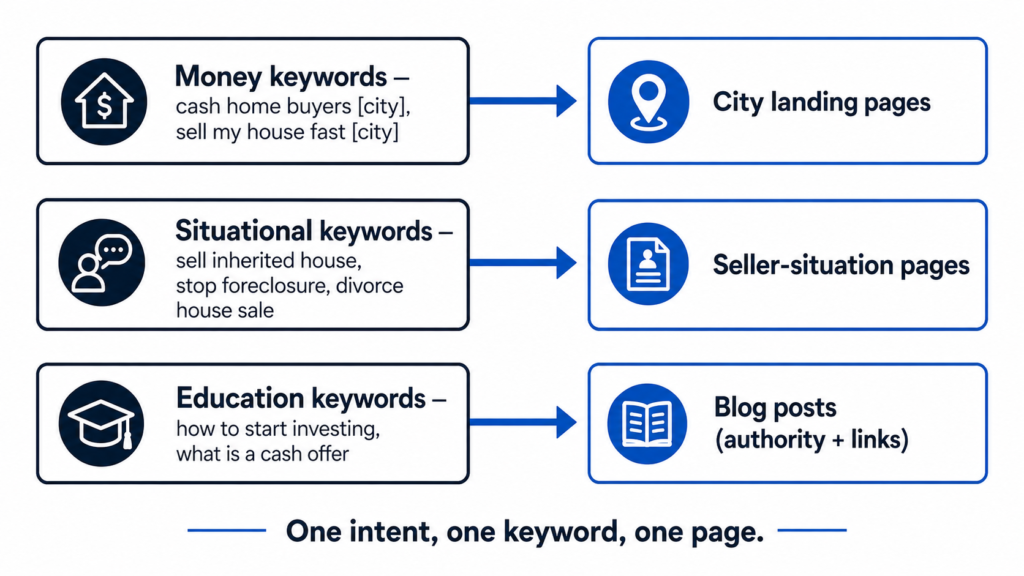
The keyword map in one picture: money terms become city pages, situations become situation pages, education becomes blog.
Worked example, a wholesaler in Kansas City. Money pages: “cash home buyers Kansas City,” “sell my house fast Kansas City.” Supporting pages: “sell inherited house Kansas City,” “we buy houses Overland Park.” Blog: “how to sell a house in probate,” “what is a cash offer.” Six targets, three jobs, zero overlap. When the leads come in, you work them in your CRM so none leak out the bottom.
Common keyword mistakes investors make
Most investor sites lose on the same handful of keyword mistakes. Check yours against these:
- Chasing head terms Zillow owns. “Real estate,” “houses for sale,” “investment property.” You cannot win them, so stop trying.
- Keyword-stuffing a page instead of matching one clear intent. Repeating “cash home buyers” 30 times doesn’t help. A clean answer to the searcher’s question does.
- Ignoring local modifiers. The single biggest miss. The city version is easier and converts better, and most investors skip it.
- Targeting buyer terms when you’re a seller-side investor. “Homes for sale” brings you browsers, not sellers.
- Making one page rank for every intent. This is the quiet killer.
That last one deserves a sentence more. When you mix multiple intents on one page, it ranks for none of them. Google can’t tell whether the page is for a seller, a buyer, or a student of wholesaling, so it stops ranking it for anything. One page, one intent, one keyword. That’s not a style preference, it’s how ranking works.
Turn this list into ranked pages
A keyword list is step one. Nothing on this page ranks by itself.
Each money keyword needs its own optimized, AEO-ready page to actually rank and get cited by the AI engines. BASEO builds those SEO, AEO, and programmatic pages for cash home buyers and investors, and works only with this niche, so it already knows your keywords, your competitors, and your seller situations. Some operators run the whole map themselves and do fine. Most would rather spend that time closing deals.
If you want to know which of these keywords your market can actually rank for, and what your top competitor already owns, that’s what the free audit is for. Written, delivered in about 2 business days, no call required, and it’s yours to keep either way.
Frequently asked questions
Quick answers to the questions investors ask most about keyword strategy.
The best keywords for real estate investors combine high seller intent with local modifiers, for example “sell my house fast [city],” “cash home buyers [city],” and “we buy houses [city].” These convert far better than generic terms and face less competition than portal-dominated searches like “homes for sale.”
Start with 5 to 15 keywords, not hundreds. Pick 3 to 5 high-intent “money” keywords tied to your market, add 5 to 10 long-tail supporting phrases, and a few educational terms for your blog. Each money keyword should get its own dedicated, optimized page.
SEO keywords earn free organic rankings over time and suit long-tail, question, and local terms. PPC keywords are paid and best for high-intent commercial terms you want to rank for instantly, like “cash home buyers.” Most investors use both, matching each keyword to intent.
Look for terms combining a selling situation with an urgency trigger word, fast, quick, cash, now, or as-is. Examples: “sell inherited house fast,” “sell house as-is for cash.” Use Google autocomplete and the “People also ask” box to expand each into long-tail variations.
Yes. Keywords still signal intent and topic to search engines and AI Overviews, but the goal is matching search intent, not stuffing. In 2026, question-format and long-tail keywords also help you get cited in AI answers, making keyword strategy more important, not less.