Most landscapers think the problem is volume. Not enough jobs, not enough calls, not enough of the phone ringing in March.
Look at your June schedule and your April schedule side by side. June is full. April is half empty. And a good share of the names on that June list already bought from you before. You sold them again from scratch.

The day the patio gets finished is the cheapest day of the year to turn that homeowner into an account.
In this article:
- How to get clients for a landscaping business: the short answer
- A landscaping job and a landscaping client are not the same thing
- Where landscaping clients actually come from, ranked by what they cost
- How to get more landscaping clients in my area, specifically
- How to turn a one-time job into a client on the same visit
- How to find landscaping clients when the phone is quiet
- The 90-day sequence for getting landscaping clients
- How to tell if it’s working (three numbers, not rankings)
- Final thoughts
- Frequently asked questions
How to get clients for a landscaping business: the short answer
To get clients for a landscaping business, work three channels: local search, reputation, and paid ads. Claim and finish your Google Business Profile, build a page for every service and every town your crew drives to, and ask for a review on every finished job. Ads fill this week.
Two of those three leave you with an account that is still yours next year. The third one does not, and that difference is the whole rest of this article.
Ranked by what they cost you per client won:
- Google Business Profile and the map. Costs time, not money. The contact is yours.
- Reviews and referrals. Close to nothing, and the homeowner arrives already sold.
- Service and city pages. Cost months before they pay, then they compound.
- Google Ads and Local Services Ads. Cost money every month, and they fill this week.
- Shared aggregator leads. The most expensive per client won, and the contact never carries your name.
A landscaping job and a landscaping client are not the same thing
A job is an invoice you collect once. A client is an account: maintenance underneath, installs and hardscape on top.
Almost everything Google returns for this search gets you jobs, not clients. That is why every spring starts at zero. If what you need this month is work you can book in weeks, that is a different problem with a different answer, and it is worth solving first.
Here is the mechanic behind it. When all of your revenue is one-off work, you pay the full cost of acquiring every customer, every season, at that season’s price. The crew that runs on accounts starts April already partly sold, and only has to go find the difference.
That distinction changes what “more clients” even means. It is not a bigger pile of leads. It is a book of work that carries some of next year for you before you make a single call.
This article is not about ordering your channels by speed. It is about ordering them by what the account costs, which turns out to be a different order.
What a repeat client is worth over three years
Start with the number the industry publishes about itself. The median landscape firm serves 355 customers and generates $14,682 per customer per year, according to the National Association of Landscape Professionals, citing the 2025 Financial Benchmark Study.
Read that number again, because nobody does. No landscaping business gets to $14,682 per customer selling single mows. That median already assumes an account.
Run the table below on your own numbers. The middle two rows are deliberately blank: drop in what a maintenance account is worth to you in a year, because that figure is yours and no industry average will get it right. The point is not the figure. It is the multiplier.
| Type of account | Year 1 | Over 3 years | What drives it |
|---|---|---|---|
| One-off install, no account | The ticket, once | The same ticket, once | Nothing. You re-sell from zero |
| Maintenance account, no install | Your annual maintenance number | That number ×3, if it renews | Renewal |
| Maintenance + one hardscape job in three years | Your annual maintenance number | (That number ×3) + $14,800 | The account is already inside when the install lands |
| Industry median, all clients | $14,682 (NALP) | $14,682 ×3 if it holds all three years | NALP publishes the annual figure. The three-year line is that figure extended, not a separate finding |
The multiplier does not come from charging more. It comes from the account still being there when the big job shows up. A design-build runs $3,000 to $50,000. Two of the jobs one San Antonio landscaper closed from organic search were a $14,800 patio and an $18,600 retaining wall (BASEO client data). Neither of those started as a patio search. They started as a homeowner who already knew the crew.
And accounts do hold. The industry retains an average of 89% of its customers, up from 88% the year before, according to Lawn & Landscape. The crew living on one-off work retains zero, not because it is worse at the job, but because there is nothing there to retain.
Why one-off jobs make the spring feel harder every year
If nothing renews, March is a full acquisition campaign. Every year. At that year’s prices.
Run it on your own numbers. Say you need 40 booked jobs to fill April, and you close one in four quotes. That is 160 quote requests you have to generate in March, from scratch. Now say 40% of April is already committed because those accounts renewed. You need 96. The whole difference is work you did last year and never had to do again.
That gap is what the 89% retention figure buys the crews that have it. They are not out-marketing you in March. They are starting the race from a different line.
Meanwhile the room for error is getting smaller. Average net profit margins in the industry dropped from 19% to 17% in the most recent report (Lawn & Landscape). When the margin tightens, paying full acquisition cost twice for the same house hurts twice as much.
Where landscaping clients actually come from, ranked by what they cost
Everything below is ordered by cost per client won, not cost per lead. Those are different numbers and only one of them pays your bills. A cheap lead that never renews is an expensive client.
Reorder the channels that way and the ranking flips. The channel with the lowest cost per lead in this industry is usually the highest cost per client, for one reason: the contact never becomes yours. That reorder is why the list below runs in this sequence and not the usual one, and it is the sequence BASEO builds in, because a channel that hands you a contact you keep is worth paying more per lead for.
| Channel | What it buys you | Typical cost | Contact becomes yours? | Renews on its own? |
|---|---|---|---|---|
| Google Business Profile and the map | Position on the map in the towns you serve | Time, not money | Yes | Yes, while the profile and reviews hold |
| Reviews and referrals | Pre-sold homeowners who already saw the work | Close to nothing | Yes | Yes |
| Service and city pages | Rankings for the work with margin | Months before it pays | Yes | Yes, and it compounds |
| Google Ads and LSA | This week’s schedule | Home and home improvement median: $8.33 a click, $90.92 a lead (WordStream) | Yes | No. It stops when the budget stops |
| Shared aggregator leads | Volume, immediately | Paid per lead, won or lost | No | No |
If you want to know which of those five is broken on your site before you spend anything, that is what the audit is for. Free. No call. Written, in about two business days. Send Me the Marketing Audit →
Google Business Profile and the map pack
The crew sitting above you on the map is not a better landscaper than you. They finished filling out a profile you left half done.
Google is unusually direct about how it picks. Local ranking comes down to relevance, distance and prominence, and on the part you control, Google states plainly that “businesses with complete and accurate info are more likely to show up in local search results.” The map, meaning the three businesses Google shows above everything else, largely goes to whoever finished the profile.
Finished is specific. The correct primary category, not the one you picked in 2019. The full service list, so the patio work shows and not just “landscaping.” A service area that matches the towns your trucks really reach, because that field is much of what decides where you appear at all. Photos of real jobs. Hours. Posts.
Reviews do double duty. Google says “more reviews and positive ratings can help your business’s local ranking.” On the homeowner’s side of the screen, 97% read reviews, 47% will not consider a business with fewer than 20, and 74% prioritize reviews written in the last three months, according to BrightLocal’s 2026 survey.
That last one is what operators miss. Forty reviews from three years ago carry less weight than twelve from this quarter. Reviews are not a total you reach, they are a cadence you keep. The rest of what moves the map, in the order it moves, is its own playbook.
So the profile gets rebuilt from scratch before anything else does, and the review system goes on top of it, wired to the finished job so the request goes out on its own schedule instead of the owner’s memory. Call tracking goes on every number before either, because a profile that starts producing calls you cannot count is a profile you cannot prove. That is the order BASEO works in, and one San Antonio landscaper went from position 11 to the top three of the map in under six months on his main money keyword (BASEO client data).
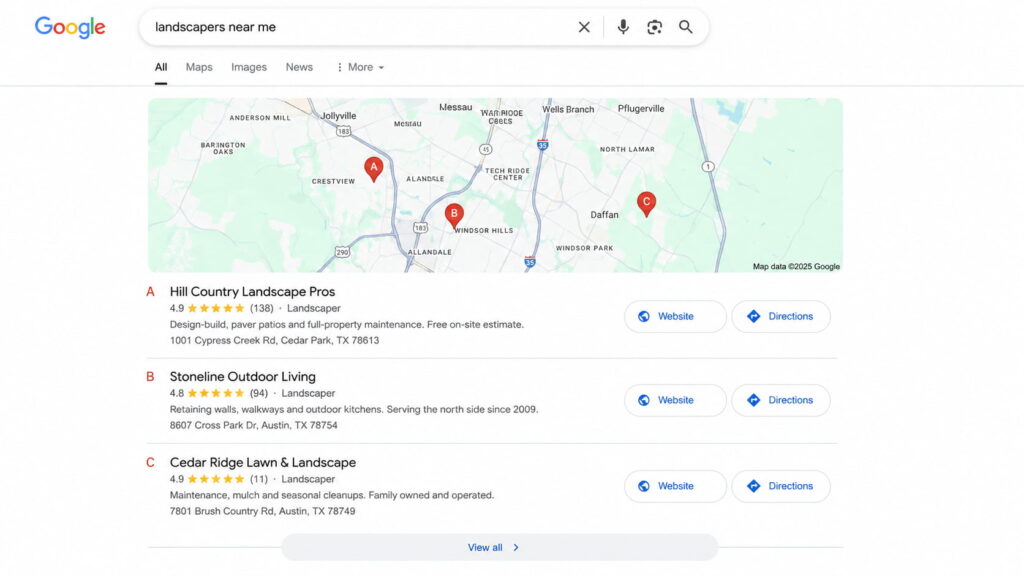
Same star rating, different review count. That gap is most of the distance between position one and position three.
Service and city pages that rank for the work with margin
Your homepage is not your most important page. It is not close.
The jobs come in through the page about the service and the page about the town. The homepage is where the homeowner confirms you are real, after one of those two already caught him.
Which makes the order of those pages the biggest decision on the whole site. Winning the search for a paver patio costs roughly what winning the search for a mow costs, and one of them is a $14,800 job. But rank for the patio alone and you have just bought a more expensive version of the same problem: a big invoice with nothing underneath it. The page order that actually builds a book puts the margin service first and the maintenance service where the patio buyer will find it on his way out.
City pages follow the same logic in the other direction. A homeowner two towns over types his own town into the search, and one page cannot be the best answer for six of them at once. A single “Service Areas” page listing all six is the most common version of that mistake.
BASEO builds them in that order: a page for every service you sell, sequenced by margin instead of by search volume, and a real page for every town the crew actually drives to. Order matters more than count, because the page you build third instead of first is a year of the wrong job type. The build reordered which pages existed before it touched anything else, and the count of people asking for a price went from 28 a month to 77 inside six months for one San Antonio landscaper (BASEO client data). Same crew, same service area, same trucks. What changed was which page the patio search landed on.
If you want the page-by-page version of this, we wrote up what to put on each one. The ordering itself is what our landscaping SEO page covers.
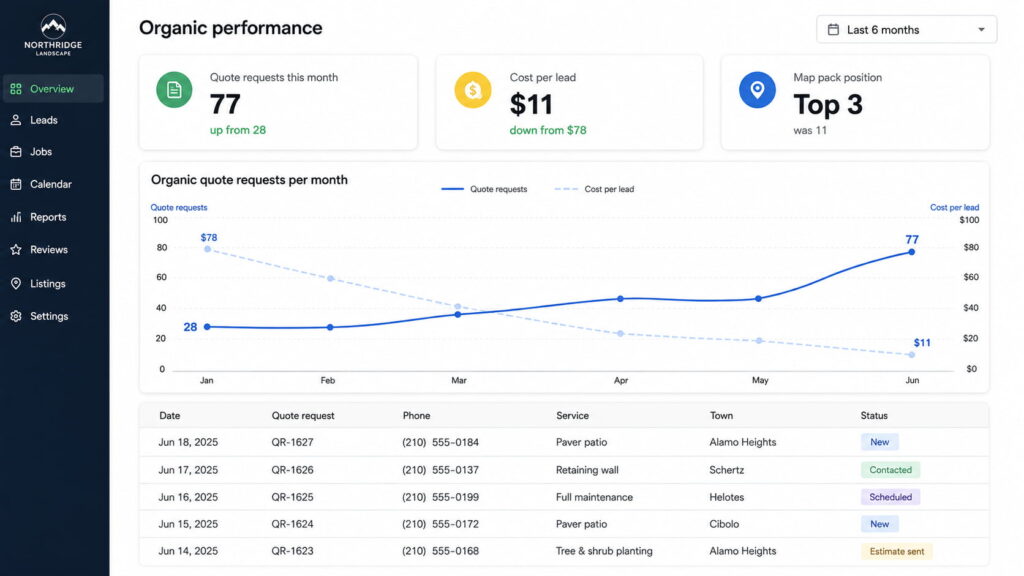
Quote requests, not sessions. The right-hand line is the one that decides whether the schedule is affordable.
Paid: Google Ads and Local Services Ads
Ads buy this week’s calendar. Pages build next year’s book. They do not compete, they take turns, and any advice that tells you to pick one is advice from someone who has never had a half-empty month to fill.
Here is the going rate. Paid search in home and home improvement runs a median of $8.33 a click and $90.92 a lead, according to WordStream’s 2026 benchmarks. That is the price of entry, not the price of running it well.
A second landscaping operator went from $84 to $43 cost per lead in six months on the same ad budget, and from 18 to 54 leads a month (BASEO client data). Against that benchmark, $43 is less than half the industry median, with the same check going to Google every month. The budget did not change. What it bought did.
What moves that number is unglamorous. Separate campaigns by trade and by service, because bidding “landscaping” next to “paver patio” in one campaign is how a budget dies quietly. Geo targeting tight to the area the trucks actually cover. Negative keywords, so you stop paying for people looking for a job instead of a quote. And a landing page that converts, one that names the town and the service, because the click is wasted on a homepage that names neither. Quality Score, Google’s grade on how well your ad matches the search, does the rest: a better grade means the same position costs less.
Local Services Ads sit above all of it. Pay-per-lead units carrying the Google Guaranteed badge, and the part that matters for this trade is that it is a phone call, not a form. For urgent work that is the whole ballgame.
None of that is exotic. It is just work somebody has to do every month, under a lens that counts booked jobs instead of clicks. And the ad spend never touches our invoice, it goes straight to Google unmarked, because the moment an agency makes money on your budget it stops having a reason to lower your cost per lead. The full breakdown is on our Google Ads and LSA for landscapers page.
Shared-lead aggregators (Angi, HomeAdvisor, Thumbtack)
Three facts about how the model works, with no moralizing attached.
The lead gets resold to four or five crews. You pay whether you close it or lose it. And the contact never carries your name, which means you cannot call that homeowner next spring, because he was never yours to call. Angi Pro is sold on a pay-per-lead basis with a stated entry point around $200 a month (Fit Small Business).
Put those three together and you get the sentence this whole article is built on: aggregators produce jobs, almost never clients. Angi is not a lead source. It is a lead rental.
The numbers on the other side of that rental are not close. The same San Antonio landscaper was paying $78 for an Angi lead. Six months into the organic build, leads were arriving from pages he owns at about $11 each (BASEO client data). And the part a cost-per-lead comparison never shows: the $11 lead came with a phone number that belongs to him. Leads from an owned channel are exclusive, permanently, never shared with four other crews bidding the same driveway.
Now the honest part, which most agencies skip because it sounds off-message. Do not cancel it on Monday. That invoice is feeding your crew this week, and anyone telling a contractor to shut off working lead flow before the replacement exists has never made a payroll. The move is weaning, not quitting.
Build the owned channel while the aggregator keeps running, and watch one number to know when to turn the spend down: the share of your quote requests arriving from channels you own. When that share covers the hole the aggregator would leave, the spend comes down. Not before, and not on faith.
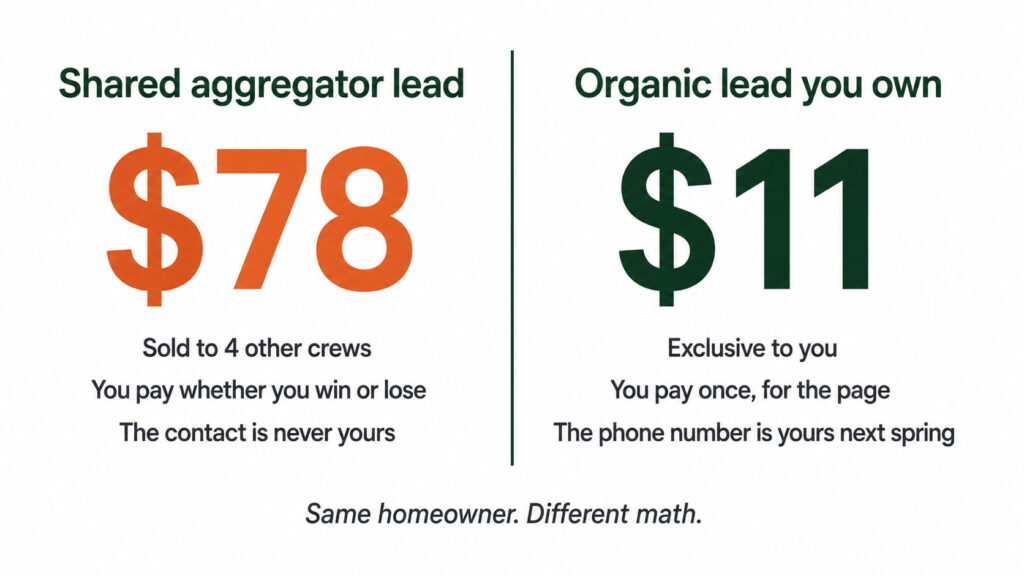
Same homeowner, same job, seven times the acquisition cost. And only one of the two leaves you with a phone number.
Referrals, door hangers, and the neighbor next door
The neighbor next door is the cheapest lead in this business, because he already watched your crew work for two days and saw how the property looked when you left.
The truck is already on the street, the drive time is already paid for, and the proof is sitting in the yard he can see from his kitchen window. Door hangers, yard signs and a word to the neighbor while the trailer is still hitched all work for exactly that reason, and none of them require anybody to find you on Google.
There is a real system underneath this: when to ask, who to ask, and what a referral is worth paying by job type. That is its own subject and its own article, and it is not this one.
How to get more landscaping clients in my area, specifically
“In my area” is almost never an effort problem. It is a footprint problem. You drive to six towns and you show up in one.
What makes that expensive is the part nobody counts: the town you are invisible in is usually a town your trucks are already crossing. You are paying the drive time and collecting revenue from one house on the street.
Two levers fix different halves of that. One is margin, and it is about which streets you already own. The other is visibility, and it is about which towns can find you at all.
Route density: the second client on a street you already drive
The second account on a block you already service is close to pure margin. Same drive, same fuel, same crew, and the half hour of windshield time now splits across two invoices instead of one.
One clarification before you run with it, because the concept comes from the lawn care side of the industry. Density governs the work that repeats. Installs are scattered by nature, since a patio is wherever the patio is. In a landscaping business what repeats is the maintenance underneath the account, and that is where density pays. The install is the ticket on top, and it lands wherever the account already is.
Run the comparison on paper. Two new maintenance accounts on the same block against two new accounts twenty minutes apart. Identical revenue. Very different margin, and the whole difference is drive time nobody invoices.
Which points at the cheapest audience you have. The neighbors of a job in progress are watching the work happen. They do not need to be convinced the crew is competent, because they can see it, and the ask costs you a conversation rather than a click.
That gets you the people who saw the truck. It does nothing for the people who did not, and those are the ones the pages are for.
The pages that decide which towns you show up in
One original page per town the crew genuinely drives to. Not fifty generated in bulk, and not one “Service Areas” page listing eleven names.
Google is explicit about where the line sits. Its spam policies define doorway abuse as “having multiple domain names or pages targeted at specific regions or cities that funnel users to one page,” and scaled content abuse as “creating large amounts of unoriginal content that provides little to no value to users, no matter how it’s created” (Google Search Central). In operator terms: the same page with the town name swapped is precisely what the updates sweep out.
A town page that survives has things in it only you have. Work you did in that area. The services that actually sell there, which are not the same in every suburb. Local proof. The page count follows the crew’s real footprint and drive time, not a keyword list, which is why a four-town operator and a twenty-town operator get very different builds.
Each of those pages gets built out of what only that crew has in that town, which is the same reasoning behind the pages that rank for margin on the service side. It is the slowest part of the build, which is exactly why BASEO starts it first.
How to turn a one-time job into a client on the same visit
The cheapest moment you will ever get to turn a customer into a client is the day you are already standing on his property and the work looks better than it will ever look again.
Every day after that one costs money. Here is the sequence, and the reason each step sits where it does.
- Have the conversation before you get in the truck. Not a pitch. A question about what comes next on the property, asked while you are both looking at what you just built. It is the only moment all year when the homeowner is looking at your finished work and at you at the same time, and getting there cost you nothing extra.
- Hand over the maintenance proposal the same day as the install. That day is the one day the value of your work is visible from the street. A week later it is an email competing with thirty others, from a company he now remembers slightly less clearly.
- Put a date on the seasonal follow-up before you leave. The next sale on that property already has a date and you know what it is while the homeowner does not. Write it down, in whatever you already use to run the business. This is not a system anybody needs to sell you.
- Ask for the review inside the window where the work looks best. Two reasons, and the second gets missed. The customer is happiest now. And 74% of consumers prioritize reviews written in the last three months (BrightLocal), so one review from this month outweighs three from two years ago.
All four are free. What they cost is remembering, on the day, with the trailer loaded and the next job waiting. Three of them you can do with a sentence and a note. The fourth is the one that reliably does not happen, which is why BASEO takes it off the pile: the request fires off the finished job itself, on the day the property still looks the way you left it.
How to find landscaping clients when the phone is quiet
The off-season is not the part of the year with no clients in it. It is the part of the year with enough time to build the channel that brings them in April. It is also, not coincidentally, the only stretch where you can think about any of this without doing it from the seat of a machine.
The window is November through February in the snow belt, December through March in the sun belt. Three things go in it, in order of how fast each one moves.
Reactivate the dormant accounts first. You already have the name and the number. It is the cheapest acquisition work available all year and it does not require a single person to find you on Google. Start with the ones who bought an install and never came back, because they already trusted you with the expensive decision.
Fix the profile second. Categories, service list, service area, photos. This is the piece that can move the map in weeks rather than months, which makes it the best return on a January afternoon.
Build the pages third, which is why you start them first. They take months to rank and then keep compounding, so the order of operations runs backwards from the order of payoff.
On timing, one honest sentence instead of a promise. That San Antonio landscaper took six months to go from 28 organic quote requests a month to 77. Your market, your competition and your starting point decide yours, and anybody quoting you a date has looked at none of the three.
The general shape of the channel: first organic quote requests usually land between month three and month five, real volume between month six and month nine. Ads run on a different clock and can book jobs inside the first two or three weeks. Keeping those two straight is the whole difference between an honest expectation and a pitch.
The January version that costs nothing is the audit. Send the domain, get it back written in about two business days, keep it either way.
The 90-day sequence for getting landscaping clients
This is not a ranking of channels by speed. It is an order of operations for building a book: the things that retain first, the things that acquire second.
Days 1 to 30. Work what is already yours. Finish the profile with the correct primary category, the real service area and photos of actual jobs. Get the review system running off completed work. Then call the dormant accounts, starting with the install customers who never came back.
The number at day 30: how many dormant accounts answered. That is your baseline for how much book you already had and were not counting.
2. Days 31 to 60. Build what compounds. Write the service page for your highest-margin service, not your most-searched one. Then the pages for the two towns the crew drives to most, not the six you wish you covered.The number at day 60: organic quote requests that month. Not position. The count.
3. Days 61 to 90. Measure, then decide. Work out cost per client won by channel, with the aggregator spend included at its real number. Then make the one decision this whole quarter was setting up: whether the aggregator spend comes down, and by how much.The number at day 90: what percentage of next month’s revenue is already committed without you selling anything new.
Ninety days does not get you a finished channel. It gets you the base of a book and the three numbers that tell you what to build next.
How to tell if it’s working (three numbers, not rankings)
Quote requests per month. Not sessions, not impressions. How many people asked you for a price.
Cost per client won, not cost per lead. Divide what the channel cost by the number of accounts still on your books, not by the number of contacts that came in the door. That single change in the denominator reorders every channel in this article.
Percentage of revenue that renews on its own. This is the one that says whether you are building a book or repeating a campaign, and it is the number almost nobody tracks.
Position three is not a business number. It is an input. It can improve while the phone stays quiet, and that case is more common than anyone selling rankings will tell you. A report showing rankings and nothing else is the signature of the company that burned you.
And the reason most operators cannot answer these three questions is not that they did anything wrong. It is that call tracking was never installed, and GA4 and Search Console were set up by somebody once and never opened again. You cannot count calls nobody instrumented.
A report that answers those three questions is a short document, not a dashboard. The one BASEO sends fits on a single page and leads with the quote requests, each with the phone number attached, so you can call the ones that never got a bid. Everything else on it exists to explain that first number: what the leads cost this month against last, where you sit on the map, and what gets built next.
Final thoughts
You are not short on work. You are short on accounts that come back without being sold again.
The fastest way to find out where you stand is to open last year’s revenue and count what share of it came from people who had already bought from you. That percentage, not your ranking, is the number that tells you what to build first.
You can work out most of this yourself with last year’s invoices and a free afternoon, and some operators do exactly that. The audit just skips the afternoon: it comes back with the towns you never show up in, the service pages you never built, and what that costs you in a season. The team on your account works only with landscapers, so nobody has to explain to them why a patio page matters more than a mow page.
Free. No call. Written, in about two business days. Yours to keep, even if we never speak again.
Frequently asked questions
Landscaping customers come from three places: local search, reputation, and paid ads. Claim and fill out your Google Business Profile, build a page for each service and each town you actually drive to, and ask every finished job for a review. Ads fill this week’s schedule while those pages build next year’s.
Both, and the difference is money. A customer buys one job and disappears. A client keeps an account with you: maintenance underneath, installs and hardscape on top. Crews built on customers re-sell the whole book every spring. Crews built on clients start each season already partly booked.
Average net profit margins in the industry fell from 19% to 17% in the most recent report (Lawn & Landscape, March 2026). Your service mix decides where you land: maintenance carries a lower ticket with predictable margin, while install and hardscape work carries the ticket.
Start where proof already exists. Ask past customers and the neighbors of any job you’ve finished, since they’ve seen the work. Then claim your Google Business Profile and get five real reviews on it. That combination books the first accounts faster than any ad spend at this stage.
Shared leads from Angi, HomeAdvisor, or Thumbtack get resold to four or five crews, and you pay whether you close or not. They can fill a gap this week. They rarely build a client list, because the contact never becomes yours. Treat them as rented volume, not as a channel you own.
Profile work and reviews can move map visibility in weeks. Service and city pages take months to rank and then keep compounding. One San Antonio landscaper went from 28 organic quote requests a month to 77 in six months. Your market and competition decide your own timeline.