

The goal of every strategy below: this call, coming in, not going out.
Nobody got into real estate to make 300 dials a day and eat 295 rejections. Yet that’s how most investors are told to fill a pipeline: buy a list, skip-trace it, grind the phone.
There’s a better answer. You get real estate leads without cold calling by building inbound channels: SEO, referrals, direct mail, and paid ads that make motivated sellers contact you first. That’s how to get real estate leads without cold calling in one sentence, and the rest of this guide is the how.
This isn’t another flat list. The 9 strategies below are ranked by how hard they compound, and you’ll get two things the usual roundups skip: which channel to start with for your budget, and the real cost per deal of each one.
Contents
- Why Cold Calling Is the Slowest Way to Fill Your Pipeline
- 9 Ways to Get Real Estate Leads Without Cold Calling
- Which Strategy Should You Start With?
- Cold Calling vs. Inbound: The Real Cost Per Deal
- Want Motivated Sellers Calling You Instead?
- Frequently Asked Questions
Why Cold Calling Is the Slowest Way to Fill Your Pipeline
Cold calling produces deals. That’s not the argument. The argument is the ratio.
Across real estate, dial-to-appointment rates average 1.7–2.7% (Gitnux). The floor is worse: a Baylor University study tracked 6,264 genuinely cold calls and found only 28% were answered, and just 0.3% became appointments. About one appointment for every 330 dials (CallingAgency).
One appointment for every 330 dials. That’s the measured worst case of buying a list and grinding the phone.
Even the grinders hit a ceiling: agents making 100+ calls a day average around 18 cold-call closings a year (Gitnux). That’s a full-time job’s worth of dialing for a deal and a half a month.
Meanwhile, the seller you’re trying to reach is already online. NAR’s 2025 Profile found 46% of buyers start their search online, and essentially everyone uses the internet during it (NAR). Off-market sellers behave the same way: they google “sell my house fast” before they talk to anyone.
So it’s not that cold calling “doesn’t work.” It’s that it has the worst time-per-deal ratio of any channel, and it doesn’t compound. The day you stop dialing, the pipeline dies.
9 Ways to Get Real Estate Leads Without Cold Calling
The 9 strategies below run from most compounding to least. The first ones build an asset that keeps producing after you stop feeding it; the last ones buy activity you have to keep buying. If you want the broader picture of every seller channel, the motivated seller leads playbook covers it.
1. Rank Your Website for Motivated Seller Searches (SEO)
When a seller decides to sell fast, they type “sell my house fast [city]”, “we buy houses [city]”, or “cash home buyers near me”. Most of those clicks go to the top 3 organic results, not the ads.
That’s why this is the hero strategy. The seller who finds you already chose you: motivated seller websites convert 7–20% of visitors, and the 20% end of that range only happens with organic search or direct traffic (Carrot). Inbound leads from targeted sources close around 1 in 10 to 1 in 15 (Goliath Data).
Getting there takes three pillars, minimum:
- City and service pages: one original page for every market you buy in. Template pages that just swap the city name got crushed by Google’s March 2024 update, so original local content is the entry price.
- Seller-situation content: pages answering what stressed sellers actually search: probate, foreclosure, inherited house, problem tenants. This is where how to do SEO for a real estate website goes deepest.
- Local reviews and citations: Google Business Profile, real reviews, consistent listings. Google won’t rank a site it doesn’t trust.
That architecture is what BASEO builds for cash home buyers, with lead tracking installed first so every call and form gets counted from day one. One Florida client went from 3 to 28 motivated seller leads a month in nine months, same market, no extra ad spend (BASEO client data). Start with the keywords for real estate investors that fit your footprint.
Be honest about the timeline: 4–8 months for real traction in most markets. That same Florida client saw his first 12 organic leads and 3 closed deals in month 5 (BASEO client data). Which is exactly why you start today, not when the skip-tracing list runs dry. If you want to know which pillar your site is missing, a free written audit will tell you.
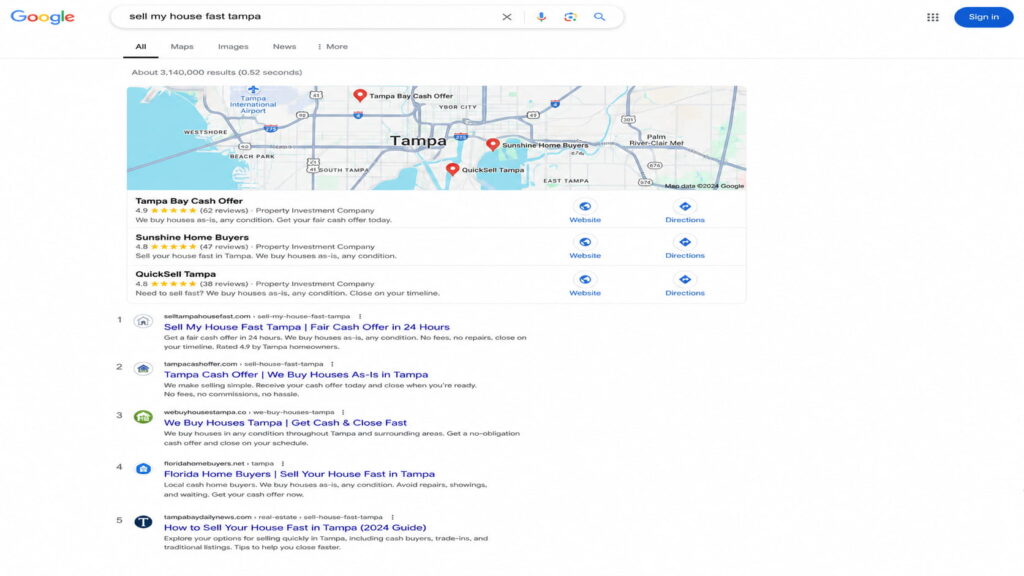
The page a Tampa seller sees. The top 3 organic spots and the Map Pack take almost every click.
2. Show Up When Sellers Ask ChatGPT and Google AI (AEO)
Sellers don’t only google anymore. They ask ChatGPT, Perplexity, and Google’s AI Overviews things like “should I sell my house to a cash buyer” and “best we buy houses company in Tampa”. The engines answer by citing a short list of sites, and the list comes from structured content, clear FAQs, and consistent brand mentions across the web.
The traffic is small but it closes hard. ChatGPT visitors convert at 15.9% versus 1.76% for Google organic (Seer Interactive). One Carrot user got 26 of his 45 weekly leads from ChatGPT (Carrot). AI referrals grew 527% year over year, even though they’re still around 1% of total traffic (AirOps).
What to do: add FAQs with schema markup (labels that tell Google exactly what your page is), answer full questions in 40–60 words, keep your name, address, and phone identical everywhere, and earn mentions in local directories and press that the AI engines use as sources. The full playbook is in rank in AI Overviews.
BASEO formats client pages for citation and tracks AI citations weekly across the major engines. Nobody controls whether an AI cites a page, but this is the 2010 version of SEO: the window is open and most of your competitors aren’t in it.
3. Run PPC While Your SEO Compounds
Google Ads on high-intent keywords brings leads this week. That speed has a meter running: seller campaigns cost $5–$65 per click depending on your market (ROA Marketing), and motivated seller leads typically run $50–$200 each (Promodo). Those leads still close around 1 in 10 to 1 in 15 (Carrot).
Treat PPC as the bridge while your organic matures, not the permanent plan. And know the failure mode: without a landing page that converts (social proof, a clear offer, a short form), PPC just burns budget. Pick terms from the top real estate keywords with buying intent, not research intent.
Facebook and Instagram ads are cheaper but lower intent: use them for retargeting and awareness, not bottom-funnel seller capture.
BASEO manages motivated-seller PPC under the same lens as organic (leads and cost per deal, never clicks), and the plan is always to shrink it: most clients cut paid spend 30–50% by months 6–9 as organic takes over.
4. Direct Mail That Sends Sellers to Your Website
Direct mail still works for off-market sellers. What changed is its job: mail no longer competes with your website, it feeds it.
The mechanics: pull segmented lists (absentee owners, high equity, pre-foreclosure, probate, vacant), pick a farm of 200–500 properties, and mail them on a 6–8 week cadence instead of blasting one-and-done postcards.
The modern twist is a QR code or short URL pointing at your site, so the seller can research you on their own terms instead of having to make an awkward phone call. That matters because they were going to google you anyway. Mail with no credible website behind it converts worse: the seller checks you out, finds nothing, and tosses the postcard. Your letter starts the conversation; your site and reviews close it.
5. Referrals and Your Sphere of Influence
After 2–3 transactions, you already have a network: past sellers, the contractors on your flips, title companies, even the neighbors who watched a rehab happen.
Most investors never work it. The play is a quarterly touch with something of value, a market update, a completed project, an introduction. Not “got any deals?”
Where your state allows it, offer a clear, legal referral fee and say the number out loud. People refer more when they know exactly what happens when they do. Referrals stay one of the most reliable sources of repeat business in this industry, and the cost is coffee and follow-through.
6. Strategic Partnerships: Attorneys, Agents, and Other Investors
The agent version of this advice is stale. Here’s the investor version.
Four partners worth building: probate and divorce attorneys, whose clients have legal urgency and a property to solve; agents holding expired listings or houses too rough for the MLS; local wholesalers, whose overflow you can buy when their buyer list passes; and property managers with tired landlords ready to sell the headache.
Open every one of these by giving value first: close fast, close clean, make the attorney or agent look good to their client. Then formalize it. A partner who knows exactly what you buy and how you close sends the next one without being asked.
7. Social Media Content That Pre-Sells You
Social media’s real job for an investor isn’t volume. It’s proof. Among real estate professionals, 52% say social media leads beat MLS leads on quality (Resimpli).
Skip the listings. Document the work: before-and-after flips, deal-number breakdowns, a seller saying the process was painless. That’s the content another human trusts.
Pick one or two platforms and post consistently rather than everywhere occasionally. More on the investor angle in social media marketing for investors.
Here’s the quiet payoff: when your letter lands or your site comes up, the seller googles you. If they find a feed full of real projects and real people, you’re safe to call. Social is the trust layer under every other channel on this list.
8. Email and SMS Nurture for Leads That Aren’t Ready Yet
Most seller leads don’t close on first contact. 80% of deals need five or more follow-ups (Goliath Data), and the investor who follows up usually beats the one with the better offer.
Build one automated sequence for leads who filled your form but didn’t book: a market update, a success story, a simple “still thinking about selling?” Segment warm from cold so a motivated probate seller doesn’t get the same drip as a tire-kicker. A basic setup like the one in using a CRM for real estate covers it.
One compliance line, plain language: text only people who opted in (that’s the TCPA rule). This is nurture for leads who already contacted you. It is not cold texting, and it shouldn’t smell like it.
9. Driving for Dollars + Mail Follow-Up
The zero-budget classic, minus the cold call. Drive your farm neighborhoods and log the distress signals in person:
- Grass a foot tall or a yard full of junk
- A stuffed mailbox or piled-up flyers
- Boarded windows, tarped roofs, code-violation notices
Log each property in an app while you drive. Then, instead of skip-tracing the owner and dialing, send a letter or postcard that points to your website (strategy 4 does the converting).
This is the cheapest channel in cash and the most expensive in time, which makes it exactly right for an investor starting with no budget. The list you build is also an asset: those addresses feed your mail cadence for months.
Which Strategy Should You Start With?
A list of nine is useless without a starting point. Your budget picks for you.
| Your situation | Start with | Why |
|---|---|---|
| No budget, have time | Driving for dollars + referrals + social, and start a basic blog/SEO now | Costs hours, not dollars, and the site you start today is the asset that compounds |
| Moderate budget ($1–3K/month total marketing) | SEO/AEO as the base + segmented direct mail | One channel compounds while the mail produces conversations this quarter |
| Need deals now, have budget | PPC as the bridge + SEO in parallel | Paid keeps the phone ringing while organic grows to replace it in 6–12 months |
The rule underneath all three rows: run one channel that compounds (SEO) plus one channel of immediate activity (mail or PPC). The first builds your future cost per deal down; the second pays this quarter’s bills. Investors who run only activity channels are still renting their pipeline in year five. The full source-by-source comparison lives in seller leads for investors.
Cold Calling vs. Inbound: The Real Cost Per Deal
Run the math on all three and the argument settles itself.
Cold calling pays in hours. 100 calls a day, five days a week, at a ~2% dial-to-appointment rate is about 10 appointments from 25+ hours of dialing. Every week. Forever. The cost per deal is your calendar.
Organic pays up front, then gets cheap. Inbound leads close around 1 in 10 to 1 in 15 (Goliath Data), and once you rank, the marginal cost of the next lead approaches zero. BASEO’s flagship client pays $161 per organic lead from Google, declining monthly (BASEO client data). In month 9 he closed 3 organic deals for $54K combined profit against a $4,500 monthly invoice (BASEO client data).
PPC pays per lead: at $50–$200 per lead and 10–15 leads per deal, you’re at roughly $500–$3,000 in ad spend per deal, climbing with your market’s competition.
| Channel | Cost per lead | Leads per deal | Cost per deal | Compounds? |
|---|---|---|---|---|
| Cold calling | Your hours | ~1 appointment per 330 dials (worst case) | 25+ hrs/week of dialing | No |
| PPC | $50–$200 | 10–15 | ~$500–$3,000 + | No |
| Organic (mature) | $161 and falling (client example) | 10–15 | Lowest of the three, still dropping | Yes |
On a deal netting $25K, those differences are the margin. The honest conclusion: inbound costs more in the first months and wins by a mile at 12+.
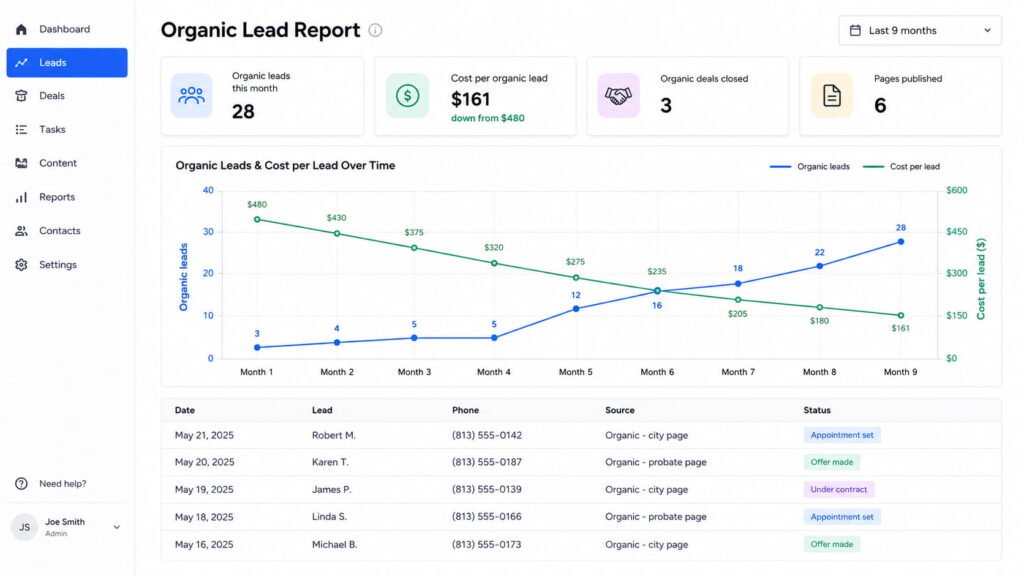
The compounding curve: leads up 3 → 28 over nine months while cost per lead falls. This is what “the asset kicks in” looks like on a report.
Want Motivated Sellers Calling You Instead?
The best time to start building inbound was a year ago. The second best is today, because every month of dialing is a month your future rankings aren’t aging.
BASEO works only with cash home buyers: we build the city pages, seller-situation content, and AI-search presence that put you in front of motivated sellers before your competitors, and we report in leads, not impressions. No dials, no burned lists. If you want to see exactly where your site stands, start with the free site audit: free, in writing, delivered in about 2 business days, no call required, yours to keep.
Frequently Asked Questions
Quick answers to the questions investors ask most about getting leads without cold calling.
Real estate investors get leads without cold calling by ranking their website for motivated seller searches, sending targeted direct mail, running PPC ads, building referral partnerships with attorneys and agents, and posting proof-of-work content on social media. Inbound channels make sellers initiate contact, which produces warmer, higher-converting leads.
The main free lead sources are referrals from past sellers and contractors, driving for dollars, posting consistently on social media, and answering questions in local Facebook groups. They cost time instead of money. Pair one free channel with basic SEO on your website so leads compound over time.
Cold calling still produces deals, but it’s the least efficient channel: only about one in four prospects answers, roughly 1–2% of dials become appointments, and results stop the moment you stop calling. Most investors get a better return by shifting that time into SEO, referrals, and direct mail.
Organic search is the highest-quality source of motivated seller leads. Sellers searching “sell my house fast” have already decided to sell and are choosing who to call, so inbound leads typically convert to a deal for every 10–15 leads, far better than cold outreach.
Expect 4–8 months to see consistent seller leads from SEO in most markets, faster in smaller cities with weak competition. Rankings compound: after the initial ramp, leads keep arriving at near-zero marginal cost, which is why investors pair SEO with direct mail or PPC while it matures.
Final thoughts
The investors winning inbound in your market aren’t smarter than you. They started building the asset 12 months ago while everyone else kept dialing.
The move this week is simple: pick one compounding channel and one activity channel, and put the hours you were going to spend on the phone into both. In deal terms, that’s trading 25 hours a week of dialing for a pipeline that gets cheaper every quarter.
Every piece of the SEO side is work, every month, and some operators run it themselves just fine. Most would rather spend that time closing. If you want to know exactly which pieces your site is missing before you decide either way, that’s what the audit is for. We work only with cash home buyers, so it already knows your competitors, your keywords, and your seller situations. Free, in writing, no call required.