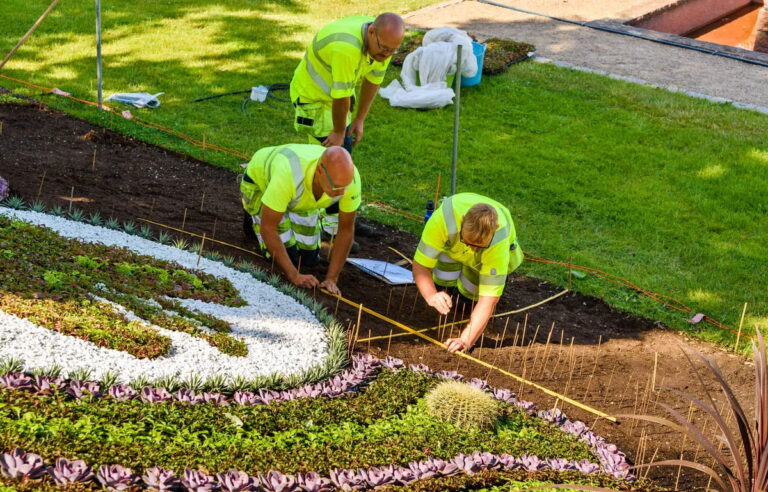
The person choosing the ad agency is usually the person who loaded the trailer that morning.
Most landscapers looking for the best landscaping PPC companies do not have a click problem. They have a problem where the clicks arrive, the phone rings twice, and next month’s schedule still has holes in it.
So here is what this page does differently. Every agency below is measured against what landscaping keywords actually cost in the real world, $3.81 a click and $104.15 a lead, not against its own marketing copy. You get fee models with real numbers, the benchmarks nobody else on this search publishes, and the specific things that should end a sales call.
One disclosure before you read a word of it: TheBaseo published this page, and TheBaseo is listed first. Read that entry as skeptically as you would read a competitor’s, and run every shortlist through the seven questions at the end.
If you have thirty seconds, the table below is the article.
- Quick comparison of all ten
- What landscaping PPC actually costs
- The ten companies, in order
- Local Services Ads vs Google Ads
- Maintenance vs design-build
- Seasonality and your January
- Seven questions to ask
- Get a plan built around booked jobs
- FAQs
Quick Comparison: The 10 Best Landscaping PPC Companies
| Agency | Best for | Green-industry focus | Typical monthly management fee | Minimum ad spend |
|---|---|---|---|---|
| 1. TheBaseo | Green industry operators who want booked jobs, not an impressions report | Exclusive | Custom (quote-based) | Custom (quote-based) |
| 2. WebFX | Depth of bench and reporting infrastructure | Home services | From $750/mo (published) | Not published |
| 3. Thrive | One vendor across ads, SEO and the website | Generalist | Custom (quote-based) | Not published |
| 4. Scorpion | Multi-location operators who want one system | Home services | Custom (quote-based) | Not published |
| 5. Blue Corona (RYNO) | Call tracking and attribution maturity | Home services | Custom (quote-based) | Not published |
| 6. Landscape Leadership | Owners who want no translation layer | Exclusive | Custom (quote-based) | Not published |
| 7. Evergrow Marketing | Operators who want the data behind the advice | Exclusive | Custom (quote-based) | Not published |
| 8. Lawnline Marketing | Southern markets with a near year-round season | Exclusive | Custom (quote-based) | Not published |
| 9. Halstead Media | Creative and landing pages, not just bid management | Home services | Custom (quote-based) | Not published |
| 10. Digital Third Coast | Analytics rigor and earned coverage at scale | Generalist | Custom (quote-based) | Not published |
One of these ten prints a rate on its own website. The rest ask you to call.
That is not an accusation, it is the standard this column runs on: a number goes in that cell only if the agency publishes it itself. Figures quoted for these firms elsewhere are somebody else’s estimate, repeated until it looked like a fact.
The fee is the small number anyway. The one that decides whether the account works is what a booked job costs you, two sections down.
What Landscaping PPC Actually Costs in 2026 (Benchmarks)
You cannot judge an agency’s quote until you know what a landscaping click costs and what a paver patio search costs to win in your own market, and that is the part this search does not give you. Silverback’s roundup is the most thorough page ranking for this keyword today, and it lists no pricing, no minimum ad spend and no contract terms for a single agency on it, plus no cost per click or cost per lead anywhere. The others are thinner.
The numbers below are national, which makes them a line to measure against and not a price to expect. A dense metro with a dozen funded competitors bidding the same three keywords runs above it, and a rural county runs below it. The only way to know which one you are in is to open your own account, though cost per lead by channel is a useful wider view first.
Average CPC, CPL and Conversion Rate for Landscaping Keywords
| Service | CTR | Avg CPC | Cost per lead | Conversion rate |
|---|---|---|---|---|
| Landscaping | 4.51% | $3.81 | $104.15 | 3.66% |
| Lawn care | 4.69% | $4.67 | $84.24 | 5.54% |
| Combined | 4.56% | $4.14 | $85.48 | 4.85% |
2025 Google Ads data published January 2026 by Evergrow Marketing, a green industry agency that spent roughly $150,000 of its own budget on landscaping keywords that year.
Landscaping costs more per lead than lawn care even though the click is cheaper. $3.81 against $4.67 on the click, $104.15 against $84.24 on the lead. The gap is the conversion rate: 3.66% against 5.54%.
That is the trade showing up in the data. A lawn care search is mostly a decision already made. A landscaping search is the start of a shortlist: bigger ticket, longer thinking, two or three estimates compared before anyone signs.
A second dataset disagrees, and the disagreement is the useful part. LocaliQ, working from 3,211 US home services campaigns run between April 2024 and March 2025, puts landscaping at $8.76 a click and $117.92 a lead.
Look at the shape of that. The clicks cost 2.3 times more and the leads cost 13% more, because the expensive clicks convert at nearly double the rate. Two datasets built from different accounts in different years, and they land within fourteen dollars of each other on the only number that puts a crew on a job. That is what a landscaping lead costs, and neither dataset could talk you out of it.
Which is how you judge an agency. A report showing your cost per click coming down has told you almost nothing: it can fall while your cost per lead climbs, and you would not know until the schedule told you.
So carry this number into every conversation on this page. Take $104 a lead and a close rate of one in three, which is a working assumption rather than a benchmark, so run yours instead: roughly $347 of ad money is sitting inside every booked job.
Against an $8,000 design that is 4% of the ticket. Against a single $55 mow it is six visits of revenue to win one customer.
The mow still works, but only if you count the contract instead of the cut. A maintenance customer at $200 a month for three years is $7,200. Same $347 either way. What changes is what you sold, and there is more on cost per booked job if you want to run yours.
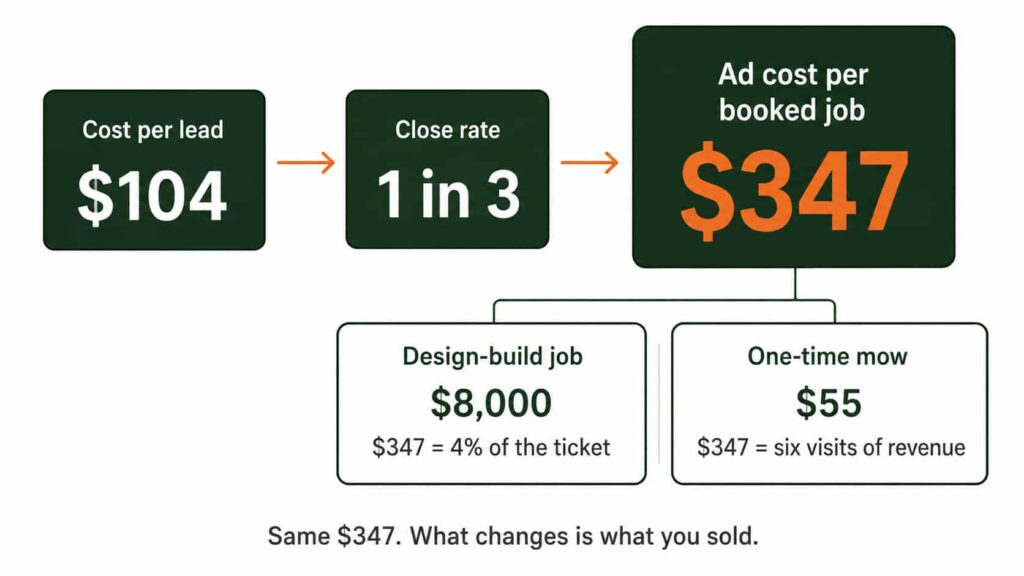
The conversion that matters. Every agency on this page should be able to do this math for your business before it quotes you.
What Agencies Charge to Manage It
| Fee model | What it means | Typical figures |
|---|---|---|
| Percentage of ad spend | The fee scales with the budget, usually with a monthly floor | 10% to 20% of spend |
| Flat monthly fee | A fixed number, set by the size of the account | $500 to $2,000 on $1,000 to $5,000 of spend; $1,500 to $5,000 on $5,000 to $25,000 |
| Hybrid | A fixed base, plus a smaller percentage above a set budget | Base plus a percentage |
Ranges from OuterBox, which calls them planning ranges rather than quotes. Treat them the same way. Hourly consulting sits at $75 to $250 and up, but almost nobody buys landscaping PPC by the hour.
Here is the part the fee pages leave out. The percentage model pays the agency more in May than in January for the same account, because your spend went up and their workload did not. The flat fee is the one where the incentives sit still.
Neither is dishonest. But if you sign a percentage deal, ask what happens the month your budget doubles for the spring rush, and get the answer before you need it.
Treat anything near $299 a month as what it is. At that price nobody is opening the account, reading the search terms, or cutting the words costing you money.
One thing to settle before you sign: which dollars are the agency’s and which are Google’s. The media should land in Google’s account at the price Google charged, with the fee sitting beside it where you can see it. Ours works that way. An agency that will not draw that line plainly has already told you something.
Before any of these calls, the free ad audit puts your real cost per lead next to the $104 line and tells you which side of it you are on. Written, about two business days, no call. Send Me the Ad Audit
1. TheBaseo
Best for: landscaping, lawn care, tree service and irrigation companies that want jobs on next week’s schedule rather than a monthly report about impressions.
What they do well: the position is that ads book jobs this week and SEO makes every job after that cheaper, and that the two run together. In the account, that means campaigns split by service line instead of one campaign called “landscaping.” A paver patio search and a mow search are different buyers at very different prices, and in one budget the cheap one eats it.
It also means tracking that runs to the booked job rather than stopping at the form fill. That is the difference between a report you can act on and a report you have to believe.
The last landscaping PPC engagement is worth reading as a budget story rather than a lead story. Cost per lead fell from $84 to $43 in six months and monthly leads went from 18 to 54, and the ad budget never changed (BASEO client data). Against the $104 benchmark above, that account started slightly ahead of the trade and finished at less than half of it.
Nobody was asked for more money. They were asked to let the account be rebuilt.
The team on your account runs green industry Google Ads only. Not dentists, not plumbers.
Pricing: custom, quote-based. Built around your market and delivered inside the free ad audit, before there is an invoice to look at. The media budget stays yours and lands in Google’s account at Google’s price.
Watch out for: two things. This is a green industry team, so an e-commerce brand or a software product belongs somewhere else. And the model assumes you can absorb the volume. A campaign that books faster than you can get out and quote turns into missed calls and a worse close rate than you started with. If you are behind on estimates already, fix that first.
2. WebFX
Harrisburg, Pennsylvania, founded 1996, and the largest firm on this list by a wide margin. It appears on essentially every ranking page for this search.
Best for: operators who would rather have a department than a relationship, and who will not be the biggest account in the building.
What they do well: scale, proprietary reporting technology, and enough people that nobody on your account is a single point of failure.
Pricing: the only agency here that prints a number on its own site. PPC services start at $750 a month, with management typically framed as 10% to 20% of ad spend or roughly $1,000 to $3,000 a month depending on the account.
Watch out for: this is a local services generalist, not a green industry shop. Landscaping is one vertical among many, which is fine until it means your account sits in a large pool. Ask who specifically will be on it, and how many other accounts that person carries.
3. Thrive Internet Marketing Agency
Arlington, Texas, founded 2005. Present in every roundup for this keyword, with a dedicated landscaping PPC page.
Best for: operators who want ads, SEO and the website bought from one place, with one point of contact.
What they do well: full-service coverage, and a large volume of verifiable reviews, which counts for more than it sounds when you are hiring somebody you found on a search results page.
Pricing: not published. Their landscaping PPC page carries no rate, no minimum ad spend and no contract terms, so the figures circulating on third-party roundups are not theirs. Ask directly.
Watch out for: an industry portfolio broad enough that landscaping is one line on a long list. Before you sign, ask for landscaping case studies specifically, with the cost per lead and the close rate attached. A screenshot of traffic is not a case study.
4. Scorpion
Lehi, Utah, founded 2001. A large home services player running its own platform, with engagements that commonly include the website itself.
Best for: multi-location operators who would rather buy one system than assemble parts from four vendors.
What they do well: infrastructure, and pattern data from a very large base of contractor accounts. Run that many campaigns in one trade and you know what works before you test it.
Watch out for: get three things in writing before you sign, here or anywhere. Who owns the website. Who owns the Google Ads account and its history. What leaves with you the day the contract ends, and in what format.
Those questions are fair to ask any agency on this page, including the one that wrote it. Ask them in writing, and read the answer rather than listening to it.
5. Blue Corona (RYNO Strategic Solutions)
Gaithersburg, Maryland, founded 2008, operating under RYNO Strategic Solutions. A home services specialist built on HVAC, plumbing and roofing that also works with green industry accounts.
Best for: operators who want call tracking and attribution handled by people who have done it several thousand times.
What they do well: maturity in following a phone call all the way to a job, the piece most landscaping accounts never get right.
Watch out for: the DNA here is emergency trades. A burst pipe closes in an hour and the only thing that matters is who answered. A $30,000 design-build closes over six weeks, across three conversations and two revisions, against two other bids. Ask how they handle a lead that does not convert for a month, and listen for whether the answer is about following up or about cutting the keyword.
6. Landscape Leadership
Austin, Texas, founded 2008. The most niche-native firm on this list, green industry only, with a content library the trade actually reads.
Best for: owners who do not want to spend the first month explaining their own business to their agency.
What they do well: no translation layer. Nobody has to be told what the spring rush is, why the patio keyword is worth more than the mow keyword, or that your service area is nine towns and not one city.
Watch out for: the reputation was built on inbound and content more than on paid media. That is not a knock, it is a question of fit. Ask what share of the team works on paid specifically, and who would be in your account day to day.
7. Evergrow Marketing
Landscaping and lawn care specialists, and the source of the benchmarks in the costs section above.
Best for: operators who want to check the reasoning, not just the reference list.
What they do well: they publish their own aggregated Google Ads numbers for the trade, which almost nobody in this space does. Publishing your averages means publishing the accounts that dragged them down, and most agencies would rather not.
Worth saying plainly: this page cites their data and also lists them as a competitor. Both are true, and the first is why the second is credible.
Watch out for: a smaller team than the generalists. Confirm response times, and ask who covers your account when the person who runs it is out for a week.
8. Lawnline Marketing
Tampa, Florida, founded 2016. Lawn care and landscaping focus, strongest in southern markets where the season barely stops.
Best for: Sun Belt operators competing in markets that never take a winter off.
What they do well: they understand a market that is high-competition twelve months a year, which is a different problem from a four-season one. In Minneapolis you plan around a cliff. In Tampa you plan around never getting a break in the auction.
Watch out for: fewer public case studies than the large shops. Ask for three current clients at roughly your revenue, in roughly your kind of market, and actually call them. Nobody does this and it is the highest-return twenty minutes in the whole process.
9. Halstead Media
Ardsley, New York, founded 2013. Landscaping and home improvement focus, and ranked first on Silverback’s list of PPC agencies for landscaping.
Best for: operators whose ads are basically fine and whose landing pages are where the money leaks out.
What they do well: creative and landing page work, not just bid management. That matters more than it sounds. The best-managed click in the world is wasted if it lands on a homepage that does not name the town, the service, or a phone number above the fold. For design-build and hardscape especially, the page is doing the selling: photographs of finished work in the buyer’s own town do more than any bid adjustment.
Watch out for: the core market is the Northeast. If you run in the Sun Belt, ask what they have run in a market with a twelve-month season, because the budget calendar is not the same shape at all.
10. Digital Third Coast
Chicago, Illinois, founded 2007, with a dedicated landscaping PPC page and a presence across the roundups.
Best for: operators past the point where the ad account is the only lever worth pulling.
What they do well: analytical rigor, and digital PR that can move the whole domain rather than just the campaign. That second piece is the one worth understanding before you buy it: earned coverage lifts what the whole site can rank for, which is slow, compounding, and hard to attribute to a single job.
Watch out for: a generalist with a substantial B2B client base, and fees that usually start above what a niche boutique quotes. That can be worth it at scale. It is harder to justify on a $2,000 monthly ad budget, where the fee starts to rival the media.
Ask what they have run in the green industry specifically, and whether that work was maintenance or design-build. The two are not the same account.
Local Services Ads vs Google Ads: Which One Should Your Agency Run First?
Two different products, sold by the same company, and most landscapers get pitched only the one their agency prefers to run.
Local Services Ads charge per lead, not per click (Google). They sit above the search ads at the very top of the page, carrying the green badge Google grants after its screening process.
That screening is real, and it is why the badge converts. In the US, landscaping and lawn care are both listed Local Services categories, and both require general liability insurance, professional liability insurance, and a business licence and owner licence at state level where local law applies (Google). A share of the crews you compete with cannot get through that.
Be careful with the cost numbers you get quoted. In the trades where Local Services Ads are actually measured, leads run about $53 against $104 for blended Google Ads and $149 for non-branded search (SearchLight, February 2026). Landscaping is not one of those trades. When somebody quotes you an LSA cost per lead, it is usually borrowed from plumbing.
The same dataset carries the trade-off. Average ticket on Local Services Ads came in at $1,826 against $2,465 on Google Ads. Cheaper leads, smaller jobs.
One more thing before you buy. An LSA lead can go to more than one provider, and you dispute the bad ones after you have been charged.
If you have ever paid Angi or HomeAdvisor for a phone number that four other crews bought the same morning, you know that shape. Local Services Ads are a better version of it, run by Google and priced honestly, but the lead is still shared.
A lead from a search campaign pointed at a page you own is exclusive to you, which is how every lead we generate for a client works. The landscaping LSA cost per lead numbers are written up separately.
| Local Services Ads | Google Ads | |
|---|---|---|
| You pay for | Each lead | Each click |
| Where it sits | Above the search ads | Below LSA, above organic |
| Setup required | Licence, insurance, screening | An account and a landing page |
| Lead exclusivity | Shared, disputable after the fact | Exclusive to you |
| You control | Category and budget | Keyword, message, landing page |
| Best for | Maintenance and recurring work | Design-build, hardscape, irrigation |
So: most maintenance-led operators should run Local Services Ads first, because it is the fastest phone call for the least setup, and Google Ads for the high-ticket lines where the message and the landing page decide the sale. An agency offering only one of the two is selling you what it knows how to do.
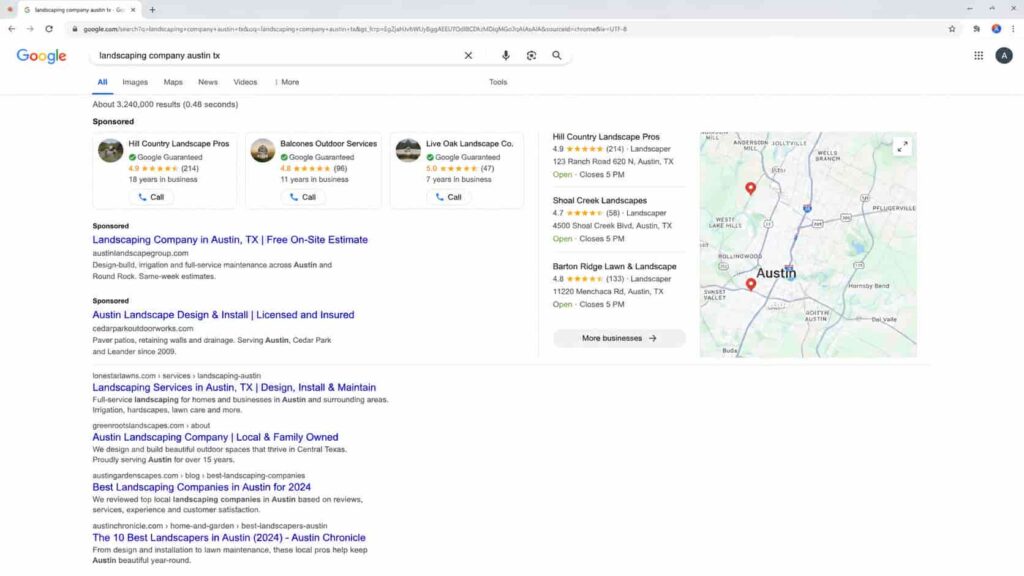
Four separate auctions on one page. An agency that runs one of them and calls it your paid strategy is not wrong so much as incomplete.
Maintenance vs Design-Build: Why One PPC Strategy Doesn’t Fit Both
A $55 mow and a $20,000 patio arrive from the same search bar and land in the same campaign. Both clicks cost about the same to win. One of them is worth forty of the other.
That is the most expensive mistake in a landscaping ad account, and it is the default setting.
Run the number both ways. $347 of ad cost inside a booked job is 1.7% of a $20,000 hardscape and you would never think about it again. On a single mow it is the whole job and then some.
The mow only works if you count the contract. A maintenance customer at $200 a month held for three years is $7,200, and against that, $347 to acquire them is a number you would take every time. The mistake is not spending it. The mistake is judging it against the first visit and switching the campaign off in week three.
Different targets follow. A different cost per lead per service line. A different response time, because a design-build lead survives an afternoon and a same-week cleanup lead does not.
And a different landing page, because the patio buyer wants photographs of finished work in his own town and the maintenance buyer wants a price and a start date. There are ads written out in full by service line if you want the difference on the page.
Two terms your agency will use, translated. Negative keywords are the searches you tell Google to ignore, so “landscaping jobs hiring” stops eating the budget. Match type is how loosely Google may interpret the keyword you bought, and loose is expensive.
So here is the question to take into every one of these calls: are you going to split my campaigns by service line, and set a different target cost per lead for each one?
Anything vaguer than yes means one campaign called “landscaping” and a budget going wherever converted first. Which will be the mowing.
Seasonality: How a Good Agency Handles Your Spring Rush and Your January
The budget goes up three to four weeks before the season opens, not the week the phone starts ringing. By the time you feel the rush, the crews sitting at the top of the page bought that position in February.
Then the message rotates to whatever your market buys in the cold months. Leaf cleanup and pruning in the fall. Snow and ice where it snows. Project planning where it does not, because the homeowner who books a spring patio in January is the cheapest lead you will buy all year.
The part most operators get wrong is the trough. Switching the account off feels responsible, and it destroys what the campaign learned. It restarts cold in March at a worse cost per lead, in the exact month you needed it sharp.
Reduce and redirect. Do not pause. In Minneapolis the January question is what replaces the revenue; in Phoenix and Tampa it is which service moves to the front of the queue. Neither answer is leaving the same campaign running and hoping.
Which gives you a question worth asking in September rather than November: what changes in my account in the off-season? An agency charging the same fee in January as in May, with the same campaigns and the same ad copy, is charging for May’s work twelve times a year. Line it up against what to budget from margin and you will see it.
How to Choose a Landscaping PPC Company (7 Questions to Ask)
- Who owns the Google Ads account and its history if we split? A good answer is “you do,” with no pause before it. The history is the asset. Starting over on a fresh account means paying to relearn what your old one already knew.
- Do you measure to the booked job or to the form fill? Form fills are easy to count and easy to inflate. Jobs are neither. If the report stops at the form, you are buying a number that nobody has checked against your schedule.
- Will you split my campaigns by service line? This is the single question that separates a built account from a template. If mowing and hardscape share a budget, the cheap keyword wins and the profitable one starves.
- What cost per lead are you targeting, and in how many months? A good answer names a number and a date, and then explains what would make it wrong. Anyone who names a number with total confidence has not looked at your market.
- Who writes and maintains the landing pages? If the answer is “send us the page you want us to use,” you are buying clicks, not leads. The page is half the cost per lead.
- Do you run Local Services Ads as well as Search, and who handles the lead disputes? Turning LSA on takes an afternoon. Disputing the leads that were never your customer, every month, is the actual work.
- How does the plan change between peak season and off-season? Ask this in September. The answer tells you whether you are buying a strategy or a subscription.
Red Flags That Should End the Call
- A twelve-month contract with no exit clause.
- They will not give you admin access to your own ad account.
- The report shows impressions and clicks and never shows leads or jobs.
- They guarantee position #1. It does not exist in paid search. The auction reprices every time somebody searches.
- They quote you before asking your average ticket or how many crews you can put on a job next week.
- A monthly fee under about $500 on a real account. At that price nobody is opening it.
Get a PPC Plan Built Around Booked Jobs
Everything above measures one thing: whether the money turns into work on the schedule. Clicks are the receipt. Jobs are the result.
What we do differently is narrow: campaigns split by service line, tracking that runs to the booked job, and a team that works only in the green industry.
Before you call anybody on this list, send us the account you are running now. You get your real cost per lead set beside the $104 benchmark, and the three things costing you the most money. If the search volume in your towns cannot carry a program at all, the audit will say that instead of selling you one. Free, written, and pricing for your market is in it, before there is any invoice.
Frequently Asked Questions
Most landscaping companies spend $1,000 to $5,000 per month on ads plus a management fee. Agencies typically charge 10% to 20% of ad spend or a flat $500 to $2,000 fee at that budget level. Full programs that bundle SEO with paid ads generally run higher, and the ad spend sits separately on top of whichever model you pick.
Around $104 per lead is the current benchmark for landscaping keywords, and about $84 for lawn care. Anything under $80 in a competitive metro is strong. What matters more is your cost per booked job: at a 30% close rate, a $104 lead means roughly $347 in ad spend per job you win.
Yes, when your average job value clears roughly $500 or the customer is recurring. Design-build and hardscape work profits immediately at industry cost-per-lead levels. Single mowing visits usually do not, and those only pay off when you measure what a maintenance contract is worth over three years instead of what the first visit is worth.
Expect the first calls within days and stable performance in 60 to 90 days. The first four to six weeks go into gathering conversion data, cutting wasted search terms and testing landing pages. Any agency promising optimised results in week one is guessing rather than measuring.
Use both, in that order, for most companies. Local Services Ads sit above search ads, charge per lead instead of per click, and work well for maintenance and recurring work. Google Ads gives the keyword and landing page control that high-ticket design-build, hardscape and irrigation jobs require.
A practical floor is 30 to 50 leads’ worth of budget per month, roughly $3,000 to $5,000 at industry cost per lead. Below about $1,000 per month there is not enough data for the campaign to learn, and results stay unpredictable no matter who manages the account.
You can, and it makes sense under about $1,500 in monthly ad spend. Past that, the wasted spend from loose match types, missing negative keywords and untracked calls usually costs more than a management fee. The break-even point is where an agency saves you more than it charges.