A lead that comes from something you own is still working the morning after you stop paying for it.
Most landscapers think the problem is the number of leads. It is not.
You paid for that lead. So did four other crews. All five of you called the same homeowner that afternoon, and by dinner he had four voicemails and one estimate on the calendar.
Next spring you will pay for that same homeowner again. He was never yours. He was rented.
- How to get landscaping leads: the short answer
- Rented landscaping leads and owned landscaping leads are not the same thing
- Where landscaping leads come from, ranked by who keeps the contact
- How to get more leads for your landscaping business without raising your budget
- Landscaping lead management: know where every lead came from
- How to get free landscaping leads (and what free actually costs)
- Three numbers that tell you if your landscaping leads are working
- Final thoughts
- Frequently asked questions
How to get landscaping leads: the short answer
How to get landscaping leads comes down to four sources: local search, reputation, paid ads, and buying shared leads from a marketplace. The price of each one matters less than a second question almost nobody asks: when the month ends, who still has the homeowner’s phone number, you or the platform?
Ranked by what each lead costs you, cheapest first:
- Referrals and reviews. The neighbor who watched your crew work. No invoice, and the contact is yours from the first call.
- Local search. Your Google Business Profile and a real page for every service and every town you drive to. You pay to build and maintain them, not per lead.
- Paid ads. Google Ads and Local Services Ads. You rent the top of the search, the lead is exclusive to you, and it stops the day the budget stops.
- Shared leads. A marketplace sells you a homeowner it also sold to several other crews. You pay whether you close it or not, and the contact stays with the platform.
Rented landscaping leads and owned landscaping leads are not the same thing
A rented lead arrives with a receipt and leaves with the contact. You bought a chance to call somebody, once. When you stop paying, nothing stays behind, because nothing was ever yours to keep.
An owned lead arrives through something you already paid for. A finished profile. A page about the town you drive through every day. That page brings a quote request in March without charging you again for the same homeowner.
This is the part that makes the word “owned” mean something instead of sounding like marketing. Every lead BASEO delivers is exclusive to the client and never shared, which is the whole difference in one sentence: nobody else got sold the same phone number this morning.
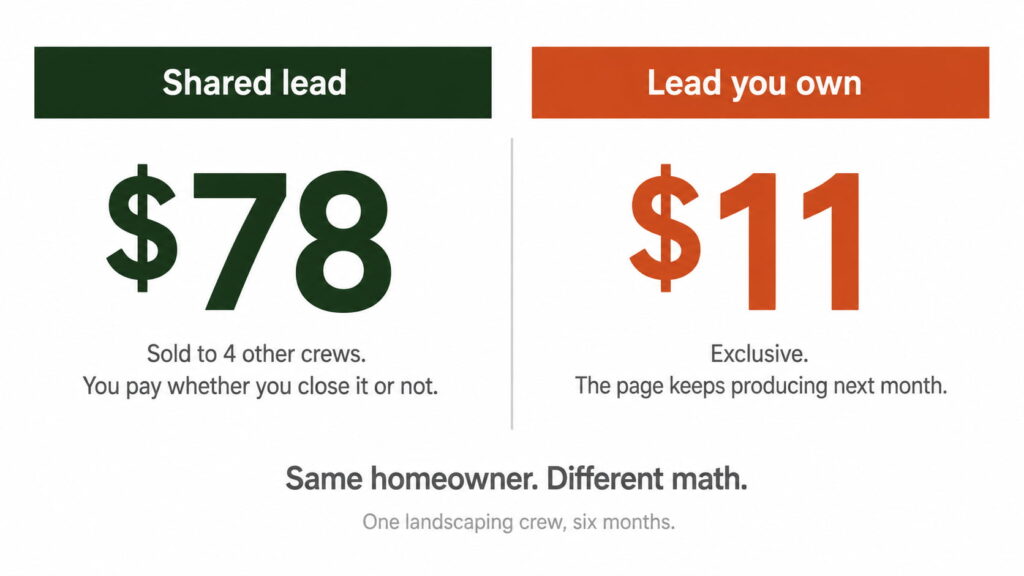
The two units this article is about, side by side.
That is where this article stops, by the way. This is about where the lead comes from and who owns it. What happens once it lands is a different problem with a different answer.
What a shared landscaping lead really costs you
The mechanics are simple and nobody selling them explains it from your side. The marketplace generates one homeowner request. It sells that request to several crews. You pay for it whether the job lands on your schedule or goes to the guy who called first, and the homeowner’s contact information stays inside the platform.
Now run the number the way it actually hits your bank account. If four other crews bought the same lead and you close one out of every five you buy, your cost per booked job is five times your cost per lead.
A lead price is not a price. It is a fifth of a price, and you find that out at the end of the month. If you want that math run channel by channel, that is what a lead costs by channel.
That is the arithmetic nobody in this search result does for you, including the companies ranking on page one for the phrase you just typed.
| Lead source | What you pay | Exclusive? | Do you keep the contact? | What is left when you stop paying |
|---|---|---|---|---|
| Shared lead marketplace | Per lead, win or lose | No. Resold to several crews | No. It stays in the platform | Your invoice history |
| Google Ads | Per click | Yes | Yes | Nothing. The ads stop |
| Local Services Ads | Per lead | Yes | Yes | Nothing. The ads stop |
| Google Business Profile | Nothing per lead | Yes | Yes | The profile keeps ranking |
| Service and city pages | Nothing per lead | Yes | Yes | The pages keep working |
| Referral from a finished job | Nothing | Yes | Yes | The work is still in the ground |
What an owned lead costs once the page is built
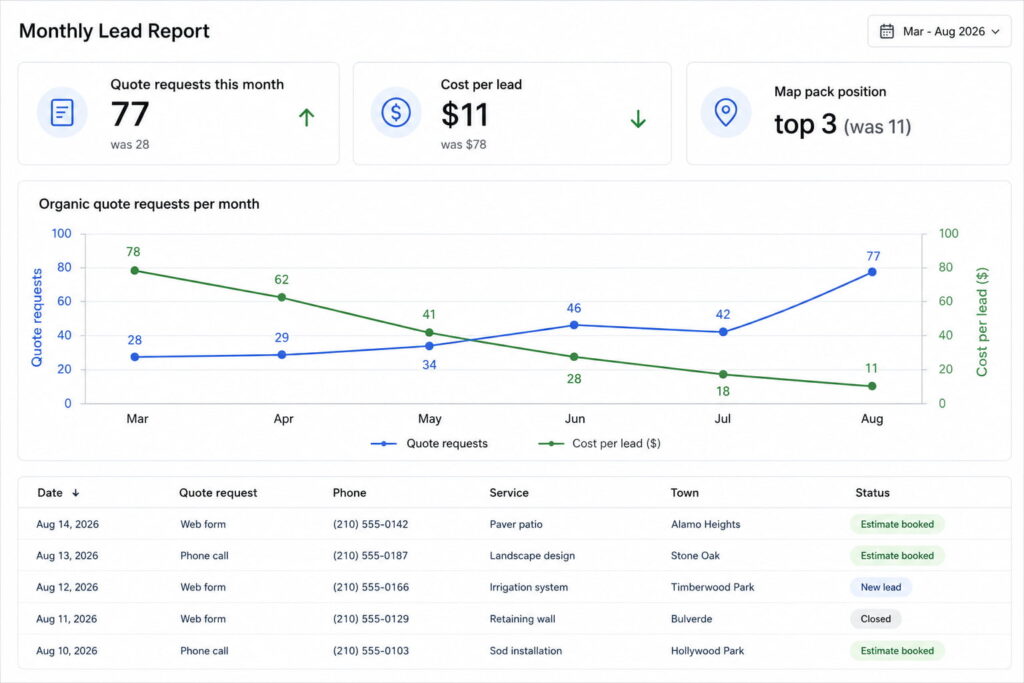
One San Antonio landscaper was paying $78 for an Angi lead. Six months later the same business was getting leads at about $11 from pages and a profile it owns (BASEO client data). Same crew, same market, same trucks.
The mechanism matters more than the number. A rented lead costs the same in month twelve as it did in month one, and usually more. An owned lead gets cheaper every month, because the page is already paid for and the number of quote requests it produces keeps climbing while the cost of building it stays where it was.
That is what happened to one crew. It is not a projection for yours. Your market, your competition and how many towns you actually cover decide your own number, and any marketing company that quotes you a figure before looking is guessing.
Where landscaping leads come from, ranked by who keeps the contact
Five sources, ordered by one question: who has the homeowner’s phone number when the month ends. That is a different order than ranked by speed instead, which is the right way to sort them when your April is half empty. This order is the right one when you are deciding what to build. BASEO builds the ones at the top of this list, and runs the ones in the middle.
Google Business Profile and the map pack
The crew sitting above you on the map, meaning the three businesses Google shows before everything else, is not better at landscaping than you are. They finished filling out a profile you have not opened in two years.
The profile is how Google decides which three. Primary category, the full list of services you sell, photos of jobs you actually did, the towns you actually serve, and reviews that keep arriving. Get the category wrong and you disappear from searches you should own by default.
Reviews are the part operators underrate, and the numbers are blunt. 47% of consumers will not use a business with fewer than 20 reviews, and 74% look for reviews written in the last three months (BrightLocal, 2026). Translated to the map pack you are looking at: the crew above you with 147 reviews and the one below you with 12 are not being judged on the same page, and the one with 12 is you after two seasons of not asking. A wall of five-star reviews from 2022 reads as a business that stopped.
It is also the only source on this list with no cost per lead at all. You pay to keep it current, not to be found. That is why rebuilding the profile and running the review system is the first thing BASEO does when it takes on a landscaping SEO client. One client went from position 11 to the top three of the map pack in under six months (BASEO client data).
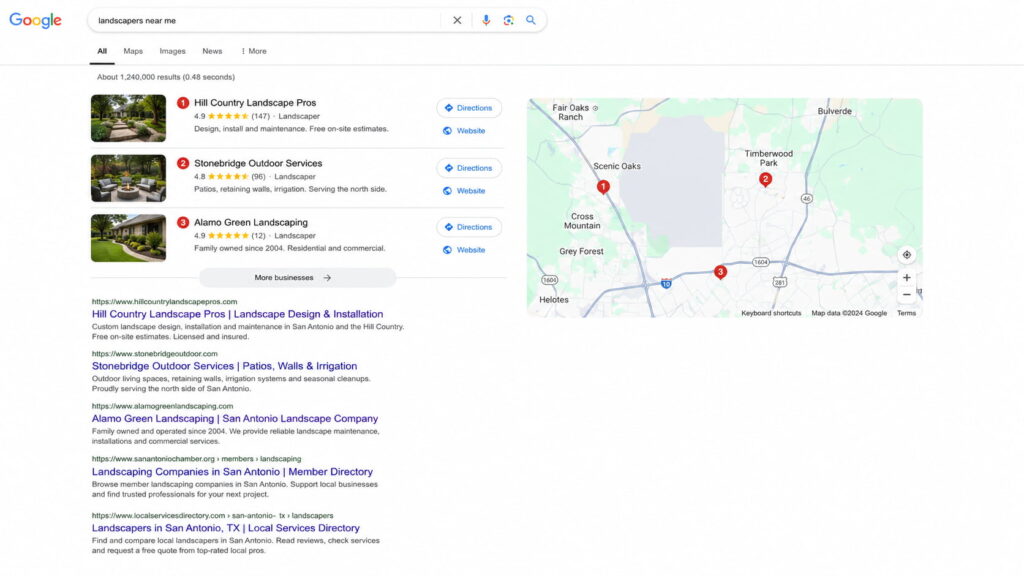
The gap between 147 reviews and 12 is the gap between the first call and no call.
Service and city pages: landscaping leads online, while you sleep
Your homepage is not your most important page. It is close to your least important one. The homeowner lands there after another page already caught him, just to confirm you are real.
The pages that bring work are the page about the service and the page about the town. And the order you build them in decides the size of the jobs that come through, because winning the search for a paver patio costs roughly what winning the search for a mow costs. One of them is a $14,800 job (BASEO client data). The other is forty mowings before you match it. Rank for the patio, not just the mow.
One page per town you actually drive to, with copy about that town. Google will not rank one page for eleven suburbs, and a single “Service Areas” page listing all eleven is the most common version of that mistake. Fifty generated pages covering every zip code is the worse version: Google calls that doorway abuse, “having multiple domain names or pages targeted at specific regions or cities that funnel users to one page” (Google Search Essentials). The line is whether the page is about the town or only says its name.
That is the work BASEO does after the profile: a real page per town served, and service pages ordered by margin instead of by search volume. The San Antonio crew went from 28 organic quote requests a month to 77 in six months on the back of it (BASEO client data). The page-level detail is in what to write on each page.
Google Ads and Local Services Ads
Ads are rented leads that are worth renting. The rent is transparent, the lead is yours alone, and you control the meter. Compare that to a shared lead, which is also rent, except you are splitting the apartment with four crews who did not agree to be quiet.
What separates ads that book jobs from ads that burn a budget is not the platform. It is geo targeting pinned to the towns you serve, negative keywords so you stop paying for “landscaping jobs hiring”, copy that repeats the search back to the homeowner, and call tracking on every number.
For scale: paid search in Home and Home Improvement averages $8.33 per click and $90.92 per lead across 13,474 US campaigns (WordStream, 2026). A second landscaping operator running landscaping PPC with BASEO moved from $84 to $43 per lead in six months on the same ad budget, and from 18 to 54 leads a month (BASEO client data). Same money, better account.
Local Services Ads sit above all of it and work differently: it is a phone call, not a form, and it carries the Google Guaranteed badge. We broke down what LSA leads cost and what Google Ads costs a landscaper separately. Worth stating plainly: ad spend goes straight to Google and is never marked up.
Landscaping lead generation companies, decoded
You know the names. Angi, HomeAdvisor, Thumbtack and Houzz Pro generate the lead themselves, with their ad budget and their traffic. Resellers like 33 Mile Radius and 99 Calls mostly buy that same demand and sell it forward, which means the phone number in your inbox may already be on its second markup before it reaches you. Half the results on this search are companies selling this product, and not one of them explains the model from the side of the person paying for it. If you are trying to tell them apart from an actual marketing company, we sorted the companies pitching you into five kinds.
Here it is in four answers. The lead is generated once, by their site and their ad budget. It is sold to several crews at the same time. The contact belongs to the platform, and the day you stop paying you keep nothing except the record of what you spent.
Angi is not selling you a lead. It is renting you a phone number, on a meter that only goes one direction, and it rents the same one to four other crews the same morning.
That said, nobody should cancel it on Monday. That invoice is feeding your crew this week, and an operator who drops his only working channel to make a point about ownership is an operator with an empty April.
The move is weaning, not quitting: keep buying while you build the profile and the pages, and watch one number to know when to pull back. When your cost per booked job from the channel you own drops below the same number from the channel you rent, the marketplace stops being necessary and becomes optional. There is no date on that. There is a crossover, and you only see it if you are tracking the source of every lead.
What they sell is real: volume, fast, with no build time. What they do not sell is a contact that is still yours next season.
Referrals and the neighbor who already saw the work
The cheapest lead in this business is the neighbor who watched your crew for three days. The proof is in the ground and he already walked past it twice.
That is not a small channel, it is just a solved one, and the whole system for running it on purpose lives in the six-step referral system. Yard signs, door hangers and a truck people recognize all belong to the same category: cheap, local, and yours.
Free. No call. Written, in about two business days. Yours to keep, even if we never speak again.
How to get more leads for your landscaping business without raising your budget
This is not about closing more of the leads you already have. That is a different job. This is about the same traffic producing more quote requests than it does today, which is usually the cheapest lead source you own and the one nobody audits.
Here is where the leads you already paid for fall out:
- The form asks for six fields when three would do. Name, phone, and what they need. Every extra box is a homeowner standing in his yard who decides to do this later.
- The phone number is not tappable on a phone. He is not writing it down. He is going back to the map pack.
- The page takes too long to load. He came from a search on mobile data, parked in a driveway.
- The photos are from 2021. So is the last Google post, and he can see the date.
- The reviews are thin or stale. He found you and still has three other tabs open.
Fixing those five is not a redesign, and it is the highest-return work on this list because the traffic is already arriving. It is also why BASEO builds the site and the pages together instead of treating them as separate projects: a page that ranks and does not convert is a bill with extra steps. We have written the full build in build a site that books jobs, and the service itself is landscaping website design.
Landscaping lead management: know where every lead came from
This section is not about follow-up. It is bookkeeping, and it takes two fields per lead.
Field one: where it came from. Field two: what time you answered it. That is the entire system.
The first one is not optional. Without it you cannot calculate cost per lead by channel, and without that you cannot decide a single thing this article has suggested. You are running the business on a feeling about which channel seems busy.
The second one is the one operators lose money on quietly. Harvard Business Review’s study of online lead response found that most companies were not responding nearly fast enough, and that was in 2011, before every homeowner had four other estimates a tap away.
Any system works. A CRM, a spreadsheet, a notebook in the truck, as long as the source gets written down before the estimate does. BASEO does not sell software and does not touch the one you use. What we do is put call tracking on every number and send one monthly report: quote requests and calls with phone numbers, the cost per lead trend, map position, pages published, and next month’s plan in plain English.
Then the table above becomes something you can fill in with your own numbers instead of mine.
The two columns that decide everything else: where the lead came from, and what it cost.
How to get free landscaping leads (and what free actually costs)
No lead is free. Some of them cost time instead of money, which is the more expensive currency when you are on a machine until six.
What is in that category: a Google Business Profile filled out all the way, a review asked for after every finished job, the neighbors of the property your crew is on this week, and the customers from last year who have not heard from you since.
What it costs: about an hour a week, which is fifty hours across a season. Put your own number on that hour, the one you use when you decide whether to send a crew or walk a property yourself, and you have the real price of a free lead. The profile does not work because you set it up. It works because somebody keeps posting jobs to it and answering reviews on it in February, when nothing is happening and it feels pointless.
That is the real invoice on free leads, and most operators default on it around week five.
Three numbers that tell you if your landscaping leads are working
| The number | What it measures | Where it comes from | What to do if it is wrong |
|---|---|---|---|
| Cost per lead, by channel | What one quote request costs on each channel you run | Channel spend divided by leads tagged to that channel | Nothing, until you can split it by channel. Then move the budget to the cheaper one |
| Cost per booked job | What one job on the schedule costs. The only number that pays payroll | Cost per lead divided by your close rate on that channel | Check close rate first, then the page the lead landed on |
| Share of leads still yours next year | How much of this year’s work you will have to buy again | Leads from things you own, divided by total leads | Build one real page for one town, and finish the profile |
Notice what is not on that list. “Position 3” is not a business number. Neither is traffic. If the report your marketing company sends you is a page of rankings with no phone numbers on it, you are not being reported to, you are being managed.
Cost per booked job is also the number that makes an expensive lead look cheap, which is where the order of your pages comes back around. Take that $14,800 patio, closed from an organic quote request (BASEO client data). A lead that costs $40 and turns into that job is a bargain. The same $40 lead for a weekly mow is not, and no amount of ad optimization fixes that, because the problem was never the ad. It was which search you decided to win.
The same client closed an $18,600 retaining wall the same way (BASEO client data), which is a year of a small maintenance route in one signature.
Final thoughts
The problem was never how many leads come in this month. It is how many of them are still yours in March.
Pick the town you drive through most often and count how many pages you have about it. Then look at what you spent on rented leads last season, and divide it by the jobs that actually landed. Some operators run this themselves in the off-season and do fine. Most would rather spend those weeks bidding work, and the team on your account here works only with landscapers, so it already knows your competitors, your keywords and your season. Either way, nobody at BASEO has ever been put on a 12-month contract.
If you want the list of pages you are missing, and what the crew above you on the map built instead, that is what the written audit will tell you.
Free. No call. Written, in about two business days. Yours to keep, even if we never speak again.
Frequently asked questions
Landscaping leads come from three places: local search, reputation, and paid ads. Fill out your Google Business Profile, build a page for every service and every town you drive to, and ask each finished job for a review. Ads fill this week while those pages build next season.
No lead is free, but some cost time instead of money. A complete Google Business Profile, reviews after every job, and neighbors of work you are already doing all produce leads without an invoice. They cost you attention and a season of consistency.
It depends on who owns it. A shared lead costs the same whether you win or lose, and it is resold to several crews, so the real number is what a booked job costs, not what a lead costs. One San Antonio landscaper moved from $78 Angi leads to $11 organic leads over six months.
They deliver volume fast, which is real. What they do not deliver is a contact that stays yours: the same lead goes to four or five crews, and you pay whether you close it or not. Useful as a bridge, expensive as a permanent channel.
Tag every lead with where it came from and how fast you answered it. Without those two fields you cannot tell which channel is paying for itself. Any system works, a CRM or a notebook, as long as the source is recorded before the estimate.
The profile can move in weeks. Pages take months. A San Antonio landscaper went from 28 to 77 organic quote requests a month over six months, and ads carried the schedule while that built. Your market and your competition decide your own timeline.