You’ve got four lists of marketing ideas for a landscaping business open on your phone right now. One has nine ideas, one has twenty-five, and not one of them tells you which to do first in March with eight hundred dollars.
Look at who writes them. The top of that search is four software companies, two marketing agencies, a direct mail printer, a call tracking vendor and a job board. Five of the nine sell one of the tactics on their own list.
We sell several of these too. Which is exactly why the order matters more than the list.
So here are 21, ranked by three things none of those lists rank by: what a booked job actually costs in that channel, what month the demand exists, and whether the lead falls inside the route you already drive.
What’s in this guide
- What actually drives landscaping leads (and what just looks busy)
- Before you spend a dollar: 3 numbers that decide your landscaping marketing
- Marketing ideas that own local search
- Marketing ideas that turn past jobs into new ones
- Marketing ideas that make you visible in the neighborhood
- Marketing ideas that show the work
- Paid ads: when they make sense for a landscaping business
- 21. The marketing step nobody markets: how fast you answer the lead
- A 12-month landscaping marketing calendar
- What to run first at $500, $2,000, and $5,000 a month
- Landscaping promotion ideas that waste money
- How to tell if your landscaping marketing is working
- Frequently asked questions
The person this article is written for, at the hour he actually has time to read it.
What actually drives landscaping leads (and what just looks busy)
Almost all of the buying demand in this business comes through local search and through what the street sees. Not through social.
The numbers back it harder than most people expect. A May 2026 WebFX study of home services search found the local pack, meaning the three businesses Google puts on a map above everything else, showed up in 97.6% of results pages, at an average position of 1.5. Local Services Ads appeared in 28.4% of them, and when they appeared they were always in position one. Traditional Google Ads appeared in 8.4%, at an average position of 11.3.
One honest note, because it matters. That study ran 100 keywords five times each, 500 searches total, across HVAC, plumbing, roofing, electrical, and garage doors. It did not cover landscaping. The local search pattern is the same, but the number is borrowed and you should know that.
The map is the fight. Classic search ads show up rarely and low, which doesn’t make them useless, it makes them specific. And the crew sitting at the top of that map is not the one posting three times a week.
That’s the order for everything below: get found in local search, get your existing customers to bring you more, get the neighborhood to see you, get your work seen, then paid ads, then how fast you answer the phone.
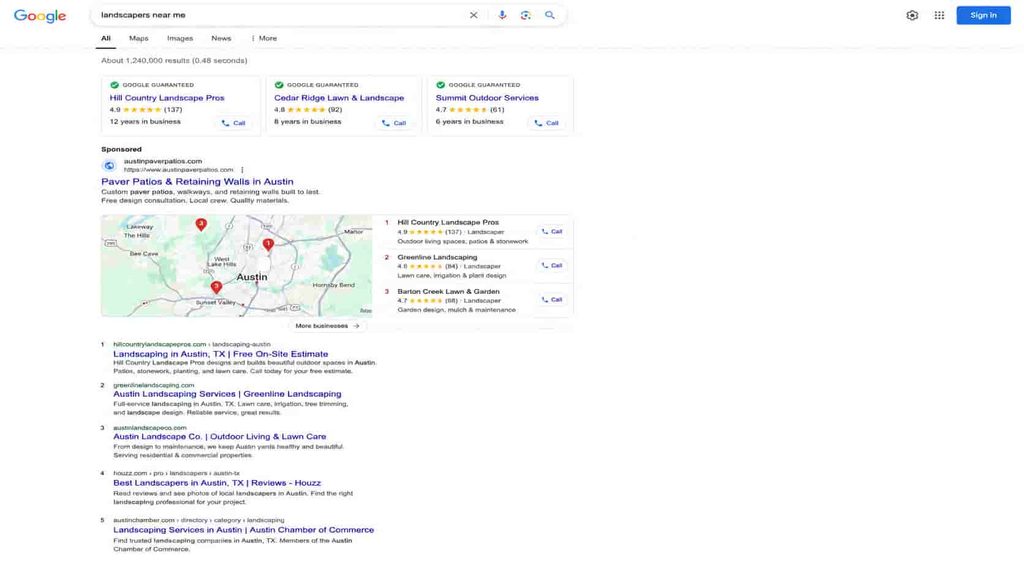
The stack a homeowner sees on a phone: pay-per-lead ads, then one search ad, then the map, then everything else. Note how far down the classic ads sit.
Before you spend a dollar: 3 numbers that decide your landscaping marketing
Every list of tactics has the same hole. Without three numbers, every channel on it looks reasonable, and you have no way to kill any of them.
The three are your average job value, your real cost per lead by channel, and how far your route actually reaches. Get those and the list below sorts itself.
Your average job value and what a client is worth over a season
A $60 mow and a $12,000 patio cannot carry the same cost per lead. Same Google, same click, two different businesses.
Here’s what the range looks like across the services most crews sell. These come from Get X Media’s 2026 landscaping benchmarks.
| Service | Typical job value | Gross margin |
|---|---|---|
| Mowing, per visit | $30–$85 | 50–65% |
| Monthly maintenance plan | $100–$410/mo | 45–60% |
| Mulch and planting, per bed | $200–$700 | 40–55% |
| Sod installation | $1,070–$3,000 | 35–50% |
| Irrigation system | $2,400–$7,000 | 35–50% |
| Hardscape or paver patio | $3,000–$20,000 | 30–45% |
One note on the numbers: that source publishes in Canadian dollars, so these are converted to USD.
Now the math that decides your budget. A maintenance client at $200 a month who stays eight months is $1,600 in revenue. At 50% gross margin that’s $800 in your pocket. If you close one estimate out of four, four leads buy you one client, so at $80 a lead you spent $320 to earn $800.
Be honest about that trade. $320 is 40% of the first year’s margin. It works if he renews next season and it hurts if he doesn’t, which is why what a customer is worth over time (his lifetime value) matters more here than what it costs you to get one job (your cost per acquisition). One number without the other tells you nothing.
Your real cost per lead, by channel
This is the table to screenshot.
| Channel | Typical cost per lead | Exclusive to you? | What the number hides |
|---|---|---|---|
| Google Local Services Ads | $20–$55 | Yes | About 45% of leads are unbookable, so your real cost runs higher |
| Standard paid search | $100–$250 | Yes | Broad terms like “landscaping” burn budget before the patio search ever runs |
| Home services average, paid channels | About $91 | Varies | An average across five trades, not a landscaping number |
| Shared aggregator lead | $78 in one landscaper’s account | No. Four other crews bought the same one | You pay it whether you close the job or lose it |
| Organic lead from pages you own | $11 in that same account, six months in | Yes | Nothing lands in month one |
| Referral from a past client | The reward you pay on booked work | Yes | Capped by how many jobs you finish |
| Door hanger on a street you already serve | The price of the printed piece | Yes | Doesn’t scale past the route you already drive |
Cost per lead figures for ads from Get X Media (converted from CAD) and Blue Grid Media. The $78 and $11 rows are BASEO client data.
Now the part none of the other lists give you. The published cost per lead is not what you pay. Blue Grid Media, which manages Local Services Ads accounts for contractors, reports that roughly 45% of LSA leads are unbookable: spam, wrong numbers, out-of-area calls, duplicates. It puts the booking rate on answered calls at about 31%.
Run that through. A $40 cost per lead with 45% waste is $73 per usable lead. At a 31% close rate, that’s $235 per booked job.
$40 and $235 are the same channel. Only one of them is a number you can decide with.
So the metric that decides isn’t cost per lead. It’s cost per booked job, against what that customer is worth.
Two independent sources land in the same place on LSA, which is worth something: Get X Media puts it near $39 a lead, Blue Grid puts the landscaping range at $20 to $55. Benchmarks, not quotes. Your market will move them.
Your route density radius
In this business, price isn’t what kills your margin. Drive time is.
Say a customer sits 25 minutes off your route. That’s up to 40 unbillable minutes per visit, and on a weekly mowing contract it eats the year’s profit on that account before you’ve bought gas.
Which turns geography into a campaign filter, not a footnote. A lead outside your radius isn’t a small win. It’s a slow loss you’ll book happily and regret in August.
Draw the real radius first. Not the city limits and not the drive-anywhere version. It’s the ZIP codes or map polygons where you already have three or more clients. That shape is your service area.
Then use it in four places: set your Google Business Profile service areas to it, pick door hanger and direct mail streets inside it, geo-fence your Google Ads to it, and decide which calls to turn down.
The example that makes it concrete: twelve houses across three blocks versus twelve houses scattered across the county. Identical revenue. Opposite margins.
This is also why a page for every town has to be built on the footprint your crew actually drives, not on a keyword list. BASEO builds them against the density map rather than against a keyword list, which is why a crew covering four towns and a crew covering twenty end up with completely different builds.
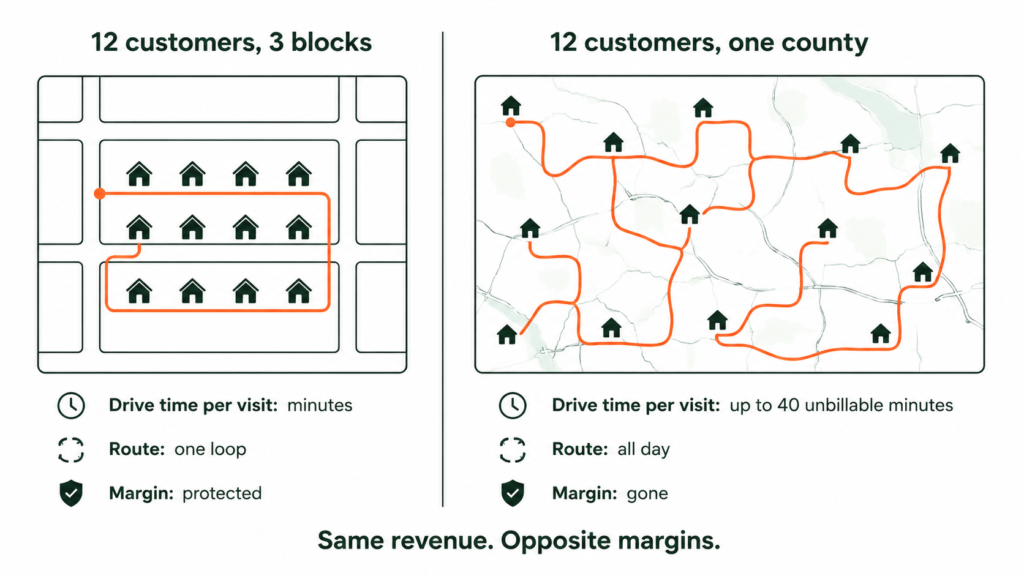
The same twelve accounts, two completely different businesses.
The 21, sorted by those three numbers
Here’s what the three numbers do to the list. Order is what to fix first, not the idea number.
| Order | Idea | What a lead costs you | When | Route-bound? |
|---|---|---|---|---|
| 1 | Answer the lead fast (21) | Nothing | Every day | Multiplies everything below it |
| 2 | Google Business Profile (1) | Time only | Any month, starting now | Yes, set it to your radius |
| 3 | Reviews (4) | Time only | Push hardest May–Jun, at peak volume | No |
| 4 | Sell the neighbors (7) | Price of a door hanger | Every day the truck is out | Yes, by definition |
| 5 | Local Services Ads (3) | $20–$55, about $73 usable | Budget peaks Mar–Apr | Yes, geo-fence it |
| 6 | Referrals (6) | The reward, paid on booked work | Year-round | Yes, ask same-street |
| 7 | Re-book and upsell (8) | Time only | Jan–Feb | Yes, existing accounts |
| 8 | Service and city pages (2) | Build cost, then near zero | Publish 4–6 weeks pre-season | Yes, only towns you serve |
| 9 | Website (16) | Project cost | Before the season | No |
| 10 | Yard signs and door hangers (10) | Price of the printed piece | Every job day | Yes |
| 11 | Email and text cadence (9) | Time only | Every season change | No |
| 12 | Before-and-after photos (15) | Time only | Every job | No |
| 13 | Seasonal content (17) | Time only | 4–6 weeks pre-season | Yes, city-targeted |
| 14 | AI search and answer engines (5) | Time only | Now | Yes, city-targeted |
| 15 | Direct mail by route (12) | Price per piece, three touches | Sep–Oct and Jan–Feb | Yes, carrier routes |
| 16 | Search Ads on high-ticket (19) | $100–$250 | Mar–Jun | Yes, geo-fence it |
| 17 | Local partnerships (13) | Commission on booked work | Year-round | Loosely |
| 18 | Retargeting (18) | Small budget | Jul–Aug, for fall projects | No |
| 19 | Meta ads (20) | Higher and colder than LSA | Jan–Mar, for spring builds | Yes, tight radius |
| 20 | Vehicle wraps and uniforms (11) | One-time, hard to attribute | Once | Yes, you drive it daily |
| 21 | Sponsorships (14) | Not lead generation | Season start | Loosely |
Two honest notes on that table. “Time only” doesn’t mean free, it means the cost is your Sunday instead of your bank account, and for most operators that’s the scarcer of the two. And nothing below row 12 is worth starting until the rows above it are running, which is the whole argument of the budget section further down.
The rest of this article is those 21 in detail, grouped by what they do rather than by rank, because that’s how you’ll actually work through them.
Marketing ideas that own local search
This is where most of the budget belongs, because this is where the demand with a credit card behind it actually happens. Five ideas.
1. Optimize your Google Business Profile like it’s a storefront
Twenty years in, three crews, a reputation you built one referral at a time. And the guy with two trucks sits above you on the map. That gap isn’t quality. It’s a profile he finished filling out and you didn’t.
Seven things, in order:
- Set the right primary category
- Match your service areas to the towns you actually drive to
- List every service you sell, with a real description
- Add new photos of real work every week
- Post something seasonal
- Seed the Q&A with the questions people ask you on the phone
- Answer every review
The first one carries more weight than the other six combined. Your primary category decides which searches Google will even consider showing you for. Landscaper, Lawn Care Service and Landscape Designer aren’t competing for the same queries, and a hardscape crew sitting in the Lawn Care Service category will surface all day for the $60 job and never once for the $14,800 one. The other frequent mistake: a home address published as a storefront instead of the profile set up as a service-area business.
One change from 2025 worth knowing. Reviews on your Google Business Profile and reviews collected through Local Services Ads now count toward the same rating on your LSA listing, per Blue Grid Media’s read of Google’s documentation. Your reviews work two shifts now.
This is the first thing BASEO rebuilds on a new account, and the reason it goes first is the section above. Your service-area setting is the only place on the internet where you get to tell Google the shape of your route. Most profiles have it set to the whole metro, which is how a crew that works three towns well ends up ranking in none of them and taking calls from six. One San Antonio landscaper went from position 11 to the top three on the map in under six months (BASEO client data), and the profile came first because nothing else can be measured until it’s right. Longer version: the map pack playbook.
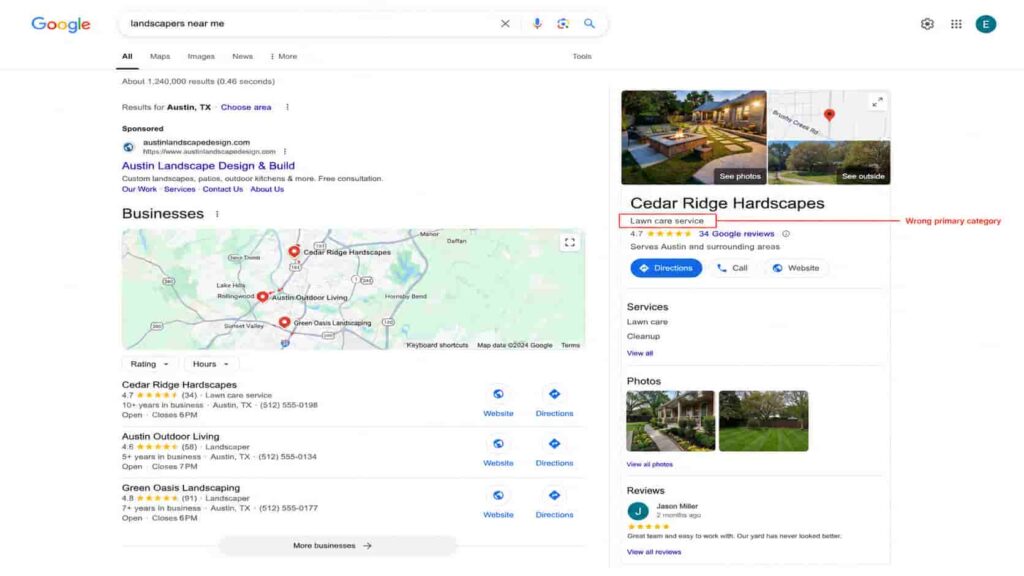
A hardscape company filed as a lawn care service. It will never surface for “paver patio near me,” and the owner has no idea.
2. Build service + city pages so you rank where you actually work
One page per service, per main city. Not a single “Services” page, and not a single “Service Areas” page listing eleven towns.
The reason is mechanical. A page trying to cover eleven suburbs ranks well in none of them, and the homeowner in the next town over types his town’s name into the search. If your page doesn’t say that name, you’re not in the running.
What keeps it from being doorway spam is the same thing that makes it work: each page has to be real. Photos of jobs you did in that city. Neighborhood names. The drainage conditions that page’s readers deal with. Reviews from that zone. We went long on what goes on a city page because this is where most crews get it wrong.
The warning: 400 identical pages with the city name swapped isn’t local SEO. It’s why your pages look like everyone else’s, so Google ranks none of you.
And only build pages for towns inside the radius from the last section. A page that ranks for a town you can’t serve profitably costs you money.
Then order them by margin, not by search volume. The search for a paver patio costs about the same to win as the search for a mow, and one of those jobs was $14,800 for a San Antonio landscaper who closed it off a page he owns (BASEO client data).
Run that against the mowing row in the table above. At $85 a visit, the top of that range, one patio is more than 170 cuts. You’d hold a weekly account for over three years to bill the same money, and drive there 170 times to do it. Same search cost, same page, same month of work to rank it.
Ranking for the mow and not the patio is the most expensive ordering mistake in this industry, and it’s why BASEO builds service pages around margin instead of around volume.
3. Run Google Local Services Ads for the Google Guaranteed badge
Local Services Ads charge per lead, not per click, and they sit above the map and above the regular search ads. Google verifies your license and insurance, and then you carry the Google Guaranteed badge.
The badge does real work. Put three unfamiliar company names in front of a homeowner and the one carrying Google’s checkmark wins the call. That isn’t a preference, it’s a shortcut, and it’s the whole reason the verification paperwork is worth doing.
The other thing to know before you turn it on: the lead arrives as a ringing phone, not a form sitting in an inbox. For a crew that’s in the field all day that’s either the best or the worst feature on this list, and idea 21 decides which.
The numbers, all from Blue Grid Media’s account data: the top three LSA positions capture 70 to 80% of the calls from those listings. Landscaping has some of the cheapest leads in home services, $20 to $55, against $45 to $110 in HVAC and $60 to $130 in roofing. Optimized accounts average about four dollars back for every dollar spent, which is an average across their book, not a number to plan on.
Now the part almost nobody does, and it’s the difference between a good channel and an expensive one. Google lets you dispute the unbookable 45% and get the credit back, inside a window. Not disputing them is paying for spam every month, on purpose. Build it into someone’s Friday.
Your LSA ranking depends on reviews, response time, proximity, and how often you answer the phone. Three of those four aren’t money. They’re operations, and they’re free.
BASEO runs LSA for green industry accounts the same way it runs everything else: profile setup and verification, budget and lead management, disputing the bad ones, call tracking on every number, and reporting in cost per lead and cost per job.
4. Turn reviews into a compounding ranking asset
Everyone says ask for reviews. Nobody says when.
The moment is when you finish, with the customer standing in front of the result. Three days later the yard is just the yard again and he’s back at work. Send a text with a direct link, from the phone of the person who did the job. A crew lead who just rebuilt a wall has standing an automated email never will.
Why it isn’t optional: 87% of homeowners will not hire a business rated below 4 stars, per Scorpion’s 2026 State of Home Services Marketing Report, a survey of 2,000 US homeowners run with the research firm Dynata. Below four stars you aren’t losing the comparison. You’re not in it.
The angle none of the other lists mention: ask them to name the service and the neighborhood. “They rebuilt our retaining wall in Cedar Park” feeds local relevance in a way “great service!” never will. And those reviews now count toward your LSA rating too.
Answer the bad ones. In public, short, no arguing. The next customer is reading your reply, not the complaint.
One thing you don’t do: never offer a discount or a gift for a review. It violates Google’s policies and risks the whole profile.
BASEO runs review generation as a system that fires off completed jobs, alongside real local citations and editorial links from chambers, trade associations and local press. No link farms, no purchased reviews.
The reason it has to be a system and not a good intention is that the gap compounds on its own. Crews at the top of the map get more calls, more calls means more finished jobs, and more finished jobs means more people to ask. Which is why the review count you have in March mostly decides the one you’ll have in October.
5. Get cited by AI search and answer engines
More homeowners every month are asking ChatGPT, Google’s AI Overviews or Perplexity who the best landscaper in their town is. Those systems don’t invent the shortlist. They assemble it from sources they can cite: your name, address and phone written identically everywhere, presence in real local directories, mentions in local press, and content on your own site that answers a real question directly enough to quote.
So four things you can do. Write 40 to 60 word answers to the questions people ask you on the phone, and put them on your site. Keep LocalBusiness structured data in place, which is just labels telling a machine what your business is and where it works. Get mentioned by local media and trade associations. And keep the Google profile spotless, because it’s a primary source for all of them.
Almost nobody in the green industry is set up for this yet. That’s a window, not a silver bullet, and it’s the only urgency claim in this article.
Why this isn’t a separate project from ideas 1 and 4: the assistants name two or three businesses, and the reputation signals they lean on are the same ones that move the map. Same profile, same reviews, third job. Which is also why it doesn’t need its own budget line yet, and why we broke down what AI search changed separately.
Marketing ideas that turn past jobs into new ones
The customer you already have is on a street you already drive. Selling to him again costs you almost nothing in drive time, which is the only input that actually moves your margin.
It’s the cheapest marketing in this business, and it’s the part almost nobody systematizes.
6. Build a referral program that pays on booked work
Pay the reward when the referral books and pays for the first job. Not when someone hands you a name.
Size it to the job. A free month of mowing or $50 to $100 in credit for a maintenance client, more for a project. If you want the version broken out by job type, we covered what to pay by job type in its own piece.
But the money isn’t in the reward. It’s in the asking, and this is the part that gets skipped. A program that lives in the footer of your invoice doesn’t exist. A one-sentence script the crew says while packing up does.
Something like: “If you know a neighbor who needs this, send them our way and your next cut’s on us.”
And the detail the competition leaves out: ask for referrals on the same street. A referral three blocks away is worth more than a referral across town, because one of them densifies your route and the other stretches it.
7. Sell the neighbors while the truck is still parked
While your crew works one house, the whole block watches. It’s the only hour of the year your best ad is installed on the street, running for free.
Three things, same day. Door hangers on the eight to ten nearest houses with an offer that uses the fact you’re there: “We’re already on your street this Thursday.” A yard sign for the length of the job. And a neighbor price for anyone who books onto the same route day.
Why this beats every other idea on the list economically: the marginal cost of serving the house next door is almost zero in drive time. You’re already parked. The truck is already loaded.
Hang ten and land one and your customer acquisition cost is the price of ten pieces of card stock. Hang ten and land none and you’re out lunch money. There is no other channel on this list with that ratio.
8. Re-book and upsell your existing clients before spring
In January and February your competition hasn’t called your customers yet. By March he has.
So work the whole list from last year before the season starts, and close the season contract while the phone is quiet.
Here’s the part that turns a generic email into a sale: attach a specific upsell to what your tech already saw in that yard. An irrigation zone that wasn’t reaching. Beds that went a year without mulch. A tree somebody should look at. That’s not an offer, it’s an observation, and it lands completely differently.
Which means somebody has to write those observations down during the season. That’s a five-second habit for a crew lead and it’s worth more than any campaign in this article.
Push toward the annual agreement over the one-off job. Looking back at the table above, a maintenance plan at $100 to $410 a month is the asset that carries your winter. A cleanup in October is a good week.
9. Email and text your customer list on a seasonal cadence
Not “send newsletters.” A cadence with a reason behind each send.
Pre-spring is contract renewals. Spring sells aeration and mulch. Summer sells irrigation service. Fall sells leaf cleanup and overseeding. Winter sells pruning, hardscape planning, and snow where it applies.
Channel rules, because getting this wrong costs you the list. Text is for appointment reminders and time-sensitive offers only, and only to people who explicitly opted in. Email carries everything else. Keep the opt-in clean and the unsubscribe visible, every time.
And the discipline nobody keeps: stop sending in the dead months. Emailing every month out of season trains people to ignore you right before the one month you need them to open.
Marketing ideas that make you visible in the neighborhood
Physical marketing still works in this trade for a reason it doesn’t work for a plumber. Your product is visible from the street, all year, with nobody looking for it.
10. Yard signs and door hangers on the streets you already serve
What goes on the sign, in this order: your name, the one service you most want to sell, and a phone number big enough to read from a moving car. A QR code is optional and almost nobody scans one from the driver’s seat.
Get the customer’s permission, and agree how long it stays. A week after a cleanup, the length of the build on a hardscape job.
The part that separates this from a list of tips: put a different tracking number or a short URL on the sign. Without one you’ll never know if signs work, you’ll keep buying them on faith, and in three years you still won’t know. With one you’ll know by August.
11. Vehicle wraps and crew uniforms
Treat the truck as print media, not as a vanity purchase. It drives the same streets every day whether it says anything or not.
What has to be readable at 30 miles an hour, in this order: the service, the city, the phone number. A big logo and a clever name tell a driver nothing. “Paver Patios, Round Rock, 512-555-0134” tells him everything.
Uniforms and a lettered trailer hold your price when the unmarked pickup quotes $200 less. Looking like a company is part of charging like one.
Be honest about measuring it: you mostly can’t, not directly. Which is exactly why “how did you hear about us” has to be asked on every single call, and written down. It’s the only attribution this channel will ever give you.
12. Direct mail targeted by route, not by ZIP code
Almost everyone who tries direct mail mails a ZIP code. A ZIP code can hold 15,000 homes and you can profitably serve maybe 900 of them.
The version that pays mails only the carrier routes that fall inside your density radius, and inside those, prefers homeowners with a property value that matches the ticket you’re selling. Same printer, same postage, a tenth of the waste.
Put a seasonal offer on it with a deadline. A generic percentage off with no date is a flyer, and flyers go in the bin at the mailbox.
One piece does nothing. Three touches across a season starts to do something. If you can’t afford three passes over the good routes, mail fewer streets three times rather than every street once.
Measure it with an offer code or a dedicated number, same as the yard signs.
And run the break-even before you print. Take a maintenance contract at $200 a month for eight months from the table above: $1,600 in revenue, roughly $800 in margin. If a thousand pieces cost you a few hundred dollars all-in, one signed contract clears it and the second one is profit. That threshold is lower than most people assume, which is why the targeting matters more than the budget.
13. Local partnerships that send you work
Some people talk to your customer every week and aren’t competing with you for the job.
Real estate agents prepping yards before a listing. Property managers. Builders who finish a house and leave a dirt lot. Nurseries and garden centers. Pool companies, standing in the exact backyard you want to hardscape. Independent designers who draw and don’t install.
Structure it so it survives the handshake: reciprocal referrals both directions, a clear commission or a stated trade, and a physical piece the partner can hand over.
The failure mode is always the same. A pleasant conversation at a trade show, no follow-up, nothing. Put a calendar reminder on it or don’t start.
14. Community events and youth sports sponsorships
Straight answer first: this is slow brand work, not lead generation. Anyone selling it to you as a source of jobs is selling you a banner.
It makes sense in two situations: when your search channels already work and you’re building on top of them, or when you’re in a small town where local reputation outweighs ranking.
Either way, put a number on it before you sign. Say a team sponsorship runs $600. Against the maintenance plan in the table earlier, one contract at $200 a month across an eight-month season is roughly $800 in margin, so that banner has to produce a single client to clear. If you can’t picture which family on that roster becomes that client, put the $600 into three passes of direct mail on your best route instead, where at least you’ll know by August.
Sponsor a team. Donate the maintenance on a park or a school’s front beds. Show up with the crew.
Then do the step almost everyone skips, which is the only thing that turns it into marketing: document it. Photos, and a Google Post on the profile from idea 1. Without that you donated a Saturday.
Marketing ideas that show the work
This is a visual purchase. The homeowner isn’t buying your argument, he’s buying the photo of what you did to the yard down the street.
15. Before-and-after photos and short-form video
Make it a system, not a mood. The “before” gets shot from a fixed spot, and when you finish, someone stands in that exact spot again. A pair that doesn’t line up isn’t a before and after, it’s two photos.
Where it goes: Instagram, Facebook, YouTube Shorts, TikTok. The best format by a distance is a timelapse of a hardscape build, because it compresses three weeks of skilled work into forty seconds and the skill is the whole sale.
Here’s the part that pays and almost nobody does. Reuse them. The same photos feed your Google profile, your service and city pages, and the proposal you send the next customer. One shoot, four jobs.
Now the honest part, which contradicts most of what’s written about this. For most landscapers, social is social proof and brand reinforcement. It is rarely the primary source of leads. Anyone telling you daily posting will fill your schedule hasn’t looked at where the booked jobs actually came from. Post because it makes every other channel more convincing, not because it’s a channel.
16. A website that proves you’re real in five seconds
You paid a web guy five years ago and you can’t name one job that came from it. That’s normal, and it’s usually not the design.
What matters is a conversion checklist, not a design one:
- A tappable phone number at the top on mobile
- Photos of your own work in the hero, not stock
- Your service area visible without scrolling
- A quote form with four fields, maximum
- Reviews on the page
- A page that loads before he leaves
Mobile decides it, because the homeowner is standing in his own yard holding a phone while he looks at the problem.
Just over 91% of the world’s searches go through Google (StatCounter, July 2026), and every idea above this one eventually points at your site. It’s the destination. A slow destination wastes the whole trip.
The most expensive mistake is a beautiful site that never says the city or shows the number.
One idea barely anyone uses: let the quote form take a photo upload. A picture saves you a site visit on half the estimates you’d otherwise drive to.
BASEO builds sites this way, a page per service and a page per town, mobile first, with quote forms and call tracking that actually fire. A surprising share of landscaping sites have a form that emails an inbox nobody checks. If you want the cost side, we published what a landscaper site costs with real ranges.
17. Seasonal content that ranks in your city
Three kinds of pages are worth writing, and you write them for your homeowners, on your site.
Local maintenance calendars. Cost pages. Plant guides for your climate.
Cost pages produce the most leads by a wide margin, and it’s not close. Someone searching what a paver patio costs in his city isn’t researching, he’s budgeting. That’s the highest commercial intent in this business, and almost no landscaper has that page, because it feels like giving away the number. Your competitor’s silence is the opportunity.
To be clear about whose page this is: “How much does a paver patio cost in Round Rock” is a page you publish for the homeowner searching it. This article isn’t answering that question, it’s telling you to own it.
Publish four to six weeks ahead of the season. Google needs time to find and trust a page, and the homeowner starts searching before you feel ready to sell. Pages that go up in March for spring are pages that rank in June.
That timing is the whole reason for the calendar in the next section.
18. Retargeting ads for visitors who didn’t call
The real use case isn’t more impressions on people who already know you. It’s the gap.
A $10,000 hardscape project takes weeks to decide. He gets three quotes and disappears to think about it, talk to his wife, and look at the credit line. Retargeting keeps you in front of him during those weeks.
It doesn’t convince anyone. It stops you from being the one he forgot.
The creative that works is a before and after of the same kind of project he was looking at. Not your logo, not “we’re hiring,” not a generic ad. The wall he was reading about, finished.
Keep the budget small. This is a layer on the channels above, not a channel of its own.
And skip it entirely for $60 mowing. Nobody comparison-shops three lawn quotes for three weeks. The cycle is too short for the tactic to have anywhere to work.
Paid ads: when they make sense for a landscaping business
Ads book jobs now. The organic work makes every job after that cheaper. They run together, and they’re not the same product.
The decision rule is simple. Ads amplify a business that already closes well and answers fast. They do not fix a business that doesn’t answer the phone, and if that’s the situation, the ad budget is the wrong thing to change first. That’s a criticism of the operation, not of the channel.
Two of them are worth your money, in a specific order.
19. Google Search Ads vs. Local Services Ads
| Local Services Ads | Standard Google Search Ads | |
|---|---|---|
| You pay for | A lead | A click |
| Where it sits | Above the map, top of the page | Below the ads block, average position 11.3 |
| Verification | License and insurance required | None |
| Badge | Google Guaranteed | None |
| Best for | Recurring and mid-ticket work, phone-first | High-ticket, specific searches like “paver patio” |
| Main risk | Unbookable leads you have to dispute | Broad keywords burning budget |
Start with LSA. It charges by lead instead of by click, it sits above everything, and in landscaping it carries some of the cheapest leads in home services.
The WebFX study from the top of this article backs the order: classic Google Ads showed up in only 8.4% of home services results pages, at an average position of 11.3. That’s not an argument against search ads. It’s an argument for knowing what you’re buying.
Use Search Ads for high-ticket, specific searches where LSA has no inventory. Paver patio. Retaining wall. Irrigation repair. Those are projects, and the person typing them has a number in his head.
Then the mistake that eats more budget than any other: bidding “landscaping” in the same campaign as “paver patio.” One is a price shopper and the other is a $14,800 job, and a shared budget lets the cheap one drink first.
Run properly, the same money buys a different account. One landscaping operator’s cost per lead went from $84 to $43 in six months, and his lead flow went from 18 a month to 54 (BASEO client data).
Sit with that second number, because it isn’t obviously good news. At the 31% booking rate from earlier, 54 leads is roughly 17 booked jobs a month instead of 6, but only if somebody answers all 54 calls. Fix the ad account and you inherit a scheduling problem. That’s idea 21, and it’s why it’s on this list.
Worth saying plainly, because everyone wonders and nobody asks: when BASEO manages ads, the ad spend goes straight to Google. It isn’t marked up. That’s how we run green industry campaigns: one campaign per service instead of one per business, fenced to the density map, and landing pages that name the town.
20. Meta ads for high-ticket hardscape and design-build
Nobody opens Facebook looking for a retaining wall. But plenty of people who are going to build one next year are already scrolling.
That’s the use case: latent demand, not active search. Which makes it a project channel, not a maintenance channel.
Target a geographic radius trimmed to your route, homeowners rather than renters, and a property value that matches the ticket. Then let the creative do the work: a before and after, or the timelapse from idea 15.
The offer decides everything. “Free design consultation” converts. “Call us” doesn’t. One asks for twenty minutes of curiosity, the other asks him to sell himself.
And the honest limits. Meta isn’t the channel for recurring mowing, and cost per lead runs higher and colder than LSA, because you interrupted him instead of answering him. We put real numbers on it in what Facebook ads cost a landscaper.
21. The marketing step nobody markets: how fast you answer the lead
If you’re spending $2,000 a month on ads and returning calls at six in the evening, you’re throwing away a good chunk of it. The ad worked. You weren’t there.
Blue Grid Media’s account data puts the booking rate on answered calls at about 31%, with the best operators clearing 40%. Then the number that should change how you run your day: calling back the next day cuts that roughly in half, to around 15%.
Same ad, same lead, half the jobs, because of who picked up and when.
The fixes have to work for a business with the crew in the field, not for someone at a desk:
- An answering service that takes the call live
- Automatic text-back on missed calls, so he hears from you in ten seconds instead of ten hours
- A quote form that fires an immediate text, not an email to an inbox you check Sunday
- Two twenty-minute blocks a day for returning calls
Then a four-question script so whoever answers can qualify without you:
- What’s the address? (Does it fall inside the route?)
- What service do you need?
- When do you need it?
- Do you have a budget in mind?
Question one matters most and nobody asks it first. An address outside your radius changes the whole conversation, and finding that out on the phone beats finding it out after you’ve driven there.
This is the cheapest improvement in the article, and the only one that costs nothing, which is probably why nobody sells it to you. It’s also why a monthly report listing quote requests and calls with actual phone numbers beats one listing traffic. You can’t fix a leak you can’t see.
A 12-month landscaping marketing calendar
Seasonality isn’t a detail in this business. It’s the structure. A marketing plan without it is a plan for a business that doesn’t exist.
| Month | What to promote | Where to push |
|---|---|---|
| Jan–Feb | Season contracts, hardscape projects | Email the past-client list, publish cost pages |
| Mar–Apr | Spring cleanups, the season start | LSA budget to the ceiling, door hangers on the route |
| May–Jun | Mulch, planting, irrigation, upsells | Ask for reviews at peak job volume |
| Jul–Aug | Irrigation service, maintenance | Retargeting for fall projects |
| Sep–Oct | Aeration, overseeding, leaf cleanup | Direct mail by route, seasonal content |
| Nov–Dec | Pruning, holiday lighting, snow where it applies | Low-cost SEO and content work for spring |
Two things about that table.
The first: it’s a promotion calendar, not a work calendar. May and June are when the mulch and irrigation offers go out, which is a different question from when that work should be done. You know the second one better than we ever will.
The second, and it’s the one that makes or breaks the table: adjust it for your climate. A snow belt operator runs November through March mostly dead and survives on snow and ice, so his January is entirely about locking next season’s contracts and selling hardscape for spring. A Sun Belt operator runs close to year-round and shifts everything four to six weeks earlier. One calendar for both is exactly the kind of generic advice this article exists to avoid giving.
Notice where the review push lands. May and June, when you’re finishing the most jobs, which is when asking is easiest and the reviews are freshest going into the second half of the year.
What to run first at $500, $2,000, and $5,000 a month
Here’s the part the other lists skip. Twenty-five tactics with no budget attached is a menu with no prices.
Industry guidance puts marketing spend at 3 to 10% of revenue, per Phil Risher of Phlash Consulting, via Jobber. A business doing $100,000 budgets $3,000 to $10,000 a year. Companies holding steady sit at the low end; companies adding crews or moving into new neighborhoods sit at the high end.
Which means the tiers below aren’t three options you pick from by preference. They’re matched to what you’re doing in revenue.
| Budget | Fits a business doing | What to run |
|---|---|---|
| $500/mo | Roughly $60K–$200K a year | Google Business Profile fully built out (free, just time), a review system that runs, door hangers on the route, LSA at a minimum budget |
| $2,000/mo | Roughly $240K–$800K a year | Everything above, plus service and city pages, LSA at scale, a formal referral program, consistent job photography |
| $5,000/mo | Roughly $600K–$2M a year | Everything above, plus monthly seasonal content, Search Ads on high-ticket services, direct mail by route, retargeting, an answering service |
Read the middle column before the right one. $2,000 a month is $24,000 a year, which is 3 to 10% of a business doing between $240,000 and $800,000. If you’re doing $150,000 and someone puts you on a $2,000 plan, that’s 16% of your revenue, and it’s the wrong plan no matter how good the tactics are.
Each tier buys the one below it again and adds a layer. Nobody skips to the third. The $500 row isn’t a starter package you graduate from, it’s the foundation that makes the other two work, and running LSA on top of a half-built Google profile is how people conclude LSA doesn’t work.
If you’re at the bottom of that table and need work booked in weeks rather than months, that’s a different sequencing question, and we covered book work in seven days separately.
Not sure which row is yours? Send us the domain and the audit tells you, in writing, in about two business days. No call.
Landscaping promotion ideas that waste money
Half of what gets recommended on this topic wastes money at your size. Here’s what fails most often, and what to do instead.
- Buying shared leads. You’re renting the same phone number as three competitors, at a price that only moves up. The fix isn’t cancelling on Monday, because it’s feeding your crew this week. Build the channel you own alongside it until the bought one is optional. Months, not a phone call.
- Deep discounts to get in the door. They bring one-time customers who leave for the next discount and leave you a book of low-margin accounts to service. Use a neighbor price tied to the route instead: that lowers your cost, not your price.
- Posting daily and waiting for leads. Social is proof, not a pipeline. Post the photos you already took, reuse them on your profile and your pages, then go answer the phone.
- Mass flyers outside the route radius. A customer 30 minutes out at negative margin isn’t a customer, he’s a commitment. Same money, one tenth of the area, three times.
- A beautiful site with no city and no phone number. Run it against the checklist in idea 16.
- Cheap SEO that produces 200 cloned city pages. Google ranks none of them and now the site looks like spam to a human too. Fewer pages, each one real, only for towns you can serve profitably.
- Sponsorships with no follow-through. No photo, no post, no way to know if anyone called.
Notice what isn’t on that list. Google Ads and Local Services Ads aren’t a waste of money. Ads run badly are, and that’s a different problem with a different fix.
How to tell if your landscaping marketing is working
If your marketing company’s report never used the words “quote requests,” you already know what to look for in the next one.
Five numbers, in order of how much they matter:
- Cost per booked job, not cost per lead
- Close rate by channel, because two channels at the same cost per lead are rarely worth the same
- Average job value by channel, because the channel with the cheapest leads often brings the smallest jobs
- Route density of new customers, meaning how many landed inside the radius
- Season-to-season retention, which is the one that decides whether any of this compounds
Number one leads for the reason the earlier table showed. A $40 cost per lead with 45% waste and a 31% close rate is $235 per booked job. Same channel, and only one of those numbers is true enough to spend against.
The tools are cheap and you have most of them. A separate tracking number per channel, “how did you hear about us” asked on every call and written down, and a spreadsheet. That beats a dashboard nobody logs into.
One principle that saves months: stop chasing perfect attribution. You’ll never untangle the yard sign from the Google search from the neighbor who mentioned you. Decide on 90-day trends, not on a bad week. In a seasonal business a bad week is sometimes just rain.
What you’re watching is one relationship: what a customer is worth over time against what he cost to get. When that gap widens the channel stays. That’s the lens BASEO’s monthly reporting uses, and the channel-by-channel version is in cost per job by channel.
Want a landscaping marketing plan built around your routes?
None of these 21 ideas is hard. The hard part is picking the four that fit this month’s budget, this month’s season, and the streets you already drive, and in July nobody has an afternoon for that.
That’s the shortcut the audit is. Send the domain and we draw the density map you’d otherwise draw yourself, check whether your Google profile matches it, and name the channel quietly costing you the most per booked job. Three of the 21 answered before you spend a dollar. And if the search volume across your towns can’t carry the math, the audit says that too, which is the answer nobody sends you and the only one worth having. Free, in writing, about two business days. No call.
Frequently asked questions
Start with local search: optimize your Google Business Profile, collect reviews after every job, and run Google Local Services Ads. Then work your existing base with a referral program and door hangers on streets you already serve. Those five moves cover most landscaping demand before you spend on anything else.
Google Local Services Ads are usually the best paid channel for landscapers. They charge per lead instead of per click, place you above regular search results, and run $20 to $55 per lead in landscaping, among the lowest of any home service category. Dispute unusable leads to keep that cost real.
Get more clients where your crew already works. Leave door hangers on the eight to ten homes nearest each job, put out a yard sign, and pay referral rewards on booked work. Neighbor customers cost almost nothing in drive time, which protects your margin as you grow.
Industry guidance puts marketing spend at 3 to 10% of revenue, so a $100,000 landscaping business would budget $3,000 to $10,000 a year. Established companies holding steady sit near the low end; companies trying to add crews or enter new neighborhoods spend toward the high end.
Fully optimize your Google Business Profile, ask every customer for a review at the moment you finish the job, put a sign in each yard you work, and ask satisfied clients for one neighbor’s name. All four cost time instead of money and drive local search rankings.
Sell the block, not the city: offer neighbors a same-day price while your truck is on their street. Other underused ideas include partnering with realtors on pre-sale yard prep, timelapse videos of hardscape builds, and direct mail targeted by mail route rather than by ZIP code.
A good landscaping slogan names the outcome and the area you serve, like “Austin’s yard, done right, every week.” Keep it under seven words and readable from a moving truck. A slogan supports recognition, but reviews, response speed, and local search rankings are what actually book jobs.